The old thread is here
http://forums.bharat-rakshak.com/viewtopic.php?t=2981
------------------------------------------------
boss.. its relative.. hinduism is not a religion like others. thats all. SD does not make it a different category because its not one among. From Allah upto Christ and Judaism all religions were formed to prevent evil things that was prevalent.
If you consider barbarism and barbaric behaviors, it was more towards west rather east. East had more peace or was disturbed either by Xtians, Allahs folks who seek to conduct either crusade or go evanjihadic.
we did not call it hindu-ism because it was not originated by a sole entity who found the truth. It was a collective wisdom, fact findings by sages, and vedic (learned people) about truth. They did not have science as we have today, but had vedantic works. the schools then were different.. and its all about the way we lived.
Religion happened only really when Christi-Anity was formed.. Even the buddhists were only taking parts of hindutvams, and making it simpler with a well defined scope.
Lets not dilly dance on these. Lets not go on and on cycling where, what, and how do we do.. and what is the thread about. No single poster here has been able to write down the scope, though they can.
Lets take this contextual to the needs. Hinduism is definitely a religion, by the definition of religion, and is definitely not a religion, by the definition of what is not a religion. intersections happen. lets complement the other religion for this.
Religion Thread 2
Very lucid and very interesting. Probably true as well. I can see why Savarkar thought the way he did. Thanks for sharing your viewpoint in a straightforward manner.The core flaw of Hindutva or the tradition of political Hinduism founded by Savarkar is that it incorporates an envy of Islam's ruthlesness and insularity, and Islamism's ability to mobilise communities.
Rather than building on Hinduism's strengths, it tries in its toned down and limited fashion to borrow Islam's strength - the party line, and the intrinsic reliance on physical intimidation by other believers to prevent the flock from straying from it.
While Hindus like *all* human beings are capable of such behaviour, it is not part of Hindu philosophical tradition, and political Hinduism's attempt to incorporate it is self-defeating.
Savarkar wanted to create a 'new' Hindu, one who imitated the fierce sense of communal religious defence against the outsider in-built in to Islam while incorporating Western scientific, corporate and political dynamism.
Really? Why not? Are not these missionary faiths gaining fresh ground every single day? How come they won't take a dominating position in every continent before the end of this century?? You're sorta saying 'even if it looks, walks, and quacks like a duck, it is not one'. Why so?It all starts with a belief that you dont have what it takes to survive.
Islam and Islamism is NOT going to inherit the earth.
Evangelical Christianity's challenge to Hinduism is quite different from that of Islam, but they are not going to win over India, let alone the world.
not true.While evangelical Christianity's desire to persuade people to convert is alien and irritating to Hindus, the real source of friction today is fear among many Hindus that Christianity's ways are some how more effective - that in the end they will steal the majority of Hindus and others away.
The fear is that what Christianity teaches is on the false premise that believe in Christ, and all your sins will be washed off. Its arguable or debatable that such a solution for a highly corrupted indian society (evil #1) may work.. but, its too late to introduce christianity to vedic India, but too early for illiterate, down trodden, poverty stricken people, who can't read and write, or comprehend these things. They would be classified as best believers of any religion in the world who gives them free money.
this is ******** #1. we don't mind them joining the church work.. and get paid as salary, rather baptize them, and then give them free money, and give a false hope for their younger generations. brasstacks, its all for the head count. how many christian names are there in India?
If Christianity needs to flourish in India, its simple. They just have to join the Vedic works. Call it christian augmentation. provide a better framework to already well established foundation, and see how they fit? There is nothing that the same can happen by any other religions. The muslims on the other hand, have only occupation in mind. nothing else.
Its the exploitation.. especially from religious people, whose thoughts are totally foreign in origin. its an invasion of minds, and adding further corruption to the society.
Sarvarkar did what he did based on what he saw in his life time. The call for partition and struggle for freedom was a huge challenge for that entire generation and they were being manipulated without their knowledge by the British.vsudhir wrote:Very lucid and very interesting. Probably true as well. I can see why Savarkar thought the way he did. Thanks for sharing your viewpoint in a straightforward manner.The core flaw of Hindutva or the tradition of political Hinduism founded by Savarkar is that it incorporates an envy of Islam's ruthlesness and insularity, and Islamism's ability to mobilise communities.
Rather than building on Hinduism's strengths, it tries in its toned down and limited fashion to borrow Islam's strength - the party line, and the intrinsic reliance on physical intimidation by other believers to prevent the flock from straying from it.
While Hindus like *all* human beings are capable of such behaviour, it is not part of Hindu philosophical tradition, and political Hinduism's attempt to incorporate it is self-defeating.
Savarkar wanted to create a 'new' Hindu, one who imitated the fierce sense of communal religious defence against the outsider in-built in to Islam while incorporating Western scientific, corporate and political dynamism.
The period 1900 to 1947 was crucial for shaping the minds of many nationalists and they could see the rise of nation states in Europe Asia and else where.
Fundamentally there is a huge difference now with awareness and communication about the world. Political awareness in the Hindu soceity is sweeping now with the advent of media and education.
But the Hindu society is still the target of indoctrination and manipulation by political players using the tools of social engineering and political sociology.
The best book to understand this topic is Saffron Swastika'
http://www.esnips.com/web/Hindutva
Hindutva at work
In this prolonged furious conflict our people became intensely conscious of ourselves as Hindus and were welded into a nation to an extent unknown in our history. It must not be forgotten that we have all along referred to the progress of the Hindu movement as a whole and not to that of any particular creed or religious section thereof—of Hindutva and not Hinduism only. Sanatanists, Satnamis, Sikhs, Aryas, Anaryas, Marathas and Madrasis, Brahmins and Panchamas—all suffered as Hindus and triumphed as Hindus. Both friends and foes contributed equally to enable the words Hindu and Hindusthan to supersede all other designations of our land and our people. Aryavarta and Daxinapatha, Jambudweep and Bharatvarsha none could give so eloquent an expression to the main political and cultural point at issue as the word, Hindusthan could do. All those on this side of the Indus who claimed the land from Sindhu to Sindhu, from the Indus to the seas, as the land of their birth, felt that they were directly mentioned by that one single expression, Hindusthan. The enemies hated us as Hindus and the whole family of peoples and races, of sects and creeds that flourished from Attock to Cuttack was suddenly individualised into a single Being. We cannot help dropping the remark that no one has up to this time taken the whole field of Hindu activities from A.D. 1300 to 1800 into survey from this point of view, mastering the details of the various now parallel, now correlated movements from Kashmir to Ceylon and from Sindh to Bengal and yet rising higher above them all to visualise the whole scene in its proportion as an integral whole. For it was the one great issue to defend the honour and independence of Hindusthan and maintain the cultural unity and civic life of Hindutva and not Hinduism alone, but Hindutva. -i. e. Hindudharma that was being fought out on the hundred fields of battle as well as on the floor of the chambers of diplomacy. This one word, Hindutva, ran like a vital spinal cord through our
whole body politic and made the Nayars of Malabar weep over the sufferings of the Brahmins of Kashmir. Our bards bewailed the fall of Hindus, our seers roused the feelings of Hindus, our heroes fought the battles of Hindus, our saints blessed the efforts of Hindus, our statesmen moulded the fate of Hindus, our mothers wept over the wounds and gloried over the triumphs of Hindus.
It would require a volume if we were to substantiate these remarks by quoting all the words and writings of our forefathers that bear on the point. But the argument in hand does not allow us to be drawn aside even by so alluring a task as that. Consequently we must content ourselves with quoting a few eloquent lines either from the lips or the pen of some of the foremost representatives of our Hindu race.
Having thus tried to trace the successive chapters of the history of the words Hindu and Hindusthan from the earliest Vedic period to the fall of the last of our Hindu empire in 1818 A. D., we are now in a position to address ourselves to the main task of determining the essentials of Hindutva. The first result of our enquiry is to explode the baseless suspicion which has crept into the minds of some of our well-meaning but hasty countrymen that the origin of the words Hindu and Hindusthan is to be traced to the malice of the Mohammedans! After all that has been said in the previous paragraphs about the history of these words, this suspicion seems so singularly stupid that to mention it is to refute it. Long before Mohammad was born, nay, long before the Arabians were heard of as a people, this ancient nation was known to ourselves as well as to the foreign world by the proud epithet Sindhu or Hindu and Arabians could not have invented this term, any more than they could have invented the Indus itself.
Essential implications of Hindutva
But throughout our inquiry we have been concerning ourselves more with what would have been or what should be. Not that to paint what should be is not a legitimate pursuit; nay, it is as necessary and at times more stimulating; but even that could be better done by first getting a firm hold of what actually is. We must try, therefore, to be on our guard so that in our attempt to determine the essentials of Hindutva we be guided entirely by the actual contents of the word as it stands at present. So although the root-meaning of the word Hindu like the sister epithet Hindi may mean only an Indian, yet as it is we would be straining the usage of words too much—we fear, to the point of breaking-if we call a Mohammedan a Hindu because of his being a resident of India. It may be that at some future time the word Hindu may come to indicate a citizen of Hindusthan and nothing else; that day can only rise when all cultural and religious bigotry has disbanded its forces pledged to aggressive egoism, and religions cease to be 'isms' and become merely the common fund of eternal principles that lie at the root of all that are a common foundation on which the Human State majestically and firmly rests. But as even the first streaks of this consummation, so devoutly to be wished for, are scarcely discernible on the horizon, it would be folly for us to ignore stern realities. As long as every other 'ism' has not disowned its special dogmas, whichever tend into dangerous war cries, so long no cultural or national unit can afford to loosen the bonds, especially those of a common name and a common banner, that are the mighty sources of organic cohesion and strength. An American may become a citizen of India. He would certainly be entitled, if bona fide, to be 'treated as our Bharatiya or Hindi, a countryman and a fellow citizen of ours. But as long as in addition to our country, he has not adopted our culture and our history, inherited our blood and has come to look upon our land not only as the land of his love but even of his worship, he cannot get himself incorporated into the Hindu fold. For although the first requisite of Hindutva is that he be a citizen of Hindusthan either by himself or through his forefathers, yet it is not the only requisite qualification of it, as the term Hindu has come to mean much more than its geographical significance.
Who is a Hindu ?
The words Hindutva and Hinduism both of them being derived from the word Hindu, must necessarily be understood to refer to the whole of the Hindu people. Any definition of Hinduism that leaves out any important section of our people and forces them either to play false to their convictions or to go outside the pale of Hindutva stands self-condemned. Hinduism means the system of religious beliefs found common amongst the Hindu people. And the only way to find out what those religious beliefs of the Hindus are, i. e., what constitutes Hinduism, you must first define a Hindu. But forgetting this chief implication of the word, Hinduism which clearly presupposes an independent conception of a Hindu many people go about to determine the essentials of Hinduism and finding none so satisfactory as to include, without overlapping all our Hindu communities, come to the desperate conclusion—which does not satisfy them either —that therefore those communities are not Hindus at all; not because the definition they had framed is open to the fault of exclusion but because those communities do not subject themselves to the required tenets which these gentlemen have thought it fit to lable as 'Hinduism'. This way of answering the question 'who is a Hindu' is really prepostereus and has given rise to so much of bitterness amongst some of our brethren of Avaidik school of thought, the Sikh, the Jain, the Devsamaji and even our patriotic and progressive Aryasamajis.
'Who is a Hindu ?' —he who is subject to the tenets of Hinduism. Very well. What is Hinduism ?— those tenets to which the Hindus are subjected. This is very nearly arguing in a circle and can never lead to a satisfactory solution. Many of our friends who have been on this wrong track have come back to tell us ' there are no such people as Hindus at all!'
Last edited by svinayak on 16 Mar 2007 05:21, edited 2 times in total.
No Sunoor Singh.Sunoor Singh wrote:Reading this thread, it seems to me that this is not a religion thread because
(a) it is only about Hinduism. Religion is a generic word for all religions.
(b) Hinduism is not a religion - some participants here say. Since English language doesnt have a word to describe "dharma", therefore the practice of Hinduism was named religion because this is what it corresponded with in "those" days.
I suggest that this thread be renamed to Hindu Dharma Discussions because effectively this is what it has turned into. If this was a religion thread we would have discussions of all religions. But we have no religion represented here.
It will be the religion thread and other religions can be brought in as needed.
I have a specific goal in mind in starting a "religion" thread. I think the predominance of talk of Hindu Dharma is only a reaction to the fact that a lot of previously unsaid things are being said. You cannot discuss the interaction of one religion upon another without discussing the effects or basics of both religions. Geopolitics today use religion for various purposes and it is worth finding out what is what.
I intend to do one more thing with this thread.
I will probably let it run to ten pages and then split off the bottom page or so into thread 2 for continuity.
Or maybe I will create the new thread now...

Cross post from the old thread
It is not suicidal but defensive.
It is not a ‘Public Relations Bungle’ as it is a brilliant Public Relations victory by the other side.
Since independence, the RSS and other ‘Hindutva’ organizations have been derided so much by the officialdom and the p-sec media that the perception has spread that these are some kind of villainous organizations, synonymous with Nazism and Fascism, that should be ridiculed, shunned and banned. That is why someone like Singhvi in HT blithely calls them “Chaddiwalas/ Kachchhawalasâ€
Shiv:Kakkaji wrote:How come, on average, people tend to associate RSS with "right wing extremism" while they never tend to associate the word "missionary" with anything like "extremism but with more positive things
There has to be a serious public relations bungle somewhere.
It is not suicidal but defensive.
It is not a ‘Public Relations Bungle’ as it is a brilliant Public Relations victory by the other side.
Since independence, the RSS and other ‘Hindutva’ organizations have been derided so much by the officialdom and the p-sec media that the perception has spread that these are some kind of villainous organizations, synonymous with Nazism and Fascism, that should be ridiculed, shunned and banned. That is why someone like Singhvi in HT blithely calls them “Chaddiwalas/ Kachchhawalasâ€
-
saumitra_j
- BRFite
- Posts: 381
- Joined: 24 Dec 2005 17:13
- Location: Pune, India
Shivji, absolutely well put - their intellectual cacification as you call it is mot juste and that is precisly why the Sangh has never attracted me beyond a point.shiv wrote: Someone please tell them, if anyone thinks they are doing good and need to move out of a state of intellectual calcification.
However FWIW, the dedicated "Pradcharak" do a fantastic job despite the fact that questioning the existing thought process within the Sangh is not necessarily encouraged. It is interesting to know that the thinking in RSS is largely driven by the "Sar Sanghchalak" - and only Balasaheb Deoras had the ability and foresight to do precisly what you have been suggesting - he even supported Rajeev Gandhi 's Congress over the BJP in 1984 as "it was important" for the nation to stay united then. Anyway talk about the RSS supremo is probably a distraction on the topic of the thread so will not talk more.
However as you have correctly put in your previous post, Hindus are a victim of "You farted" syndrome and IMHO the reason they get easily victimized is because there is no single path that a Hindu can allude to to defend his position. Having multiple paths as opposed to having just ONE path dicated by some book may be more sophisticated intellectually but in the world of "Might is Right" - intellectual sophistication can hardly defend itself against single track thought processes which win over through physical force. It is this - the "free will" and "free thought" process which the Hinduism gives to its followers that needs to be defended against the onslaught from the Semitic religions (and I DO NOT mean Judaism here!) IMHO.
I hope to see the day the middle east runs out of oil and the west goes bust - all this nonsense of Jihaadism/E-Jihadism will end automagically - in the interim we will have to do what ever it takes to preseve the wisdom and culture of our 5000 years of history.....
-
Vishy_mulay
- BRFite
- Posts: 174
- Joined: 09 Feb 2007 09:21
- Location: Melbourne
Being from Sangh background ( my family has always been associated with the Sangh since 1925) and having interacted with giants like late Dattopantaji (BMS founder) about the role of media projection and its importance in new age, all I can say is that Sangh thinkers believe that they will never get good media coverage no matter what, in intellectually bankrupt Indian media. They firmly believe in doing grass route work and building its base there. I don't know about anyone else but have you realised that Sangh which once was labeled as Nagpur Brahmin's club now has one of the most robust programme in SC/ST and especially tribal communities in MP and UP. Another example is BMS which slapped INTUC and CITU on face by being numero uno trade union in India with more than 8 million members. Sangh is changing, may be not fast enough for many or still is publicity shy but calling it calcified thinking is not reality. Social engineering is always very slow. Shivji you are one of the most analytical intellect I have read but on this account I think you jump to conclusion too fast. FYI http://www.sevabharathi.org/ ( Sangh Work in AP)
Just want to make clear that like any organization, Sangh is going through cathartic process of changing guards. The new generation is coming and I believe is of good quality (Drawn from semi urban and rural India as no one from tier I and II cities join RSS). Time will tell whether the new crop will be able to successfully handle the challenges. Like any Sanghi I think this will be my first and probably last post on Sangh. Just my 2 paisa.
Just want to make clear that like any organization, Sangh is going through cathartic process of changing guards. The new generation is coming and I believe is of good quality (Drawn from semi urban and rural India as no one from tier I and II cities join RSS). Time will tell whether the new crop will be able to successfully handle the challenges. Like any Sanghi I think this will be my first and probably last post on Sangh.
Just my 2 paisa.from the prev incarnation of the thread :
kumar :
kumar :
this is really interesting, Lakshmi AFAIK is supposed to be a post vedic era goddess along with Ganesha. can you give any references etc ??Indra, Varuna, Aryama, Agni, Usha, Prajapati, Yama, Ashwini, Rudra, Vishnu, Medha, Lakshmi, Saraswati, Devi and many others are there in the Rgveda. So, proliferation of the deities happened right at the first step IMHO.
Acharya - as a "pant-shirt" BRF wala I intend to be critical of your words as those of a "typical Indian" - almost in a chalta hai way.Acharya wrote:India needs hindu systems for its very identity. For people objecting to Savarkar's Hindutva -- yes RSS cannot be Hindu India's intellecual basis, but it the working arm and should be appreciated for its action. So there is no point trying to misinterpret the role of it in the modern Hindu sphere.
The RSS is said is doing good work. But the RSS has a serious image problem and the harm it does to the image of Hindus is far greater than the non publicized good work it does - considering the amount of publicized good work that EJs do.
Speaking to Indians - I find that words like "XYZ should be appreciated for his action" is a conversation stopper that means, in a very polite and Indian way "XYZ should be appreciated, not criticized"
Sorry, but I am not going to stop at that. The RSS need to be strongly crticized for its mulelike stubbornness in holding on to its reputation as being a Hindu organization while being equally stubborn in not improving its pathetic reputation that makes people say "Extremist - just like Lashkar e taiba". That has happened on and off this forum
The RSS has no business going on like this and deserves absolutely ZERO appreciation for not being able to get out of this image.
I own Hinduism as much as anyone else and am pained by the idiocy that is constantly "excused" by people saying "Oh they must be appreciated"
No they must not. they need to be roundly criticized for keeping themselves asleep.
-
Vishy_mulay
- BRFite
- Posts: 174
- Joined: 09 Feb 2007 09:21
- Location: Melbourne
Thank you for your frank inputs.Vishy_mulay wrote: Like any Sanghi I think this will be my first and probably last post on Sangh.
It appears to me then, that the RSS do not seem to have the same fear and urgency regarding Hindus and Hinduism that has been expressed on here by some forum members.
-
Vishy_mulay
- BRFite
- Posts: 174
- Joined: 09 Feb 2007 09:21
- Location: Melbourne
Shiv frankly Hinduism is a such rich human heritage that I dont think as long as human race exist, its in danger of being lost or wiped out. Having said so I am worried about my beloved country where mass majority has started feeling alienated. Dont want to be fatalist but mass anger is never good for any society. Its a shame that hindus feel insecure by 20% minority but thats what you get when you have pseudo secularist leftist indoctrination of generations. My biggest grudge is Leftist education mafia in India not minorities.
It has actually been done on here.Vishy_mulay wrote:Shivji who is projecting Sangh in same category as LeT? .
I cannot recall if it was a forum member or a link to some media - but it was during a hectic and emotional discussion - perhaps after the episode of killing of Hindu pilgrims in a train in Gujarat and the unrest thereafter. It led to some angry exchanges at a time when religion was not discussed.
Labelling the RSS "extremist" is common, and, being completely un associated with it, I did not think about it one way or another until I read the words of forum members insisting that they were doing good work.
Maybe it has to do with the Gandhi assassination as ramana said - but I don't think the RSS has to bear the burden of something forever. Times change. people change.
As a person I am not one to take the attitude of "Giving up and letting the media (or anyone) get away with the wrong impression". I believe in fighting till the last breath is squeezed out of me.
The RSS is making a mistake in not correcting the negatives of its image.
Shiv, You can change the terms of debate in the media. And then the whole image changes. Even you can do it.shiv wrote:[
As a person I am not one to take the attitude of "Giving up and letting the media (or anyone) get away with the wrong impression". I believe in fighting till the last breath is squeezed out of me.
This is both a strength and a weakness in Hinduism.Vishy_mulay wrote:Shiv frankly Hinduism is a such rich human heritage that I dont think as long as human race exist, its in danger of being lost or wiped out..
The truths laid out will continue to exist even if everyone in India or the world is converted to Islam Christianity or Musharrafism.
But Indians have never been adept at protecting history and they have been so-so at documentation. It is important to change that and preserve the "memes" generated by Hindu thinkers even if their thought teaches you that it does not make a whit of a difference to truth whether those memes are preserved or not.
As a practising (as an unapologetically and unashamedly allopathic) doctor I am exposed every day to "memes" of traditional folk medicine that has been bulldozed over by modern medicine. There is enough "openness" and humility in the medical scientific community to look at these memes to see if there is any truth in them - and there often is something usable, even if currently unproven by the rigid rules of science.
But religions like islam and the Evanjihadists are not held back by the humility of scientists. They are led by dogma and blind faith that only they are right and they will erase all previous knowledge without compunction or remorse unless you, and I and the RSS and whoever is concerned start working NOW on using modern methods to preserve and propagate knowledge that we must not lose.
You can argue that whatever the ultimate truth and reality - we are bound to live for a short while on this earth.
And while we are on this journey, if we discover that the knowledge given to us by thinkers in the past can be in some way useful to teach and assist children who are being born now and yet to be born, then it must be our unshakeable duty to ensure that those thoughts are preserved and propagated.
Preservation and propagation of those thoughts and that knowledge means doing what it takes to oppose or neutralize those forces that seek to destroy that knowledge.
There is no room for inaction.
Last edited by shiv on 16 Mar 2007 08:54, edited 2 times in total.
-
Vishy_mulay
- BRFite
- Posts: 174
- Joined: 09 Feb 2007 09:21
- Location: Melbourne
Frankly I dont expect any Indian media or blind media believers to have good words about RSS. Media management is really big tool. Reality is that in independent India Sangh has always been targeted one way or other. It didn't bother them in last 60 years and they continued working. Sangh old guards have allergy to publicity and it only started becoming open to media in last 15 years. It will take sometime for Sangh to be media savvy and I do see some changes. But then I am a very small person who happen to know few things. No one besides the inner core of Sangh in Keshavkung, Nagpur know everything. Secrecy is one thing Sangh has adopted because of its targeting in last 60 years. Give them sometime to be frank and out spoken.
-
saumitra_j
- BRFite
- Posts: 381
- Joined: 24 Dec 2005 17:13
- Location: Pune, India
One of the things that I hold against RSS is their utter failure in not creating a single news paper of repute - Tarun Bharat is for dyed in the wool Sanghi and sorry but it is no match for the other more advanced news paper despite them being complete DDM on defense matters.
And yes, I agree with Shivji here that all the good work is being forgotten because RSS is still labelled as "extremist" - as his classic example showed, the other side keeps saying that you (the RSS in this case) farted and that is taken as the truth.
The whole point as I understand is, what prevents orgs like RSS and similar "Hindu" organizations doing good work to let the world know about them? If the present media is not good enough, what prevented them from doing that? (They had their govt in power with their own Information & Broadcastic minister - FWIW)
I think where RSS and others completely undo their good work is in their failure to mix reality with principles and emotions - they are way too unrealistic about certain things to shrugg of their negative image.
As an aside, I had landed myself in a typical RSS meet courtsey a close friend and I ended up meeting a dyed in the wool Sangh types who was also working on warheads for Agni - unfortunately thanks to the company I had, I could not steer the discussion away from "architechture of ancient Hindu temples v/s that found in Vatican etc" to what would have pleased us jingos more - now you know why I dislike some of the RSS people
On a more positive note, an effort is required to change the mindset in the way Hindus, Hinduism and Hindu organisations are seen - can this
thread be a good starting point??
And yes, I agree with Shivji here that all the good work is being forgotten because RSS is still labelled as "extremist" - as his classic example showed, the other side keeps saying that you (the RSS in this case) farted and that is taken as the truth.
The whole point as I understand is, what prevents orgs like RSS and similar "Hindu" organizations doing good work to let the world know about them? If the present media is not good enough, what prevented them from doing that? (They had their govt in power with their own Information & Broadcastic minister - FWIW)
I think where RSS and others completely undo their good work is in their failure to mix reality with principles and emotions - they are way too unrealistic about certain things to shrugg of their negative image.
As an aside, I had landed myself in a typical RSS meet courtsey a close friend and I ended up meeting a dyed in the wool Sangh types who was also working on warheads for Agni - unfortunately thanks to the company I had, I could not steer the discussion away from "architechture of ancient Hindu temples v/s that found in Vatican etc" to what would have pleased us jingos more
- now you know why I dislike some of the RSS people On a more positive note, an effort is required to change the mindset in the way Hindus, Hinduism and Hindu organisations are seen - can this
thread be a good starting point??
Last edited by saumitra_j on 16 Mar 2007 09:01, edited 1 time in total.
-
Vishy_mulay
- BRFite
- Posts: 174
- Joined: 09 Feb 2007 09:21
- Location: Melbourne
Agreed 100%And while we are on this journey, if we discover that the knowledge given to us by thinkers in the past can be in some way useful to teach and assist children who are being born now and yet to be born, then it must be our unshakeable duty to ensure that those thoughts are preserved and propagated.
Preservation and propagation of those thoughts and that knowledge means doing what it takes to oppose or neutralize those forces that seek to destroy that knowledge.
There is no room for inaction.
-
Vishy_mulay
- BRFite
- Posts: 174
- Joined: 09 Feb 2007 09:21
- Location: Melbourne
I remember very interesting story about hard core leftist named Dange ( anyone from Pune will know him) and current conversation just tickled my memory. Now Dangeji was staunch leftist who preached Hindu hate with passion like all other comrade. Dangeji had 2 daughters and he married them both to vigotri chitpawan koknashtha bramhins with detailed hindu vedic rituals. Question was asked that how come Comrade Dange who do not believe in Hindu thotand did everything according to the vedic books he spat on? He answered that his wife and mother would have committed suicide if he didnt follow the family traditions. You see he was pseudo leftist honly . I am telling this story because Shiv raised a very interesting point of propagation of ideas and values to new generations. As long as Indian family system and sanskaras exits (I found that this is one area we are still strong) Hinduism will be safe. The question of vedic philosophy and vedic heritage is another topic. We really need to make new generation aware of the beautiful vedic heritage.
. I am telling this story because Shiv raised a very interesting point of propagation of ideas and values to new generations. As long as Indian family system and sanskaras exits (I found that this is one area we are still strong) Hinduism will be safe. The question of vedic philosophy and vedic heritage is another topic. We really need to make new generation aware of the beautiful vedic heritage.This should not be a surprise. All communists in India are like that. They are in name only for political theory and discussion but personal life is just like any Indian. My own family relative is like that. He will discuss all the politburo items but life is just like everybody.Vishy_mulay wrote: Question was asked that how come Comrade Dange who do not believe in Hindu thotand did everything according to the vedic books he spat on?
RSS swayamsevaks are out there somewhere indulged in cyber war, decolonizing hindu minds, in govt jobs sitting at high positions, in PSU and corporates wearing suits, preachers wearing saffrons, in politics wearing khadis and in Nagpur and their shakhas wearing chaddis.My personal opinion is that the RSS nees to get out of that stupid enormous khaki chaddi image before they can think about the future.
Times have moved on - everybody knows it. What's in it for the RSS to stay put with its old image which includes plenty of bad and less good?
Somebody tell them please.
I believe that Hindus only talk about open minds and greatness. But those open minds and that greatness was closed some centuries ago and modern day Hindus go about life afraid to move or change anything - afraid that anything they do will shatter their faith forever. Modern Hindus, especially the fossilized mindsets that purport to "save" Hinduism may be the best gift to Evanjihadism and islam - who won their battle ages ago by killing new thought. Hinduism is nothing if it is not about new thought, questioning and moving ahead.
The current "protectors" of hinduism are like a millstone around one's neck
the only prob for them to come out in open is Psecs, Congress, DDMs. they can be banned anytime. RSS is untouchable for congs, leftis and DDMs and Ls. but, i would be very happy if the ideology is spread without lable of RSS.
***
Hindus or hinduism is not and cannot be protected by chaddidharis or kamandal dharis.
There are others... the likes of one great man from south who wears white and the other sits in north wearing saffron.
people like them will only be able to protect and carry forward hinduism to new heights.
then there is Jaya Row, there are others like Chinmay Mission, RK Mission, BAPS who will only be able to protect hinduism from within.
It would be better if we keep thosE real warriors of hinduism from being unveiled publicly. let them work underground.
LET THEM BE MAYAWI CHANAKYAN.
Chaddidharis, BD, VHP etc will be used for meeting political ends of Jinnah Lover LKA's party.
there are many things about RSS many hindus don't know.They firmly believe in doing grass route work and building its base there. I don't know about anyone else but have you realised that Sangh which once was labeled as Nagpur Brahmin's club now has one of the most robust programme in SC/ST and especially tribal communities in MP and UP.
1) RSS does not believe in Titual head of organizaiton. the saffron flag is the only head.
2) the pracharakas are full time and do not get married.
3) shakhas are of many kind keeping in mind the local need. ratri, prabhat etc.
4) there are bal shakhas
5) shakha's session ends with baudhik - an intellectual talk on contemporary or historical subject pertaining to hinduism.
6) there are muslim members also in shakhas
7) shakhas' main activities are drill and playing games with some rigorous exercises
 lathi dav
9) there is a defacto committee in local, taluka, jilla and state levels with part time/ full time people
10) pracharaks live very austere life. local swayamsevaks maintain their expenses, food etc.
11) Standing instruction to rush whenever any natural calamity strikes. Help everyone irrespective of their religious identities.
12) there have been many muslim supporters in a particular state. one of the muslim gentelemen used to address Shakhas' annual camps
***
i would like to say "a great hindu divide" exists here.The RSS is said is doing good work. But the RSS has a serious image problem and the harm it does to the image of Hindus is far greater than the non publicized good work it does - considering the amount of publicized good work that EJs do.
1) Hindus who only read english newspapers like ToIj, (Non)IE, FPJ etc
2) Hindus who only read vernacular
2a) Hindus who read english as well as vernacular
no. 2 and no. 2a have more exposure to Hindu Organizations activities as they are promptly reported in desi media. the rurals are more involved in their activities and many of them are members.
the hindu urbanites are, 'coz of many factors cannot, do not participate or get exposure to such activities and are not much aware about HOs.
As far as EJs and Jihadis good work and being publicized well - i would like to draw you kind attention to the fact that these EJs and Jihadis are receiving huge funds in dollars/dirhams and dinars + local funds + Govt support + moral support Mullu and Allu Yadavs + Leftists + ignorant hindus+ ISI + CIA + n...
RSS and other HOs get meagre funding from hindus and rather get hatred from learned, anglicized hindus without even caring to know what actually they are doing + apathy from govt + ban calls from Mullus and Allus + boo from Recently converted and n...
My precious two paisa!
we have to go back to gupta age - the golden age in hindus history. when Bharat grew in all spheres.And while we are on this journey, if we discover that the knowledge given to us by thinkers in the past can be in some way useful to teach and assist children who are being born now and yet to be born, then it must be our unshakeable duty to ensure that those thoughts are preserved and propagated.
Preservation and propagation of those thoughts and that knowledge means doing what it takes to oppose or neutralize those forces that seek to destroy that knowledge.
There is no room for inaction.
And let me tell these EJs, Jihadis and other ********, that, we are the descendants of those Guptas who beat the sh1t out of the most barbarious Huns. Don't try us more!
if we have done with knowing what is religion by deifintion, here are definition of deva or devata outta many deinition of deva:Gurudev, Rg-Veda is loaded with deities (Devas). Just because vedics didn't have temples and statues, and had only fire-rituals, doesn't mean that they didn't have Gods/Goddesses.
Indra, Varuna, Aryama, Agni, Usha, Prajapati, Yama, Ashwini, Rudra, Vishnu, Medha, Lakshmi, Saraswati, Devi and many others are there in the Rgveda. So, proliferation of the deities happened right at the first step IMHO.
the illuminated one
the divine one
one gives (dadati iti dev, this may not be correct!)
but this is:
In the Nirukta, Yaskacharya has defined the word 'deva' as follows: 'A deva is one who gives gifts ...
etc
The vedas found these 33 devas rudras, adityas, prajapati, indra, sun, moon, etc who give (something) or which are divine which humans got as gift without asking for.
Nakshatra give direction, sun gives life, moon etc according to their imagination.
Vedas, initially, being grateful to nature, sang suktas praising these natural forces and labelling them. Wealth=Lakshmi, Vidya=Saraswati, Technology=Prajapati (Vishwakarma) outta being grateful to them.
Few Suktas are : Sri Suktam, Purush sukta, Surya Sukta, Usha Sukta, .Saraswati Suktam, Medha Suktam, Agni Suktam etc worshipping and praising nature - pagans!
Perhaps there were no statues (but imaginations) as they used to worship Agni Devta, the fire! Yagnas were the daily rituals. Till today, many agnihotris keep the fire burning at their homes!
As an avid Numimatist, I can certainly tell you that the Imaginary Gods got images on Coins in the time of Kushanas (the invaders!) in India.
They first depicted devi ardoksho (Lakshmi(?)), Shiva on Nandi and few more 'gods' and even image of Lord Buddha on their gold coins.

Kushanas installed out huge and beautiful statues of gods at Purushpur (Peshawar) their western capital and at Mathura (Western Capital?)
Simultaneously, Guptas impressed their coins with images ofLaxmi, Kartikeya,Durga etc.
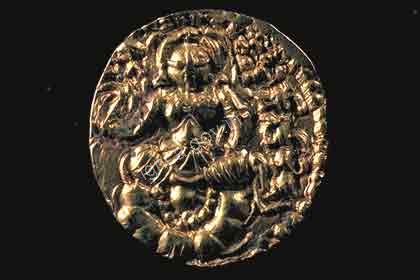

Krishna Devaraya had iamges Lord Venkateshwareengraved on their coins.
Rajput kings continue engraving images of "Laxmi" on their coins
***
33 Devas become 33 crore after these 33 deavs came in 'touch' with 'Devis' (i do not know how many) and their progenies adopted Deva Surnames!!! and there are S(u)achdevas too at present in punjab!
*** The Vedic literature reveals the ... object?'
Maurya and Guptas are non-kshatriyas according to Western Historians.
Mauryas and Gupats are not sakas.
Mauryas and Greeks were contemporaries.
***
Rather Guptas, Satvahanas and Sakas (Kshatrapas) of western india were contemporaneous.
Kshatrapi was destroyed by Gautami Putra Satkarni when he defeated Nahpana.
Again, Kshatrapas came to power in saurashtra and malwa who were ultimately overran by Ramagupta and Chandragupta II.
Though being labelled as invaders, kshatrapas were great scholars and in their time many type of sanskrit literature came up. Western Kshatrapa's Valabhi had a university as good as nalanda. Valabhipur (valabhi) is near Bhavnagar!
Mauryas and Gupats are not sakas.
Mauryas and Greeks were contemporaries.
***
Rather Guptas, Satvahanas and Sakas (Kshatrapas) of western india were contemporaneous.
Kshatrapi was destroyed by Gautami Putra Satkarni when he defeated Nahpana.
Again, Kshatrapas came to power in saurashtra and malwa who were ultimately overran by Ramagupta and Chandragupta II.
Though being labelled as invaders, kshatrapas were great scholars and in their time many type of sanskrit literature came up. Western Kshatrapa's Valabhi had a university as good as nalanda. Valabhipur (valabhi) is near Bhavnagar!
-
Raju
http://en.wikipedia.org/wiki/Chandragupta_Maurya
There are different theories regarding Chandragupta Maurya’s origins. Most regard Chandragupta to have originated from Magadha, possibly as the son of a Nanda prince.
There are different theories regarding Chandragupta Maurya’s origins. Most regard Chandragupta to have originated from Magadha, possibly as the son of a Nanda prince.
There is however an alternative school including noted Buddhist scholar B.M. Barua and others like Dr J.W. McCrindle, Dr D.B. Spooner, Dr H. C. Seth, Dr Hari Ram Gupta, Dr Ranajit Pal who connect Chandragupta to Gandhara.A kshatriya people known as the "Mauryas" who had received the relics of the Buddha are also mentioned in the Mahaparinibbana Sutta of the Digha Nikaya. Then the Moriyas of Pipphalivana came to know that at Kusinara the Blessed One had passed away. And they sent a message to the Mallas of Kusinara, saying: "The Blessed One was of the warrior caste, and we are too. We are worthy to receive a portion of the relics of the Blessed One. We will erect a stupa over the relics of the Blessed One and hold a festival in their honor."
Claims that the Mauryas were the Muras or rather Mors and were kshatriyas of Indo-Scythian origin have been proposed. Based on Plutarch's evidence, other historians state that Chandragupta Maurya belonged to the Ashvaka or Assakenoi clan of Swat/Kunar valley ( modern Mer-coh or Koh-I-Mor — the Meros of the classical writings). Ashvakas were a section of the Kambojas who were exclusively engaged in horse-culture and were noted for renting out their cavalry services
ComplainMurugan wrote: RSS and other HOs get meagre funding from hindus and rather get hatred from learned, anglicized hindus without even caring to know what actually they are doing + apathy from govt + ban calls from Mullus and Allus + boo from Recently converted and n...
Complain
Complain
Complain about stingy Hindus, complain about anglicized Hindus, complain about goi, complain about Mallus, complain about allus, complain about converts..
And then say RSS veryvery good.
But you are not alone
This has been the unsophisticated modus operandi of RSS supporters while the RSS itself does not look for publicity.
This is not the way to win accolades from anyone. This is the route to digging a deeper grave for the RSS. Yes grave. Not pyre. Say that everyone else has a problem, and claim that the entity you speak of is good.
From a psy ops viewpoint this approach gets 0 out of 10.
Better not to say anything at all rather than curse half the world while trying to put RSS in a favorable light.
Sorry Murugan. Did you have to score two psy-ops own goals in two posts? Don't intend to hurt you but stating that a "Right wing paper" should be started is like getting both testicles surgically removed on the day before one's wedding.Murugan wrote:AND YOU KNOW : WE NEED A RIGHT WING NEWSPAPER - IN HINDI, IN ENGLISH AND IN OTHER MAJOR LANGUAGES
When you state the intent to start a "right wing paper" you are instantly putting off lots of fence sitters who might otherwise read the paper.
In fact you might as well say "This is a right wing paper. No need to read it. Read left wing and other literature and learn what they have to say about right wing and you can safely assume that we are all that and more, since we are a right wing paper"
You start a paper and put forward views that you think are correct. Not "rightwing or leftwing". Others who read your paper will reach conclusions about you and make accusations if they dislike something.
Why would anyone want to start a paper with a readymade accusation for others to hold to? Imagine the girl you want to marry wearing a T-shirt that says "ex-hooker".
This is not a complaint for RSS alone. this is a fact for all HOs working overtly.
Better not to say anything at all rather than curse half the world while trying to put RSS in a favorable light.
My efforts alone are not going to change RSS and other HOs work. I am also not an RSS chamcha. But, i will claim i know many thing, good or bad about RSS and few HOs
My post was in reply to comparing RSS and other HOs with EJ and Jihadi publication machinery. and there is no denying the fact that HOs are underfunded. But still this is not a dampner.
I am not here to gain grades by favouring any ideology.
still Sticking to my replies on:
1) How RSS work (reply to your post)
2) Why don't they publicize what they do (reply to your post onlee)
You are playing games! Sometimes asking questions and when you get reply you find some design (or you indicate) in reply made unattached to any ideology.
You can play - you are admin!
***
Exactly, this happens when RSS comes out in defence of their work. People just speak your words!
thanx
Better not to say anything at all rather than curse half the world while trying to put RSS in a favorable light.
My efforts alone are not going to change RSS and other HOs work. I am also not an RSS chamcha. But, i will claim i know many thing, good or bad about RSS and few HOs
My post was in reply to comparing RSS and other HOs with EJ and Jihadi publication machinery. and there is no denying the fact that HOs are underfunded. But still this is not a dampner.
I am not here to gain grades by favouring any ideology.
still Sticking to my replies on:
1) How RSS work (reply to your post)
2) Why don't they publicize what they do (reply to your post onlee)
You are playing games! Sometimes asking questions and when you get reply you find some design (or you indicate) in reply made unattached to any ideology.
You can play - you are admin!
***
Exactly, this happens when RSS comes out in defence of their work. People just speak your words!
thanx
before a while, i thought we want to counter Jihadi and EJ threats!In fact you might as well say "This is a right wing paper. No need to read it. Read left wing and other literature and learn what they have to say about right wing and you can safely assume that we are all that and more, since we are a right wing paper"
I tried to say that also need a balancer!
otherwise, other arguments may be invited to counter these Jihadi and EJ machinery and propganda. can we do it with left wing or secular media?
I believe Right Wing does not mean violence, forcible coversion, jihad etc.
Moreover, i also do not want to start (dont have money, nor i am affiliated with any RSS/BJP/VHP/BD, Hindu mahasabha, Munani etc)
If leftist have their news paper, if secular parties have their pet media why not RW have their NP to fill the gap?
Last edited by Murugan on 16 Mar 2007 14:46, edited 1 time in total.
-
abhischekcc
- BRF Oldie
- Posts: 4277
- Joined: 12 Jul 1999 11:31
- Location: If I can’t move the gods, I’ll stir up hell
- Contact:
shiv wrote:Sorry Murugan. Did you have to score two psy-ops own goals in two posts? Don't intend to hurt you but stating that a "Right wing paper" should be started is like getting both testicles surgically removed on the day before one's wedding.
When you state the intent to start a "right wing paper" you are instantly putting off lots of fence sitters who might otherwise read the paper.
Hmmm....
Hitler faced the same problem at the beginning of his career - whether to appear compromising first, gain power easily then ****** everybody, or to appear non-compromising in the beginning, attain power through struggle, then ****** everybody.
We know he went for the first option. What's important is the reason he gave for it (in Mein Kampf). He said that it is important to build a strong core first, and for that it is important to take an extreme stance because the weak are automatically repelled by that.
He specifically rejected the 'fence sitters'. And we know that the Nazi Party stuck with him till the bitter end, unlike the Italian Fascist Party which abandoned Mussolini.
IMVVHO, one should reveal one's true objective when one is ready to start a revolution for it.
However, if your objective is to take a stance only to change it on attaining power, that is, if you want to start another BJP, then one can take a moderate stance.
----------
Shiv, I think you have allowed yourself to be swayed by the apparent power of numbers. Since when have fence sitters ever been the source of strength?
However, I will agree with the notion, and only with the notion, that 'right wing' has been made uncool. I also feel in public and media's opinion, anything that isn't warm and fuzzy and doesn't give you goose bumps is right wing.
I mean, 'right wing' itself is so amorphous that it is impossible to say what is right and wrong (left) in India.