Great you're from Himachal!
I'll complete the rest of the Kangra story from what books I have...hopefully you can add some good info to that.
Will send you mail on Jaswan sometime later.
Historical Battles in Ancient & Medieval Bharat
Jehangir received news of the conquest of Kangra and records, "Kangra is an ancient fort to the north of Lahore, situated in the midst of the hill country, famous for its strength and the difficulty of conquering it.....
Whoever sat on the throne of Delhi sent an army to subdue it but the thing went no further. My revered father also sent an army once, under Hussain Quli Khan...
When by the grace of glorious Allah, the throne of state was adorned by the existence of this supplicant, this was one of the jehads incumbent upon me."
Jehangir, emperor of a vast territory called his invasion of the small hill-state as 'a jehad'——so in his understanding of Islam, there was no 'improve yourself jehad' or 'a jehad in self-defence' as modern interpreters now claim. Jehad has always meant, and continues to mean, the invasion of infidel lands and the destruction of their religion and culture.
Jehangir's visit to Kangra (1622)
The Mughal Emperor visited Kangra with his wife two years later. His actions at Kangra come as no surprise to the objective historian——but the leftists have gone to bizarre lengths to rationalize his bogotry.
"Perhaps the place inspired him with religious hate...."
"He was ill at that time and given to bouts of anger...."
"Jehangir was an enigma, sometimes liberal and sometimes bigoted..."
are some of the comments by such communal people to defend him for something which was so common in the annals of Islamic history in India.
Fortunately the internet has ended the leftist dictatorship and intellectual fascism, and made available the original sources of history for all to study and learn from——centrists, rightists, and even new-generation leftists!
In Jehangir's own words, "I went towards Kangra and after four days march encamped on the River Ban-Ganga. On the 24th of the month I went to pay a visit to the fort, and I gave orders that the Qazi, the Chief Justice and others learned in the law of Islam, should accompany me and perform the ceremonies required by our religion.
After passing over about half a kos we mounted the fort, and then by the grace of Allah prayers were said, the khutba was read, a cow was killed, and other things were done such as had never been done before, from the foundation of the fort to the present time."
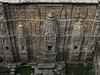 remains of a temple in Kangra Fort
Mughal administration in Kangra unsettled (1622-1707)
The fort and town of Kangra were not a part of the Mughal administration in Punjab——like Gwalior or Ranthambhor, or the port-city of Surat, they were under the direct control of the Mughal Emperor. The surrounding land was to be assigned as jagirs to Mughal officers——this would lead to the gradual growth of a Mughal colony in the hills, covered with their monuments, tombs, and mosques.
Raja Hari Chand was compensated with a portion of his kingdom, the province of Rajgir, where he lived in peace for only about a year. Because after Jehangir's gross communal act of temple-desecration, cow-slaughter, and 'other things" that were done, all in the ancestral holy land of the Katoch clan, the teenaged Hari Chand broke out in revolt. The Katoch Rajputs joined their king in ravaging the lands annexed by the Mughals till Hari Chand was caught and executed (1627).
Hari Chand died young and was not able to raise a family due to the continuous wars——he was succeeded as Raja by Chandarbhan Chand, his nearest kinsman. Chandrabhan, like all Katoch nobles, had been present at the defence of Kangra and assumed the leadership of the resistance. His title of Raja was not recognized by the Mughals, which in effect meant nothing, since the clan rallied around him.
 Palampur
The new Raja built a fort in the towering heights between Dharamsala and Palampur, called today Chandarbhan ka tila. When the Mughal forces were in strength, he would hold out in this stronghold——when they were engaged elsewhere Chandarbhan would emerge and sack the Mughal territory, cooping up the remaining Mughals inside Kangra Fort.
Military balance
Mughal armies under the faujdar of Jalandhar, and the subahdar of Lahore, were engaged against the Katoch clan in this period. In times of crisis forces from Delhi were sent to cooperate with these units.
The Katoch forces were now mostly infantry and they used mountain warfare against the superior Mughal armies——blocking mountain passes and trapping their cumbersome units in remote valleys, raining down stones, tree-trunks, and boulders on them. Horses were bred in the Kangra valley, but foreign horses were also purchased, and when the region was drained of Mughal forces these cavalry units would be used in sacking the Mughal territory in Kangra.
The non-stop war continued throughout Shah Jahan's reign, and after Chandarbhan's death, with fits and starts carried on into Aurangzeb's reign. The war was confined to the Kangra valley but the result was that the Mughal officers could not settle down in the annexed portions of Kangra, and no revenue could be collected.
Attempts by Shah Jahan to grant jagirs to local Hindu officers did not produce better results. The annexed portions were permanently recovered by the Katoch Rajas during Ahmad Shah Abdali's invasions (1751).
Kangra Fort
Kangra Fort remained under Mughal control for another 30-odd years——the last kiladar Nawab Saif Ali Khan continued to correspond directly with the shadowy Mughal government in Delhi after the Abdali invasions. The Katoch clan did not even attempt a siege of the fort.
Ironically the fort built and designed to defy the might of foreign armies also kept at bay its original owners! The clan, engaged in constant warfare that kept their lands unsettled, could not garner the resources to besiege the fort or find any strong or dependable ally——till the emergence of a new power in the 18th century solved this problem.
The Katoch Rajas took the aid of the Sikhs in blockading the strong fort, but even then it was only surrendered after the death of the Nawab, by an agreement with his soldiers. A marble slab, with Persian inscriptions, set up by Jehangir was broken into pieces by Raja Sansar Chand Katoch in 1786.
It is significant that despite this 160-year occupation the only few Mughal monuments are inside the fort. No town was settled by the foreigners, no Mughal building or mosque is visible in any part of Kangra——graphically diplaying the effectiveness of the local Hindu resistance in preventing the Islamisation of their land.
All the important towns of Kangra were founded by the Rajas even as they fought against the Mughals——Vijapur by Vijai Ram Chand (1660), Alampur by Alam Chand (1700), Hamirpur by Hamir Chand (1740), and Tira-Sujanpur by Ghammand Chand (1751).
 Hamirpur
Whoever sat on the throne of Delhi sent an army to subdue it but the thing went no further. My revered father also sent an army once, under Hussain Quli Khan...
When by the grace of glorious Allah, the throne of state was adorned by the existence of this supplicant, this was one of the jehads incumbent upon me."
Jehangir, emperor of a vast territory called his invasion of the small hill-state as 'a jehad'——so in his understanding of Islam, there was no 'improve yourself jehad' or 'a jehad in self-defence' as modern interpreters now claim. Jehad has always meant, and continues to mean, the invasion of infidel lands and the destruction of their religion and culture.
Jehangir's visit to Kangra (1622)
The Mughal Emperor visited Kangra with his wife two years later. His actions at Kangra come as no surprise to the objective historian——but the leftists have gone to bizarre lengths to rationalize his bogotry.
"Perhaps the place inspired him with religious hate...."
"He was ill at that time and given to bouts of anger...."
"Jehangir was an enigma, sometimes liberal and sometimes bigoted..."
are some of the comments by such communal people to defend him for something which was so common in the annals of Islamic history in India.
Fortunately the internet has ended the leftist dictatorship and intellectual fascism, and made available the original sources of history for all to study and learn from——centrists, rightists, and even new-generation leftists!
In Jehangir's own words, "I went towards Kangra and after four days march encamped on the River Ban-Ganga. On the 24th of the month I went to pay a visit to the fort, and I gave orders that the Qazi, the Chief Justice and others learned in the law of Islam, should accompany me and perform the ceremonies required by our religion.
After passing over about half a kos we mounted the fort, and then by the grace of Allah prayers were said, the khutba was read, a cow was killed, and other things were done such as had never been done before, from the foundation of the fort to the present time."
remains of a temple in Kangra FortMughal administration in Kangra unsettled (1622-1707)
The fort and town of Kangra were not a part of the Mughal administration in Punjab——like Gwalior or Ranthambhor, or the port-city of Surat, they were under the direct control of the Mughal Emperor. The surrounding land was to be assigned as jagirs to Mughal officers——this would lead to the gradual growth of a Mughal colony in the hills, covered with their monuments, tombs, and mosques.
Raja Hari Chand was compensated with a portion of his kingdom, the province of Rajgir, where he lived in peace for only about a year. Because after Jehangir's gross communal act of temple-desecration, cow-slaughter, and 'other things" that were done, all in the ancestral holy land of the Katoch clan, the teenaged Hari Chand broke out in revolt. The Katoch Rajputs joined their king in ravaging the lands annexed by the Mughals till Hari Chand was caught and executed (1627).
Hari Chand died young and was not able to raise a family due to the continuous wars——he was succeeded as Raja by Chandarbhan Chand, his nearest kinsman. Chandrabhan, like all Katoch nobles, had been present at the defence of Kangra and assumed the leadership of the resistance. His title of Raja was not recognized by the Mughals, which in effect meant nothing, since the clan rallied around him.
PalampurThe new Raja built a fort in the towering heights between Dharamsala and Palampur, called today Chandarbhan ka tila. When the Mughal forces were in strength, he would hold out in this stronghold——when they were engaged elsewhere Chandarbhan would emerge and sack the Mughal territory, cooping up the remaining Mughals inside Kangra Fort.
Military balance
Mughal armies under the faujdar of Jalandhar, and the subahdar of Lahore, were engaged against the Katoch clan in this period. In times of crisis forces from Delhi were sent to cooperate with these units.
The Katoch forces were now mostly infantry and they used mountain warfare against the superior Mughal armies——blocking mountain passes and trapping their cumbersome units in remote valleys, raining down stones, tree-trunks, and boulders on them. Horses were bred in the Kangra valley, but foreign horses were also purchased, and when the region was drained of Mughal forces these cavalry units would be used in sacking the Mughal territory in Kangra.
The non-stop war continued throughout Shah Jahan's reign, and after Chandarbhan's death, with fits and starts carried on into Aurangzeb's reign. The war was confined to the Kangra valley but the result was that the Mughal officers could not settle down in the annexed portions of Kangra, and no revenue could be collected.
Attempts by Shah Jahan to grant jagirs to local Hindu officers did not produce better results. The annexed portions were permanently recovered by the Katoch Rajas during Ahmad Shah Abdali's invasions (1751).
Kangra Fort
Kangra Fort remained under Mughal control for another 30-odd years——the last kiladar Nawab Saif Ali Khan continued to correspond directly with the shadowy Mughal government in Delhi after the Abdali invasions. The Katoch clan did not even attempt a siege of the fort.
Ironically the fort built and designed to defy the might of foreign armies also kept at bay its original owners! The clan, engaged in constant warfare that kept their lands unsettled, could not garner the resources to besiege the fort or find any strong or dependable ally——till the emergence of a new power in the 18th century solved this problem.
The Katoch Rajas took the aid of the Sikhs in blockading the strong fort, but even then it was only surrendered after the death of the Nawab, by an agreement with his soldiers. A marble slab, with Persian inscriptions, set up by Jehangir was broken into pieces by Raja Sansar Chand Katoch in 1786.
It is significant that despite this 160-year occupation the only few Mughal monuments are inside the fort. No town was settled by the foreigners, no Mughal building or mosque is visible in any part of Kangra——graphically diplaying the effectiveness of the local Hindu resistance in preventing the Islamisation of their land.
All the important towns of Kangra were founded by the Rajas even as they fought against the Mughals——Vijapur by Vijai Ram Chand (1660), Alampur by Alam Chand (1700), Hamirpur by Hamir Chand (1740), and Tira-Sujanpur by Ghammand Chand (1751).
Hamirpur
Last edited by Airavat on 05 Jan 2008 06:48, edited 1 time in total.
Thanks Airavat
I belive the Aurangjeb's subedar also arrived in Nadaun to fight the Kangra king and extract taxes from him by force.
The Raja asked Guru Gobind Singh for help, who arrived with miliatry help. The Moghul subedar retreated.
A stone was erected in Naduan to commemorate all this. I have not been able to locate it. But it is there.
Naduan is part of Kangra at that time. Near Naduan, there is a small "khad" i.e. seasonal nullah called Maseha Khad. That is where Kangra eneded in the history and the small kingdom of Jaswan began and it ended at Amb-Una corridor. Would you know how this king faired against the Moghul onslaught. The kindom of Jaswan was no more after Maharaja Ranjit singh asked for huge payment for not showing up in person in his durbar in 1830. British agreed with Maharaja Ranjit singh and dissolved the kingdom and added it to Kangra.
I belive the Aurangjeb's subedar also arrived in Nadaun to fight the Kangra king and extract taxes from him by force.
The Raja asked Guru Gobind Singh for help, who arrived with miliatry help. The Moghul subedar retreated.
A stone was erected in Naduan to commemorate all this. I have not been able to locate it. But it is there.
Naduan is part of Kangra at that time. Near Naduan, there is a small "khad" i.e. seasonal nullah called Maseha Khad. That is where Kangra eneded in the history and the small kingdom of Jaswan began and it ended at Amb-Una corridor. Would you know how this king faired against the Moghul onslaught. The kindom of Jaswan was no more after Maharaja Ranjit singh asked for huge payment for not showing up in person in his durbar in 1830. British agreed with Maharaja Ranjit singh and dissolved the kingdom and added it to Kangra.
Naga military history
Shri EN Rammohan, IPS (Retd)
[quote]The Nagas consist of about 30 odd tribes who inhabit the Nagaland state, parts of Manipur, a small part of North Cachar hills and Karbi Anglong in Assam, and a part of the old Tirap district of Arunachal Pradesh. The Naga leadership and historians claim that several small tribes in Manipur and Arunachal Pradesh are Nagas, but this is disputed by the Chin-Kuki-Mizo leaders who claim that these were really Kuki tribes who have decided to be Nagas because the Naga insurgent group is more powerful and it helps to be with the stronger group. There are several Naga tribes who live in Myanmar in the Sagaing Division opposite Nagaland and in the Somrah tracts, opposite Manipur. These are, however, the same tribes who live on the Indian side. In Nagaland the main tribes are the Angami, Ao, Sema, Konyak, Lotha, Chakesang, Rengma, Pochuri, Sangtam, Yimchunger, Khiamnungan, Phom and Zeliangrong, the last a group of three tribes, the Rongmei, Liangmei and Zemi. In Manipur, the Nagas dominate three districts. Ukhrul is the home of the Thangkuls, Senapati of the Maos, Marams, Poumeis and a very small tribe the Thengals and Tamenglong is dominated by the Zeliangrong. Chandel is divided between several Naga and Kuki tribes. The Kuki leaders claim that several tribes, whom the Naga leadership claims to be Nagas, are really Kuki. These are the Maring, Anal, Lamkhang, Moyon, Monsong, Chote, Chiru and Tarao.1 In Assam, in the North Cachar hills, there are a number of villages of Zemis, a minority compared to the Dimasa Cachari who dominate the district and the Kukis and Hmars, who are in a sizeable majority. In Myanmar, the Thangkuls live in the Somrah tracts opposite Ukhrul district, while in the Sagaing division opposite Nagaland are the Konyak, Phom, Yimchunger, and several smaller tribes. Three tribes in the old Tirap district are Nagas.
Origin of the Nagas
Who are the Nagas and what is their origin? There is an aura of mystery about the origin of the Nagas, and their migration to their present habitation in Nagaland, Manipur, and the districts of Khonsa and Changlang of Arunachal Pradesh, and in Myanmar. There are no composite ‘Naga’ people, and among them there are many distinct tribes having more than 30 dialects, with every tribe constituting a separate language group. Their cultural and social setup varies vastly from tribe to tribe. Their physique and appearance differ from group to group. The nomenclature ‘Naga’ was given to this group by outsiders. In fact for long the appellation of ‘Naga’ was resented, till political expediency caused it to be accepted. In many cases these tribes existed in complete isolation.
For the majority of tribes, the entity was the independant village. There were both monarchical and republican systems in each village. Among the lower Konyaks and the Maos, some sort of confederation was formed where the great kings act as the titular head over some other villages. The Angs, the kings of Konyak villages, used to pay tribute to the great Ang, who had, however, no power to interfere with the other Angs.3 Among the Aos, Tatars (Councillors), who were the representatives of the people, could become the chief of the village by merit. In general a Naga village was said to be self sufficient, and by and large, maintained its sovereignty. Any interference, trespassing or encroachment by members of other villages in its territorial jurisdiction usually provoked inter village war, where head hunting could follow.
Meitheis. It is generally held that the Ahoms were the first outsiders to come in contact with the Naga tribes. This is not correct. The first organised group who came in contact with the Naga tribes were the Meitheis. The Meitheis have a recorded history of nearly 2000 years, the Cheitharon Kumbaba. In My Experience in Manipur, James Johnstone said, “the territories of Manipur varied according to the mettle of its rulers. Sometimes they held considerable territories east of the Chindwin River, at other times only the Kebaw valley.â€
Shri EN Rammohan, IPS (Retd)
[quote]The Nagas consist of about 30 odd tribes who inhabit the Nagaland state, parts of Manipur, a small part of North Cachar hills and Karbi Anglong in Assam, and a part of the old Tirap district of Arunachal Pradesh. The Naga leadership and historians claim that several small tribes in Manipur and Arunachal Pradesh are Nagas, but this is disputed by the Chin-Kuki-Mizo leaders who claim that these were really Kuki tribes who have decided to be Nagas because the Naga insurgent group is more powerful and it helps to be with the stronger group. There are several Naga tribes who live in Myanmar in the Sagaing Division opposite Nagaland and in the Somrah tracts, opposite Manipur. These are, however, the same tribes who live on the Indian side. In Nagaland the main tribes are the Angami, Ao, Sema, Konyak, Lotha, Chakesang, Rengma, Pochuri, Sangtam, Yimchunger, Khiamnungan, Phom and Zeliangrong, the last a group of three tribes, the Rongmei, Liangmei and Zemi. In Manipur, the Nagas dominate three districts. Ukhrul is the home of the Thangkuls, Senapati of the Maos, Marams, Poumeis and a very small tribe the Thengals and Tamenglong is dominated by the Zeliangrong. Chandel is divided between several Naga and Kuki tribes. The Kuki leaders claim that several tribes, whom the Naga leadership claims to be Nagas, are really Kuki. These are the Maring, Anal, Lamkhang, Moyon, Monsong, Chote, Chiru and Tarao.1 In Assam, in the North Cachar hills, there are a number of villages of Zemis, a minority compared to the Dimasa Cachari who dominate the district and the Kukis and Hmars, who are in a sizeable majority. In Myanmar, the Thangkuls live in the Somrah tracts opposite Ukhrul district, while in the Sagaing division opposite Nagaland are the Konyak, Phom, Yimchunger, and several smaller tribes. Three tribes in the old Tirap district are Nagas.
Origin of the Nagas
Who are the Nagas and what is their origin? There is an aura of mystery about the origin of the Nagas, and their migration to their present habitation in Nagaland, Manipur, and the districts of Khonsa and Changlang of Arunachal Pradesh, and in Myanmar. There are no composite ‘Naga’ people, and among them there are many distinct tribes having more than 30 dialects, with every tribe constituting a separate language group. Their cultural and social setup varies vastly from tribe to tribe. Their physique and appearance differ from group to group. The nomenclature ‘Naga’ was given to this group by outsiders. In fact for long the appellation of ‘Naga’ was resented, till political expediency caused it to be accepted. In many cases these tribes existed in complete isolation.
For the majority of tribes, the entity was the independant village. There were both monarchical and republican systems in each village. Among the lower Konyaks and the Maos, some sort of confederation was formed where the great kings act as the titular head over some other villages. The Angs, the kings of Konyak villages, used to pay tribute to the great Ang, who had, however, no power to interfere with the other Angs.3 Among the Aos, Tatars (Councillors), who were the representatives of the people, could become the chief of the village by merit. In general a Naga village was said to be self sufficient, and by and large, maintained its sovereignty. Any interference, trespassing or encroachment by members of other villages in its territorial jurisdiction usually provoked inter village war, where head hunting could follow.
Meitheis. It is generally held that the Ahoms were the first outsiders to come in contact with the Naga tribes. This is not correct. The first organised group who came in contact with the Naga tribes were the Meitheis. The Meitheis have a recorded history of nearly 2000 years, the Cheitharon Kumbaba. In My Experience in Manipur, James Johnstone said, “the territories of Manipur varied according to the mettle of its rulers. Sometimes they held considerable territories east of the Chindwin River, at other times only the Kebaw valley.â€
while the Nagas can rightly lay claim to a long and proud fighting history, little credit has been given to the hill tribes of eastern and central arunachal - Singfou, Miri, Aka, Dafla, Adi.....these more than the Nagas were quite a
handful for the Ahom kings trying to establish 'stability' on the frontier
(foothills). they excelled in raiding the lowlands and disappearing into the
hills wherein pursuit groups sent from the plains were not able to move, fight
or concentrate properly...so they'd burn a empty village or two and come
back. in my exp they have equal or better physiques than Nagas and would
excel both in jungle and high-alt fighting. I had a Adi college mate from
Pasighat who while being only 5" tall was impossible to shove aside once
he dug heels in. another senior was a Miri notorious for hard drinking
and hard fighting, being the reigning hardman of NIT in his era.
its high time a Arunachal Regimental Center were established in Itanagar
region and active efforts made to recruit the locals. Its their border and they
lived there for centuries, they understand the sounds of the jungle and hills
in a way a well-trained lowlander can never do.
finally in exasperation the Ahoms relocated captured mohameddan soldiers from lower assam and made a 'frontier corps' out of them ,
resettling them in the arunachal frontier.
handful for the Ahom kings trying to establish 'stability' on the frontier
(foothills). they excelled in raiding the lowlands and disappearing into the
hills wherein pursuit groups sent from the plains were not able to move, fight
or concentrate properly...so they'd burn a empty village or two and come
back. in my exp they have equal or better physiques than Nagas and would
excel both in jungle and high-alt fighting. I had a Adi college mate from
Pasighat who while being only 5" tall was impossible to shove aside once
he dug heels in. another senior was a Miri notorious for hard drinking
and hard fighting, being the reigning hardman of NIT in his era.
its high time a Arunachal Regimental Center were established in Itanagar
region and active efforts made to recruit the locals. Its their border and they
lived there for centuries, they understand the sounds of the jungle and hills
in a way a well-trained lowlander can never do.
finally in exasperation the Ahoms relocated captured mohameddan soldiers from lower assam and made a 'frontier corps' out of them ,
resettling them in the arunachal frontier.
http://www.youtube.com/watch?v=S6NoZteIdBc
Epic story of the longest surviving civilisation. Trailer for the upcoming website - www.hinduhistory.net


Epic story of the longest surviving civilisation. Trailer for the upcoming website - www.hinduhistory.net


http://chhattisgarh.nic.in/profile/corigin.htmAccording to a mythological legend, Ram, during his Vanvas stayed in Dakshin Kosala. Which is modern day Chhattisgarh. The unbroken history of Chhattisgarh or of South Kosala can be traced back to fourth century AD and its mythological history goes back as far back as the Mahabarata and the Ramayana. About the history of the region the famous historian C.W.Wills writes, 'in the 10th century AD a powerful Rajput family ruled at Tripuri near Jabalpur, Issuing from this kingdom of Chedi (also known as Kalchuri dynasty) a scion of the royal house by the name Kalingraja, settled about the year 1000AD, at Tuman, a site at present marked only by a few ruins in the north east of the erstwhile Laphazamidari of The Bilaspur district. His grandson Ratanraja founded Ratanpur Which continued as the capital of a large part of the country now known as Chhattisgarh. This Rajput family called themselves the Haihaya dyanasty. This dynasty continued ruling Chhattisgarh for six centuries about the 14th century it split into parts, the elder branch continued at Ratanpur, while the younger settled in semi-independent state at Raipur. At the end of 16th century it acknowledged the suzerainty of the Mughals, In Bastar, in the middle ages, Chalukya dynasty established its rule. The first Chalukya ruler was Annmdev, who established the dynasty in Bastar in 1320 .
The Marathas attacked Chhattisgarh in 1741 and destroyed the Haihaya power. In 1745 AD after conquering the region, they deposed Raghunathsinghji, the last surviving member of the Ratanpur house. In 1758, the Maraths finally annexed Chhattisgarh, it came directly under Maratha rule and Bimbaji Bhonsle, was appointed the rule. After death of Bimbaji Bhonsle, the Marathas adopted the Suba system. The Maratha rule was a period of unrest and misrule. There was large-scale loot and plunder by the Maratha army. The Maratha officials were openly surrendering the interests of the region to the British. As a result of this, the region became extremely poor and the people began resenting the Maratha rule. Only the Gonds continued to resist and challenge the advances of the Marathas and this led to several conflicts and much animosity between the Gonds and the Marathas (Captain Blunt, 1975). The Pindaris also attacked and plundered the region in the beginning of the Nineteenth Century.
Chhindak Nags were the ancestors of modern Gonds. Bastar has been a colony of Satwahana rulers from 72 BC to 200 AD. Traces of flourishing of Buddhism and Jainism before Nala dynasty can be seen in this region.
Tribal republican ruling system had been here in this area from 600 B.C to 1324 A.D., during the periods of Nalas(350-760) & Nagas(760-1324) which is worth mentioning.
Ashoka The Great had got victory over Kalinga but the brethren state
Batsar (Bastar) had remained un-conquered . This had been mentioned
in an ancient pillar as “Antanam Avijitanamâ€
-
Rudranathh
- BRFite
- Posts: 227
- Joined: 17 Nov 2007 20:06
Airavat posted from the official history of Chattisgarh as can be seen from the link he posted. Why don't you contact/take it up with them ?Rudranathh wrote:Airavatji should it not be historical legend Lord Ram.Airavat wrote: According to a mythological legend, Ram, during his Vanvas stayed in Dakshin Kosala.
Thanks, ramana
Indian leftists have treated the Hindu resistance as a mere footnote to their Delhi Sultanate-centric history texts. This deprived the student of a continuous narrative of that resistance, which lead to the formation of strong Hindu Kingdoms in Rajputana and South India in the 14th century. In the case of South India even the temporary conquest by the Delhi Sultanate (1310-37) is given a superficial treatment.
The Battles for Warangal
Ala-ud-din Khalji had invaded the Yadava Kingdom of Devagiri (Maharashtra) and made it a tributary ally in 1296. With the wealth looted from Devagiri Ala-ud-din won the throne of Delhi——after becoming Sultan he was too engrossed in his wars against the Mongols and Rajputs to expand further into the south. Only once in 1302 (after the conquest of Ranthambhor) an army sent to bring the Muslim officers in Bengal to obedience, swerved east into Orissa and penetrated into the Telingana region of Andhra Pradesh. No further details are given by the Muslim chroniclers of this campaign——for obvious reasons. Because the local Hindu inscriptions state that the invaders were defeated and forced to retreat.
As in the case of Shivaji and the Mughal Empire, events in the north had their impact on the wars of the south. The Mongol ruler of the Chagtai Khanate, Duwa Khan, died in 1306 and infighting among his successors ended the Mongol invasions of northwest India for a long time. This set the stage for a fresh expansion of the Delhi Sultanate——Ala-ud-din himself had to invade the Rajput Kingdoms of Siwana and Jalor and was engaged against them for three years. So he sent his converted Gujarati slave Malik Kafur to the south.
Malik Kafur's campaign
Taking advantage of the Delhi Sultanate's northern wars, Devagiri had sent no tribute for several years——Malik Kafur first invaded the Yadava Kingdom (1307). Reinforced by troops from the Muslim governors of Malwa and Gujarat he won a complete victory, but Devagiri was restored to its ruler Ramachandra——it became a convenient base for Turk expansion in the south.
In 1309 Malik Kafur, guided by Devagiri troops, invaded the Kakatiya Kingdom of Warangal (Andhra Pradesh). At the fort of Sirpur, after a long resistance the Hindu defenders rode out to die fighting while their families perished in the flames of jauhar. In January 1310 Kafur reached Warangal and based his army on the Hanumankonda Hill.
 Remains of Warangal Fort
The stone fort of Warangal (Orugallu) had a triple defence, being protected by one outer wall and two moats. The Kakatiya ruler Prataprudra had a garrison strong in archers, with a force of cavalry....but the invaders had superior numbers and resources. After placing his units around the fort and installing the catapults, Kafur directed his efforts to filling up the outer moat——the Kakatiyas made one night attack on the besiegers to halt this attempt. But by February the moat was filled and the outer mud wall was breached——the defenders retreated to the main fort and continued their resistance.
The next moat was also filled and the Turk catapults came closer, now raining their stones into the fort. The garrison also suffered from overcrowding and shortage of food. While the Turks were besieging the fort, their outposts along the route had been attacked by the armies of the Kakatiya vassals, who also blocked all their communication couriers. So when in March Prataprudra asked for terms Malik Kafur readily agreed. Warangal became tributary to the Delhi Sultanate and gave elephants, horses, gold and diamonds to Kafur——including the stone known later as the Koh-i-noor.
While at Warangal, Kafur heard of the fabulous wealth of the kingdoms further south. In early 1311 he started from Devagiri, invaded the Hoysala Kingdom (Karnataka) and obtained its submission, and ravaged (March-April 1311) the lands of the Pandya princes (Tamil Nadu) who were then engaged in a domestic civil war. Kafur returned to Delhi without the submission of either of the Pandya princes but with plenty of treasure and elephants.
At this time there were setbacks in Rajputana. The Turks abandoned Chittor (1311) in the face of Sesodia resistance, Jaisalmer was returned to its ruling chieftain, and the fort of Siwana was recovered by the Chauhans. At Delhi Ala-ud-din massacred 20,000 converted Mongols on suspicion of treachery.
Taking advantage of these setbacks the new ruler of Devagiri, Singhana, asserted his independence. Malik Kafur returned to Devagiri (1313), defeated and killed Singhana, and finally annexed the Hindu Kingdom into the Delhi Sultanate——with the exception of the state of Kampili where he was repulsed.
The setbacks in the north and Kafur's wars in Devagiri gave breathing space to Prataprudra. The civil war in the Pandya country had been worsened by Malik Kafur's bloody raid of temple destruction and civilian massacres, and this created the condition for a final expansion of the Kakatiya power.
Kingdom of Warangal
A Kakatiya warrior
The Kakatiyas were initially chieftains of humble origins (Samanta-vishti-vamsa) in Telingana. Their fort of Warangal was also situated in the Telingana region——for this reason the Muslims always referred to the Kingdom of Warangal as Tiling in their chronicles. The Kaktiyas rose through military service under the Chalukyas of Kalyan but became independent by the 13th century and went on to annex the coastal regions of Andhra Pradesh. Under their greatest ruler, Ganapati, the power of Warangal had spread up to Kanchi (Tamil Nadu). Since then the south had been the scene of a tripartite struggle between the Hoysalas (Karnataka), the Kakatiyas (Andhra Pradesh), and the Pandyas (Tamil Nadu), when the Turks had invaded.
And now Prataprudra found the field clear for his ambitions. Modern historians have criticized him for wasting his energy in fighting his co-religionists while the foreign invaders loomed large on his northern borders. But he was not alone——Ravivarman Kulasekhara (Kerala) and Vira Ballal Hoysala (Karnataka) also invaded Tamil Nadu at this time. The basic aim of all these powers was to expand their territory and gain wealth. Resistance to the foreigners would only be possible by accumulating such resources.
In 1313 Prataprudra captured Nellore and sent a force under his general Muppidi Nayak to Kanchi. The Pandya princes joined their forces and faced the invaders outside Kanchi——but while the battle was raging Prataprudra emerged with the main army, defeated the Pandyas, and captured Kanchi. Encouraged by this success he pushed on to capture all the land up to Trichinopoly, then under the Hoysalas.
On his return to Warangal Prataprudra learnt of the illness of Sultan Ala-ud-din Khalji and the return of Malik Kafur to his side from Devagiri (1315). The former Hindu officers of the Kingdom under the leadership of Harpaldeva recovered Devagiri from the Muslims.
Khusrav Khan's campaign
Mubarak Khalji, the new Sultan of Delhi, marched to Devagiri (1318) and after several battles captured Harpaladeva. Like his father, Mubarak had his own converted Gujarati slave, named Khusrav Khan——he was appointed to collect tribute from Tiling while the Sultan returned to Delhi.
 Warangal Fort
 Sculpture depicting cavalry
Buoyed by his success in the south, Prataprudra opposed the invaders in the open, with 10,000 horse and several thousand foot-soldiers. On being defeated they retreated into the Warangal fort. Khusrav Khan killed the chief commandant of force defending the outer mud wall, and entering through a breach, besieged the main fort. Ultimately Prataprudra agreed to pay his tribute and also ceded the fort of Badrkot to the invaders.
Khusrav then invaded the Pandya country from the side of Warangal. On returning to Delhi he murdered his master and ascended the throne as Sultan Khusrav Shah——his Hindu tribesmen from Gujarat dominated the Delhi court. Some of the Turk nobles, under the leadership of Ghiyas-ud-din Tughlaq, united against the Indian convert and killed him (1320).
Taking advantage of this, Prataprudra declared independence at Warangal and stopped the payment of tribute.
Muhammad Tughlaq as prince
In 1321 Sultan Ghiyas-ud-din Tughlaq sent his son Malik Jauna Khan (the future Muhammad Tughlaq) to tackle Prataprudra. Marching by way of Devagiri this army suffered many casualties as the siege of Warangal was prolonged. When Prataprudra offered to pay up his tribute as before, Jauna haughtily turned him down, having set his heart on capturing the fort. But as the siege dragged on a rebellion broke out within the Muslim army——several nobles left the camp with their contingents.
At this the Hindus emerged from the fort and attacked the rest of the Turk army——Jauna escaped to Devagiri, many of his men were slaughtered, and his entire baggage was looted (1322).
The deserters were punished by Ghiyas-ud-din Tughlaq and within a few months (1323) Jauna was once again sent with a fresh army to conquer Warangal. This renewed invasion, coming in such a short time, overwhelmed the Kakatiyas and after some resistance Prataprudra surrendered the fort. He was sent to Delhi as a prisoner but the Sultan let him rule a part of his old kingdom since an inscription of Prataprudra, dated 1326, has been found at Guntur.
Jauna meanwhile advanced to capture the rest of Warangal——he even dispatched a force to the south, which captured the Pandya capital Madurai (1323). Jauna then marched east and captured Rajahmundry where he built a mosque (1324). His further advance to Orissa though was repulsed.
 Architectural remains at Warangal
Next: the liberation of Warangal
The Battles for Warangal
Ala-ud-din Khalji had invaded the Yadava Kingdom of Devagiri (Maharashtra) and made it a tributary ally in 1296. With the wealth looted from Devagiri Ala-ud-din won the throne of Delhi——after becoming Sultan he was too engrossed in his wars against the Mongols and Rajputs to expand further into the south. Only once in 1302 (after the conquest of Ranthambhor) an army sent to bring the Muslim officers in Bengal to obedience, swerved east into Orissa and penetrated into the Telingana region of Andhra Pradesh. No further details are given by the Muslim chroniclers of this campaign——for obvious reasons. Because the local Hindu inscriptions state that the invaders were defeated and forced to retreat.
As in the case of Shivaji and the Mughal Empire, events in the north had their impact on the wars of the south. The Mongol ruler of the Chagtai Khanate, Duwa Khan, died in 1306 and infighting among his successors ended the Mongol invasions of northwest India for a long time. This set the stage for a fresh expansion of the Delhi Sultanate——Ala-ud-din himself had to invade the Rajput Kingdoms of Siwana and Jalor and was engaged against them for three years. So he sent his converted Gujarati slave Malik Kafur to the south.
Malik Kafur's campaign
Taking advantage of the Delhi Sultanate's northern wars, Devagiri had sent no tribute for several years——Malik Kafur first invaded the Yadava Kingdom (1307). Reinforced by troops from the Muslim governors of Malwa and Gujarat he won a complete victory, but Devagiri was restored to its ruler Ramachandra——it became a convenient base for Turk expansion in the south.
In 1309 Malik Kafur, guided by Devagiri troops, invaded the Kakatiya Kingdom of Warangal (Andhra Pradesh). At the fort of Sirpur, after a long resistance the Hindu defenders rode out to die fighting while their families perished in the flames of jauhar. In January 1310 Kafur reached Warangal and based his army on the Hanumankonda Hill.
Remains of Warangal FortThe stone fort of Warangal (Orugallu) had a triple defence, being protected by one outer wall and two moats. The Kakatiya ruler Prataprudra had a garrison strong in archers, with a force of cavalry....but the invaders had superior numbers and resources. After placing his units around the fort and installing the catapults, Kafur directed his efforts to filling up the outer moat——the Kakatiyas made one night attack on the besiegers to halt this attempt. But by February the moat was filled and the outer mud wall was breached——the defenders retreated to the main fort and continued their resistance.
The next moat was also filled and the Turk catapults came closer, now raining their stones into the fort. The garrison also suffered from overcrowding and shortage of food. While the Turks were besieging the fort, their outposts along the route had been attacked by the armies of the Kakatiya vassals, who also blocked all their communication couriers. So when in March Prataprudra asked for terms Malik Kafur readily agreed. Warangal became tributary to the Delhi Sultanate and gave elephants, horses, gold and diamonds to Kafur——including the stone known later as the Koh-i-noor.
While at Warangal, Kafur heard of the fabulous wealth of the kingdoms further south. In early 1311 he started from Devagiri, invaded the Hoysala Kingdom (Karnataka) and obtained its submission, and ravaged (March-April 1311) the lands of the Pandya princes (Tamil Nadu) who were then engaged in a domestic civil war. Kafur returned to Delhi without the submission of either of the Pandya princes but with plenty of treasure and elephants.
At this time there were setbacks in Rajputana. The Turks abandoned Chittor (1311) in the face of Sesodia resistance, Jaisalmer was returned to its ruling chieftain, and the fort of Siwana was recovered by the Chauhans. At Delhi Ala-ud-din massacred 20,000 converted Mongols on suspicion of treachery.
Taking advantage of these setbacks the new ruler of Devagiri, Singhana, asserted his independence. Malik Kafur returned to Devagiri (1313), defeated and killed Singhana, and finally annexed the Hindu Kingdom into the Delhi Sultanate——with the exception of the state of Kampili where he was repulsed.
The setbacks in the north and Kafur's wars in Devagiri gave breathing space to Prataprudra. The civil war in the Pandya country had been worsened by Malik Kafur's bloody raid of temple destruction and civilian massacres, and this created the condition for a final expansion of the Kakatiya power.
Kingdom of Warangal
A Kakatiya warrior
The Kakatiyas were initially chieftains of humble origins (Samanta-vishti-vamsa) in Telingana. Their fort of Warangal was also situated in the Telingana region——for this reason the Muslims always referred to the Kingdom of Warangal as Tiling in their chronicles. The Kaktiyas rose through military service under the Chalukyas of Kalyan but became independent by the 13th century and went on to annex the coastal regions of Andhra Pradesh. Under their greatest ruler, Ganapati, the power of Warangal had spread up to Kanchi (Tamil Nadu). Since then the south had been the scene of a tripartite struggle between the Hoysalas (Karnataka), the Kakatiyas (Andhra Pradesh), and the Pandyas (Tamil Nadu), when the Turks had invaded.
And now Prataprudra found the field clear for his ambitions. Modern historians have criticized him for wasting his energy in fighting his co-religionists while the foreign invaders loomed large on his northern borders. But he was not alone——Ravivarman Kulasekhara (Kerala) and Vira Ballal Hoysala (Karnataka) also invaded Tamil Nadu at this time. The basic aim of all these powers was to expand their territory and gain wealth. Resistance to the foreigners would only be possible by accumulating such resources.
In 1313 Prataprudra captured Nellore and sent a force under his general Muppidi Nayak to Kanchi. The Pandya princes joined their forces and faced the invaders outside Kanchi——but while the battle was raging Prataprudra emerged with the main army, defeated the Pandyas, and captured Kanchi. Encouraged by this success he pushed on to capture all the land up to Trichinopoly, then under the Hoysalas.
On his return to Warangal Prataprudra learnt of the illness of Sultan Ala-ud-din Khalji and the return of Malik Kafur to his side from Devagiri (1315). The former Hindu officers of the Kingdom under the leadership of Harpaldeva recovered Devagiri from the Muslims.
Khusrav Khan's campaign
Mubarak Khalji, the new Sultan of Delhi, marched to Devagiri (1318) and after several battles captured Harpaladeva. Like his father, Mubarak had his own converted Gujarati slave, named Khusrav Khan——he was appointed to collect tribute from Tiling while the Sultan returned to Delhi.
Warangal Fort Sculpture depicting cavalryBuoyed by his success in the south, Prataprudra opposed the invaders in the open, with 10,000 horse and several thousand foot-soldiers. On being defeated they retreated into the Warangal fort. Khusrav Khan killed the chief commandant of force defending the outer mud wall, and entering through a breach, besieged the main fort. Ultimately Prataprudra agreed to pay his tribute and also ceded the fort of Badrkot to the invaders.
Khusrav then invaded the Pandya country from the side of Warangal. On returning to Delhi he murdered his master and ascended the throne as Sultan Khusrav Shah——his Hindu tribesmen from Gujarat dominated the Delhi court. Some of the Turk nobles, under the leadership of Ghiyas-ud-din Tughlaq, united against the Indian convert and killed him (1320).
Taking advantage of this, Prataprudra declared independence at Warangal and stopped the payment of tribute.
Muhammad Tughlaq as prince
In 1321 Sultan Ghiyas-ud-din Tughlaq sent his son Malik Jauna Khan (the future Muhammad Tughlaq) to tackle Prataprudra. Marching by way of Devagiri this army suffered many casualties as the siege of Warangal was prolonged. When Prataprudra offered to pay up his tribute as before, Jauna haughtily turned him down, having set his heart on capturing the fort. But as the siege dragged on a rebellion broke out within the Muslim army——several nobles left the camp with their contingents.
At this the Hindus emerged from the fort and attacked the rest of the Turk army——Jauna escaped to Devagiri, many of his men were slaughtered, and his entire baggage was looted (1322).
The deserters were punished by Ghiyas-ud-din Tughlaq and within a few months (1323) Jauna was once again sent with a fresh army to conquer Warangal. This renewed invasion, coming in such a short time, overwhelmed the Kakatiyas and after some resistance Prataprudra surrendered the fort. He was sent to Delhi as a prisoner but the Sultan let him rule a part of his old kingdom since an inscription of Prataprudra, dated 1326, has been found at Guntur.
Jauna meanwhile advanced to capture the rest of Warangal——he even dispatched a force to the south, which captured the Pandya capital Madurai (1323). Jauna then marched east and captured Rajahmundry where he built a mosque (1324). His further advance to Orissa though was repulsed.
Architectural remains at WarangalNext: the liberation of Warangal
On becoming Sultan, Muhammad Tughlaq extended the Delhi Sultanate in the south by annexing Kampili and capturing a portion of the Hoysala Kingdom. He also changed his capital from Delhi to Devagiri, which was renamed Daulatabad (1327). The move was imposed by force on the nobles and people of Delhi and the Turk army was engaged for this purpose.
Despite this change of capital the Sultan and his army were drawn back to the north for the next three years. In the very year that the capital shift was imposed (1327) there was a temporary incursion by the Mongols under Tarmashirin, who plundered up to Meerut, and were chased out with difficulty. After this invasion Muhammad Tughlaq made plans for invading Iran, Iraq, and Central Asia, and raised a large army for that purpose, numbering up to 375,000 horse. But he changed his mind a year later and disbanded this vast army, the salaries, equipping, and training of which for a full year, created a hefty dent in his treasury.
Soon after this (1329) an army sent against Rana Hammir of Mewar was defeated——in Rajasthan only Ajmer, Nagaur, and Mandor, remained under the control of the Delhi Sultanate. Rebellions by Turk nobles in Multan and Bengal though were suppressed.
Muhammad Tughlaq's aim in shifting his capital was to extinguish the Hindu Kingdoms in the south, make Islam supreme, and squeeze their lands and people for money. By the time the Sultan could return to the south (1330) the spirit of independence had swept through the land.
Renewed campaigns in the south
It had only been five years since the annexation of Warangal and the kingdom was not fully under Muslim control. The Hindu officers and nobles, under the leadership of Prolaya Nayak of Musunsuri and Prolaya Vema Reddy, formed a union of 75 Nayaks for the liberation of their kingdom and to "revive Dharma, protect Brahmans and cows, and restore the worship of the Gods."
In a series of battles the Telugu Nayaks drove away the Muslim garrisons from coastal Andhra Pradesh——Prolaya Nayak established himself at Ekapalli and was succeeded sometime before 1335 by his nephew Kapaya Nayak.
The fire of rebellion had spread across the south. Vira Ballal Hoysala had recovered his kingdom and rebuilt his destroyed capital (1328), Chalukya Somedeva drove out the Muslim governor of Kampili, and now even while the Sultan was present at Daulatabad, the Muslim governor of Madurai declared his independence (1334).
Muhammad Tughlaq first tackled Kampili. The brothers Harihara and Bukka, former officers of Kampili who had been captured and converted to Islam, were sent to recover Kampili. Then the Sultan squeezed the Daulatabad environs for money, causing tumult among the people, and thus financed his march into Tiling——here he divided the Kakatiya Kingdom into two parts and repeated his tactics at Kampili. The disturbed eastern part was placed under a former Kakatiya general, Nagaya Gauna, now converted to Islam and named Malik Maqbul. His seat was Sultanpur (Warangal).
The Hindu rising made the roads unsafe and prevented the Sultan's advance further south towards Madurai, which became an independent Sultanate. And now an outbreak of Cholera at Warangal forced his retreat to Daulatabad. Satisfied that converts with local knowledge and ties would be able to pacify Kampili and Warangal, Muhammad Tughlaq marched on to Delhi since fresh rebellions had broken out in the north in his absence.
Liberation of Warangal
Kapaya Nayak, whom the Muslim chroniclers call Kaanaya, knew that while the small army units under each Nayak excelled in guerrilla warfare and in taking small forts and towns, a well-equipped and more organized army was needed to complete the liberation of Warangal. He visited the only independent Hindu King in the south, Vira Ballal Hoysala, and sought his military aid against the Turks, offering in turn to aid the Hoysalas in their area of interest (northern Tamil Nadu).
To divert the attention of the converted governors of Kampili, Vira Ballal set about building a fort on his northern frontier, while an army accompanied Kapaya Nayak back to Andhra Pradesh. This well-equipped army made straight for Warangal while the Telugu Nayaks fanned out in the countryside and roused the people against the Turks. Faced by these odds, Malik Maqbul abandoned Warangal and fled to Daulatabad. Kapaya Nayak now shifted his capital to Warangal (1336).
He fulfilled his pledge to Vira Ballal by joining the Hoysala army in its campaign in northern Tamil Nadu——Kanchi was liberated and placed under Venrumankodan Sambuvarya.
But the most stunning turn of events was in Kampili——after loyally serving the Sultan for a few years, the brothers Harihara and Bukka renounced Islam and embraced their ancestral faith with the help of the sage Vidyaranya (1336). They founded a strategic new capital which they named Vijaynagar.
The governor left at Daulatabad, Qutlugh Khan, did not have the resources to deal with these multiple revolts——because by this time (1337) Sultan Muhammad Tughlaq had again changed the capital back to Delhi. The rebellions in the north were complicated by the raids of the Hindu Kingdoms in the Himalayas——Tughlaq first sent an army to Kangra, which failed to capture the fort but succeeded in curbing the raids of the Katoch Rajas for the time being.
Another army sent to Uttarakhand also achieved its objectives but at a heavy cost——for its soldiers were trapped in a narrow valley and slaughtered by the Hindus. The loss of this army (100,000 horse and foot) had a serious impact on the military ability of the Sultan. In fact the Sultanate did not recover from this blow for several years. By that time (1338-40) Bengal broke away as a separate Sultanate and fresh rebellions erupted at other places.
Muhammad Tughlaq blamed his nobles, most of who were of foreign descent, for these setbacks and revolts and decided to replace them by Muslims of humble birth (cooks, gardeners, barbers) some of whom were local Hindu converts. One of these named Aziz Khammar (wine maker) was made governor of Malwa (1344), and in his first act massacred 80 high-born Muslim nobles in that province. This set off a chain-reaction in the rebellions of Turk nobles at Daulatabad and Gujarat, which Muhammad Tughlaq had to fight till his death (1351).
Epilogue
The rash of rebellions in the north should have been the opportunity for the southern Hindu Kingdoms. The Hoysala ruler Vira Ballal though died while fighting against the Sultan of Madurai (1343) and his kingdom went into decline. The union of Telugu Nayaks was showing the strains common in all confederacies, even though they all belonged to the same region and had been brother officers in the old Kakatiya Kingdom. The demand for local autonomy, equal shares in conquests, and lack of a dominant central power to impose order, collect taxes, and recruit an army, was the doom of this union.
Kapaya Nayak could not declare himself monarch and could not suppress the infighting that began among the Nayaks. The formation of the Bahmani Sultanate at Daulatabad posed a formidable threat——in 1350 the Bahmani Sultan invaded Warangal, forcing Kapaya to cede the border fort of Kaulas and pay tribute.
 map of Vijaynagar
In fact the most successful Hindu Kingdom in the south was Vijaynagar. Its rulers took advantage of the Hindu rebellions to declare their own independence but did not unite with them. Nor were they content with merely imposing tribute, which was the Hoysala policy in Tamil Nadu. From the very start Vijaynagar had border conflicts with the Hoysalas and they ejected the Vema Reddys from their ancestral land. With the death of Vira Ballal Vijaynagar went on a conquering spree, annexing the Hoysala Kingdom (1346), the Kadamba principality (1347), the Sambuvarya Kingdom in Tamil Nadu (1360), the Sultanate of Madurai (1370), and the Reddy Kingdom of Kondavidu in coastal Andhra Pradesh (1382).
By contrast the former Kingdom of Warangal, where the liberation movement had begun, again lost its independence——its coastal districts falling to Vijaynagar and its northern territories coming under the Bahmani Sultanate. Despite the bravery of the Telugu Nayaks and their selfless devotion to their land, the united front which they formed could not achieve a lasting success.
This again knocks down the myth propounded by modern Indian Historians that if only Hindu Kingdoms had united, they would have been able to drive out the Islamic invaders. Success actually came, not to those who forged a united front, but to those who made themselves the dominant power and expanded ruthlessly over their co-religionists.
This same story had unfolded in Rajputana, where clans like the Sesodias and Rathors fought their Hindu neighbors and the invading Turks with equal gusto, to form the dominant kingdoms of Mewar and Marwar, which preserved Hindu independence and formed a base for Hindu culture in the north just as Vijaynagar did in the south.
And this has been the feature of Indian History in ancient times as well——Indian civilization has expanded, and foreign invaders have been defeated, under dominant empires like the Mauryas, Guptas, Pratihars, Cholas etc.
Despite this change of capital the Sultan and his army were drawn back to the north for the next three years. In the very year that the capital shift was imposed (1327) there was a temporary incursion by the Mongols under Tarmashirin, who plundered up to Meerut, and were chased out with difficulty. After this invasion Muhammad Tughlaq made plans for invading Iran, Iraq, and Central Asia, and raised a large army for that purpose, numbering up to 375,000 horse. But he changed his mind a year later and disbanded this vast army, the salaries, equipping, and training of which for a full year, created a hefty dent in his treasury.
Soon after this (1329) an army sent against Rana Hammir of Mewar was defeated——in Rajasthan only Ajmer, Nagaur, and Mandor, remained under the control of the Delhi Sultanate. Rebellions by Turk nobles in Multan and Bengal though were suppressed.
Muhammad Tughlaq's aim in shifting his capital was to extinguish the Hindu Kingdoms in the south, make Islam supreme, and squeeze their lands and people for money. By the time the Sultan could return to the south (1330) the spirit of independence had swept through the land.
Renewed campaigns in the south
It had only been five years since the annexation of Warangal and the kingdom was not fully under Muslim control. The Hindu officers and nobles, under the leadership of Prolaya Nayak of Musunsuri and Prolaya Vema Reddy, formed a union of 75 Nayaks for the liberation of their kingdom and to "revive Dharma, protect Brahmans and cows, and restore the worship of the Gods."
In a series of battles the Telugu Nayaks drove away the Muslim garrisons from coastal Andhra Pradesh——Prolaya Nayak established himself at Ekapalli and was succeeded sometime before 1335 by his nephew Kapaya Nayak.
The fire of rebellion had spread across the south. Vira Ballal Hoysala had recovered his kingdom and rebuilt his destroyed capital (1328), Chalukya Somedeva drove out the Muslim governor of Kampili, and now even while the Sultan was present at Daulatabad, the Muslim governor of Madurai declared his independence (1334).
Muhammad Tughlaq first tackled Kampili. The brothers Harihara and Bukka, former officers of Kampili who had been captured and converted to Islam, were sent to recover Kampili. Then the Sultan squeezed the Daulatabad environs for money, causing tumult among the people, and thus financed his march into Tiling——here he divided the Kakatiya Kingdom into two parts and repeated his tactics at Kampili. The disturbed eastern part was placed under a former Kakatiya general, Nagaya Gauna, now converted to Islam and named Malik Maqbul. His seat was Sultanpur (Warangal).
The Hindu rising made the roads unsafe and prevented the Sultan's advance further south towards Madurai, which became an independent Sultanate. And now an outbreak of Cholera at Warangal forced his retreat to Daulatabad. Satisfied that converts with local knowledge and ties would be able to pacify Kampili and Warangal, Muhammad Tughlaq marched on to Delhi since fresh rebellions had broken out in the north in his absence.
Liberation of Warangal
Kapaya Nayak, whom the Muslim chroniclers call Kaanaya, knew that while the small army units under each Nayak excelled in guerrilla warfare and in taking small forts and towns, a well-equipped and more organized army was needed to complete the liberation of Warangal. He visited the only independent Hindu King in the south, Vira Ballal Hoysala, and sought his military aid against the Turks, offering in turn to aid the Hoysalas in their area of interest (northern Tamil Nadu).
To divert the attention of the converted governors of Kampili, Vira Ballal set about building a fort on his northern frontier, while an army accompanied Kapaya Nayak back to Andhra Pradesh. This well-equipped army made straight for Warangal while the Telugu Nayaks fanned out in the countryside and roused the people against the Turks. Faced by these odds, Malik Maqbul abandoned Warangal and fled to Daulatabad. Kapaya Nayak now shifted his capital to Warangal (1336).
He fulfilled his pledge to Vira Ballal by joining the Hoysala army in its campaign in northern Tamil Nadu——Kanchi was liberated and placed under Venrumankodan Sambuvarya.
But the most stunning turn of events was in Kampili——after loyally serving the Sultan for a few years, the brothers Harihara and Bukka renounced Islam and embraced their ancestral faith with the help of the sage Vidyaranya (1336). They founded a strategic new capital which they named Vijaynagar.
The governor left at Daulatabad, Qutlugh Khan, did not have the resources to deal with these multiple revolts——because by this time (1337) Sultan Muhammad Tughlaq had again changed the capital back to Delhi. The rebellions in the north were complicated by the raids of the Hindu Kingdoms in the Himalayas——Tughlaq first sent an army to Kangra, which failed to capture the fort but succeeded in curbing the raids of the Katoch Rajas for the time being.
Another army sent to Uttarakhand also achieved its objectives but at a heavy cost——for its soldiers were trapped in a narrow valley and slaughtered by the Hindus. The loss of this army (100,000 horse and foot) had a serious impact on the military ability of the Sultan. In fact the Sultanate did not recover from this blow for several years. By that time (1338-40) Bengal broke away as a separate Sultanate and fresh rebellions erupted at other places.
Muhammad Tughlaq blamed his nobles, most of who were of foreign descent, for these setbacks and revolts and decided to replace them by Muslims of humble birth (cooks, gardeners, barbers) some of whom were local Hindu converts. One of these named Aziz Khammar (wine maker) was made governor of Malwa (1344), and in his first act massacred 80 high-born Muslim nobles in that province. This set off a chain-reaction in the rebellions of Turk nobles at Daulatabad and Gujarat, which Muhammad Tughlaq had to fight till his death (1351).
Epilogue
The rash of rebellions in the north should have been the opportunity for the southern Hindu Kingdoms. The Hoysala ruler Vira Ballal though died while fighting against the Sultan of Madurai (1343) and his kingdom went into decline. The union of Telugu Nayaks was showing the strains common in all confederacies, even though they all belonged to the same region and had been brother officers in the old Kakatiya Kingdom. The demand for local autonomy, equal shares in conquests, and lack of a dominant central power to impose order, collect taxes, and recruit an army, was the doom of this union.
Kapaya Nayak could not declare himself monarch and could not suppress the infighting that began among the Nayaks. The formation of the Bahmani Sultanate at Daulatabad posed a formidable threat——in 1350 the Bahmani Sultan invaded Warangal, forcing Kapaya to cede the border fort of Kaulas and pay tribute.
map of VijaynagarIn fact the most successful Hindu Kingdom in the south was Vijaynagar. Its rulers took advantage of the Hindu rebellions to declare their own independence but did not unite with them. Nor were they content with merely imposing tribute, which was the Hoysala policy in Tamil Nadu. From the very start Vijaynagar had border conflicts with the Hoysalas and they ejected the Vema Reddys from their ancestral land. With the death of Vira Ballal Vijaynagar went on a conquering spree, annexing the Hoysala Kingdom (1346), the Kadamba principality (1347), the Sambuvarya Kingdom in Tamil Nadu (1360), the Sultanate of Madurai (1370), and the Reddy Kingdom of Kondavidu in coastal Andhra Pradesh (1382).
By contrast the former Kingdom of Warangal, where the liberation movement had begun, again lost its independence——its coastal districts falling to Vijaynagar and its northern territories coming under the Bahmani Sultanate. Despite the bravery of the Telugu Nayaks and their selfless devotion to their land, the united front which they formed could not achieve a lasting success.
This again knocks down the myth propounded by modern Indian Historians that if only Hindu Kingdoms had united, they would have been able to drive out the Islamic invaders. Success actually came, not to those who forged a united front, but to those who made themselves the dominant power and expanded ruthlessly over their co-religionists.
This same story had unfolded in Rajputana, where clans like the Sesodias and Rathors fought their Hindu neighbors and the invading Turks with equal gusto, to form the dominant kingdoms of Mewar and Marwar, which preserved Hindu independence and formed a base for Hindu culture in the north just as Vijaynagar did in the south.
And this has been the feature of Indian History in ancient times as well——Indian civilization has expanded, and foreign invaders have been defeated, under dominant empires like the Mauryas, Guptas, Pratihars, Cholas etc.
Airavat, Try to get hold of "Evolution of Civilizations" By Caroll Quigley. He traces the various stages of the growth of civilization. One of the stages is an outside peripheral power establishes dominance by capturing the middle and that leads to stability. He gives example of Macedonia under Philip all the way to modern times.
Even Gandhi was peripheral entity that captured the middle of the INC and that led to the freedom struggle. The Peshwas were a peripheral power that captured Delhi by 1740.
LINK
Please all download and read.
Even Gandhi was peripheral entity that captured the middle of the INC and that led to the freedom struggle. The Peshwas were a peripheral power that captured Delhi by 1740.
LINK
Please all download and read.
airavat:
http://en.wikipedia.org/wiki/Janjua
(Shahrukh khan's forefathers were Pandava, Janmejaya!!!???!!!)
http://en.wikipedia.org/wiki/Janjua
(Shahrukh khan's forefathers were Pandava, Janmejaya!!!???!!!)

When, How and why did the early Slave/Mameluke sultans give way to the non-Slave sultans? And why did the mansabdaris system come up?
I know the Slave dynasty, who were mostly Turks, were replaced by the Afghans: Khiljis, Tughlaqs, and Lodis. And this happened over one hundred and fifty years (1300-1556). Was the system changed due to the composition of the Muslim elite? And Sher Shah Suri set up the mansabdari system which Akbar implemented it effectively.
The key thing is that the Mughals who were Chagtai turks could not bring back Slave/Mameluke type of rule again for their feudatories. What was going on in the Islamic world to bring about this change in form of rulership? Was it the Mongol raids, the decline of Arab Caliphate and rise of Turkish power?
The Caliphate was already in decline when the Islamic hordes came over to India yet the early dynasty was Slave or Mameluke.
I know the Slave dynasty, who were mostly Turks, were replaced by the Afghans: Khiljis, Tughlaqs, and Lodis. And this happened over one hundred and fifty years (1300-1556). Was the system changed due to the composition of the Muslim elite? And Sher Shah Suri set up the mansabdari system which Akbar implemented it effectively.
The key thing is that the Mughals who were Chagtai turks could not bring back Slave/Mameluke type of rule again for their feudatories. What was going on in the Islamic world to bring about this change in form of rulership? Was it the Mongol raids, the decline of Arab Caliphate and rise of Turkish power?
The Caliphate was already in decline when the Islamic hordes came over to India yet the early dynasty was Slave or Mameluke.
the bulk of manpower in the Islamic world ( from CA i.e.) was getting diverted to the Jihad against Europe. The Islamic world always gave higher priority to the Jihad against Christian Europe than in converting India to Dar-ul-Islam.
The key thing is that the Mughals who were Chagtai turks could not bring back Slave/Mameluke type of rule again for their feudatories. What was going on in the Islamic world to bring about this change in form of rulership? Was it the Mongol raids, the decline of Arab Caliphate and rise of Turkish power?
Paul, Not so fast the Crusades were over by the late 1200s and were led by the Turkish Mameluke Sultans. Mid 1200 was quite significant ear in Middle East- Mongol sack of Baghdad ended Arab primacy, Battle of Ain Julut ended Mongol raids in Middle East, fall of Acre in late 1200 finshed off the Crusade threat. Something more significant occured in that region. The rise of the Afghans in India led to the end of Mamulke rule in Delhi and no one tried to restore it again.
Ramana,ramana wrote:I know the Slave dynasty, who were mostly Turks, were replaced by the Afghans: Khiljis, Tughlaqs, and Lodis. And this happened over one hundred and fifty years (1300-1556).
The Khiljis and Tughlaqs were also Turks, driven out from their homeland into India by the Mongol invasion.
The break-up of the Delhi Sultanate under Muhammad Tughlaq changed the fate of the Muslim elite in the various parts of India. The Bahmani Sultanate in the Deccan received immigrants from Iraq, Iran (Shias) and Ethipoia (Sunnis), which caused its break-up by the fights between the local Sunni nobles and the foreign Shia nobles.
In Delhi-Punjab the rise of the local powers (converts, indigenous Jats, Rajputs, Ahirs, Gujjars etc.) and the invasion of Timur (1398) weakened the Turk elite. (See the revolt of the Turkbacchas, i.e. sons of Turks against the Sayyidds) The Lodis were originally settled in Punjab and expanded their hold over Delhi by crushing out the local powers.
The Lodi Sultanate fell to Babur because the Afghans divided the land (Punjab-UP-Bihar) into numerous estates and formed many factions....maybe this prompted Sher Shah to devise a centrally controlled system of land grants.ramana wrote:And why did the mansabdaris system come up? Was the system changed due to the composition of the Muslim elite? And Sher Shah Suri set up the mansabdari system which Akbar implemented it effectively.
Simple Rule of Thumb: Not much in Central Asia, Persia or Arabia to loot and plunder - compared to Indian sub-continent - until 40 years back. Only the Mongols, who came from even more barren lands, were interested in raiding those areas.VikasRaina wrote:A question for experts..
How come we always had hordes coming from North West into India for loo,plunder and occupy but we never had
anyone from India/Delhi sultante going out towards Arab and persian land for military expeditions and I am talking about Moslem kings too.
Vikas
You are correct in saying that none of the Sultanates launched an expedition into Central Asia or Persia, but the Mughals certainly fought many wars to expand ther control into Central Asia. The Mughal hope for capturing Samarkhand, Emir Timur's capital, from their historic enemies - the Uzbegs - is quite well known. One of the biggest reasons for Mughal bankruptcy was the unending war with Persians for control over Afghanistan.
Jehangir, Shahjahan and others later mughals launched several unsuccessful expeditions to move into central asia but could never make it past Kandahar. The central asians and persians were far superior in tactics and artillery. Balkh came under Mughal rule for some time but it could never stabilize the frontier.
Akbar had a running feud with the shaibanid uzbeks and would have loved to avenge the historical defeat that Shaibani Khan gave to Babar.
The Uzbeks were ejected by the Russians from Russia and made their way back to CA where they came into conflict with the Timurids. They kicked Babur out and he made his to India.
Akbar had a running feud with the shaibanid uzbeks and would have loved to avenge the historical defeat that Shaibani Khan gave to Babar.
IMO Islamic and other moderist historians tend to gloss over Timur's destruction and assign the blame to Genghis Khan. Reason being Timur was a nominal muslim and as we know muslims do not kill brotherly muslims. It is a matter of interpretation as to whether Timur was a mongol or not. His raids on Baghdad, Damascus, Delhi, Herat, and defeat of Bazayid the ottoman broke the islamic world's spine. There must have been a big vacuum in the islamic world after Timur. This vacuum was filled by the recovery of the Ottomans who then continued their Jihad in Europe. Hence the fulcrum of the Islamic world shifted to the west. Damascus, Baghdad, and cairo became provincial outposts under the ottomans.Ramana wrote:
Paul, Not so fast the Crusades were over by the late 1200s and were led by the Turkish Mameluke Sultans. Mid 1200 was quite significant ear in Middle East- Mongol sack of Baghdad ended Arab primacy, Battle of Ain Julut ended Mongol raids in Middle East, fall of Acre in late 1200 finshed off the Crusade threat. Something more significant occured in that region. The rise of the Afghans in India led to the end of Mamulke rule in Delhi and no one tried to restore it again.
The Uzbeks were ejected by the Russians from Russia and made their way back to CA where they came into conflict with the Timurids. They kicked Babur out and he made his to India.
Airavat, your work and efforts in bringing Indian military history to the fore on this forum are exceptional. Thank you.
A question though, when I studied Indian military history of the medieval period, especially Timur's invasion, not much was said about Hindu resistance to it or how effective/ tenacious it was. Can you shed any light ?
A question though, when I studied Indian military history of the medieval period, especially Timur's invasion, not much was said about Hindu resistance to it or how effective/ tenacious it was. Can you shed any light ?
Most of the information on this invasion is drawn from Timur's auto-biography, Mulfuzat-i-Timury, so it is one-sided. We have to trace the effectiveness of resistance from his words, or wherever local chronicles provide alternative views.Sanjay wrote:Airavat, your work and efforts in bringing Indian military history to the fore on this forum are exceptional. Thank you.
A question though, when I studied Indian military history of the medieval period, especially Timur's invasion, not much was said about Hindu resistance to it or how effective/ tenacious it was. Can you shed any light ?
Timur was born in 1336 into the Barlas clan of Turks, which ruled the small principality of Kech in Central Asia. In his autobiography Timur describes how his Turk ancestors converted to Islam:
KerachÄ
Airavat, How much of the defeat of the Hindus can be attributed to lack of technology. For example, in the battle between Rajputs and Babur, Rajputs lost because Babur had cannons and the Rajputs did not.
Is it fair to say that the inferior military technology alone was responsible? Or does it also involve military tactics, strategy as well.
Is it fair to say that the inferior military technology alone was responsible? Or does it also involve military tactics, strategy as well.
csharma, I don't think you can use technology as a basis of analysis for Hindu military defeats.
Let us look for example at the principal strength of most Islamic invaders - mounted archers with composite bows.
The composite bow was well known in India for perhaps as much as a 1000 years before Islam (sources and dates vary but we have some evidence even in books such as the Rg Veda that the technology was known) and Indian mounted archers had been deployed in the past - by the Gupta Empire and Harsha (Airavat step in to correct me here if I am going wrong).
What may have been more plausible is a two-fold problem, namely that as large Hindu states/ empires fell, the cost of maintaining large, well-trained and well equipped armies proved to be too much for the successor states.
It is not inconceivable that the average Hindu army at the time was much smaller that the size attributed to it by Islamic sources and that of the personnel in such armies, only a relatively small fraction would have been well mounted heavy cavalry and/or archers. The bulk would have been armed with cheaper weapons such as bamboo bows and various melee weapons and armour would have been in short supply. Add to that a recurring problem with horses of inadequate quality and you can see a problem developing.
There is also the issue of warfare becoming somewhat ritualized in certain Hindu principalities with strict codes of conduct on the battlefield rendering the core pragmatism of warfare (ie kill the enemy by whatever method) as an advantage to the adversary.
In addition, we have to look at tactics. I am not sure if, for example, Rajput heavy cavalry was ever trained to attack as a massed, disciplined shock-force until it was integrated into Mughal cavalry units. Without such tactics, the potential strengths of Indian armies may have been squandered.
Gunpowder may not have been as decisive a factor in winning the Mughal empire as might be supposed. It is not inconceivable, though still debated, that artillery made its appearance in Indian in 1360 or thereabouts as battles of the Vijayanagara empire speak of hundreds of "guns" and "gun carriages" being captured and we have evidence of Rana Kumbha of Mewar ordering 2 "kaman-i-rad" for an ally in 1442. It is possible, if not probable that the "kaman-i-rad" was a siege bombard. Furthermore, when Vasco da Gama came to India, he records being greated by several shots from a caliver (a large arquebus) in salute.
What may have been decisive, is Babur's forward deployment of artillery as a battlefield weapon rather than as a cumbersome siege device.
Let us look for example at the principal strength of most Islamic invaders - mounted archers with composite bows.
The composite bow was well known in India for perhaps as much as a 1000 years before Islam (sources and dates vary but we have some evidence even in books such as the Rg Veda that the technology was known) and Indian mounted archers had been deployed in the past - by the Gupta Empire and Harsha (Airavat step in to correct me here if I am going wrong).
What may have been more plausible is a two-fold problem, namely that as large Hindu states/ empires fell, the cost of maintaining large, well-trained and well equipped armies proved to be too much for the successor states.
It is not inconceivable that the average Hindu army at the time was much smaller that the size attributed to it by Islamic sources and that of the personnel in such armies, only a relatively small fraction would have been well mounted heavy cavalry and/or archers. The bulk would have been armed with cheaper weapons such as bamboo bows and various melee weapons and armour would have been in short supply. Add to that a recurring problem with horses of inadequate quality and you can see a problem developing.
There is also the issue of warfare becoming somewhat ritualized in certain Hindu principalities with strict codes of conduct on the battlefield rendering the core pragmatism of warfare (ie kill the enemy by whatever method) as an advantage to the adversary.
In addition, we have to look at tactics. I am not sure if, for example, Rajput heavy cavalry was ever trained to attack as a massed, disciplined shock-force until it was integrated into Mughal cavalry units. Without such tactics, the potential strengths of Indian armies may have been squandered.
Gunpowder may not have been as decisive a factor in winning the Mughal empire as might be supposed. It is not inconceivable, though still debated, that artillery made its appearance in Indian in 1360 or thereabouts as battles of the Vijayanagara empire speak of hundreds of "guns" and "gun carriages" being captured and we have evidence of Rana Kumbha of Mewar ordering 2 "kaman-i-rad" for an ally in 1442. It is possible, if not probable that the "kaman-i-rad" was a siege bombard. Furthermore, when Vasco da Gama came to India, he records being greated by several shots from a caliver (a large arquebus) in salute.
What may have been decisive, is Babur's forward deployment of artillery as a battlefield weapon rather than as a cumbersome siege device.
Lets turn this question around:How much of the defeat of the Hindus can be attributed to lack of technology
How much can Hindu victories be attributed to availability of technology? Victories like the formation of Rajputana (14th century), or the formation of the Vijaynagar Empire (14th century), both by defeating the Delhi Sultanate. Or the Bundelas, Jats, Marathas, and Sikhs in the 18th century.
Each of these can be studied through changing technology, tactics, financial positions, guerrilla warfare, etc.
I don't think this is true but let me know the sources.The composite bow was well known in India for perhaps as much as a 1000 years before Islam (sources and dates vary but we have some evidence even in books such as the Rg Veda that the technology was known) and Indian mounted archers had been deployed in the past - by the Gupta Empire and Harsha
Tactics are employed in battle, strategy for the campaign of war.Is it fair to say that the inferior military technology alone was responsible? Or does it also involve military tactics, strategy as well.
One should not look just at a battle, but at the entire campaign, the achievement of larger objectives.
For example Rana Pratap lost the Battle of Haldighati but won each campaign against Akbar....because the latter was unable to capture the Rana or make him submit.
Ahmad Shah Abdali won the Third Battle of Panipat....but what did he actually gain? His aims were to recoup his financial losses through war, rescue the Ruhelas from Maratha domination, and annex Punjab. Out of these only the second was achieved, while the third was only partly achieved.
As for his financial position, it actually worsened after fighting the battle, which ultimately led to the decline of his empire under his descendants.
Sanjay and Airavat. Thanks for your responses.
Obviously the answers are complex as there were several battles some of which Hindus won and some they lost.
Talking about the cannons and muskets, the Ottomans used them to defeat the Mamluk Turks in Egypt roughly around the time Babur appeared in India with the same kind of tactics.
In a way the Turks/Mongols pretty much ruled the roost from Ottomans in Europe to Arabia, Egypt, Persia, Central Asia and of course the Indian sub continent. The slave dynasty folks were mamluk Turks. In that sense the defeat of Hindus at that time was keeping with the trends of that time.
In any case, the rise of Marathas and Sikhs after the long Turkic rule is remarkable and their success in capturing most of India was just stunning.
Do you recommend any good history books written by Indian authors?
Obviously the answers are complex as there were several battles some of which Hindus won and some they lost.
Talking about the cannons and muskets, the Ottomans used them to defeat the Mamluk Turks in Egypt roughly around the time Babur appeared in India with the same kind of tactics.
In a way the Turks/Mongols pretty much ruled the roost from Ottomans in Europe to Arabia, Egypt, Persia, Central Asia and of course the Indian sub continent. The slave dynasty folks were mamluk Turks. In that sense the defeat of Hindus at that time was keeping with the trends of that time.
In any case, the rise of Marathas and Sikhs after the long Turkic rule is remarkable and their success in capturing most of India was just stunning.
Do you recommend any good history books written by Indian authors?
Airavat, two sources I used regarding the composite bow and mounted archers - namely Ancient Indian Warfare by Sarva Daman Singh at pages 93-94 (this gives some indication of possible composite bow use in Vedic times) and A Military History of Ancient India by Gurcharn Singh Sandhu which at p.151 deals with composite bows in the epic period and at p 316-317 deals with mounted archers being used by the Saka empire and at 326 analyses some inscriptions and at p.390 and 391 deals with composite bows and mounted archers during the Gupta empire.
Sources may be imperfect but I don't ignore anything - there is usually some value somewhere.
Sources may be imperfect but I don't ignore anything - there is usually some value somewhere.
-
Raju
Ancient Nuclear Weapons? Another Aspect of the Ancient Indian Astronaut Connection
by Colin Mulligan
Is it really possible that the ancient Indians had the capacity to deploy devastating nuclear weapons against their enemies? Moreover, is it really possibly, as may UFO researchers claim, that awesomely powerful nuclear weapons were actually given to ancient Indian warriors by Extraterrestrials: highly technologically advanced sentient beings from other planets? Well, passages from ancient Indian national epics certainly appear to provide evidence of such astonishing claims.
It is in ancient Indian epic poems such as such The Mahabarata and The Ramayana that we can read what appear to be references to an otherwise relatively primitive people having the capacity to wield highly destructive nuclear weapons. Not surprisingly it is as a direct consequence of such compelling passages that many UFOlogists like Erich Von Daniken and W. R. Drake (According to The Evidence – Souvenir, 1977 and Gods & Spacemen In The Ancient East - Sphere, 1976 ), have argued that the highly advanced capacity to use (and misuse) nuclear weaponry must have being handed down to these ancient people by the "gods" or, in other words, highly-advanced extra-terrestrial spacemen.
How else, these proponents of ancient astronauts say, could such an ancient people manage to develop the extremely advanced technological status necessary to make such complex and destructive weaponry that could ‘scorch the universe’ and make ‘inauspicious winds’ blow? Surely even the crude but ultimately terribly destructive nuclear device dropped on Hiroshima demanded an highly advanced science to develop and deliver it, they say.
Reading through the various passages of The Ramayana and The Mahabarata with an eye to references of destructive nuclear type weapons certainly does lend itself to believing such claims, too. The evidence does appear to be highly compelling. For instance on p.383 of the Drona Parva we come across the following lines which certainly could be construed as evidence of the loathsome effects of detonating a nuclear weapon of some sorts:
“Encompassed by them (bowmen)... Bhisma smiting the while and uttering a leonine roar, took up and hurled at them with great force a fierce mace of destruction of hostile ranks. The mace of adamantine strength, hurled like Indra’s thunder by Indra himself, crushed, O King, thy soldiers in battle. And it seemed to fill… the whole earth with a loud noise. And blazing forth in splendour, that fierce mace inspired thy sons with fear. Beholding that mace of impetuous course and endowed with lightening flashes coursing towards them, thy warriors fled away uttering frightful cries. And at the unbelievable sound …of that fiery mace, many men fell down where they stood and many car (vimana or flying vehicle) warriors also fell down from their cars.â€
by Colin Mulligan
Is it really possible that the ancient Indians had the capacity to deploy devastating nuclear weapons against their enemies? Moreover, is it really possibly, as may UFO researchers claim, that awesomely powerful nuclear weapons were actually given to ancient Indian warriors by Extraterrestrials: highly technologically advanced sentient beings from other planets? Well, passages from ancient Indian national epics certainly appear to provide evidence of such astonishing claims.
It is in ancient Indian epic poems such as such The Mahabarata and The Ramayana that we can read what appear to be references to an otherwise relatively primitive people having the capacity to wield highly destructive nuclear weapons. Not surprisingly it is as a direct consequence of such compelling passages that many UFOlogists like Erich Von Daniken and W. R. Drake (According to The Evidence – Souvenir, 1977 and Gods & Spacemen In The Ancient East - Sphere, 1976 ), have argued that the highly advanced capacity to use (and misuse) nuclear weaponry must have being handed down to these ancient people by the "gods" or, in other words, highly-advanced extra-terrestrial spacemen.
How else, these proponents of ancient astronauts say, could such an ancient people manage to develop the extremely advanced technological status necessary to make such complex and destructive weaponry that could ‘scorch the universe’ and make ‘inauspicious winds’ blow? Surely even the crude but ultimately terribly destructive nuclear device dropped on Hiroshima demanded an highly advanced science to develop and deliver it, they say.
Reading through the various passages of The Ramayana and The Mahabarata with an eye to references of destructive nuclear type weapons certainly does lend itself to believing such claims, too. The evidence does appear to be highly compelling. For instance on p.383 of the Drona Parva we come across the following lines which certainly could be construed as evidence of the loathsome effects of detonating a nuclear weapon of some sorts:
“Encompassed by them (bowmen)... Bhisma smiting the while and uttering a leonine roar, took up and hurled at them with great force a fierce mace of destruction of hostile ranks. The mace of adamantine strength, hurled like Indra’s thunder by Indra himself, crushed, O King, thy soldiers in battle. And it seemed to fill… the whole earth with a loud noise. And blazing forth in splendour, that fierce mace inspired thy sons with fear. Beholding that mace of impetuous course and endowed with lightening flashes coursing towards them, thy warriors fled away uttering frightful cries. And at the unbelievable sound …of that fiery mace, many men fell down where they stood and many car (vimana or flying vehicle) warriors also fell down from their cars.â€

A beautiful Kangra miniature depicting the construction of the Rama Setu leading up to the battle with Ravan.
On Composite bows:
I think Sandhu talks of Composite bows being around from Scythian times. I seem to have read that elsewhere too. The Huns apparently had them too, so by medieval times they should have been well known even in the hinterland of India (where invaders came less frequently)
On Ancient nukes:
von Daniken has been discredited a long time ago, so lets not go there! (I confess to having been enthralled by his books when I first read them too!)
I wonder if any of us have ever read the original texts in sanskrit or pali and translated them, or seen translations from credible sources? I can easily attribute some of what is described to gunpowder and naptha... technologies which have also been around for some time
my main contention is this - if ancient Indians and indeed ancient Chinese were so technologically superior, how did they ever loose? And how did these weapons get forgotten?
I think Sandhu talks of Composite bows being around from Scythian times. I seem to have read that elsewhere too. The Huns apparently had them too, so by medieval times they should have been well known even in the hinterland of India (where invaders came less frequently)
On Ancient nukes:
von Daniken has been discredited a long time ago, so lets not go there! (I confess to having been enthralled by his books when I first read them too!)
I wonder if any of us have ever read the original texts in sanskrit or pali and translated them, or seen translations from credible sources? I can easily attribute some of what is described to gunpowder and naptha... technologies which have also been around for some time
my main contention is this - if ancient Indians and indeed ancient Chinese were so technologically superior, how did they ever loose? And how did these weapons get forgotten?
-
Raju
Lalmohan, I don't about the prowess of ancient Chinese but when I look at the landscape of places like Rajasthan, Sinkiang, parts of ME etc I think these places have been hit by some kind of nukes. These places look quite gutted unlike a natural sandy desert.
If you ask me the ancients fought, they gutted the place and they left. Then those places were repopulated by dregs on periphery of those civilizations. And then they claimed these lands as their own.
http://rpd.oxfordjournals.org/cgi/conte ... t/63/3/207
Ofcourse people like Daniken will always be discredited. And proof of such ancient nukes can never be made mainstream .. you know why ! To avoid the obvious questions that come after.
The discription given in the Rig Veda is not of any mere Gunpowder explosions.
If you ask me the ancients fought, they gutted the place and they left. Then those places were repopulated by dregs on periphery of those civilizations. And then they claimed these lands as their own.
http://rpd.oxfordjournals.org/cgi/conte ... t/63/3/207
Ofcourse people like Daniken will always be discredited. And proof of such ancient nukes can never be made mainstream .. you know why ! To avoid the obvious questions that come after.
The discription given in the Rig Veda is not of any mere Gunpowder explosions.


Unit types of Ancient india ?
I dont know if this topic is covered here or not but i was wondering if anyone had any info on types of Units in india or indian kingdoms.
for eg major Roman unit types were
Tiariri - Spear men
Eqquties-Light Cavelary
Precepies-Experienced swordsmen with javelins and swords and rectangle shields.
Hastasi-Same as above but young men.
Precepies and Hastasi could form a famous battle formation called tesudeo where they get into really close formation and are protected from all sides with their large shields.they keep moving towards the target and when close enough they break formation and charge.
These units also carry javellins which they throw at te enemy before they charge .
lol ok Too much info
so did india have specialied units like these. or was it a MOB going to war ?
i know India did have Indian LongBow and the Indian Elephants .
i am gussing other units consisted of Spear men,swordsmen with circular shields. but was there anything else ?
for eg major Roman unit types were
Tiariri - Spear men
Eqquties-Light Cavelary
Precepies-Experienced swordsmen with javelins and swords and rectangle shields.
Hastasi-Same as above but young men.
Precepies and Hastasi could form a famous battle formation called tesudeo where they get into really close formation and are protected from all sides with their large shields.they keep moving towards the target and when close enough they break formation and charge.
These units also carry javellins which they throw at te enemy before they charge .
lol ok Too much info
so did india have specialied units like these. or was it a MOB going to war ?
i know India did have Indian LongBow and the Indian Elephants .
i am gussing other units consisted of Spear men,swordsmen with circular shields. but was there anything else ?
Not sure if this is the right thread to ask my qts. Here's a list of explorers in Wiki http://en.wikipedia.org/wiki/List_of_explorers Very Western and Arab oriented. My qts is - are there any historical Indian explorers/merchants/soldiers who have "explored" areas and left behind accounts? Our own history (as taught in schools) talk about a couple of Chinese travellers to India, 1-2 Arab biraders and Vasco DaGama. No discussion on Indian explorers. There is some minor mention of the Chola and other southern kingdoms sending fleets and merchants to the Indies/Cambodia. Outside of that - I don't recall any Indian travellers to foreign lands. And if we truly don't have any explorers; then why would that be?