On another note: sharing: -- Speaking up against Thenmozi Sounderajan’s anti-Hindu hate agenda at a Conference at University of California Irvine.
Equality Labs is back with more “reports” pushing the same discredited claims and selective anecdotes to demand caste as a protected category at various companies.
This is on top of caste policies that have been in place at places like Tiktok, Meta, X, Alphabet Union, IBM, Apple and many others.
A reminder–these evidence-free policies do not protect Dalits, they only create hate against Hindus. The 2024 study from Rutgers Social Perception Lab, showed the alarming impact of caste training.
The American conversation around caste is being shaped not by facts or lived experience, but by curated narratives, flawed surveys, and selective outrage.
Controversy at UC Irvine & The Caste Narrative in America - Flawed Data, Silenced Voices, & Fight for Hindu Representation
India-US relations: News and Discussions IV
Re: India-US relations: News and Discussions IV
Ann Coulter may be wrong here. Illegal immigration was the issue until Trump introduced the H-1 US$100K fee while his minions were ramping up tariff war on India, while raking up India's cheap oil buys from Russia.
Even if the US comes around to fixing the immigration system, the hate against H1Bs is not going to go away any time soon, if ever.
Re: India-US relations: News and Discussions IV
https://www.documentcloud.org/documents ... -strategy/
Download here: >> https://s3.documentcloud.org/documents/ ... rategy.pdf
VI@WA
National Security Strategy of the United States of America ........... November 2025
TABLE OF CONTENTS
I. Introduction – What Is American Strategy?........................................................... 11.
How American “Strategy” Went Astray……………………………………… 12.
President Trump’s Necessary, Welcome Correction…………………………. 2II.
What Should the United States Want?.................................................................. 31.
What Do We Want Overall?.............................................................................. 32.
What Do We Want In and From the World?......................................................5III.
What Are America’s Available Means to Get What We Want?........................... 6IV.
The Strategy……………………………………………………………………. 81.
Principles……………………………………………………………………... 82.
Priorities…………………………………………………………………….. 113.
The Regions………………………………………………………………….15A.
The Western Hemisphere………………………………………………. 15B.
Asia…………………………………………………………………….. 19C.
Europe………………………………………………………………….. 25D.
The Middle East………………………………………………………... 27E.
Africa…………………………………………………………………... 29
Download here: >> https://s3.documentcloud.org/documents/ ... rategy.pdf
VI@WA
Here are five key takeaways from the document.
Hemispheric dominance
The US is seeking to “restore American preeminence in the Western Hemisphere” by reinforcing the Monroe Doctrine – a 19th-century US policy in opposition to European colonisation and interference in the Americas.
Other than deterring foreign influence in the hemisphere, it will push to combat the drug trade and irregular migration while encouraging “private economies”.
“We will reward and encourage the region’s governments, political parties, and movements broadly aligned with our principles and strategy,” the document reads.
Trump has already put this approach into action by publicly backing conservative politicians in Latin America and bailing out the Argentinian economy under right-wing President Javier Melei with $40bn.
“We will deny non-Hemispheric competitors the ability to position forces or other threatening capabilities, or to own or control strategically vital assets, in our Hemisphere,” the document says.
“This ‘Trump Corollary’ to the Monroe Doctrine is a common-sense and potent restoration of American power and priorities, consistent with American security interests.”
The NSS also calls for shifting US military assets to the Western Hemisphere, “away from theatres whose relative import to American national security has declined in recent decades”.
The strategy comes as the US ramps up its deadly attacks on boats in the Caribbean Sea and Atlantic Ocean that it says are carrying drugs.
The Trump administration has also ordered a military buildup around Venezuela, raising speculations that Washington may be looking to topple left-wing President Nicolas Maduro by force.
Deterring conflict over Taiwan
The last two National Security Strategies, including the one released during Trump’s first term in the White House, described the competition with China as the top priority for the US.
But the rivalry with Beijing was not put front and centre in this NNS.
Still, the document highlighted the need to win the economic competition in Asia and to rebalance trade with China. To that end, it stressed the need to work with Asian allies to provide a counterweight to Beijing, singling out India.
“We must continue to improve commercial (and other) relations with India to encourage New Delhi to contribute to Indo-Pacific security,” it said.
The document spelt out the risks of China seizing Taiwan by force, noting that the self-governing island, which Beijing claims as its own, is a major producer of computer chips.
It also underscored that capturing Taiwan would give China access to the Second Island Chain in the Asia Pacific and bolster its position in the South China Sea, a vital artery for global trade.
“Hence deterring a conflict over Taiwan, ideally by preserving military overmatch, is a priority,” the NNS says.
The strategy called on US partners in the area to increase their military spending to deter conflict.
“We will build a military capable of denying aggression anywhere in the First Island Chain,” it said.
“But the American military cannot, and should not have to, do this alone. Our allies must step up and spend—and more importantly do—much more for collective defence.”
Berating Europe
Although Trump has cracked down on speech critical of Israel in the US and ordered the Department of Justice to target his political rivals, the NNS scorned Europe over what it called “censorship of free speech and suppression of political opposition”.
The strategy proclaimed that Europe is facing the “prospect of civilizational erasure” due to migration policies and “failed focus on regulatory suffocation”.
It also hit out at European officials’ “unrealistic expectations” for the war between Russia and Ukraine, saying that the US has a “core interest” in ending the conflict.
A US proposal to end the war, which would allow Russia to hold on to large territories in eastern Ukraine, garnered rare criticism from some European leaders last month.
The NNS blamed, without providing examples, the “subversion of democratic processes” for what it described as some European governments’ unresponsiveness to their people’s desire for peace.
The document also suggested that the US may withdraw the security umbrella it has long held over the old continent.
Instead, Washington would prioritise “enabling Europe to stand on its own feet and operate as a group of aligned sovereign nations, including by taking primary responsibility for its own defence, without being dominated by any adversarial power”, the NNS reads.
Switching focus from the Middle East
The NSS stresses that the Middle East is no longer the top strategic priority for the US.
It says that past considerations that made the region so important – namely, energy production and widespread conflict – “no longer hold”.
With the US ramping up its own energy production, “America’s historic reason for focusing on the Middle East will recede,” the strategy says.
It goes on to argue that the conflict and violence in the region are also subsiding, citing the ceasefire in Gaza and the US attack on Iran in June, which it said “significantly degraded” Tehran’s nuclear programme.
“Conflict remains the Middle East’s most troublesome dynamic, but there is today less to this problem than headlines might lead one to believe,” it reads.
The US administration envisioned a rosy future for the region, saying that instead of dominating Washington’s interests, the Middle East “will increasingly become a source and destination of international investment”, including in artificial intelligence.
It describes the region as an “emerging as a place of partnership, friendship, and investment”.
But in reality, the Middle East continues to be beset by crises and violence. Despite the truce in Gaza, near-daily Israeli attacks have continued as deadly raids by settlers and soldiers against Palestinians escalate in the occupied West Bank.
Israel has also been stepping up its air strikes in Lebanon, augmenting fears of another all-out assault against the country to disarm a weakened Hezbollah by force.
In Syria, a year into the fall of the government of former President Bashar al-Assad, Israel has pushed on with incursions and strikes in an effort to militarily dominate the south of the country beyond the occupied Golan Heights.
And with its uncompromising commitment to Israel’s security, the US remains deeply entrenched in the region with continuing military presence in Syria, Iraq and the Gulf area.
The NSS acknowledges that the US continues to have key interests in the Middle East, including ensuring “that Israel remains secure” and protecting energy supplies and shipping lanes.
“But the days in which the Middle East dominated American foreign policy in both long-term planning and day-to-day execution are thankfully over – not because the Middle East no longer matters, but because it is no longer the constant irritant, and potential source of imminent catastrophe, that it once was,” it says.
‘Flexible realism’
The US will pursue its own interests in dealing with other countries, the document says, suggesting that Washington will not push for the spread of democracy and human rights.
“We seek good relations and peaceful commercial relations with the nations of the world without imposing on them democratic or other social change that differs widely from their traditions and histories,” it said.
“We recognise and affirm that there is nothing inconsistent or hypocritical in acting according to such a realistic assessment or in maintaining good relations with countries whose governing systems and societies differ from ours even as we push like-minded friends to uphold our shared norms, furthering our interests as we do so.”
However, the strategy suggests the US will still press some countries – namely Western partners – over what it sees as important values.
“We will oppose elite-driven, anti-democratic restrictions on core liberties in Europe, the Anglosphere, and the rest of the democratic world, especially among our allies,” it said.
Re: India-US relations: News and Discussions IV
Strategy doc also available at https://www.whitehouse.gov/wp-content/u ... rategy.pdf
Mentions of India (not in the order in the document):
Mentions of India (not in the order in the document):
Second, the United States must work with our treaty allies and partners—who together add another $35 trillion in economic power to our own $30 trillion national economy (together constituting more than half the world economy)—to counteract predatory economic practices and use our combined economic power to help safeguard our prime position in the world economy and ensure that allied economies do not become subordinate to any competing power. We must continue to improve commercial (and other) relations with India to encourage New Delhi to contribute to Indo-Pacific security, including through continued quadrilateral cooperation with Australia, Japan, and the United States (“the Quad”). Moreover, we will also work to align the actions of our allies and partners with our joint interest in preventing domination by any single competitor nation.
President Trump’s May 2025 state visits to Persian Gulf countries demonstrated the power and appeal of American technology. There, the President won the Gulf States’ support for America’s superior AI technology, deepening our partnerships. America should similarly enlist our European and Asian allies and partners, including India, to cement and improve our joint positions in the Western Hemisphere and, with regard to critical minerals, in Africa. We should form coalitions that use our comparative advantages in finance and technology to build export markets with cooperating countries. America’s economic partners should no longer expect to earn income from the United States through overcapacity and structural imbalances but instead pursue growth through managed cooperation tied to strategic alignment and by receiving long-term U.S. investment.
A related security challenge is the potential for any competitor to control the South China Sea. This could allow a potentially hostile power to impose a toll system over one of the world’s most vital lanes of commerce or—worse—to close and reopen it at will. Either of those two outcomes would be harmful to the U.S. economy and broader U.S. interests. Strong measures must be developed along with the deterrence necessary to keep those lanes open, free of “tolls,” and not subject to arbitrary closure by one country. This will require not just further investment in our military—especially naval—capabilities, but also strong cooperation with every nation that stands to suffer, from India to Japan and beyond, if this problem is not addressed.
President Trump has cemented his legacy as The President of Peace. In addition to the remarkable success achieved during his first term with the historic Abraham Accords, President Trump has leveraged his dealmaking ability to secure unprecedented peace in eight conflicts throughout the world over the course of just eight months of his second term. He negotiated peace between Cambodia and Thailand, Kosovo and Serbia, the DRC and Rwanda, Pakistan and India, Israel and Iran, Egypt and Ethiopia, Armenia and Azerbaijan, and ended the war in Gaza with all living hostages returned to their families.
Re: India-US relations: News and Discussions IV
https://www.youtube.com/watch?v=q2eC95GV_xo
India & Russia Just Shook Washington: The End of U.S. Global Dominance
Inside Politics with Rachel Maddow
Gautam
India & Russia Just Shook Washington: The End of U.S. Global Dominance
Inside Politics with Rachel Maddow
Gautam
Re: India-US relations: News and Discussions IV
A combination of flattery and strategy to get Washington on its side.
Trump’s Pivot to Pakistan
The article describes a sharp pivot in U.S. policy as Donald Trump embraces closer ties with Pakistan’s leadership, especially Army Chief Asim Munir and Prime Minister Shehbaz Sharif, whom he has met repeatedly and publicly praised. Pakistan is leveraging this opening by highlighting its rich deposits of critical minerals—like copper, antimony, and rare earths—and signing a $500 million MOU between its military-linked Frontier Works Organisation and U.S. firm US Strategic Metals to export and eventually process these minerals for American supply chains. Alongside this, Pakistani officials are pitching cooperation on cryptocurrency and blockchain to present the country as a tech-innovation partner. The shift represents a break from Biden-era skepticism toward Pakistan and signals a resource-driven realignment that could reshape U.S.–Pakistan relations and global mineral supply politics
Trump’s Pivot to Pakistan
The article describes a sharp pivot in U.S. policy as Donald Trump embraces closer ties with Pakistan’s leadership, especially Army Chief Asim Munir and Prime Minister Shehbaz Sharif, whom he has met repeatedly and publicly praised. Pakistan is leveraging this opening by highlighting its rich deposits of critical minerals—like copper, antimony, and rare earths—and signing a $500 million MOU between its military-linked Frontier Works Organisation and U.S. firm US Strategic Metals to export and eventually process these minerals for American supply chains. Alongside this, Pakistani officials are pitching cooperation on cryptocurrency and blockchain to present the country as a tech-innovation partner. The shift represents a break from Biden-era skepticism toward Pakistan and signals a resource-driven realignment that could reshape U.S.–Pakistan relations and global mineral supply politics
-
S_Madhukar
- BRFite
- Posts: 1219
- Joined: 27 Mar 2019 18:15
Re: India-US relations: News and Discussions IV
Well all of this is recorded with online media. Hope this is mentioned in our textbooks, FP docs and babu notes. Next admin might come and try to scrub all thisAmber G. wrote: ↑07 Dec 2025 06:41 "Donald Trump deserves a Nobel Prize for bringing India and Russia together the way he did"
Re: India-US relations: News and Discussions IV
Won't helpS_Madhukar wrote: ↑09 Dec 2025 04:57Well all of this is recorded with online media. Hope this is mentioned in our textbooks, FP docs and babu notes. Next admin might come and try to scrub all thisAmber G. wrote: ↑07 Dec 2025 06:41 "Donald Trump deserves a Nobel Prize for bringing India and Russia together the way he did"
All babus, judges, netas, industrialists and even Aam Aadmi wants to send their progeny to the US of A, not Russia.
Re: India-US relations: News and Discussions IV
https://www.indiatoday.in/world/us-news ... 2025-12-09
Trump considers fresh tariffs on Indian rice as US farmers allege unfair dumping
Satyam Singh, New Delhi, Dec 9, 2025
US President Donald Trump signalled that his administration is ready to consider fresh tariffs on agricultural imports, including Canadian fertiliser and Indian rice, as he confronted farmers' complaints about cheap foreign goods undercutting US producers, according to Bloomberg.
Speaking at the White House roundtable meeting to unveil a $12 billion bailout package for American farmers, Trump said the government would investigate claims that countries are dumping low-priced rice into the American market.
Farmers at the table pressed Trump to take a harder line, arguing that subsidised rice imports are battering US markets and pushing domestic prices down. Trump replied that they're cheating and suggested tariffs could follow. He also hinted that fertiliser imported from Canada may be next, saying severe duties were on the table to boost US production.
TRUMP ASKS FARMERS WHICH COUNTRIES TO TARIFF NEXT
CEO of Louisiana-based Kennedy Rice Mill, Meryl Kennedy, told Trump that India, Thailand and China were among the top culprits, noting that Chinese shipments were going into Puerto Rico rather than the mainland. "We haven't shipped rice to Puerto Rico in years," said Kennedy, adding that "us in the South are really struggling".
"The tariffs are working, but we need to double down," Meryl Kennedy said.
"You want more?" Trump asked incredulously.
"They shouldn't be dumping," he told farmers gathered for a roundtable. He then asked Treasury Secretary Scott Bessent to write down the countries cited by farmers as sources of unfair competition.
......
Gautam
Trump considers fresh tariffs on Indian rice as US farmers allege unfair dumping
Satyam Singh, New Delhi, Dec 9, 2025
US President Donald Trump signalled that his administration is ready to consider fresh tariffs on agricultural imports, including Canadian fertiliser and Indian rice, as he confronted farmers' complaints about cheap foreign goods undercutting US producers, according to Bloomberg.
Speaking at the White House roundtable meeting to unveil a $12 billion bailout package for American farmers, Trump said the government would investigate claims that countries are dumping low-priced rice into the American market.
Farmers at the table pressed Trump to take a harder line, arguing that subsidised rice imports are battering US markets and pushing domestic prices down. Trump replied that they're cheating and suggested tariffs could follow. He also hinted that fertiliser imported from Canada may be next, saying severe duties were on the table to boost US production.
TRUMP ASKS FARMERS WHICH COUNTRIES TO TARIFF NEXT
CEO of Louisiana-based Kennedy Rice Mill, Meryl Kennedy, told Trump that India, Thailand and China were among the top culprits, noting that Chinese shipments were going into Puerto Rico rather than the mainland. "We haven't shipped rice to Puerto Rico in years," said Kennedy, adding that "us in the South are really struggling".
"The tariffs are working, but we need to double down," Meryl Kennedy said.
"You want more?" Trump asked incredulously.
"They shouldn't be dumping," he told farmers gathered for a roundtable. He then asked Treasury Secretary Scott Bessent to write down the countries cited by farmers as sources of unfair competition.
......
Gautam
Re: India-US relations: News and Discussions IV
NOW: Donald Trump mulls tariff on India for ‘dumping’ rice in US.. 
Re: India-US relations: News and Discussions IV
NOTE: That's actuallly a fake AI generated Rachel Maddow voice, not the real Rachel Maddow. Not that Rachel Maddow is an authority on anything...g.sarkar wrote: ↑08 Dec 2025 15:07 https://www.youtube.com/watch?v=q2eC95GV_xo
India & Russia Just Shook Washington: The End of U.S. Global Dominance
Inside Politics with Rachel Maddow
Gautam
Re: India-US relations: News and Discussions IV
This is aimed at creating political stress at home for Modi Sarkar. Looks more aligned with regime change or getting the current govt to agree with US terms than towards achieving any of US economic goals.
Re: India-US relations: News and Discussions IV
To be honest this might be a good thing. We should really stop concentrating on a crop like rice that requires insane amounts of water - we are really exporting our water when we export rice. GoI should start campaigns to reduce rice consumption and promote grains like jowar, bajra and millets.
Sorry OT
Sorry OT
Re: India-US relations: News and Discussions IV
As it is, Indian rice faces a 40% tariff in the US.

Re: India-US relations: News and Discussions IV
Good. Lagaa aur tariff BC. Let's see what happens. 
Resident Chump is now revealing himself to be as cognitively compromised as Biden ever was, if not more so. The US economy is in free fall. Job growth in November (according to stats from nationwide payroll services provider ADP) was net negative 32,000, with the greatest layoffs coming from small to medium businesses. Owners of such businesses, a core Republican demographic, are finding it impossible to contend with vastly increased healthcare costs now that the govt isn't supporting ACA subsidies.
Among Americans aged 18-35, who were net +10% for Trump in the 2024 election, the figure is now -46%. In response, Chump recently said that "affordability" is a "Democrat con job"
And to top it all off, the White House itself has admitted it needs to roll back existing tariffs to stop the arterial bleeding of the US economy (i.e. that tariffs are destroying the economy with no perceptible gain).
Now I really hope Chump doubles down and imposes more.
Resident Chump is now revealing himself to be as cognitively compromised as Biden ever was, if not more so. The US economy is in free fall. Job growth in November (according to stats from nationwide payroll services provider ADP) was net negative 32,000, with the greatest layoffs coming from small to medium businesses. Owners of such businesses, a core Republican demographic, are finding it impossible to contend with vastly increased healthcare costs now that the govt isn't supporting ACA subsidies.
Among Americans aged 18-35, who were net +10% for Trump in the 2024 election, the figure is now -46%. In response, Chump recently said that "affordability" is a "Democrat con job"
And to top it all off, the White House itself has admitted it needs to roll back existing tariffs to stop the arterial bleeding of the US economy (i.e. that tariffs are destroying the economy with no perceptible gain).
Now I really hope Chump doubles down and imposes more.
Re: India-US relations: News and Discussions IV
From the above article:
This is not the first time the delay of water from Mexico has caused political tensions. In May 2024, 10 US lawmakers from bipartisan congressional districts urged Congress to withhold money from Mexico until it delivered the water. The group wrote that in addition to jeopardising crops, “the lack of reliable water delivery affects municipalities and threatens the quality of life for many American citizens living along our border”.
Re: India-US relations: News and Discussions IV
Tomorrow the OM will slap additional 10% tariff on India as Delhi's air quality index has exceeded 300 and it is drifting over Los Angeles.
Re: India-US relations: News and Discussions IV
OM doesn't care about LA.
Re: India-US relations: News and Discussions IV
Rudradev wrote: ↑10 Dec 2025 01:44 Good. Lagaa aur tariff BC. Let's see what happens.
Resident Chump is now revealing himself to be as cognitively compromised as Biden ever was, if not more so. The US economy is in free fall. Job growth in November (according to stats from nationwide payroll services provider ADP) was net negative 32,000, with the greatest layoffs coming from small to medium businesses. Owners of such businesses, a core Republican demographic, are finding it impossible to contend with vastly increased healthcare costs now that the govt isn't supporting ACA subsidies.
Among Americans aged 18-35, who were net +10% for Trump in the 2024 election, the figure is now -46%. In response, Chump recently said that "affordability" is a "Democrat con job"
And to top it all off, the White House itself has admitted it needs to roll back existing tariffs to stop the arterial bleeding of the US economy (i.e. that tariffs are destroying the economy with no perceptible gain).
Now I really hope Chump doubles down and imposes more.
Rudradev ji,
old jungle saying: when all you have is a hammer, every problem begins to look like a nail
Re: India-US relations: News and Discussions IV
https://www.google.com/amp/s/www.nbcnew ... rcna248168
Dems win Miami after 30 years . This is the equivalent of BJP losing Ahmedabad mayoral seat .
I can assure you this is from anti incumbency against trump and not from domestic issues . Miami Dade county area is one of the better run urban areas in the country .
Dems win Miami after 30 years . This is the equivalent of BJP losing Ahmedabad mayoral seat .
I can assure you this is from anti incumbency against trump and not from domestic issues . Miami Dade county area is one of the better run urban areas in the country .
Re: India-US relations: News and Discussions IV
RC is more than likely to see if he can maga the statistics.. didn't he fire one bureau headchetak wrote: ↑10 Dec 2025 11:37Rudradev wrote: ↑10 Dec 2025 01:44 Good. Lagaa aur tariff BC. Let's see what happens.
Resident Chump is now revealing himself to be as cognitively compromised as Biden ever was, if not more so. The US economy is in free fall. Job growth in November (according to stats from nationwide payroll services provider ADP) was net negative 32,000, with the greatest layoffs coming from small to medium businesses. Owners of such businesses, a core Republican demographic, are finding it impossible to contend with vastly increased healthcare costs now that the govt isn't supporting ACA subsidies.
Among Americans aged 18-35, who were net +10% for Trump in the 2024 election, the figure is now -46%. In response, Chump recently said that "affordability" is a "Democrat con job"
And to top it all off, the White House itself has admitted it needs to roll back existing tariffs to stop the arterial bleeding of the US economy (i.e. that tariffs are destroying the economy with no perceptible gain).
Now I really hope Chump doubles down and imposes more.
Rudradev ji,
old jungle saying: when all you have is a hammer, every problem begins to look like a nail
Re: India-US relations: News and Discussions IV
Dilbu ji,
Bharatiya Rice Exporter Federation Pres Prem Garg shows the middle finger to Trump's threats of tariffs on Rice Exports.
"Basmati rice exports to US make up <3% of Bharat's annual 6-million-tonne Basmati shipments.
US share in Bharat's total 21-million-tonne rice exports is <1%"
Bharat can easily find new markets.
Will not budge to Trump's demand of opening Bharat's Markets to American Sh!t called GM Agro Products.
Re: India-US relations: News and Discussions IV
Private practice physicians are finding it hard to maintain staff.
I had to lay people off and get people to do extra work and do more clerical work myself .
I had to lay people off and get people to do extra work and do more clerical work myself .
Re: India-US relations: News and Discussions IV
chetak wrote: ↑10 Dec 2025 20:39
Dilbu ji,
Bharatiya Rice Exporter Federation Pres Prem Garg shows the middle finger to Trump's threats of tariffs on Rice Exports.
"Basmati rice exports to US make up <3% of Bharat's annual 6-million-tonne Basmati shipments.
US share in Bharat's total 21-million-tonne rice exports is <1%"
Bharat can easily find new markets.
Will not budge to Trump's demand of opening Bharat's Markets to American Sh!t called GM Agro Products.
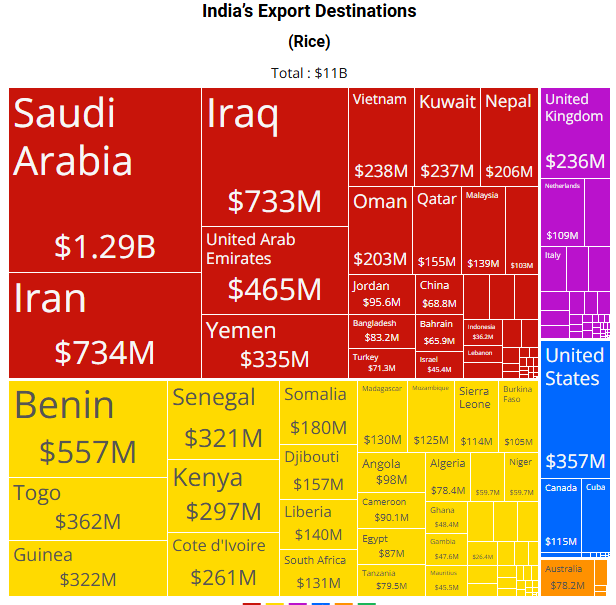
Benin and Togo buy more rice from India than the US.
Re: India-US relations: News and Discussions IV
Surely you remember the attempt to grab yhe Basmati trademark, which layer fizzled to Texmati.
-
putnanja
- BRF Oldie
- Posts: 4780
- Joined: 26 Mar 2002 12:31
- Location: searching for the next al-qaida #3
Re: India-US relations: News and Discussions IV
The Southern American food (Louisiana etc) which uses rice more in their dishes like gumbo etc use American rice. Many of the Thai and other SE Asian cusinies use Jasmine rice from Thailand. Japanese cuisine uses Japanese variety which are bit more starchy&sticky. Indian rice is mainly used by Indians and other south Asians. US isn't a bit rice market. Also Indian cooking uses slightly aged rice, like 8-18 months etc which gives it stiffer structure. New rice isn't typically preferred (at least in South India).
Had tried US rice long time back when in US when Indian rice wasn't available as Indian govt had stopped exports. It wasn't suited for Indian cooking, especially rice-sambar and curd rice . Jasmine rice has that smell which is acquired taste.
Had tried US rice long time back when in US when Indian rice wasn't available as Indian govt had stopped exports. It wasn't suited for Indian cooking, especially rice-sambar and curd rice
. Jasmine rice has that smell which is acquired taste.Re: India-US relations: News and Discussions IV
American rice is garbage. I wouldn't feed it to a dog.
Re: India-US relations: News and Discussions IV
American Indians are consuming too much chicken biryani. DJT wants to stop that. No basmati, no biryani.
Gautam
Gautam
Re: India-US relations: News and Discussions IV
Meanwhile: America approves a $686 million deal to upgrade Pakistan’s F16 fighter jets, reports Dawn (URL not given here)
Re: India-US relations: News and Discussions IV
Hmm
wonder if these are just to replace some of the jets knocked out in May

I am unsure as to what upgrades they will do, as probably next time around they may be targetted with Triumf as soon they get off the ground.
Question to Deansji and other if there are any news from Pukraine war about aircrafts deploying systems to counter S 400
Re: India-US relations: News and Discussions IV
Ambassador Sergio Gor tweets:
PM Modi:President Trump spoke with Prime Minister Modi this morning. A GREAT call between two friends. Prime Minister @narendramodi reiterated his support for the President’s efforts to bring peace to Ukraine.
11:31 AM · Dec 11, 2025
Had a very warm and engaging conversation with President Trump. We reviewed the progress in our bilateral relations and discussed regional and international developments. India and the U.S. will continue to work together for global peace, stability and prosperity.
Re: India-US relations: News and Discussions IV
https://www.rediff.com/news/report/modi ... 251211.htm
Modi dials Trump, discusses economic ties, trade deal
Senjo M R, December 11, 2025
Prime Minister Narendra Modi on Thursday held a phone conversation with US President Donald Trump that focused on enhancing economic ties at a time when the two countries are eyeing a trade deal.
The two leaders exchanged views on expanding cooperation in trade, critical technologies, energy, defence and security, officials said.
Both leaders also agreed to work closely to address shared challenges and advance common interests, they said.
Modi and Trump also reviewed progress in the India-US Comprehensive Global Strategic Partnership, they said.
The two leaders expressed satisfaction at the steady strengthening of bilateral cooperation across all domains.
Modi and Trump underlined the importance of sustaining momentum in shared efforts to enhance bilateral trade, the officials said.
......
Gautam
Who called who?
Modi dials Trump, discusses economic ties, trade deal
Senjo M R, December 11, 2025
Prime Minister Narendra Modi on Thursday held a phone conversation with US President Donald Trump that focused on enhancing economic ties at a time when the two countries are eyeing a trade deal.
The two leaders exchanged views on expanding cooperation in trade, critical technologies, energy, defence and security, officials said.
Both leaders also agreed to work closely to address shared challenges and advance common interests, they said.
Modi and Trump also reviewed progress in the India-US Comprehensive Global Strategic Partnership, they said.
The two leaders expressed satisfaction at the steady strengthening of bilateral cooperation across all domains.
Modi and Trump underlined the importance of sustaining momentum in shared efforts to enhance bilateral trade, the officials said.
......
Gautam
Who called who?
Re: India-US relations: News and Discussions IV
hope OM doesn't wake up tomorrow saying Modi said this and thatg.sarkar wrote: ↑12 Dec 2025 02:48 https://www.rediff.com/news/report/modi ... 251211.htm
Modi dials Trump, discusses economic ties, trade deal
Senjo M R, December 11, 2025
Prime Minister Narendra Modi on Thursday held a phone conversation with US President Donald Trump that focused on enhancing economic ties at a time when the two countries are eyeing a trade deal.
The two leaders exchanged views on expanding cooperation in trade, critical technologies, energy, defence and security, officials said.
Both leaders also agreed to work closely to address shared challenges and advance common interests, they said.
Modi and Trump also reviewed progress in the India-US Comprehensive Global Strategic Partnership, they said.
The two leaders expressed satisfaction at the steady strengthening of bilateral cooperation across all domains.
Modi and Trump underlined the importance of sustaining momentum in shared efforts to enhance bilateral trade, the officials said.
......
Gautam
Who called who?
Re: India-US relations: News and Discussions IV
https://www.indiatoday.in/world/us-news ... linewidget
How India's Basmati prevailed over Texmati, forced Trump to warn of tariffs again
Anand Singh, New Delhi, Dec 11, 2025
The US once tried to create its own version of the Basmati rice and gave it the funniest name one could imagine: Texmati — which sounds a lot like Bagwati from the 2011 movie Zindagi Na Milegi Dobara. But just as a first copy can't match the elegance of a Hermes or a Birkin, Texmati tried hard, but failed to replicate the aroma, the length, and the fluffy texture of the original grown in the Indian Himalayan foothills.
......
Gautam
How India's Basmati prevailed over Texmati, forced Trump to warn of tariffs again
Anand Singh, New Delhi, Dec 11, 2025
The US once tried to create its own version of the Basmati rice and gave it the funniest name one could imagine: Texmati — which sounds a lot like Bagwati from the 2011 movie Zindagi Na Milegi Dobara. But just as a first copy can't match the elegance of a Hermes or a Birkin, Texmati tried hard, but failed to replicate the aroma, the length, and the fluffy texture of the original grown in the Indian Himalayan foothills.
......
Gautam
Re: India-US relations: News and Discussions IV
Meanwhile - Despite Trump's threats, the Indiana State Senate has REJECTED the Trump-backed 9-0 gerrymandered map, leaving the existing 7-2 map in place.
Re: India-US relations: News and Discussions IV
Amrica porkistan defence deals are just ponzi schemes where murica pays pokis to spend them at their MIC. Monies just from change from left to right hand.