The Military Issues & History Forum is a venue to discuss issues relating to the military aspects of the Indian Armed Forces, whether the past, present or future. We request members to kindly stay within the mandate of this forum and keep their exchanges of views, on a civilised level, however vehemently any disagreement may be felt. All feedback regarding forum usage may be sent to the moderators using the Feedback Form or by clicking the Report Post Icon in any objectionable post for proper action. Please note that the views expressed by the Members and Moderators on these discussion boards are that of the individuals only and do not reflect the official policy or view of the Bharat-Rakshak.com Website. Copyright Violation is strictly prohibited and may result in revocation of your posting rights - please read the FAQ for full details. Users must also abide by the Forum Guidelines at all times.
Rakesh wrote: ↑11 Jan 2026 06:53
The irony of Atmanirbhar Bharat ---> components of the "zealously-over-trialed-and-sabotaged" Arjun MBT is making its way into Russian-origin T-90s. Only in India will such miraculous events occur
This is by design. Similar to the concept of *digestion* by Rajiv Malhotra. An influential section of our Armed Forces want our MIC to be, at-best, component manufacturers and not system-developers because the latter is more value-added (read baksheesh) and we trust only foreign maal
If we do induct systems (like Prachand, ATAGS etc), it will be in-spite-of the AF Leadership, not because of them. It is due to pressure from the top (Parikkar, Modi etc) or some handful of believers inside the system who push through projects like Pinaka.
Prem Kumar wrote: ↑14 Jan 2026 19:49
Similar to the concept of *digestion* by Rajiv Malhotra.
This 'digestion' has happened for a long time. The Britshits stole a bunch of stuff from India include hero Newton with Vaisesika sutra laws - all of them, and of course calculus too. Math and science was India's forte for a long time and the entire decimal system was taken in toto by the west.
The armed forces are a legacy of Britshits and many of the customs/practices/ranks are from their systems, practiced even today by Indian forces. Indians became slaves to the Britshits and the rich ones were the brokers/dalals who made money running britshit systems of loot worldwide. The current moneybags of India have a history dating back to the drug trade of the Britshits. Their outlook is entirely different than the new breed of enterpreuners of India.
Indian army is probably the most behind amongst the rest (IAF, IN) in adopting desi maal. Though IAF for a long time was fond of videshi maal. Only the IN charted a course of desi maal since their budgets were lower than the others. Look at how IA gate crashed into the helo space by adopting desi maal from HAL and thumbing their nose at IAF. Maybe IAF can run armoured vehicles, they will adopt the Arjun.
India requires a Manohar parrikar type mantriji to set the culture of armed forces to true Atmanirbhar.
Admins please pin this video to the Armoured Vehicles thread, everyone who visits the page must go through this story and understand the ground reality. Finally the inside stories from the DRDO side is coming out exposing the issues within our forces and MOD. This is a must watch for every well wisher of indigenous weapons.
Why DRDO Took Decades to Build India's Arjun Tank: Ravi Gupta, Former DRDO Scientist
The Arjun Main Battle Tank is an indigenous weapon platform designed by the DRDO to provide India with self-reliant armored capabilities. Sanctioned in 1974, it was engineered to balance firepower, protection, and mobility specifically for Indian terrain. The tank features a 120mm main gun capable of firing diverse ammunition such as thermobaric rounds and anti-tank guided missiles. It utilizes indigenously developed Kanchan composite armor reinforced with Explosive Reactive Armor to withstand modern warheads. Its hydro-pneumatic suspension offers superior stabilization and allows for a pivot turn capability, earning it the nickname "Desert Ferrari" for its agility.
Former DRDO scientist Ravi Gupta attributes the project's extended timeline to complex, evolving technical requirements. He notes that frequent revisions to the General Staff Qualitative Requirements (GSQR), such as the significant transition from a 105mm to a 120mm gun, necessitated major redesigns. Gupta indicates that rigid bureaucratic structures and the parallel import of T-90 tanks influenced indigenous production scales. Consequently, the Arjun underwent exhaustive validation, covering 70,000 kilometers in trials to prove its reliability within the procurement framework.
Kalyani Strategic Systems Ltd. (KSSL), the defence arm of the Kalyani Group, marks the first time an Indian private company has independently designed and developed a complete tank platform. According to company officials, the vehicle is scheduled for formal rollout in March 2026, with Indian Army user trials planned for September 2026.
The compressed development timeline under twelve months from concept to prototype
25 tons puts it in the same weight class as the Zorawar
So 5 tons more than the 2S25 Sprut-SD
Better built in protection (ERA, APS?) but lighter firepower (105 mm vs 125 mm)
Good luck to them. May they develop it to it's potential and see lots of exports. Orders from countries whose geography is not as challenging as ours, whose economy is not as big as ours and whose procurement system is not as 'complex' as ours
BTW, and I know it is just a rendering and also the angle, but the gun looks huge.. more like a 125 mm or even a 140 mm. Some general will probably ask for upgunning it by pointing at its weight compared to the Sprut
Will be competing in the Light Tank contest for IA. Also will look at exports since there is a huge market out there and the pvt companies are successful in exporting weaponry.
Interesting concept of the Turret!
Is that keeping in mind tbe recent incidents of Drone-delivered cheaper explosives taking out the Tank rather than a ATGM
Looks better as a modular concept rather than as a after thought 'Chatri' on the top
I feel they will still put a anti drone mesh on top (as an addon) even with the unmanned turret. It is cheap. Can be done in the field. Will complement the APS.
Vehicle Factory Jabalpur Comes Online To Overhaul T-72s
India is overhauling its ageing T-72 fleet as an interim measure before introducing indigenous Future Ready Combat Vehicles (FRCV) by 2030. Vehicle Factory Jabalpur (VFJ) completed a 2025 pilot, flagging off two overhauled T-72s meeting Army standards. The upgrades to the T‑72 Ajeya—improved armour, mobility, fire‑control, communications and electronics—extend service life and buy time for the FRCV programme. Overhaul work also creates export opportunities for nations operating legacy T‑72s. This dual-track approach balances immediate readiness with long-term modernisation.
Prem Kumar wrote: ↑14 Jan 2026 19:49
Similar to the concept of *digestion* by Rajiv Malhotra.
This 'digestion' has happened for a long time. The Britshits stole a bunch of stuff from India include hero Newton with Vaisesika sutra laws - all of them, and of course calculus too. Math and science was India's forte for a long time and the entire decimal system was taken in toto by the west.
Dont forget the Germans !! .. and the Americans even in the 20th century !.. loot and plunder of indian intellectual resources are wholesale
The new qualitative requirements (QRs) drafted by the army for the FRCV are unreasonable and follow its penchent of setting marvel-comics-like QRs.
..
An example of the unreasonable QRs is that the new tank should weigh 55 tonnes +/- 5 percent, with a crew of four, while simultaneously having frontal armor of 800mm RHA and a minimum of 600 mm RHA on all sides with blow-off panels.
No current tanks in the world with four crew members, whether American Abrams, German Leopard 2, or British Challenger, meet this requirement.
All of these tanks, which have undergone multiple iterations of improvements over the last decade, weigh nearly 60 tonnes or more.
Moreover, the army wants the tank to have provisions for all three — an autoloader, semi-automatic, and even manual loading for shells and missiles. Typically, the fourth crew member does the loading of shells and missiles if the tank does not have an autoloader.
Requirement of fourth crew member and all three ways of loading suggest that the army is unable to make up its mind, about what it wants.
Additionally, the army desires all the bells and whistles, including an active-protection system (APS) with 360° and top-attack protection against missiles, drones, and loitering munitions, jamming and electronic warfare solutions for soft-killing suicide drones, new-generation computers and electronics, the ability to control unmanned ground vehicles (UGV), and conduct manned-unmanned teaming (MUM-T) operations, all while having sufficient growth potential so that new technologies can be incorporated onto the tank as they emerge.
And all this for a modest price tag of $4 million apiece, amounting close to Rs 57,000 crores ($7.1 billion) for 1,770 tanks. Only one tank — the Korean K-2 Black Panther — comes close to this, but it costs a neat $8.5 million each and is operated by three crew members.
Here’s what the desert trials and comparative evaluations revealed when Arjun Mk‑1 was tested against the T‑90S Bhishma:
Desert Trial Results (2009–2010)
Accuracy & Firepower
Arjun consistently achieved higher hit probability at long ranges.
Its 120 mm rifled gun with advanced fire control outperformed the T‑90’s 125 mm smoothbore in precision.
Mobility in Desert Conditions
Despite being heavier, Arjun showed better stability and cross‑country performance in sandy terrain.
Its wider tracks distributed weight more effectively, reducing sinkage compared to the lighter T‑90.
Crew Comfort & Endurance
Arjun’s air‑conditioning and ergonomic design gave crews better endurance in desert heat.
T‑90 crews struggled with heat stress until retrofits were added later.
Survivability & Protection
Arjun’s Kanchan composite armor provided superior protection against APFSDS rounds in trials.
T‑90 required additional ERA (Explosive Reactive Armor) upgrades to match survivability.
Operational Readiness
In comparative trials, Arjun maintained higher availability rates, with fewer breakdowns reported.
T‑90s suffered from overheating and dust‑related issues in Rajasthan’s desert environment.
Outcome
Despite Arjun outperforming T‑90 in accuracy, survivability, and crew comfort, the Army still favored the T‑90. The official reasoning was:
Arjun’s weight and logistics burden (rail transport, bridges, recovery vehicles).
The Army’s existing infrastructure and training tailored to Soviet‑origin tanks.
Concerns about long‑term indigenous production capacity and spare parts availability.
The Irony
The Army acknowledged Arjun’s superior performance but ordered only limited numbers. Meanwhile, many of Arjun’s technologies—thermal sights, fire control systems, and desert‑specific modifications—were later adapted to upgrade the T‑90 fleet.
The Army acknowledged Arjun’s superior performance but ordered only limited numbers. Meanwhile, many of Arjun’s technologies—thermal sights, fire control systems, and desert‑specific modifications—were later adapted to upgrade the T‑90 fleet.
I get the irony of desi development helping to improve the videsi platform but it is not that uncommon globally for systems developed for newer products to find their way back into older products
For eg - The case of the Apache attack helicopters (again from AI)
The RAH-66 Comanche program, despite its cancellation in 2004, acted as a crucial technology demonstrator that directly enabled the transition of the AH-64 Apache from a 1980s-era platform to the advanced, networked AH-64D/E Apache Longbow. The technologies developed for the Comanche—designed for low-visibility, high-speed, and intense situational awareness—were transferred to the Apache to enhance its lethality, sensor capabilities, and digital connectivity.
Here is how the RAH-66 Comanche helped improve the AH-64 Apache:
Digital Connectivity and Networked Warfare: The Comanche was designed as a "digital" scout, meant to find targets and transmit that data to Apaches. The software, sensors, and data-link architecture (like Link 16) developed for this, which allows real-time sharing of battlefield information between aircraft and ground forces, were integrated directly into the AH-64E, significantly improving its "Manned-Unmanned Teaming" (MUM-T) capability.
Target Acquisition and Sensors: The advanced Target Acquisition and Designation System (TADS) on the Apache was upgraded using technology from the Comanche program, offering better second-generation FLIR (Forward-Looking Infrared) for improved detection range and situational awareness.
Helmet-Integrated Display and Sight System (HIDSS): Comanche pilots were to use advanced helmet systems for "eyes-out" fighting. This technology led to improved helmet-mounted displays for Apache pilots, reducing workload and allowing them to operate more effectively at night or in complex environments.
Software and Mission Systems: Boeing developed unique simulation software to test the Comanche's stealth and target capabilities. They adapted this software for the Apache to simulate advanced capabilities, resulting in improved avionics and weapon control systems for the AH-64D.
Modular Open System Architecture (MOSA): The move toward a "Modular Open System Architecture" in the AH-64E was influenced by the Comanche’s modern, software-driven, and adaptable design philosophy, allowing for easier, faster software updates and new technology integration.
Reduced Maintenance and Operational Costs: The Comanche’s design aimed for a 40% reduction in maintenance compared to existing fleets. Lessons learned from the RAH-66's design—such as ease of access to maintenance areas and advanced diagnostics—were applied to the Apache, helping to lower its overall support costs.
Ideally we would have had 2 designs and competed . a desi T-72++ and Arjun. Of course Natasha would have ensured 90s got imported. IAF got tested a couple of times recently , when will IA tanks ever get tested ? Probably never so tamasha will carry on till a new generation takes over
VIDEO:https://x.com/chakranewz/status/2033881 ... 85988?s=20 ---> The T-72 is not for fighting at night. But it is now. The new Thermal Imaging Fire Control System (TIFCS) made by an Indo-Israeli joint venture has now made this legacy platform an all-round-the-clock machine.
Army’s New War Playbook: Tanks Get Their Own Drone Squadrons
In a major doctrinal shift, the Indian Army is embedding dedicated drone units -Shaurya Squadrons, within its tank regiments, bringing surveillance and strike capabilities directly to the frontlines.
Structured as company-level elements, these units will operate alongside armoured columns, deploying a mix of reconnaissance drones, attack UAVs, and loitering munitions to provide commanders with real-time battlefield awareness and precision strike options.
Driven by lessons from recent conflicts like Ukraine and Gaza, the move aims to enhance survivability, reduce ambush risks and transform how armour fights in high-intensity warfare, signalling a decisive shift toward integrated, drone-led combat operations.
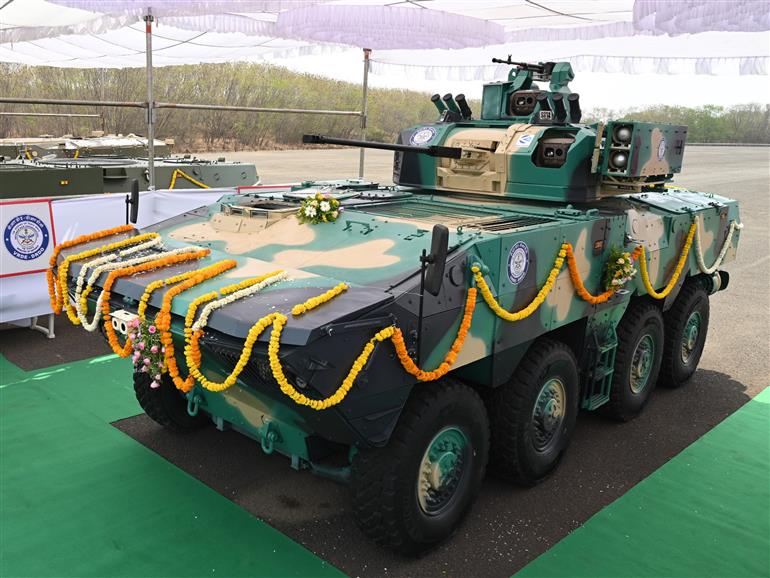
Not only Nag MK2. Even MPATGM can be fitted on the WhAP. There are many options. A big No for American Stryker | Indian Army will stay away | हिंदी में This is a video on A big No for American Stryker | Indian Army will stay away
https://static.pib.gov.in/WriteReadData ... 207827.JPG
This can be turned into an Autonomous vehicle as well. Slice the top armour and save around 5 to 7 ton weight and put back the turret and we have a formidable Autonmous vehicle capable of Anti-Tank Anti Armour Anti-personal capability that can be air lifted to any location.
lesser weight will give more range as well. If needed, the remaining space could be filled with fuel tanks and Long Range Autonomous Armoured Vehicle(LRAAV) is ready
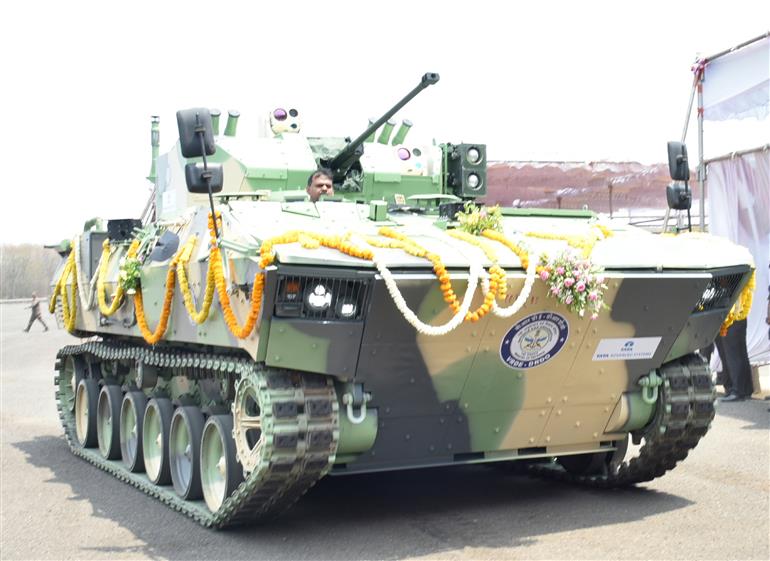
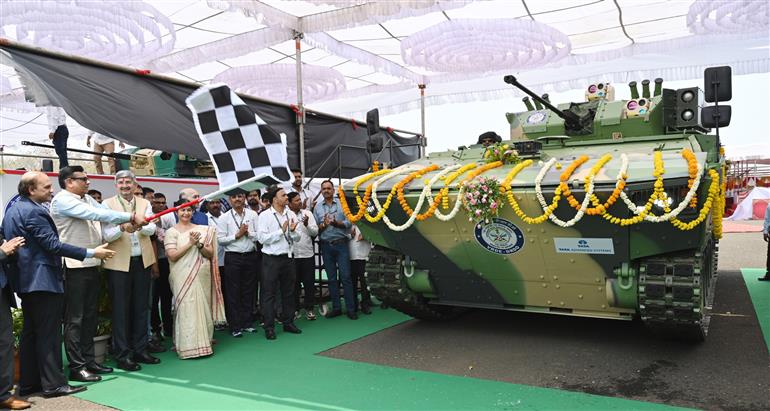
How DRDO Built India’s Deadliest Infantry Combat Vehicle
Republic World, Apr 26, 2026
DRDO has developed the Vikram VT-21 Advanced Armoured Platform as a next-generation solution for the Indian Army. This versatile armoured vehicle is available in both tracked and wheeled variants, offering superior mobility across diverse terrains including riverine and marshy areas. The Vikram VT-21 features a 30mm crewless turret with integrated Nag Mk-2 anti-tank guided missile capability, providing enhanced firepower and crew protection. Its amphibious hydro-jet propulsion allows seamless water crossing without external support, solving a long-standing operational challenge for mechanised infantry. With approximately 65 percent indigenous content developed in collaboration with Tata Advanced Systems and Bharat Forge, the Vikram VT-21 strengthens India’s self-reliance in defence manufacturing. Designed primarily as an Infantry Combat Vehicle and Armoured Personnel Carrier, this advanced armoured vehicle delivers high survivability through STANAG Level 4 and 5 protection. The Vikram VT-21 represents a major boost to Indian Army capabilities in modern battlefield scenarios.
neeraj wrote: ↑02 May 2026 05:42
No info on propulsion and if imported who is providing it.
Major Boost for ‘Make in India’: DRDO’s CVRDE 600 HP Engine Promises Superior Mobility for Indian Army https://indianmasterminds.com/news/cvrd ... ss-162179/
In a major milestone for Atmanirbhar Bharat, the CVRDE’s indigenous 600HP engine has outperformed its design specs, delivering a stunning 675HP in recent trials.
November 21, 2025
This will be engine that will be going into it. Until then for the initial tests and such the current one on WhAP will be used is my assumption. Hope they start putting the desi version onto one of the prototype platform and test it in parallel and cut short the induction time.
No info on propulsion and if imported who is providing it.
Why would they be imported when Caterpillar and Cummins both produce diesel engines in that class within India itself. Caterpillar's engine will power the Bharat Forge KSSL light tank. And Zorawar is powered by a Cummins VTA903E engine built in India itself.
India is replacing 2,400 Soviet tanks with one built entirely at home
Project Ranjeet (FRCV) has been cleared by India's Defence Acquisition Council with a budget of ₹57,000 crore for 1,770 tanks.
Here is what it carries
• 55–60 tonne frame built to move across every Indian terrain
• AI targeting that picks threats faster than any human crew
• Drones launched directly from the tank
• Missile and FPV drone interception built in
• Government paying 70% of all development costs
The T-72 entered Indian service over 40 years ago.
Modern battlefields now have precision guided missiles, loitering munitions and drone swarms that older tanks were never built to survive.
Project Ranjeet is India's answer.
Prototypes by 2028–29. Induction targeted from 2030.
The Heavy Hitter (Ranjeet): Project Ranjeet will complete the triad as the principal Main Battle Tank. Prototype development is expected to mature by 2028–2029, with serial production targeted for the early 2030s.
Combat weight strictly between 55 and 60 tonnes. Transporatable by C-17.
uddu wrote: ↑13 May 2026 09:59
...
The Heavy Hitter (Ranjeet): Project Ranjeet will complete the triad as the principal Main Battle Tank. Prototype development is expected to mature by 2028–2029, with serial production targeted for the early 2030s.
...
At this point in time i am happy they didn't name it Abhimanyu
ashthor wrote: ↑14 May 2026 13:43
Hope the army doesn't do a Arjun with it with a tincan.
It will have to compete with the T-14 Armata
But with the current state of Russia and the probability of the Ukraine war going on for another few years it might just be the desi breakthrough jingos want... a few hundred orders for sure, if it is developed within the next 5 odd years.
It is the 'Transportable by C-17' that makes me ponder. I wonder what our next heavy lifter will be. This 'heavy hitter' should be portable with that 'heavy lifter'...
Manish_P wrote: ↑14 May 2026 16:19
It is the 'Transportable by C-17' that makes me ponder. I wonder what our next heavy lifter will be. This 'heavy hitter' should be portable with that 'heavy lifter'...
For Indian context, this is a very superfluous requirement. It is highly unlikely we will fight a war outside of the sub continent. Yes, there will a rare occurrence, may be, but we should not handicap ourselves making it suitable for air-transportability. Just make it as heavy as possible to take punishment when it will face pakis in the desert, cheen in the plains, and urban combat. If that means it is too heavy for a C-17, so be it.
Jay wrote: ↑14 May 2026 21:04
Just make it as heavy as possible to take punishment when it will face pakis in the desert, cheen in the plains, and urban combat. If that means it is too heavy for a C-17, so be it.
Is Arjun even in the battle plans? I though it was a boutique project with less than 150 units built and done with. If this Ranjeet is not a MBT and Arjun and T90 still fills that role, we have T90/Arjun for MBT, T72/Ranjeet for middle weight tank? and Zorawar as a light tank? It just seems too many variants diluting the effectiveness.
Last edited by Jay on 15 May 2026 20:08, edited 1 time in total.
Jay wrote: ↑14 May 2026 21:04
...
For Indian context, this is a very superfluous requirement. It is highly unlikely we will fight a war outside of the sub continent.
...
I don't think they mean air transportable means to transport it out of the sub-continent..
I don't know what is the fascination by the armed forces in Videshi maal any more. There is nothing that India cannot achieve, it requires a proper Program manager and a will to make things within the nation, that is all. All the tech, know how, know why exists and there are many smart people within the nation (they man > 50 % GCC in the world). In the missile area India is doing great.
We have incompetent mantriji in defence and we have leadership at the top which is even more stuck in their stubborness to import videshi systems. How long does it take to get a MBT for the Indian army, the same with small arms, the same with APC vehicles and so on. This list is endless. Maybe the Indian army artillery is doing fine with Atmarnirbhata. Similar things can be said of the airforce wing. Only the Indian Navy is ploughing a solitary field of truly Atmarnirbhata products at least on the Naval ship side, but still imports P8 aircrafts, etc.
Jay wrote: ↑14 May 2026 21:04
...
For Indian context, this is a very superfluous requirement. It is highly unlikely we will fight a war outside of the sub continent.
...
I don't think they mean air transportable means to transport it out of the sub-continent..
Then it's even more impractical if we have to airlift this to locations within India during conflict.