Indian ocean being our backyard never meant that we will not let anyone pass through without taking a ticket or paying hafta. It meant that no one will be allowed to do anything that's detrimental to Indian interest. If our interest are challenged, surely there will be repercussions. Today this influence also also extends to the Mediterranean.
We are not party to Iran U.S fight. That is not threatening our security or our interest so we don't' get involved. When the Iranian ship send out SOS message our Navy did respond proving it indeed being India's ocean, even though that was in SL EEZ.
Indian Navy News & Discussion - 12 April 2021
-
S_Madhukar
- BRFite
- Posts: 1123
- Joined: 27 Mar 2019 18:15
Re: Indian Navy News & Discussion - 12 April 2021
True but I want to take the opportunity to beat MoD and RM for neglecting subs and other recon assets. The extra P-8s will help but I want our media to focus on developing IN and being cognizant that very well a Han sub might also be prowling freely
Re: Indian Navy News & Discussion - 12 April 2021
https://x.com/InsightGL/status/2029474022996705506?s=20 ---> Captain Ajayendra Kant Singh, ex-Commanding Officer, INS 312 (P-8I Sqn) had once said: "There is no possibility that any ship or a submarine would pass through the Indian Ocean region without 312 squadrons not knowing about it."

Re: Indian Navy News & Discussion - 12 April 2021
You can do that directly without causing damage to the nation's prestige or standing.S_Madhukar wrote: ↑05 Mar 2026 23:24 True but I want to take the opportunity to beat MoD and RM for neglecting subs and other recon assets. The extra P-8s will help but I want our media to focus on developing IN and being cognizant that very well a Han sub might also be prowling freely
If an event is needed, This month or next the Nilgiri frigate will be commissioned, They can be questioned for a lot of things
1) Lack on Follow on order for Vikrant class.
Vikrant construction timeline:
Laid down 28 February 2009
Launched 12 August 2013
Acquired 28 July 2022[3]
Commissioned 2 September 2022
It took 4 years for the INS Vikrant to be launched. So these 4 years from INS Vikrant commissioning from 2022 to 2026 (even if we ignore it's launch to commissioning timeframe) another ship must have been launched. Now even if the upcoming IAC is to be of 65000 tons, the delay in the process must have been utilized to have another Vikrant that could even be used as a helicopter carrier or a ship without the short take off feature.
For the delay he has caused, the follow on ships should be at least 2 in number to cover for the decommissioning of INS Vikramaditya and one more that makes the total AC being 3. 2 Decent sized and 1 small one which could even be turned into a helicopter carrier if anyone has objection to have 3 Aircraft carriers.
2) The lack of orders for Destroyers, frigates and corvettes resulting in none of them gettig inducted in the next 6 years. The follow on order for P15B, P17A, the construction of Corvettes etc has not yet started. Modi govt is literally ignoring the most vital and important aspect which is the the need to have a formidable navy that can face the challenges of modern times. Without placing orders for larger vessels in good number, our Navy will struggle in the years to come with lack of good number of large surface ships affecting national security.
We can't even ask Shri Rajnath SIngh to be sacked. Shriman Modi will replace him with Prakash Javadekar.
 or even if he finds someone capable enough, RSS Chief will jump in and say, no more unelected people.
Re: Indian Navy News & Discussion - 12 April 2021
Navy's INS Khanderi Set For DRDO's Indigenous AIP Upgrade By Late 2026, Trials In 2027
https://www.indiandefensenews.in/2026/0 ... drdos.html
07 March 2026
https://www.indiandefensenews.in/2026/0 ... drdos.html
07 March 2026
Re: Indian Navy News & Discussion - 12 April 2021
Forces First Special: Power Project At Sea | International Fleet Review 2026
Operations of INS Nilgiri. Joint operations with Seychelles by sharing information on hijacked vessel so they can act being shared
Operations of INS Nilgiri. Joint operations with Seychelles by sharing information on hijacked vessel so they can act being shared
Re: Indian Navy News & Discussion - 12 April 2021
Once again the Indian Navy shows the way forward in Atmanirbhata, working with DRDO and producing something tangible. Can't say the same for Indian Airforce or Army, though they have worked somewhat with DRDO on some projects but not wholeheartedly like the Navy. The Navy is blazing ahead taking on tough projects with a can do attitude.
Re: Indian Navy News & Discussion - 12 April 2021
Yup. And the good thing is that they have moved away from the are now making their efforts in getting the engine issue resolved as well. Probably soon, Hopefully the Missiles also will see changes with induction of VLSRSAM, Project Kusha based missiles on ships. LRLACM launched from Brahmos launchers, Hypersonic missiles. They started with the induction of Autonomous Vessels. We could see much more larger ones in the near future after each induction and Navy sailing ahead.bala wrote: ↑10 Mar 2026 09:17Once again the Indian Navy shows the way forward in Atmanirbhata, working with DRDO and producing something tangible. Can't say the same for Indian Airforce or Army, though they have worked somewhat with DRDO on some projects but not wholeheartedly like the Navy. The Navy is blazing ahead taking on tough projects with a can do attitude.
VLSRSAM, QRSAM are good choices for the IA, IAF in defending their bases as well. Add to that VSHORADS and Bhagavatastra rather than rely only on L70 as the last line of defence.
The Navy must priorities on larger ships that can carry more missiles for defensive and offensive roles and also good number of such ships.
Re: Indian Navy News & Discussion - 12 April 2021
India's submarines never fail. Here's what it takes to survive inside one
https://www.indiatoday.in/science/story ... 2026-03-10
11 March 2026
excerpts from an informative article, do read in full
selection of submariners
pressure hulls
https://www.indiatoday.in/science/story ... 2026-03-10
11 March 2026
excerpts from an informative article, do read in full
selection of submariners
atmosphere inside a submarineAt the submarine training base in Visakhapatnam, every candidate, regardless of rank or professional qualification, must complete the escape training tower drill.
They are sealed into a water suit and asked to crawl through a torpedo tube roughly 30 to 40 feet long. The tube is filled with water. At the other end, they are released into a pool and must free-ascend 20 to 30 feet to the surface, manage the pressure change in their lungs, and control their breathing, all without panicking.
“If you do not qualify the escape training tower drill, you are disqualified from the course, and you are asked to leave,” Commander Sahni tells indiatoday.in. “This is irrespective of rank and qualification. You could be a navigator, you could be a doctor, you could be a paramedic. But if you do not qualify the psychological screening of the escape training tower drill, you can never become a submariner.”
A young Dr Tarun Sahni (left, in army uniform) pictured alongside a fellow officer aboard INS Vaghsheer (S43), shortly before he transferred to the Navy and joined the submarine service (left); Dr Sahni in a full escape suit during a crew escape drill (right). (Photo: Special arrangement/Surgeon Commander Dr Tarun Sahni (Retd))
This is the first and most important act of submarine medicine. Not treatment, not monitoring. Elimination. The environment does not accommodate the full range of human physiological and psychological responses to confined, high-pressure spaces.
The escape tower removes anyone who cannot suppress the instinct to panic before they have spent a single day at sea. What remains is a population filtered to the extreme end of the psychological distribution.
When Commander Sahni later dismisses the most alarming hypotheses about submarine health, his foundational argument is always the same: "These are not ordinary people. They were made extraordinary before they ever dived."
Commodore Anil Jai Singh would agree. “The moment a person realises that they are in a sealed container several metres below the surface of the sea where there is no escape, a space which is very confined, and where there are pipes all around and machinery all around, claustrophobia can become a real, real threat and a danger to the crew.”
The few Commodore Anil Jai Singh has seen leave the Submarine Arm over the years, he notes, went on to have successful careers on surface ships. It was not a professional failure. The submarine simply does not negotiate with the bodies it cannot remake.
In conventional diesel-electric submarines, which form the backbone of India's submarine fleet, none of this happens passively. Each element is actively managed by a combination of chemical systems, medical protocols, and the trained instincts of the crew.
The air inside a conventional submarine is not air in any natural sense. Oxygen is held between 19 and 21 per cent. Carbon dioxide is kept below 0.8 per cent through continuous chemical scrubbing using sodium hydroxide, lithium hydroxide, or other compounds depending on the class of boat.
The atmosphere is monitored for 12 gases, including mercury vapour from onboard thermometers. Even within technically safe limits, CO2 sits slightly above outdoor air levels throughout a submerged patrol, and that marginal elevation has measurable effects on everyone inside.
“Sometimes you feel sleepy, and you wonder why you are feeling so tired and sleepy without letting it affect your efficiency, but you do feel a little lethargic,” Commodore Anil Jai Singh says.
He noticed this pattern during his tenure in the Navy without ever having a name for the condition.
Elevated but technically safe CO2 can result in mild headaches, reduced concentration, and low-grade sleepiness.
pressure hulls
reversing the body clockThe pressure hull, fabricated from HY-80 and HY-100 high-yield steel alloys, compresses under the weight of water as the submarine descends.
A bar is a unit of pressure, and at sea level it measures exactly 1 bar, equivalent to atmospheric pressure, something we do not notice because our bodies are built for it.
Underwater, that pressure increases by 1 bar for every 10 metres of depth. At 100 metres, the submarine's hull bears 10 bar of external pressure.
At 200 metres, it is 20 bar. To put that in perspective, 10 bar is the equivalent of having 10 car engines stacked on top of every square centimetre of the hull.
As the boat goes deeper, the steel adjusts microscopically but audibly. Metallic pings. Creaks. Occasional sharp pops.
medical proceduresInside a submarine on a long patrol, the circadian rhythm is not merely disrupted. It is deliberately inverted. A retired Navy officer with more than 25 years of submarine service, who spoke to indiatoday.in on condition of anonymity, explains the logic precisely.
“Life inside a submarine is turned around by 180 degrees,” he says. “So in the morning you have dinner, at night you have breakfast. You remain awake throughout the night assuming that it is day outside. And you change your routine during the day assuming that it is night outside.”
The most critical operational activities happen at night, when a submarine is hardest to detect. The crew’s schedule is inverted to match. The human circadian rhythm is governed principally by light, specifically by the suppression of melatonin in the presence of daylight.
health issuesThere is no dedicated surgical facility on a submarine. When a crew member requires an operation, the dining table is cleared. It becomes the operating surface. The same table where the crew ate breakfast, rationed fresh food for the first 7 to 12 days of a patrol and tinned provisions for the remaining weeks, is where a surgeon works when surgery cannot wait for them to return to shore.
The retired Navy officer explains what this means in practice.
He recalls instances wherein a crew member has lost a toe during a patrol. Appendicitis has been managed on board. Conjunctivitis has spread through a sealed vessel where the weapon compartment doubles as the quarantine space. Pox outbreaks have occurred.
Fresh water is rationed so strictly that crew members stop bathing and shaving to conserve it. The passageways are barely 55 to 60 centimetres wide. Two sailors cannot pass each other without turning edgeways.
Low-frequency noise between 20 and 200 Hz is the largest sleep disruptor inside a submarine, passing through bulkheads and bunks via the metal structure itself rather than through the air.
Bunks are placed near hydraulic pumps and air compressors because the quietest spaces are reserved for the equipment that maintains the submarine’s invisibility.
This acoustic trade-off has been formally studied by designers. But its long-term neurological and auditory consequences for the crew have not been widely studied.
Commodore Anil Jai Singh notices the auditory result in his own body. “I know my hearing in one ear is not as good as the hearing of the other ear,” he says. “It has deteriorated over the years, but that could be purely age-related. However, I would not be surprised if constant exposure to the kinds of sounds heard inside a submarine would have had some sort of effect.”
Commander Sahni says that hearing deterioration in sonar operators might have been documented. But that documentation is classified. It is not available in the public domain.
THE DATA EXISTS. THE MEN CANNOT READ IT
Studies measuring cortisol and stress hormone levels in submariners exist. Commander Sahni confirms this on record.
“There is absolutely no doubt that the stress hormones in these individuals are extremely high, and they keep continuing to even greater heights based on the duration of the voyage and the duration for which they remain underwater,” he says.
Whether these studies are accessible to the submariners themselves, or to the civilian doctors now treating them in retirement, is a separate question.
Commander Sahni says they may not be in the public domain. “Hearing deterioration data for sonar operators has probably been documented but is classified. Cortisol research is published but may not be publicly accessible.”
The consequence is specific and traceable.
Re: Indian Navy News & Discussion - 12 April 2021
Excerpts from Republic Forces First Conclave - The Navy Edition conducted by Republic TV will be Telecast tomorrow morning 0700 hrs onwards.
Please share for maximum reach.

Please share for maximum reach.
Re: Indian Navy News & Discussion - 12 April 2021
https://x.com/i/status/2032844232952819792
@MeghUpdates
HUGE! Indian Navy warships are escorting Indian vessels Shivalik and Nanda Devi through the Arabian Sea towards Indian ports.
Both ships had crossed the Strait of Hormuz earlier this morning.

@MeghUpdates
HUGE! Indian Navy warships are escorting Indian vessels Shivalik and Nanda Devi through the Arabian Sea towards Indian ports.
Both ships had crossed the Strait of Hormuz earlier this morning.
Re: Indian Navy News & Discussion - 12 April 2021
Excerpts from Republic Forces First Conclave - The Navy Edition conducted by Republic TV will be Telecast tomorrow morning 0700 hrs onwards.
Please share for maximum reach.
Please share for maximum reach.
- In this insightful session, Baba Kalyani, Chairman & Managing Director of Bharat Forge Ltd,
discusses the critical role of strengthening India's maritime sovereignty through robust indigenous capabilities and strong industry-navy partnerships.
- This discussion explores the strategic importance of public-private synergy in enhancing India's maritime defence, reducing import dependence, and ensuring technological edge in a dynamic geopolitical landscape.
- A valuable perspective for defence enthusiasts, industry professionals, and strategic thinkers interested in India's journey toward maritime self-sufficiency and national security.
Re: Indian Navy News & Discussion - 12 April 2021
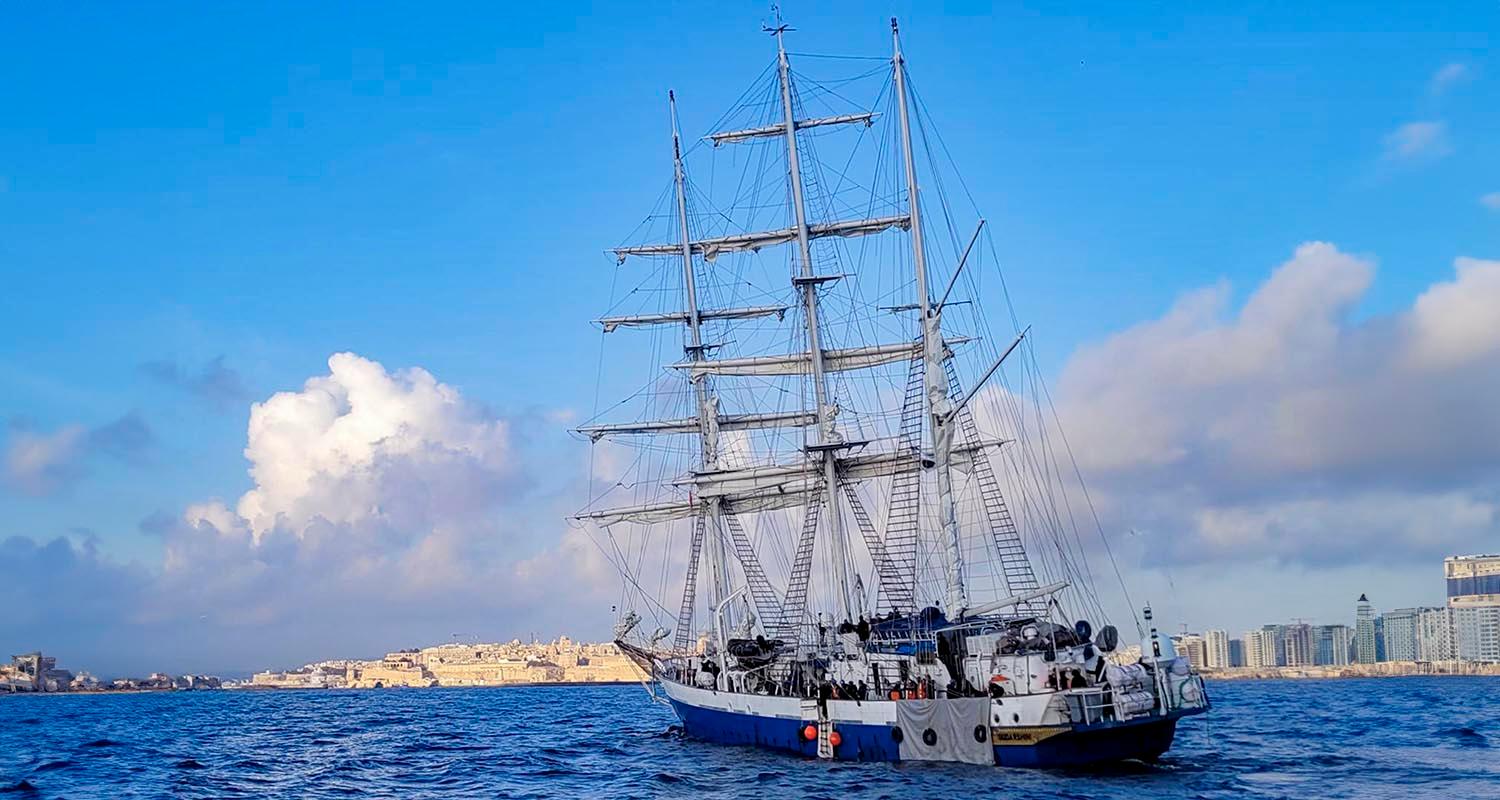
Indian Naval Sail Training Ship INS Sudarshini during its transoceanic expedition Lokayan-26, arrives at the port of Valletta, Malta.
Re: Indian Navy News & Discussion - 12 April 2021
vi@WA
The most powerful navy in history has just confessed defeat in the 33-kilometre-wide Strait of Hormuz. In March 2026, as the US-Iran war entered its third week, reports revealed that the US Navy has rejected near-daily requests from the global oil industry for escorts through the Strait of Hormuz. Three American supercarriers — Abraham Lincoln, Gerald R. Ford and George H.W. Bush — plus French and British warships sit idle in the Arabian Sea, Red Sea and Mediterranean. Though their collective military might outguns most nations, none of it can safely escort even a single oil tanker through the narrow corridor. Iranian kamikaze drones, swarms of fast-attack boats, naval mines and coastal anti-ship missiles have turned the tight waterway into a lethal gauntlet. A mere $500 contact mine can cripple a $4-billion destroyer. The best surface radars cannot detect submerged threats, and air power has proven equally ineffective at sweeping shipping lanes. The world’s most expensive hammer has been asked to thread a needle — and failed.
This is not merely an American failure. It is a warning written in fire for every navy that still dreams of blue-water dominance in the age of aerospace power. For India, staring at a peer competitor across the Indian Ocean, the message is brutally clear: surface ships and aircraft carriers are not assets; they can rapidly become liabilities. In any conflict with China — or hypothetical with a superpower like the United States — our carriers and destroyers will become expensive coffins the moment hostilities begin. The Indian Ocean is no longer a safe playground for carrier strike groups. It is a contested littoral where geography, not tonnage, decides victory.
India’s naval planners have long chased the Mahanian dream: three carriers, a 175-ship fleet, blue-water power projection from the Gulf of Aden to the South China Sea. INS Vikrant is commissioned; INS Vikramaditya soldiers on; a third carrier is on the drawing board. Billions have been poured into surface combatants that look magnificent during naval reviews but will be dead meat in real war. Chinese anti-ship ballistic missiles (DF-21D, DF-26), hypersonic glide vehicles, satellite-linked drone swarms and quiet diesel-electric submarines have turned the Indian Ocean into an anti-access/area-denial (A2/AD) killing zone. Even the Americans, with three carrier strike groups, cannot protect a tanker in Hormuz. What chance do our smaller, less-protected surface ships have when the People’s Liberation Army Navy brings the same arsenal into waters closer to its bases?
The recent US-Iran war has laid bare the arithmetic. Surface ships are sitting ducks for air-power assets — land-based missiles, aircraft, drones and mines. A carrier’s air wing is powerful only if it survives the first salvo. In narrow seas or choke points, it becomes a floating bullseye. Mines laid by fast boats or submarines cannot be cleared by Aegis destroyers. Kamikaze UAVs overwhelm point-defence systems. One lucky hit on an Indian carrier group would produce exactly the strategic humiliation Washington is now desperately avoiding. India cannot afford that humiliation; our economy depends on energy flows through the very same ocean.
Fortunately, geography has gifted India a far cheaper and more lethal alternative. Instead of scattering scarce rupees across vulnerable surface fleets, we must concentrate every paise on the natural choke points our island territories already dominate. Four corridors matter above all:
1. The Malacca Strait approaches, controlled from the Andaman and Nicobar chain.
2. The Six Degree Channel near Great Nicobar, the southern gateway between the Bay of Bengal and the Andaman Sea.
3. The Eight Degree Channel between Minicoy (Lakshadweep) and the Maldives.
4. The Nine Degree Channel within the Lakshadweep archipelago itself.
These are not open oceans.
[19:23, 15/03/2026] +91 79 7796 9266: They are 30- to 100-kilometre-wide funnels through which 80 % of China’s oil and 60 % of its trade must pass in any major conflict. A handful of land-based BrahMos and Nirbhay batteries on Great Nicobar, Campbell Bay and Minicoy, backed by P-8I aircraft, Akash-NG SAMs and underwater sensor grids, can turn these passages into Indian versions of Hormuz — but on our terms. Submarines (nuclear attack boats and Scorpène-class with AIP) can lie in ambush without ever exposing themselves to satellite reconnaissance. Autonomous underwater vehicles and smart mines can be prepositioned in peacetime. Fast-attack missile boats and coastal defence regiments on our islands cost a fraction of a carrier and deliver disproportionate effect.
We do not need to “project power” into the Western Pacific. We need to deny the adversary passage through our backyard. China understands this perfectly; its focus on Hainan, the Paracels and artificial islands in the South China Sea is pure choke-point strategy. India must copy the logic, not the tonnage.
Surface ships are part of the problem, not the solution. Every destroyer we commission is another target that Chinese satellites can track 24×7. Every carrier we build is another $7-billion hostage to the first wave of hypersonic missiles or massed drones. The US Navy’s refusal in Hormuz proves that even the richest nation on earth now calculates that the cost of failure far exceeds the shame of refusal. India, with a defence budget that must also fund land and air forces against two nuclear neighbours, cannot afford such luxury.
The time for course correction is now. Cancel the third carrier. Redirect funds to six nuclear attack submarines, hardened island airfields, long-range land-based strike aircraft, underwater drones and mine-laying capability. Fortify Minicoy, Campbell Bay and Great Nicobar as unsinkable “aircraft carriers” that cost one-tenth as much and cannot be sunk.
The Hormuz lesson is merciless but mercifully timely. India’s defence forces must learn it before Chinese missiles teach it to us the hard way. In the 21st-century Indian Ocean, geography is destiny — and surface fleets are dinosaurs. Choke points, submarines, missiles and island bastions are the future. Let us seize it before it is too late.
-
sanjaykumar
- BRF Oldie
- Posts: 6795
- Joined: 16 Oct 2005 05:51
Re: Indian Navy News & Discussion - 12 April 2021
That is why I have said they need to cancel the third carrier.
India, if it deploys the long range anti submarine missile in antiship variants will sterilize the Indian Ocean at will.
Technology has democratised warfare by making lethality more accessible. Previously possible only through nuclear weapons.
Even the Tejas is now viable. All it needs to do is carry a missile payload. So the Chinese see it 300 km away on radar. Munitions may render stealth moot.
India, if it deploys the long range anti submarine missile in antiship variants will sterilize the Indian Ocean at will.
Technology has democratised warfare by making lethality more accessible. Previously possible only through nuclear weapons.
Even the Tejas is now viable. All it needs to do is carry a missile payload. So the Chinese see it 300 km away on radar. Munitions may render stealth moot.
Re: Indian Navy News & Discussion - 12 April 2021
Aircraft carriers are not meant to function in such confined spaces. The attacks are still being carried by Jets flown from the same Aircraft carriers.
Re: Indian Navy News & Discussion - 12 April 2021
MAHASAGAR patrol the Indian Ocean
https://indiannavy.gov.in/node/37851
https://www.pib.gov.in/PressReleaseIfra ... ID=1981010
Indian Navy's INS Trikand Deployed In Gulf Of Oman To Escort Indian LPG Tanker Shivalik
Indian Navy & Mauritius Coast Guard Joint Escort Mission. INS Trikand (stealth frigate) & CGS Valiant are on their mission to jointly escort Shipping Corporation of India’s LPG tanker Shivalik in the Gulf of Oman / Arabian Sea amid heightened regional tensions. Trikand has now proceeded for the next phase of planned operational deployment.
https://indiannavy.gov.in/node/37851
https://www.pib.gov.in/PressReleaseIfra ... ID=1981010
Indian Navy's INS Trikand Deployed In Gulf Of Oman To Escort Indian LPG Tanker Shivalik
Indian Navy & Mauritius Coast Guard Joint Escort Mission. INS Trikand (stealth frigate) & CGS Valiant are on their mission to jointly escort Shipping Corporation of India’s LPG tanker Shivalik in the Gulf of Oman / Arabian Sea amid heightened regional tensions. Trikand has now proceeded for the next phase of planned operational deployment.
Re: Indian Navy News & Discussion - 12 April 2021
For a major power with a massive coastline and fourth largest economy, carriers and submarines serve two completely different, yet equally vital, roles.
Think of it as having both a heavy-duty shield and a hidden blade.
1. Aircraft Carriers: Power Projection & Presence
Carriers are the ultimate tool for influence. They allow a country to project air power thousands of miles away without needing a friendly airport nearby. Simply moving a carrier strike group near a region sends a massive political message that a submarine cannot. They provide the "umbrella" of protection for merchant ships, ensuring the global economy stays moving.
2. Submarines: Stealth & Denial: SSNs/SSBNs
Submarines are about survival and surprise. They make it incredibly dangerous for an enemy fleet to approach your long coastline. Even the threat of one "hidden" sub can paralyze an entire enemy navy. For large nations, "boomer" (SSBN) submarines carry nuclear missiles, providing a "second-strike" capability that ensures no one attacks the homeland first. They can sneak into areas where a massive carrier would be spotted immediately to gather data or deploy special forces.
Why you need both:
If you only have carriers, your fleet is vulnerable to underwater attacks you can't see. If you only have submarines, you can't protect your airspace, support ground troops, or show "presence" to prevent a war before it starts.
Think of it as having both a heavy-duty shield and a hidden blade.
1. Aircraft Carriers: Power Projection & Presence
Carriers are the ultimate tool for influence. They allow a country to project air power thousands of miles away without needing a friendly airport nearby. Simply moving a carrier strike group near a region sends a massive political message that a submarine cannot. They provide the "umbrella" of protection for merchant ships, ensuring the global economy stays moving.
2. Submarines: Stealth & Denial: SSNs/SSBNs
Submarines are about survival and surprise. They make it incredibly dangerous for an enemy fleet to approach your long coastline. Even the threat of one "hidden" sub can paralyze an entire enemy navy. For large nations, "boomer" (SSBN) submarines carry nuclear missiles, providing a "second-strike" capability that ensures no one attacks the homeland first. They can sneak into areas where a massive carrier would be spotted immediately to gather data or deploy special forces.
Why you need both:
If you only have carriers, your fleet is vulnerable to underwater attacks you can't see. If you only have submarines, you can't protect your airspace, support ground troops, or show "presence" to prevent a war before it starts.
Re: Indian Navy News & Discussion - 12 April 2021
Present Day CBGs have a potent mixture of both ---> aircraft carriers and SSNs. The latter moves far ahead of a CBG to sanitize the path for the surface vessels. SSBNs are in a league of their own and operate independent of a CBG. They have one and only task ---> assured second strike capability.