Re: India-US relations: News and Discussions IV
Posted: 07 Feb 2026 08:22
Consortium of Indian Defence Websites
https://forums.bharat-rakshak.com/
https://www.pib.gov.in/PressReleasePage ... g=3&lang=2Under the decisive leadership of PM @NarendraModi ji, India has reached a framework for an Interim Agreement with the US. This will open a $30 trillion market for Indian exporters, especially MSMEs, farmers and fishermen. The increase in exports will create lakhs of new job opportunities for our women and youth.
As part of this framework, the US will slash reciprocal tariffs on Indian goods to 18%, providing a huge market opportunity in key sectors such as textiles & apparel, leather & footwear, plastic & rubber products, organic chemicals, home décor, artisanal products, and select machinery in the world’s largest economy.
Additionally, tariffs will go down to zero on a wide range of goods, including generic pharmaceuticals, gems & diamonds, and aircraft parts, thereby further enhancing India’s export competitiveness and Make in India.
India will also get exemptions under section 232 on aircraft parts, tariff rate quota on auto parts and negotiated outcomes on generic pharmaceuticals, leading to tangible export gains in these sectors.
At the same time, the Agreement reflects India’s commitment to safeguarding farmers’ interests and sustaining rural livelihoods by completely protecting sensitive agricultural and dairy products, including maize, wheat, rice, soya, poultry, milk, cheese, ethanol(fuel), tobacco, certain vegetables, meat, etc.
This agreement will help India and the US remain focused on working together to further deepen economic cooperation, reflecting shared commitment to sustainable growth for our people and businesses.
Towards realising Viksit Bharat !

Kolkata, Feb 7: The Cyber Crime branch of Kolkata Police on Saturday busted an international cybercrime racket targeting American citizens, which was operating from the Maheshtala area of West Bengal's South 24 Parganas district, and arrested eight people in this connection.
 USA Map map makes becoming sensible.. . (Wonder why Pakis and Chinese are not happy)
Yes but what does that really mean? How will such a thing be enforced? What is the penalty clause? It is there for optics and nothing else.Cyrano wrote: ↑07 Feb 2026 15:52 The current India US trade agreement framework
https://m.economictimes.com/news/econom ... 019535.cms
It does say that India intends to purchase american energy and goods worth 500M$ over the next 5 years!
Optics , just like the trillion dollars Japan seemingly proposed to America as investmentwilliams wrote: ↑08 Feb 2026 13:51Yes but what does that really mean? How will such a thing be enforced? What is the penalty clause? It is there for optics and nothing else.Cyrano wrote: ↑07 Feb 2026 15:52 The current India US trade agreement framework
https://m.economictimes.com/news/econom ... 019535.cms
It does say that India intends to purchase american energy and goods worth 500M$ over the next 5 years!
 .. trump likes huuugee numbers. So he can have it.. btw it's not 500M but 500Billion
Under the decisive leadership of PM @NarendraModi ji, India has reached a framework for an Interim Agreement with the US. This will open a $30 trillion market for Indian exporters, especially MSMEs, farmers and fishermen. The increase in exports will create lakhs of new job opportunities for our women and youth.
As part of this framework, the US will slash reciprocal tariffs on Indian goods to 18%, providing a huge market opportunity in key sectors such as textiles & apparel, leather & footwear, plastic & rubber products, organic chemicals, home décor, artisanal products, and select machinery in the world’s largest economy.
Additionally, tariffs will go down to zero on a wide range of goods, including generic pharmaceuticals, gems & diamonds, and aircraft parts, thereby further enhancing India’s export competitiveness and Make in India.
India will also get exemptions under section 232 on aircraft parts, tariff rate quota on auto parts and negotiated outcomes on generic pharmaceuticals, leading to tangible export gains in these sectors.
At the same time, the Agreement reflects India’s commitment to safeguarding farmers’ interests and sustaining rural livelihoods by completely protecting sensitive agricultural and dairy products, including maize, wheat, rice, soya, poultry, milk, cheese, ethanol(fuel), tobacco, certain vegetables, meat, etc.
This agreement will help India and the US remain focused on working together to further deepen economic cooperation, reflecting shared commitment to sustainable growth for our people and businesses.
Towards realizing Viksit Bharat !


Is it factual or is it FUD?Today’s bargain restores market access by asking India to repudiate strategic autonomy.
The US-India trade deal is many things, but a respectful accord between two major economies it is not. It tracks closer to an IMF bailout, only instead of receiving aid for reform, India will pay $500 billion to rehabilitate itself in America’s strategic orbit.
While rivals Thailand, Malaysia, Indonesia, and Vietnam secured settled agreements, the text that greeted Indians Saturday made it clear: This is the framework to an “interim” pact. Indian exporters are getting a discount on the 50% duty they have faced since August — half of which was punishment for allegedly financing Vladimir Putin’s war in Ukraine via purchases of Russian oil.
In a separate order, US President Donald Trump announced a committee, led by Commerce Secretary Howard Lutnick, to monitor whether India “directly or indirectly” imports Russian oil. Based on the panel’s advice, the US could snap back the 25% punitive duty. “
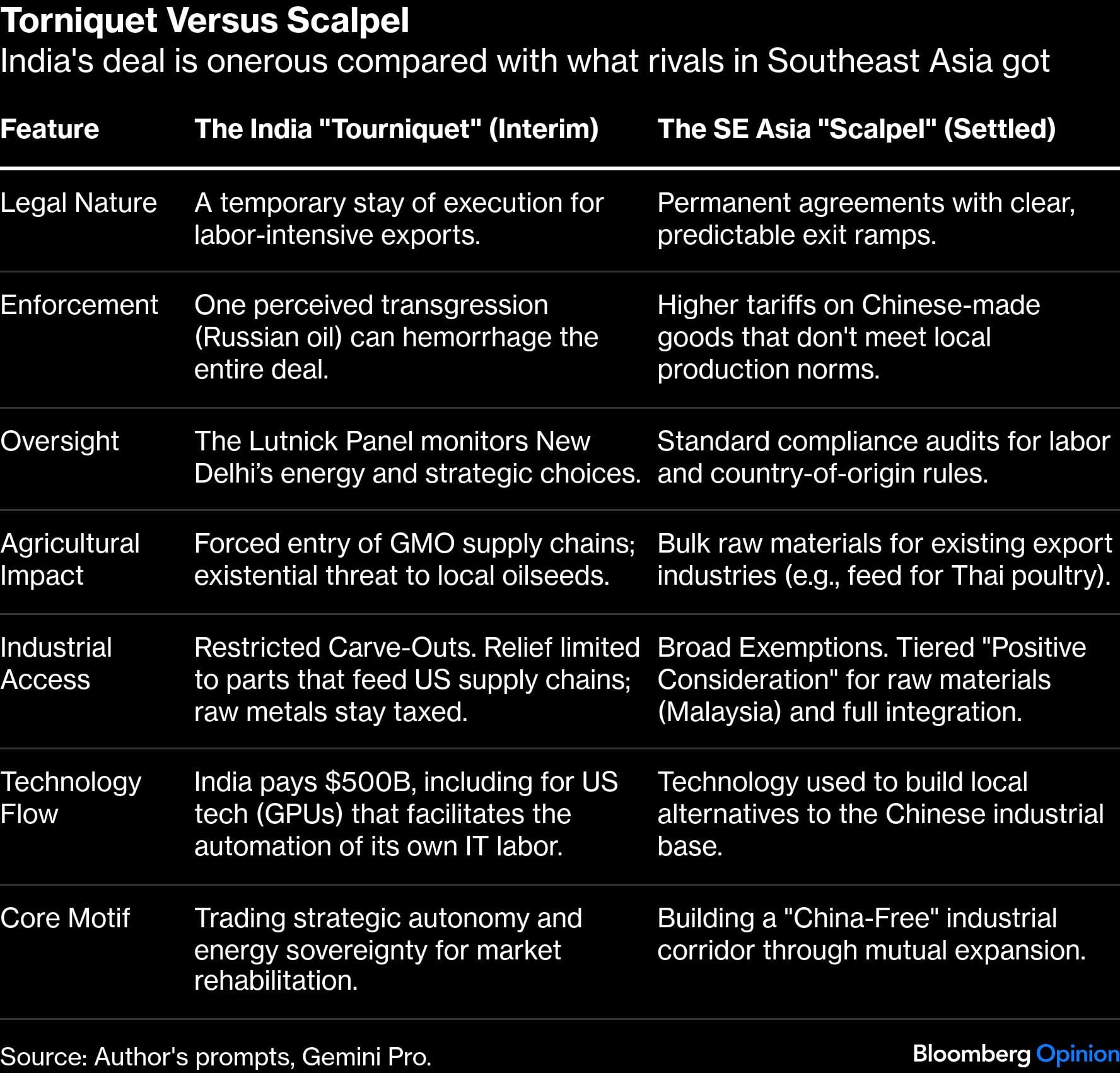
But Trump’s maneuver is very much about trade. He now controls the tourniquet keeping labor-intensive Indian exports from bleeding out — and he can tighten or loosen it at any time. This differs from the “scalpel” approach used in Southeast Asia. There, if a Vietnamese consignment is suspected of laundering Chinese goods, it is marked out for higher tariffs. The specific supplier could be blacklisted. In India, a perceived transgression might cause the entire deal to hemorrhage.
This anxiety will spike compliance costs that Prime Minister Narendra Modi should have anticipated. US giants like Walmart Inc. and Target Corp. might require factories in Tirupur, a textile hub in Tamil Nadu, to sign affidavits disavowing use of “indirect Russian energy.” (How will the manufacturers even know?) Exporters will demand “snapback clauses” in contracts to protect against sudden tariff spikes, lest buyers sue them for nonadherence to pre-agreed prices. Shipments to India’s largest overseas market will grow again under the newly reduced 18% tariff, but they may encounter tremendous operational uncertainty.
The political price is high. India has agreed to open crucial parts of its $580 billion agricultural sector immediately. The US has gained export access for animal feeds derived from genetically modified corn. This is unfair to Indian farmers who aren’t allowed to grow transgenic food because of environmental and biosafety concerns. Nevertheless, GM soy oil has long been allowed. Now that the interim deal has promised concessional duties, it might enter India in even larger quantities. That could stifle any revival of indigenous substitutes like mustard or groundnut already weighed down by imports of Indonesian and Malaysian palm oil.
The US sees the accord as a clear win, with Agriculture Secretary Brooke Rollins saying that it would lift prices and pump cash into rural America. The triumphalism is making farmers’ groups in India nervous. They have vowed strikes against this “total surrender,” fearing that the influx of US commodities will ultimately destroy the so-called minimum support price system that serves as their safety net. Farmers in north India are a politically powerful lobby group, with a history of successful anti-government agitation.
Finally, the $500 billion price tag. India has committed to spend this over five years on US military hardware, energy, and tech products. Chalk up at least a fifth of the expenditure to chips and servers for AI data centers. But the tokens that emerge from that spending will hardly be a substitute for the coming decline of software code-writing — and the disappearance of the many jobs it supports.
How will India fund a near-doubling of imports from America, flipping a trade surplus into a deficit? The joint statement promises little new access — only a restoration of what was lost to punitive taxes, plus some concessions on aircraft parts and auto components.
Even the vital pharmaceutical sector remains in limbo, with the US refusing to close its national security investigation into generic drugs. The “pharmacy of the world” has been promised a negotiated outcome, but for that to happen the rest of agreement may have to work to Trump’s satisfaction. As long as uncertainty persists, the Indian tycoons who control this trade would rather put up their next factory in the US than India, effectively hollowing out the domestic manufacturing base to satisfy the White House.
What Is DDGS?
DDGS is made from genetically modified (GM) corn and is a protein-rich byproduct of ethanol manufacturing. It is widely used as cattle fodder and as feed for poultry and fisheries. In India, however, DDGS is made using non-GM corn or maize and rice. As per the interim trade deal announced last week, India will allow imports of DDGS at zero import duty in limited quantities.
Do We Import DDGS?
New Delhi already imports DDGS from other countries, including Brazil and Argentina, which grow GM soy. As per reports, Union Commerce Minister Piyush Goyal has stated that “there is no threat” to any farmers under the deal and that the opening up of DDGS imports was driven by industry demand amid scarce grazing land and a rising livestock population.
Why Does India Resist GM Products?
India’s long-standing resistance to genetically modified farm products sits at the intersection of regulatory caution, political economy considerations and environmental concerns. Owing to perceived health risks, India follows a precautionary biosafety framework, a report by Business Standard said.
Opening up the sector to GM products could also hurt Indian farmers, whose interests are often cited as part of the national interest. Large-scale imports of GM-linked crops from the US could distort domestic prices and affect rural livelihoods, the report said. Moreover, experts have raised concerns over gene flow, biodiversity loss, and long-term ecological impact.
What Does the Opposition Claim?
The opposition has criticised the Centre’s move, stating that India is yet to allow the use of transgenic technologies in food crops. Member of Parliament and former environment minister Jairam Ramesh alleged that opening the agriculture sector to duty-free DDGS imports amounts to a “backdoor entry” of GM crops into food systems.
"There is an exaggerated attempt to present it as a benefit for India that cheaper Distillers Dried Grains with Solubles (DDGS) will be imported from the US. But the truth is that DDGS is made from GM corn. This is nothing but entry through the back door, if not directly," Ramesh said in a post on X.
Farmers’ union Bharatiya Kisan Sangh has also objected to the move, with other industry experts flagging concerns that such imports could disproportionately impact prices for Indian farmers growing soybean and corn. The farmers’ union has called for a nationwide strike on February 12.
What Will US DDGS Have in Store?
According to a Mint report, imports of corn-based DDGS are likely to remain limited, even though US-made DDGS is considered to be of better quality. Details and clarity on import volumes are still awaited, with the formalisation of the India-US deal expected by mid-March.
A key question remains whether Indian cattle feed manufacturers will replace domestically produced DDGS with US imports. Reports have also suggested that analysts have flagged concerns that imports from the US could hurt Indian soybean farmers — a claim Goyal has said is overstated. As per preliminary details of the interim deal, a quota of only 5 lakh tonnes has been offered under the India-US agreement, while domestic animal feed consumption stands at nearly 500 lakh tonnes.
While DDGS is meant for animal feed and not direct consumption, critics say permitting GM-derived fodder could set a precedent for wider acceptance of genetically modified crops in India’s agri supply chain.
India’s Experience with Bt Cotton
India has so far approved only Bt cotton for GM crop cultivation, primarily to reduce insecticide use, and it has remained the sole GM crop for nearly two decades. According to a report by India Today, Bt cotton cultivation has shown adverse environmental effects, including a reduction in nectar production in flowers, leading to changes in honeybee behaviour.
Farmers who once harvested 25–30 kilos of honey per beehive reportedly found no honey in their fields. A GM crop introduced to combat pink bollworm is now again facing attacks from the same pest, the report said.
Spin / Opinion / Framing
Comparison to an IMF bailout: The headline and framing liken the deal to an IMF bailout, implying India is being forced into concessions rather than negotiating as an equal partner. This is an interpretive analogy, not a factual description.
“Costly surrender of strategic autonomy”: The article characterizes the deal as undermining India’s independence in foreign policy. This is evaluative language, not a verifiable fact.
“Not a respectful accord”: Another subjective judgment, suggesting India is being treated unfairly.
Concerns about Indian farmers: While US agricultural access could indeed affect Indian farmers, the article frames this as a looming threat without presenting specific data or farmer reactions.
Factual Elements
Existence of a US–India interim trade deal: The article reports that such a deal has been struck.
Key provisions mentioned:
- India will reduce tariffs on certain goods.
- India is required to spend around $500 billion on US military, energy, and technology sectors.
- The US will gain greater access to Indian agricultural markets.
- A monitoring mechanism will be set up to check if India imports Russian oil “directly or indirectly.”
- Snapback duties (reinstating tariffs) could be imposed if India violates terms.
- Announcement by Donald Trump: A committee led by Commerce Secretary Howard Lutnick will monitor India’s Russian oil imports.
These are presented as concrete details of the agreement.
A_Gupta wrote: ↑09 Feb 2026 20:16 Since Andy Mukherjee used Gemini Pro to help prepare this article, I used Microsoft CoPilot to separate the spin from the factual in Andy Mukherjee's article.
Spin / Opinion / Framing
Comparison to an IMF bailout: The headline and framing liken the deal to an IMF bailout, implying India is being forced into concessions rather than negotiating as an equal partner. This is an interpretive analogy, not a factual description.
“Costly surrender of strategic autonomy”: The article characterizes the deal as undermining India’s independence in foreign policy. This is evaluative language, not a verifiable fact.
“Not a respectful accord”: Another subjective judgment, suggesting India is being treated unfairly.
Concerns about Indian farmers: While US agricultural access could indeed affect Indian farmers, the article frames this as a looming threat without presenting specific data or farmer reactions.Factual Elements
Existence of a US–India interim trade deal: The article reports that such a deal has been struck.
Key provisions mentioned:
- India will reduce tariffs on certain goods.
- India is required to spend around $500 billion on US military, energy, and technology sectors.
- The US will gain greater access to Indian agricultural markets.
- A monitoring mechanism will be set up to check if India imports Russian oil “directly or indirectly.”
- Snapback duties (reinstating tariffs) could be imposed if India violates terms.
- Announcement by Donald Trump: A committee led by Commerce Secretary Howard Lutnick will monitor India’s Russian oil imports.
These are presented as concrete details of the agreement.

US lost the T20 World Cup match against India by 18%, and I made a very humble request to Sergio Gor, suggesting that if you had made the reciprocal tariff zero, you might have won the match.”
Calibrated Market Opening with Strong Safeguards:
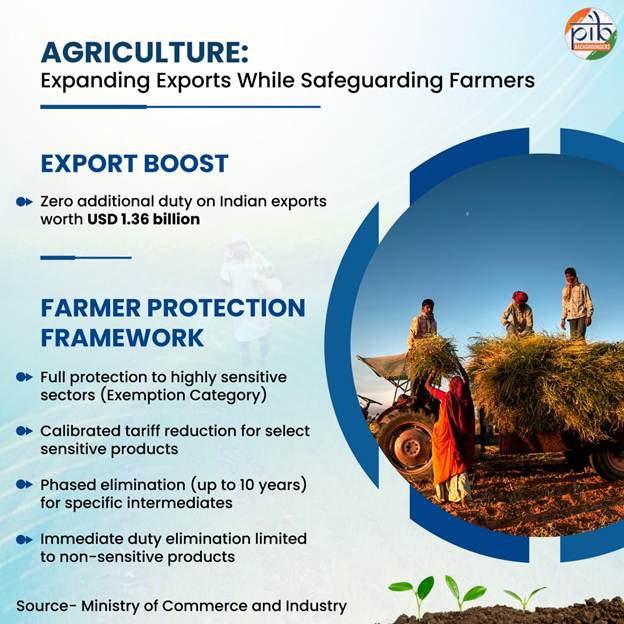
In line with India’s approach in previous trade agreements, agricultural market access has been structured based on product sensitivity. The offer is categorized into immediate duty elimination, phased elimination (up to 10 years), tariff reduction, margin of preference and tariff rate quota mechanisms.
Highly sensitive agricultural sectors remain fully protected under a carefully crafted Exemption category. These broadly include meat, poultry and dairy products; GM food products; soyameal; maize; cereals; millets such as jawar, bajra, ragi, kodo and amaranth; fruits including bananas, strawberries, cherries and citrus fruits; pulses such as green peas, kabuli chana and moong; oilseeds; certain animal feed products; groundnuts; honey; malt and its extracts; non-alcoholic beverages; flour and meals; starch; essential oils; ethanol for fuel; and tobacco.
For select sensitive agricultural products, the tariff reduction category has been applied to ensure that a measured level of duty protection continues. Examples include parts of plants, olives, pyrethrum and oil cakes. Alcoholic beverages have been offered under tariff reduction along with minimum import price-based formulations, consistent with India’s approach in other FTAs.
Certain highly sensitive items have been liberalised under Tariff Rate Quotas (TRQs), where limited quantities are allowed at reduced duties. Products under this category include in-shell almonds, walnuts, pistachios, lentils etc.
Phased elimination of tariffs over up to ten years has been adopted for certain intermediate products used by India’s food processing industry and sourced from multiple countries. These include albumins; certain oils such as coconut oil, castor oil and cotton seed oil; hoofmeal; lard; stearin; modified starches; peptones and their derivatives; and plants and parts of plants etc. This extended timeline provides adequate adjustment space for domestic stakeholders.
Immediate duty elimination has been offered only for select non-sensitive products that are already liberalised under other FTAs.
Non-Agriculture Market Opening with Robust Safeguards
The agreement reflects extensive stakeholder consultations with industry bodies, sectoral associations and concerned ministries to identify product sensitivities and sector-specific requirements before finalizing the market access framework.
Market access for industrial goods has been structured strictly on the basis of product sensitivity, combining immediate tariff elimination, phased reduction (up to ten years) and quota-based access.
Sensitive sectors such as Automobiles have been liberalised through a combination of quota and duty reduction mechanisms. Medical devices have been addressed through long and staggered phasing schedules. Precious metals and other sensitive industrial products have been managed through quota-based tariff lowering. These calibrated safeguards ensure that liberalisation strengthens competitiveness without compromising manufacturing capacity or employment.
Strengthening Trade Facilitation and Quality Ecosystems
Beyond tariff reforms, the agreement advances trade facilitation and addresses non-tariff measures. The provisions offer balanced and improved market access with India’s right to regulate, while addressing technical barriers to trade.
India and the United States will work towards strengthening quality standards, accreditation systems and ease of compliance in priority sectors including high-technology products, medical devices and ICT goods.
Recognition of conformity assessments will reduce double- testing requirements, saving time and costs for exporters. Alignment with international standards enhances export readiness and enables Indian manufacturers to upgrade quality, especially in advanced machinery, medical devices and electronics. It also ensures deeper integration into global value chains, including advanced markets such as the European Union, the United Kingdom and Japan.
Health and Medical Infrastructure
India and the U.S. demonstrate strong complementarity in the medical devices sector. Improved access to high-end diagnostic and surgical equipment will support the scaling of advanced healthcare infrastructure.
Streamlined entry of life-saving technologies enhances affordability and accessibility of specialised healthcare services, contributing to improved patient outcomes and strengthening India’s medical ecosystem.
Consumer Welfare: Enhancing Imports Without Disrupting Domestic Supply
Meanwhile, the agreement also strengthens consumer welfare by enabling calibrated access to select consumer-oriented imports that bridge demand gaps without placing stress on domestic farmers or producers.
Limited and structured access ensures that imports supplement, rather than replace, domestic production, contributing to price stability and greater product variety for consumers.
Key consumer-oriented product categories include tree nuts; fresh and processed fruits such as berries; niche and high-quality oils; processed food products including yeast, margarine and abalone; wine and premium beverages; select pet food products; and frozen food items such as salmon, cod and Alaska pollack.
Intermediate Goods that Strengthen Indian Manufacturing and Value Chains
The agreement facilitates access to critical intermediate inputs that power India’s export engine. By enabling raw materials and specialised components to enter at competitive terms, the framework strengthens value-added manufacturing and reinforces India’s position in global supply chains.
Key intermediate goods include rough diamonds and precious stones; specialty chemicals for pharmaceuticals and agro-processing; select active pharmaceutical ingredients; semiconductor wafers and fabrication inputs; electronics components such as IC substrates, sensors and microcontrollers; carbon fibres and specialty materials; industrial enzymes; industrial machinery parts and precision tools; aerospace components; battery materials including lithium compounds and cathode materials; and fertilizer inputs such as phosphate rock and potash where cost-effective.
High Technology and Advanced Technology Imports
The agreement supports India’s technological advancement by facilitating access to high-technology and strategic goods that catalyze domestic capability building. The access to advanced technologies accelerates India’s digital and industrial transformation while reinforcing self-reliance objectives.
Key high-technology categories include advanced medical devices such as diagnostic imaging equipment and surgical robotics; AI chips and high-performance processors; semiconductor manufacturing equipment; cloud computing infrastructure hardware; telecom and ICT network equipment; cybersecurity hardware; non-sensitive aerospace electronics; clean energy technologies including smart grids and meters; precision agriculture technology; biotechnology research equipment; quantum computing components; advanced laboratory and testing equipment; satellite and space technology components; and data centre infrastructure equipment.
Trump thought Bharat was S Korea. Then he remembered Bharat has PM in .@narendramodi Ji.
Trump tried to bully India. Failed. Quietly changed fact sheet on US-Bharat Trade Deal.
1. Lied: India will import pulses from US
Now: Pulses dropped
2. Lied: India 'committed' to buy $500 Billion goods
Now: India 'intends' to buy
3. Lied: India will 'remove its digital services tax'
Now: Mention dropped
Looks like nutlick has been quite busy. This is not as innocent as it sounds, there has been a serious effort to create chaos in India and some "farmer leader's" have been paid off to agitate and blame Modi ji and Piyush Goel
papooze agenda busted even before supriya shrinate starts writing some sh!t posts

.White House Quietly Revises U.S.-India Trade Fact Sheet After Indian Concerns
Last updated 2 seconds ago
The White House updated its fact sheet on the U.S.-India interim trade framework, removing references to tariff reductions on pulses like lentils and chickpeas, and stripping 'agriculture' from India's planned purchases of American goods.
It also softened language around a $500 billion shopping list from a firm 'commitment' to India merely 'intends' to buy U.S. energy, tech, coal, and other products.
These revisions align the document more closely with the official joint statement from February 6, following concerns from Indian officials and opposition figures about safeguarding farmers amid ongoing protests.
Pro-government voices in India called it a diplomatic win, while U.S. Trade Representative Jamieson Greer highlighted market openings and India's moves to reduce Russian oil purchases.
This story is a summary of posts on X and may evolve over time
“As you are aware, the India-U.S. Joint Statement on the framework for an Interim Agreement on reciprocal and mutually beneficial trade was issued on 7 February 2026. The Joint Statement is the framework and remains the basis of our mutual understanding in the matter. Both sides will now work towards implementing this framework and finalizing the Interim Agreement.
The amendments in the US fact sheet reflect the shared understandings contained in the Joint Statement.
जैसा कि आप जानते हैं, पारस्परिक रूप से लाभकारी व्यापार पर एक अंतरिम समझौते (Interim Agreement) के ढांचे हेतु भारत-अमेरिका Joint Statement, 7 फरवरी 2026 को जारी किया गया था। यह Joint Statement ही वह ढांचा है और इस मामले में हमारी आपसी समझ का आधार है। अब दोनों पक्ष इस ढांचे को लागू करने और अंतरिम समझौते को अंतिम रूप देने की दिशा में काम करेंगे।
अमेरिकी 'फैक्ट शीट' (Fact Sheet) में किए गए संशोधन Joint Statement में निहित साझा समझ को दर्शाते हैं।”
Adding to the above -- what some newspapers are saying (with some of my take- FWIW)Tanaji wrote: ↑12 Feb 2026 15:03 I was about to post the same thing:
https://arstechnica.com/space/2026/02/e ... y-balloon/
It is quite strange all this. There is more to the story than a party balloon

<from Twitter > Father of this Indian student died just before $29 million settlementAmber G. wrote: ↑13 Feb 2026 04:46 Meanwhile Seattle authorities have announced $29 million ( in compensation for the family of Jahnavi Kandula, who was killed by a speeding police vehicle while crossing the road.
Jaahnavi Kandula, a 23-year-old Indian graduate student who was struck and killed by a speeding Seattle police vehicle in January 2023. Kandula was crossing a street when the patrol car, driven by Officer Kevin Dave, hit her; he was reportedly traveling up to 74 mph in a 25 mph.
The case drew widespread public outrage, particularly after another officer was recorded on a body-cam making insensitive /racist remarks about Indian student due to his nationality.

