For many years, India had a skeptical take on the energy transition, arguing since the 1970s that poverty was a more pressing problem than protecting the environment. The difference now is that zero-carbon power is decisively cheaper than the competition.
Meanwhile, rising incomes mean the government needs to also think about the needs of about half a billion middle-class citizens, who worry more about where to find a good job in a clean, livable city than the basics of subsistence living.
India is still building coal-fired power plants to make sure those newly minted urbanites do not suffer power cuts in the middle of punishing heat waves, but they are not necessarily being used. Thanks to milder weather than in the past few years and the rising volumes of renewables pushing it off the grid, fossil-fired power generation fell 4 percent in the first half relative to last year.
Re: India's Power Sector
Posted: 03 Aug 2025 19:07
by A_Gupta
> fossil-fired power generation fell 4 percent in the first half relative to last year.
Amazing. And this while manufacturing PMI has been healthy for months. I assume here that major manufacturing does not have captive power plants.
Re: India's Power Sector
Posted: 04 Aug 2025 02:41
by Vayutuvan
> Thanks to milder weather than in the past few years and the rising volumes of renewables
Re: India's Power Sector
Posted: 04 Aug 2025 05:23
by KL Dubey
A_Gupta wrote: ↑03 Aug 2025 19:07
> fossil-fired power generation fell 4 percent in the first half relative to last year.
I assume here that major manufacturing does not have captive power plants.
I don't think we can know until we dig into the PMI numbers. Captive power is a huge segment in Bharat.
'Na Bijli Aayegi...' — How A Stubborn CM And An IAS Brought Electricity To Bihar's Hinterlands
Re: India's Power Sector
Posted: 21 Aug 2025 20:36
by uddu
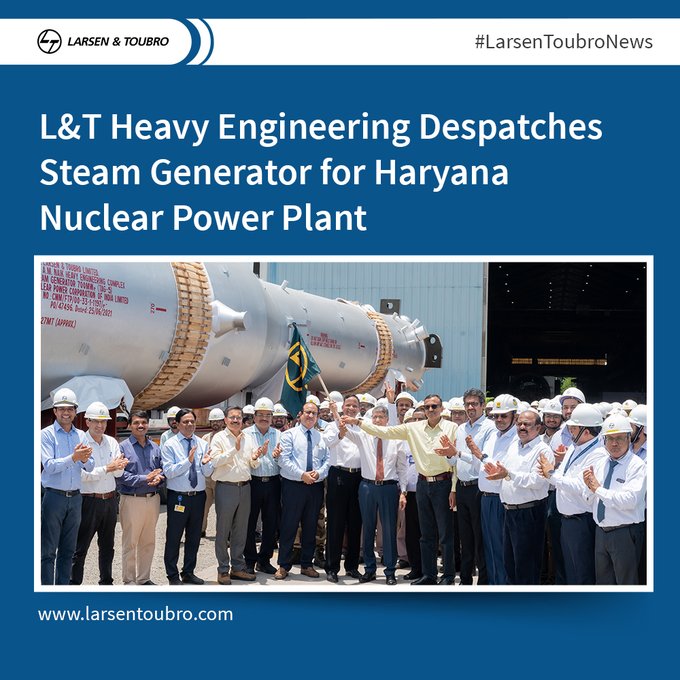
https://x.com/larsentoubro/status/1958407166274224507
Marking yet another milestone in India’s civil nuclear energy programme, L&T Heavy Engineering has despatched a Steam Generator to the Gorakhpur Haryana Anu Vidyut Pariyojana (GHAVP), located in Fatehabad district, Haryana.
China and India are both pursuing thorium-based nuclear programs to leverage their vast thorium reserves (India has the world's largest, followed by China) as a sustainable alternative to uranium, aiming for energy security and reduced waste. China's approach centers on molten salt reactors (MSRs), which use thorium directly in a liquid fuel cycle for inherent safety and efficiency. India's strategy is a phased, indigenous three-stage program that indirectly incorporates thorium via fast breeder reactors (FBRs) to produce fissile uranium-233 (U-233), followed by advanced heavy water reactors (AHWRs) for thorium utilization. While China has made rapid progress with a prototype already operational, India's program is more evolutionary but faces delays due to technological complexities.
China
Prototype (TMSR-LF1, 2 MWth) achieved criticality in Oct 2023, full power in June 2024, and first-ever online refueling without shutdown in April 2025. Demonstrates continuous operation. Full-scale 10 MWe demonstration reactor under construction.
Prototype operational (2023-2025). Full-scale Gobi Desert plant construction starts 2025 (Gansu Province), criticality by 2030. Aims for commercial deployment post-2030.
India
Stage 1: 24 operational reactors (8.18 GW total). Stage 2: Prototype FBR (PFBR, 500 MWe) at Kalpakkam began core loading in 2024; facing "first-of-a-kind" delays but issues being resolved systematically as of Aug 2025. Stage 3: AHWR design ongoing with delays; experimental thorium tests at BARC show promise (e.g., small reactors powering districts with minimal fuel).
Stage 2 PFBR commissioning targeted for 2026 (delayed from earlier 2024 goal). Stage 3 AHWR prototype expected mid-2030s after FBR success. Overall thorium utilization after achieving 50 GW nuclear capacity (current ~8 GW).
Key Differences and Similarities
Direct vs. Indirect Path: China's MSR enables direct thorium use in a single reactor type, allowing quicker deployment and innovation in liquid fuel. India's FBR-centric approach requires sequential stages, making it more complex but tailored to bootstrap from limited uranium stocks.
Progress Speed: China is ahead, with a working prototype and refueling milestone in 2025, positioning it for near-term full-scale ops. India is steady but slower, with PFBR delays pushing thorium breeding to late 2020s.
Similarities: Both prioritize thorium for sustainability (abundant, less waste than uranium), national energy security, and reduced carbon emissions. They face shared R&D challenges like fuel reprocessing and safety certification.
Global Context: China's program revives U.S. MSR concepts abandoned in the 1970s, potentially leapfrogging Western efforts. India's is uniquely suited to its resource constraints, influencing international thorium collaborations.
Overall, China's MSR program is more advanced and disruptive, potentially setting a global standard by 2030, while India's three-stage FBR path offers a proven, scalable model for thorium-dominant nations despite setbacks.
Re: India's Power Sector
Posted: 20 Sep 2025 00:58
by Amber G.
Sharing:
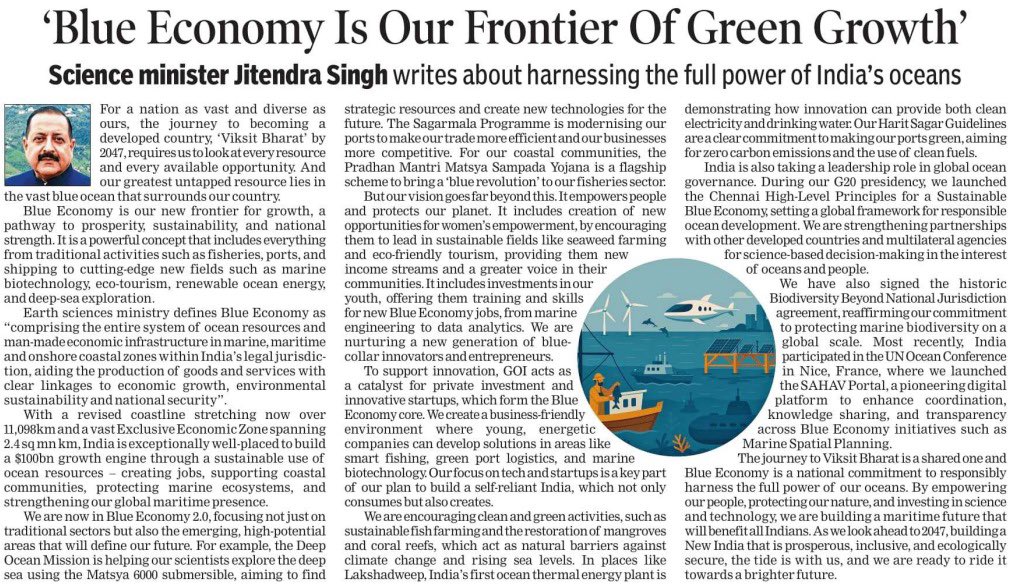
MoS (Science and Tecnology) Article in ‘Times of India’
I found this very informative. It explains how Indian solar projects work to make solar power competitive or more than competitive. https://www.youtube.com/watch?v=j2y3DhrgjVc
Listen to Joseph Majkut, Director, Energy Security and Climate Change Program discuss CSIS's Greencycles Report with Dr. Shashwat Kumar, Fellow, Chair on India and Emerging Asia Economics and India's Morena Solar-Plus-Storage Project with Mr. Manu Srivastava, Additional Chief Secretary, New and Renewable Energy Department of the Government of Madhya Pradesh.
Re: India's Power Sector
Posted: 25 Oct 2025 22:34
by A_Gupta
India’s largest hydropower project undergoes test run
Work on NHPC’s 2,000 MW Subansiri Lower Hydroelectric Project, straddling the Arunachal Pradesh-Assam border, was suspended between 2011 and 2019 due to protests https://www.thehindu.com/news/national/ ... 201146.ece
One of the eight units of India’s largest hydropower project, which straddles the Arunachal Pradesh-Assam border, has begun undergoing a test run, signalling its commissioning soon.
Officials of the NHPC Limited said the wet commissioning of the first 250 megawatt unit of the 2,000 MW Subansiri Lower Hydroelectric Project was commenced on Friday (October 24, 2025).
....
The Subansiri Lower project, located at Gerukamukh on the inter-State boundary, was launched in January 2005. Work on the project was suspended in 2011 following protests by anti-dam activists in Assam and concerns over downstream environmental impacts.
The work resumed in October 2019 after the Prime Minister’s Office pushed for its completion, and the NHPC adopted enhanced mitigation and safety measures.
Wiki says: The Subansiri Lower Dam, officially named Subansiri Lower Hydroelectric Project (SLHEP), is an under construction gravity dam on the Subansiri River in North Eastern India. It is located 2.3 km (1.4 mi) upstream of Subansiri River in Arunachal Pradesh. Described as a run-of-the-river project by NHPC Limited, the project is expected to supply 2,000 MW of power when completed.
This is a GoI press release.
Capacity Addition Crosses 50,000 MW in FY 2025-26 (Up to 31st January 2026)
Over 11% added to total installed capacity in just 10 months https://www.pib.gov.in/PressReleasePage ... g=3&lang=1
During the current financial year 2025–26 (up to 31st January 2026), a record 52,537 MW of generation capacity (from all sources) has been added . Of this, 39,657 MW has been added from Renewable Energy sources, which includes 34,955 MW of Solar Power, 4,613 MW of Wind Power.
This marks the highest ever capacity addition in a single year, surpassing the previous record of 34,054 MW achieved during FY 2024–25.
As on 31 January 2026, India’s total installed power generation capacity stands at 520,510.95 MW, comprising:
New Delhi: Around 6,600 megawatt nuclear capacity is under construction, and another 7,000 megawatt is under various stages of planning and approval, Power Minister Manohar Lal said on Thursday.
12,723.50 MW of hydroelectric projects are under construction.
Further, 4,274 megawatt (MW) of hydroelectric projects are under various stages of planning and targeted to be completed by 2031-32, he said in a written reply to the Lok Sabha.
In energy storage systems, 11,620 MW/69,720 MWh Pumped Storage Projects (PSPs) are under construction.
A total of 6,580 MW/39,480 MWh capacity of Pumped Storage Projects (PSPs) is concurred and yet to be taken up for construction.
Currently, 9,653.94 MW/ 26,729.32 MWh Battery Energy Storage System (BESS) capacity is under construction, and 19,797.65 MW/ 61,013.40 MWh BESS capacity are under tendering stage.
Minister of State for Power Shripad Naik informed the House that India added 52,536.49 MW installed generation capacity in the current financial year, FY 2025-26 (till January 2026).
As of January 31, the total installed generation capacity is 5,20,511 MW, of which the share of renewable energy sources was 2,63,189 MW (50.6 per cent).
Re: India's Power Sector
Posted: 15 Mar 2026 08:25
by Mukhi
A curious question to Gurus.
All those solar installations on individual homes, do they count towards total national capacity or not because they are paid by the home owner to ofset the use. ??
Re: India's Power Sector
Posted: 15 Mar 2026 10:54
by Amber G.
Mukhi wrote: ↑15 Mar 2026 08:25
A curious question to Gurus.
All those solar installations on individual homes, do they count towards total national capacity or not because they are paid by the home owner to ofset the use. ??
From what I know- rooftop solar does count toward national installed capacity, but there is a subtle statistical point that often causes confusion in energy discussions.
Rooftop solar is counted in national solar capacity: reported by MNRE:
->-Utility-scale solar parks +Commercial & industrial rooftop systems +Residential rooftop solar
All of these together make up India’s total solar installed capacity.
(who pays for the system makes no difference to how it is counted in national capacity statistics as long as it is physically installed and grid-connected)
The subtle statistical confusion (because rooftop solar is “behind the meter.”)
The confusion arises - the electricity is consumed directly in the home.
It never appears as electricity supplied by the grid.
As a result: It counts in installed capacity statistics. but it may not appear in grid electricity generation numbers.
So someone looking only at grid generation data might think solar output is smaller than it actually is.
This creates the some statistical confusion if not understood.
So. Rooftop solar installations are included in India’s national solar capacity, even when paid for by homeowners, but much of their generation occurs behind the meter, which can make energy statistics look inconsistent if one only looks at grid-supplied electricity.
Re: India's Power Sector
Posted: 13 Apr 2026 14:43
by rajkumar
India's transmission transformation | FT Energy Source
The Andhra Pradesh government has made a major regulatory change by granting `Deemed Distribution Licence’ status to Google through its subsidiary Raiden Infotech.
The Andhra Pradesh government has made a major regulatory change by granting `Deemed Distribution Licence’ status to Google through its subsidiary Raiden Infotech.
ADVERTISING
By becoming a power distributor, Google can buy electricity, both conventional and green, directly from any power generator or use its own renewable sources from across India to distribute power among its own units, ensuring greater control over supply reliability and long-term costs.
This status allows the tech giant to bypass the standard grid to independently manage a staggering one-gigawatt supply, which is crucial for maintaining the 24/7 operations required by its massive $15 billion data centre project that is coming up at three locations in Viskhapatnam.
Re: India's Power Sector
Posted: 07 Jun 2026 21:52
by sumsumne
Power generator NTPC Ltd has floated an expression of interest (EoI) to identify technology providers and engineering, procurement and construction (EPC) partners for developing flexible thermal power generation solutions to support grid integration of renewable energy.
The EoI has been invited for sub-critical thermal power units in the 150-250 megawatt (MW) range capable of two-shift operation and operation at a minimum technical load of 25 per cent, the company said in a statement.
vijayk wrote: ↑18 Sep 2025 00:33
China and India are both pursuing thorium-based nuclear programs to leverage their vast thorium reserves (India has the world's largest, followed by China) as a sustainable alternative to uranium, aiming for energy security and reduced waste. China's approach centers on molten salt reactors (MSRs), which use thorium directly in a liquid fuel cycle for inherent safety and efficiency. India's strategy is a phased, indigenous three-stage program that indirectly incorporates thorium via fast breeder reactors (FBRs) to produce fissile uranium-233 (U-233), followed by advanced heavy water reactors (AHWRs) for thorium utilization. While China has made rapid progress with a prototype already operational, India's program is more evolutionary but faces delays due to technological complexities.
China
Prototype (TMSR-LF1, 2 MWth) achieved criticality in Oct 2023, full power in June 2024, and first-ever online refueling without shutdown in April 2025. Demonstrates continuous operation. Full-scale 10 MWe demonstration reactor under construction.
Prototype operational (2023-2025). Full-scale Gobi Desert plant construction starts 2025 (Gansu Province), criticality by 2030. Aims for commercial deployment post-2030.
India
Stage 1: 24 operational reactors (8.18 GW total). Stage 2: Prototype FBR (PFBR, 500 MWe) at Kalpakkam began core loading in 2024; facing "first-of-a-kind" delays but issues being resolved systematically as of Aug 2025. Stage 3: AHWR design ongoing with delays; experimental thorium tests at BARC show promise (e.g., small reactors powering districts with minimal fuel).
Stage 2 PFBR commissioning targeted for 2026 (delayed from earlier 2024 goal). Stage 3 AHWR prototype expected mid-2030s after FBR success. Overall thorium utilization after achieving 50 GW nuclear capacity (current ~8 GW).
Key Differences and Similarities
Direct vs. Indirect Path: China's MSR enables direct thorium use in a single reactor type, allowing quicker deployment and innovation in liquid fuel. India's FBR-centric approach requires sequential stages, making it more complex but tailored to bootstrap from limited uranium stocks.
Progress Speed: China is ahead, with a working prototype and refueling milestone in 2025, positioning it for near-term full-scale ops. India is steady but slower, with PFBR delays pushing thorium breeding to late 2020s.
Similarities: Both prioritize thorium for sustainability (abundant, less waste than uranium), national energy security, and reduced carbon emissions. They face shared R&D challenges like fuel reprocessing and safety certification.
Global Context: China's program revives U.S. MSR concepts abandoned in the 1970s, potentially leapfrogging Western efforts. India's is uniquely suited to its resource constraints, influencing international thorium collaborations.
Overall, China's MSR program is more advanced and disruptive, potentially setting a global standard by 2030, while India's three-stage FBR path offers a proven, scalable model for thorium-dominant nations despite setbacks.
Chinese prototype produces 2 MW of power. Indian PFBR produces 500 MW. China aims for a 10 MW and 60 MW reactor in 2029. The Thorium AHWR (Advanced Heavy water reactor) India planned to build in 2010 should have 300 MW capacity. But the project is delayed in regulatory compliance and land acquisition SDREs are famous for shooting at their own foot.

 SDREs are famous for shooting at their own foot.