Re: Indian Education System
Posted: 26 Oct 2025 09:22
Consortium of Indian Defence Websites
https://forums.bharat-rakshak.com/
 }
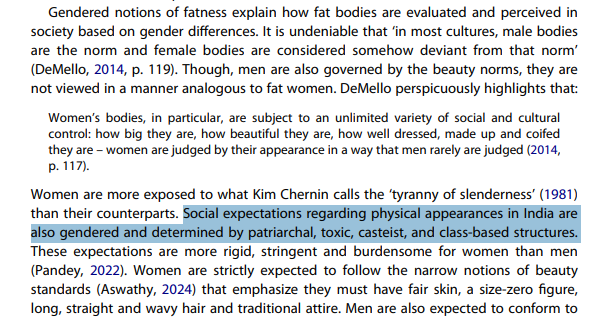
}A new research is somehow concluding that Indian society is patriarchal, sexist, toxic, casteist, and oppressive.
Here is why it is problematic and dangerous:
1. Not a single page on health risks of obesity.
The entire focus is on how “fatness” is a site of discrimination. In other words: not the body, but the politics of the body. Epistemology replaced with activism.
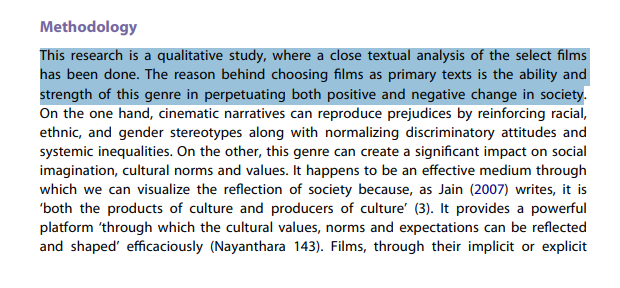
2. The methodology? “Qualitative.”
Meaning: no data, no measurement, no falsifiability.
What exactly is the quality? Cultural texts aka films.
Take Western social-justice theories, apply them to two Bollywood films, and declare the findings as India’s social reality. A prêt-à-porter ideology fitted onto Indian society with tailor’s chalk.
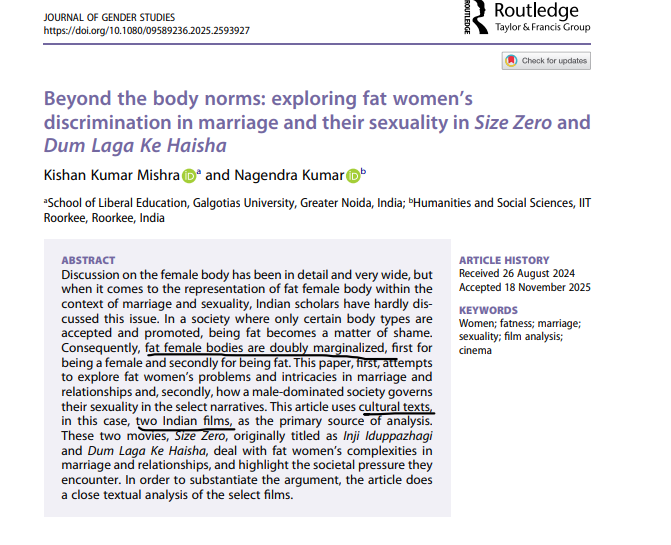
3. The introduction confidently asserts that “fat women are doubly discriminated.”
Evidence? None. No surveys, no fieldwork, no psychometric sampling.
Only two fictional films.
This is not research—this is Sabrina Strings cosplay, imported wholesale, stapled to Indian society, and passed off as sociology.
4. Then comes the standard incantation:
“Butler on domination… heterosexual order… girls taught to be passive… boys encouraged to be sexually aggressive…”
These are hypotheses in American gender theory, not gospel truths. Butler is not a census.
Turning speculative philosophy into “Indian reality” isn’t scholarship. It is just theological zealotry dressed as research.
5. At one point, the authors even claim men face less beauty-based discrimination.
Anyone who has lived in Indian society for five minutes knows this is laughable. But ideology requires blind spots; reality is merely an inconvenience.
6. The conclusion is the climax:
“Fat women become undesirable… emotional and physical bond with husbands is shattered… sexuality governed by male-dominated society.”
This is not a conclusion; it is wartime propaganda.
No data. No sample. No statistical model.
Just an ideological monologue projected onto society via two films—like using Marvel movies to reconstruct US foreign policy.
What’s happening here is clear:
A new political identity is being manufactured for the next generation.
Fatness → victimhood → discrimination → patriarchy → activism → funding → discourse.
This is not harmless.
Public institutions are being turned into printing presses for imported ideological constructs.
What exactly is the societal value addition of such “studies”?
How does any of this improve health, education, welfare, mobility, or opportunity?
We are paying to produce narratives, not knowledge.
And this needs to be stopped!
NEET-PG Cut-off Reduced To -40 (out of 800): Details explained
The recent decision to reduce the NEET-PG cut-off for the 2025–26 academic session has sparked significant discussion. The reduction was implemented for the third round of counselling to fill a large number of vacant postgraduate medical seats across India.
1. How many marks are actually needed?
The qualifying marks vary by category under the revised criteria issued by the National Board of Examinations in Medical Sciences (NBEMS):
General / EWS (Unreserved): The cut-off was reduced from the 50th percentile (276 marks) to the 7th percentile, which corresponds to 103 marks out of 800.
SC / ST / OBC (Reserved): The cut-off was slashed from the 40th percentile (235 marks) to the 0th percentile, meaning a score of –40 marks now qualifies a candidate for counselling.
General-PwBD: The cut-off is now the 5th percentile, or 90 marks.
2. Who qualifies with -40 marks?
Only candidates from the Reserved categories (SC, ST, and OBC), including their respective Persons with Benchmark Disabilities (PwBD) sub-categories, are eligible to qualify with a score as low as –40.
The General (Unreserved) category still requires a positive score of at least 103 marks to be eligible for the third round of counselling.
3. How many will get a PG seat with such low marks?
While thousands are newly eligible, qualifying for counselling does not guarantee a seat.
Vacancies:
There are approximately 9,000 to 18,000 vacant seats remaining after the first two rounds of counselling.
Allocation:
Seats are still allocated based on inter-se merit (rank) and candidate preferences. Candidates with higher ranks, even among the newly eligible, will have priority.
Available Seats:
Experts note that the seats remaining at these lower percentiles are typically in non-clinical branches (like Anatomy or Physiology) or in private medical colleges and deemed universities that may have extremely high tuition fees.
4. Is this new, or has it happened before?
Drastic cut-off reductions have occurred in previous years to prevent seat wastage, though the specific thresholds vary:
2023: The Health Ministry reduced the qualifying percentile to "zero" across all categories, including the General category.
2024: The cut-off was lowered to the 5th percentile for all categories.
Current (2025–26): This is the first time the cut-off has been specifically differentiated in this way for the third round, with reserved categories reaching the 0th percentile (–40 marks) while the unreserved category remains at the 7th percentile.
The government justifies these moves by stating that NEET-PG is a ranking exercise for already-qualified MBBS doctors, and leaving nearly one in seven specialist training seats vacant would weaken the healthcare system.
Note: Even if PG seats are denied to those with -40 marks, they are still practicing doctors, as they all have valid MBBS degrees.
,Dr Kuma.r

Tandavji, while I dont doubt what you have stated, the Neet-PG thing is not down to that. There has been a lot of discussion on this topic previously. A learned minister from BJP also exhorted people to not worry about marks as “they are already doctors”tandav wrote: ↑11 Mar 2026 00:13 Apparently since there is a stated policy of not failing any student until they reach 9th standard. Therefore 90% of children in Indian Schools learn nothing and drop out in 9th standard as schools will not allow them to sit for 10th exams unless they pass 9th. 1 or 2 attempts later the "students" crash out and join the work force with very little functional literacy. This is situation in Delhi government schools say nothing about other schools in tier 2 cities tier 3 towns and villages
https://www.facebook.com/share/16VAZ4BJcA/
The Supreme Court's recent judgment directing the dissociation of Professor Michel Danino and his colleagues from all publicly funded educational roles is nothing short of a draconian overreach, a blatant assault on academic freedom, and a chilling attempt to sanitise the narrative of institutional flaws in India. As a Padma Shri awardee and a scholar who has dedicated his life to illuminating India's ancient civilisation, Danino has been unfairly vilified for daring to include a factual discussion on judicial corruption in a Class 8 NCERT textbook. This ruling not only undermines the principles of transparency and education but also exposes the judiciary's hypersensitivity to scrutiny, even as real corruption festers within its ranks. Let us dissect this travesty with the data it demands.
First, consider Michel Danino's impeccable credentials. Born in France in 1956, he relocated to India in 1977, becoming an Indian citizen and immersing himself in the study of its heritage. He has authored seminal works such as The Lost River: On the Trail of the Sarasvati (2010), which marshalled archaeological, hydrological, and satellite data to revive the Vedic Sarasvati River's historical significance, challenging colonial-era myths. Danino debunked the outdated Aryan Invasion Theory through rigorous evidence from sites like Dholavira and Lothal, demonstrating the continuity of the Indus Valley Civilisation with Vedic culture. As a guest professor at IIT Gandhinagar, he helped establish its Archaeological Sciences Centre, and in 2017, he was honoured with the Padma Shri for contributions to literature and education. He convened the International Forum for India's Heritage, boasting over 160 eminent members, and has published in journals like Man and Environment and Puratattva. To brand such a scholar as lacking "reasonable knowledge" or deliberately misrepresenting facts is an insult to intellectual integrity.
Now, turn to the offending chapter in the NCERT Class 8 social science textbook, titled "The Role of the Judiciary in Our Society." Far from being a sensationalist rant, it factually addressed systemic challenges, including "corruption at various levels" that delays justice. It highlighted the staggering backlog: approximately 81,000 pending cases in the Supreme Court, 6.24 million in high courts, and 47 million in district and subordinate courts. The text linked these to structural issues like judge shortages, complex procedures, and weak infrastructure, echoing the maxim "justice delayed is justice denied." It noted that a code of conduct binds judges, yet corruption persists, impacting access to justice, especially for the economically disadvantaged. This is not "misrepresentation"—it is essential civic education for young minds to understand institutional realities and push for reforms.
The irony is palpable when juxtaposed against the data on actual judicial corruption in India. Between 2016 and 2025, over 8,600 complaints were filed against sitting judges, peaking at 1,170 in 2024. Transparency International's 2013 Global Corruption Barometer found that 45% of Indian households viewed the judiciary as corrupt, with an average corruption score of 3.3 out of 5. A 2026 India Today survey revealed that 85% of Indians perceive the judiciary as deeply or somewhat corrupt, with only 8% believing it is corruption-free. In 2013, 36% of citizens reported paying bribes to the judiciary, with 59% to lawyers, 5% to judges, and 30% to court officials for favourable outcomes. As of 2024, over 50 million cases remain pending, exacerbating vulnerabilities where litigants resort to bribes to expedite proceedings. Chief Justice BR Gavai himself acknowledged in 2025 that instances of corruption erode public confidence, citing cases like the Allahabad High Court's Justice Yashwant Varma, embroiled in a cash scandal. From 2017 to 2021, 1,631 complaints on judicial misconduct were forwarded via the Centralised Public Grievance Redress system. These figures, drawn from official and international sources, affirm that the chapter's content was grounded in reality, not malice.
This ruling reeks of institutional insecurity. By blacklisting Danino and his associates—Suparna Diwakar and Alok Prasanna Kumar—from any publicly funded work, the court has effectively censored discourse on its own failings. It mocks the separation of powers, positioning the judiciary as untouchable while it lectures on accountability. Where was this zeal when former Law Minister Shanti Bhushan alleged that eight of sixteen former chief justices were corrupt? Or when the Press Information Bureau reported recurring complaints about judicial integrity? The court's order to rework the chapter only with "domain experts", including a former judge, smacks of self-preservation, not pedagogy.
Education should foster critical thinking, not shield power from critique. By punishing scholars like Danino, who has enriched India's historical narrative, the judiciary risks alienating the very citizens it serves. This is not justice; it is judicial authoritarianism. We must demand a reversal, for the sake of our democracy and our children's right to truth.
#StandWithDanino #JudicialOverreach #AcademicFreedom
tandav Saar,tandav wrote: ↑11 Mar 2026 07:44 Zeroth Law of Good Governance: No taxation without representation and no representation without taxation. India has miserably failed to adhere to the above law of good governance. Taxpayers are Nation Builders. India has produced freebie seeking voters (100 Cr voters) in spades and failed miserably in producing competent taxpayers (2Cr) at scale. Not a single political party in last 80years has ever put on its manifesto to provide universal 10+2 education of high quality that had the potential to create compeyent taxpayers. On the other hand India has consistently lowered standards to pander to the lowest common denominator. In India political parties are looking to develop/create a ~10% vote bank in the first past the post multi party system. Most political parties win on a strategy of redistribution of 2% taxpayers money and win elections. This perverse anti democratic and anti meritocratic governance paradigm has ruined the nation.
I posit that the success of China lies in their ability to create competent citizens by a relentless focus on competence in schools and colleges. China creates competent citizens largely due to their government KPIs focus on economic activity and increased tax collection (mostly from production). India on the other the KPI of Indian leadership is indexed to production of the incompetent dole seeking voter. Currently elected leadership makes money by 20% cut of government spend. Therefore most of the spend create outcome free infrastructure and wastes taxpayers money.
Solution: Directly Remunerate the elected leadership with a small say 1% of All taxes collected from their constituency x votes share/ total population. All taxes: GST, PIT, CIT Property tax, cess, stamp duty etc. Once this simple incentive model is put in place. I have no doubt that our leaders will go hammer and tongs to develop more competent taxpayers and increase their take. This direct transfer of tax generated to elected leaders is akin to corporate CEO profit performance linked remuneration. In a country tax generation is functionally equivalent to profit generation in a corporate.