Re: Bangladesh News and Discussion
Posted: 24 Jan 2026 16:31
Its official Kangalu are out!!
replaced by Scotland
replaced by Scotland
Consortium of Indian Defence Websites
https://forums.bharat-rakshak.com/
 As the saying goes these days FAFO
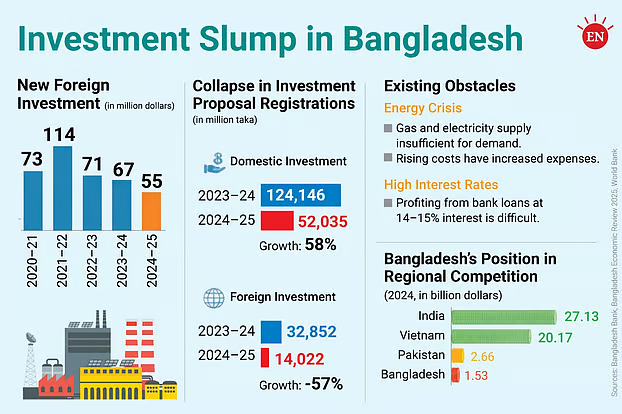
  They were punching above their weight thinking they can force ICC to bend to their demands. Don't know why BDs always have such a high opinion of themselves, from thinking they can beat all major cricket nations to dreams of capturing all of India's northeast! Claiming ICC will lose money because they will lose 200mil viewers, that India's economy will go down bcos of BDs boycotting them etc. Wonder what is causing such a mass delusion! I mean, they are going around with a begging bowl and literally their garment industries are shutting down and other companies are leaving the country. But their delusions seems to be growing stronger by the day!
 Exactly the same mental virus that afflicts Pakistan is beginning to spread in Bangladesh. There are still sane voices in Bangladesh, but they are being intimidated; newspaper offices burned down; mob violence, etc. And the Yunus caretaker government is hugely culpable in actively incubating these.
At the end of FY25, the total outstanding balance of government securities rose 28 percent year-on-year to Tk 744,850 crore.
All signs of gas blowing by Pakis .. Khalis, Khangressis BhadraBengali, Lootyens all being simped … Kanglas are just the latest victimsputnanja wrote: ↑24 Jan 2026 22:11 BDs are having a meltdown after they were replaced by Scotland in T20 world series !! Calling ICC Indian cricket council and other names and playing victim
The Bangladesh Textile Mills Association (BTMA) on Thursday announced that all textile mills across the country will be shut down indefinitely from February 1, citing the government’s failure to take effective measures to protect local yarn-producing mills.
The immediate trigger was a commerce ministry letter asking the National Board of Revenue (NBR) to scrap the zero-duty facility for yarn imports under the bonded warehouse system. The ministry believes duty-free imports have tilted the playing field against local spinning mills and should be suspended to protect domestic producers.
While the NBR has yet to act on the 12 January request, the response from the two industries has been swift—and sharply divided.
Garment exporters have called the proposal "suicidal", warning that removing access to cheaper imported yarn would cripple competitiveness in global markets. Textile millers, on the other hand, see the move as a "lifeline" and have demanded immediate action. The Bangladesh Textile Mills Association (BTMA) has gone a step further, threatening to shut down mills from 1 February if the interim government fails to intervene.
This is not a clash between rival sectors. The two industries are deeply interdependent—and together form the backbone of Bangladesh's export economy.
The labour-intensive apparel sector earned nearly $39 billion last fiscal year, accounting for about 85% of total merchandise exports. The capital-intensive textile sector, with investments of around $23 billion, supplies yarn and fabric to garment factories. Both employ millions, rely heavily on bank financing and are highly exposed to global market shocks.
How the standoff emerged
Bangladesh once relied heavily on imported yarn and fabric. Over the past three decades, however, large investments have created strong backward linkages, enabling local producers to supply nearly all knitwear demand and around half of woven garments.
That progress has come under pressure in the past two to three years. As imported yarn—mainly from India—has become cheaper, garment exporters have increasingly shifted to imports. Government data show yarn imports doubled in the two years following FY2022–23, with India dominating the supply.
The fallout for local mills has been severe. As garment orders slowed, spinning mills accumulated inventories three to four times higher than normal, while nearly half of installed capacity went idle. The slowdown spread to weaving, dyeing and printing, affecting operations across nearly 2,000 textile units.
After months of appeals from mill owners, the government moved to curb duty-free yarn imports under bond licences. Once the proposal became public, exporters reacted sharply. The BTMA's shutdown threat soon followed, pushing the two sectors into open confrontation.
BTMA argues that continuing zero-duty imports poses an existential threat to local mills. Garment manufacturers' associations—BGMEA and BKMEA—counter that scrapping the bond facility would raise production costs by 8% to 10%, adding more than $2 billion annually to exporters' expenses.
Without duty-free imports, exporters would face additional duties of around 37% on yarn, forcing them to source locally at an extra cost of $0.40–$0.60 per kilogram.
At present, Indian yarn costs about $2.55 per kg, while Bangladeshi mills say they cannot sell below $2.80—and even then struggle to break even. Exporters argue that buyers will not absorb the difference. Millers say the comparison is unfair.
The best I can tell (I can only go by search results) - India does not provide any rebates for yarn exports, except in some technical fibers, not cotton yarn. India does allow duty-free import of capital equipment -- which Bangladesh could do, too.Bangladeshi spinning mills argue that Indian exporters benefit from extensive government support, allowing them to sell yarn in Bangladesh at prices lower than in India's domestic market—what local producers describe as dumping.
According to industry estimates, Indian incentives provide benefits of nearly $0.30 per kg through export rebates, technology upgrade funds, production-linked incentives and state-level subsidies on power, land and financing.
 with its policies slowly and methodically over the months. With "mother of all deals" with EU it will be more difficult for bangaldesh
On January 26th, in the Dhaka Tribune:The European Union (EU) has suspended export benefits to sectors such as textiles and plastics under a preferential scheme for India and two other countries from January 1, a move that will impact the country's shipment to the 27-nation bloc.
does it matter since FTA signed, are those products covered in the FTAA_Gupta wrote: ↑27 Jan 2026 17:55 On January 22nd, the Hindu reported:
EU suspends GSP export benefits; to impact India's shipments
The EU periodically reduces export benefits, as it did earlier in 2013 and 2023; this time, the concessions have been completely withdrawn for three years from 2026 to 2028On January 26th, in the Dhaka Tribune:The European Union (EU) has suspended export benefits to sectors such as textiles and plastics under a preferential scheme for India and two other countries from January 1, a move that will impact the country's shipment to the 27-nation bloc.
https://www.dhakatribune.com/business/4 ... sh-step-up
As India hits GSP stumble, can Bangladesh step up?
Sectors such as readymade garments (RMG), textiles, leather, and light engineering now face renewed prospects, as Bangladesh’s competitive standing in Europe appears set to strengthen
And on January 27, the India - EU FTA was signed.
Copilot is asked:drnayar wrote: ↑27 Jan 2026 18:06does it matter since FTA signed, are those products covered in the FTAA_Gupta wrote: ↑27 Jan 2026 17:55 On January 22nd, the Hindu reported:
EU suspends GSP export benefits; to impact India's shipments
The EU periodically reduces export benefits, as it did earlier in 2013 and 2023; this time, the concessions have been completely withdrawn for three years from 2026 to 2028
On January 26th, in the Dhaka Tribune:
https://www.dhakatribune.com/business/4 ... sh-step-up
As India hits GSP stumble, can Bangladesh step up?
Sectors such as readymade garments (RMG), textiles, leather, and light engineering now face renewed prospects, as Bangladesh’s competitive standing in Europe appears set to strengthen
And on January 27, the India - EU FTA was signed.
 Immediate Impact of GSP Withdrawal
 Medium-to-Long Term Effect of the FTA
Bangladesh is set to produce unmanned aerial vehicles (UAVs) domestically following the signing of an agreement between the Bangladesh Air Force and China Electronics Technology Group Corporation (CETC) International for UAV production, assembly facilities, and technology transfer.
The agreement was signed at the Bangladesh Air Force Headquarters in Dhaka Cantonment on Tuesday, according to information published on the website of the Inter-Services Public Relations Directorate (ISPR).
,,,
ISPR further said that in the initial phase, the Bangladesh Air Force will acquire the capability to produce and assemble various types of Medium Altitude Low Endurance (MALE) UAVs and Vertical Take-Off and Landing (VTOL) UAVs.
In addition, the Bangladesh Air Force will manufacture its own indigenous UAVs through this project.
𝐓𝐫𝐚𝐠𝐢𝐜 𝐀𝐞𝐫𝐨𝐛𝐚𝐭𝐢𝐜 𝐌𝐚𝐧𝐞𝐮𝐯𝐞𝐫 𝐑𝐞𝐬𝐮𝐥𝐭𝐬 𝐢𝐧 𝐃𝐞𝐚𝐭𝐡 𝐨𝐟 𝐁𝐚𝐧𝐠𝐥𝐚𝐝𝐞𝐬𝐡 𝐀𝐢𝐫 𝐅𝐨𝐫𝐜𝐞 𝐒𝐪𝐮𝐚𝐝𝐫𝐨𝐧 𝐋𝐞𝐚𝐝𝐞𝐫.
Earlier statement from @BD_Air_Force , said the crashed YAK 130 fighter jet encountered mechanical failure, resulting in a catastrophic crash in the Patenga area of Chittagong. However, a recently obtained cctv footage from the runway area contradicts this claim by BAF, displaying a chilling sequence where the aircraft attempts to perform three consecutive aileron rolls at a perilously low altitude, nearly colliding with the runway in the process.
The footage reveals the jet scraping the runway at high speed, causing significant damage to the fuselage and igniting a fire. At the 19-second mark, a slowed-down analysis shows fragments of the aircraft detaching as it rebounds and gets airborne.
In the critical moments that followed, as captured in the video, the engine became engulfed in flames, emitting black smoke. The two pilots, demonstrating exceptional skill under pressure, managed to eject from the flaming jet. The ejection, a procedure known to exert enormous g-force on the body, often results in temporary loss of consciousness.
Given Chittagong's proximity to the sea, Bangladesh Air Force pilots are mandated to wear a 'mae west' life jacket, designed to inflate automatically upon water contact, thus ensuring the pilot remains buoyant. On this tragic day, Wing Commander Suhan's mae west functioned correctly, but Squadron Leader Asim's failed. Despite being extracted from the water by civilian boatmen pulling his parachute, Squadron Leader Asim did not survive.
Wing Commander Suhan, an expert in aerobatic maneuvers, was reportedly instructing Squadron Leader Asim Jawad, who was training in advance aerobatic techniques. The exercise was part of a demonstration for military guests at the Air Force Base Zahurul Haq.
The tragic death of Squadron leader Asim, raises serious questions about the safety measures in place during such high-risk training exercises and the reliability of life-saving equipment provided to the pilots by Bangladesh Air Force.
Biman will be overflying India, I think.Biman Bangladesh Airlines is set to resume direct flights between Dhaka and Karachi tomorrow after a 14-year gap, with the inaugural flight departing fully booked, reflecting strong passenger demand for the revived route.
All 162 seats on the inaugural flight were sold out, leaving no vacant seats, airline officials said.
“The first flight was fully booked, and the second flight is also almost full, indicating significant interest among travelers,” Biman’s General Manager (Public Relations), Boshra Islam told BSS today adding that the response from passengers has been highly encouraging.
....
Initially, the national carrier will operate two weekly flights on the route every Thursday and Saturday.
The inaugural flight will depart Hazrat Shahjalal International Airport at 8:00 am and is scheduled to arrive in Karachi at 11:00 am local time. The return flight will leave Karachi at 12:00 am and reach Dhaka at 4:20 am the following day.
Chief Adviser Professor Muhammad Yunus on Wednesday said Bangladesh has earned an unenviable reputation as a “world champion in fraud,” citing widespread document forgery that has damaged the country’s global credibility.
“Everything is fake. Many countries do not accept our passports. Visas are fake, passports are fake,” Yunus said. “You must have seen the headlines—‘American base of fakes.’ This is a factory of fraud that we have built.”
HC orders state to transfer land for border fence in nine Bengal districts
The division bench also said that the states concerned and the Centre would not have to settle the issues with immediate effect so that fencing in the remaining part of the border between the two countries could be completed by March 31 this
year
A division bench headed by Chief Justice Sujoy Paul of Calcutta High Court on Tuesday directed the Bengal government to transfer to the Centre immediately a 2,016km stretch running through nine districts of the state to erect fences between India and Bangladesh.
"Problem of handing over the areas to the Centre during the ongoing SIR process by the state would not be considered. It will have to handover the land by evicting the occupiers for which the Centre had already paid the compensation amount," the court said.
The division bench also said that the states concerned and the Centre would not have to settle the issues with immediate effect so that fencing in the remaining part of the border between the two countries could be completed by March 31 this year.
The bench fixed the matter for hearing again on April 2.
People involved in port operations say many new companies have increased imports of essential commodities this year. But a large number of these firms lack adequate warehousing or storage facilities.
As a result, after goods are transferred from large vessels to lighter ships, they cannot be unloaded quickly at river terminals. This causes lighter vessels to remain stuck for extended periods.
At the same time, rising imports have increased demand for lighter vessels, further worsening the shortage.
…
According to {Chattogram} port data, an average of 50,000–60,000 tonnes of essential commodities are transferred daily from large vessels to lighter ships. These lighter vessels then transport the goods via river routes to Dhaka, Barishal, Khulna, and various terminals across the country for unloading.
…
The sudden surge in imports has significantly increased demand for lighter vessels used in river transport. However, under the Bangladesh Water Transport Coordination Cell (WTCC), the number of lighter vessels has fallen from around 1,200 previously to just 1,022 at present, making the shortage more acute.
According to a WTCC report dated 25 January, 265 lighter vessels have been stuck at various river terminals for periods ranging from 10 days to one and a half months while awaiting unloading. Of these, 122 are carrying essential commodities.
The report also highlights how long lighter vessels can remain stranded. For instance, the lighter vessel Shubharaj-8, with a capacity of around 2,000 tonnes, was allocated on 11 December to unload wheat from the MV Telerig at Chattogram Port’s outer anchorage for importer SS Trading. Although the vessel was taken to a terminal in Narayanganj, unloading had not been completed even after more than one and a half months.
WTCC data show that this is not an isolated case. A total of 13 lighter vessels carrying wheat for SS Trading have been stuck for one to one and a half months at terminals in Narayanganj, Noapara, and Kanchpur.


They should be looking forward to meeting their 72 hooris in jannat soon. The surprising encounters of the unknown kind! BD land of late is filled with tales of the paranormal, where foreign agents seem to be booking their tickets to jannat in a hurry.uddu wrote: ↑01 Feb 2026 14:43 https://x.com/i/status/2017461756839530696
@SahidulKhokonbd
Arrival of Lashkar-e-Taiba militants from Pakistan to Bangladesh.
Bangladesh Biman flight ‘BG-342’ landed in Dhaka at 4:20 am on January 30 from Jinnah International Airport in Karachi with 113 passengers. The Lashkar-e-Taiba militants mentioned in the passports arrived in Bangladesh on that flight.
WoW! Younus WoW!

The briefing, hosted on Monday at the Rayburn House Office Building by HinduACTion and the Coalition of Hindus of North America (CoHNA), drew more than 100 participants, including congressional staff, diplomats, journalists, academics, and members of the Bangladeshi Hindu community living abroad. The timing, just days before Bangladesh's elections, underscored growing concern in Washington that democratic backsliding and Islamist resurgence are converging into a major regional and human rights crisis.
Delivering the keynote address, foreign policy analyst Michael Rubin warned that religious freedom is often the earliest indicator of a state's democratic collapse.
"Religious freedom is always the canary in the coal mine," Rubin said, cautioning that once tolerance erodes, it is exceedingly difficult to restore. Drawing parallels with Pakistan, he reminded attendees that Bangladesh's former adversary once had a visible Hindu and Christian population before descending into entrenched intolerance.
Rubin also referenced the 1971 genocide carried out by the Pakistan Army and Jamaat-e-Islami militants, noting that Bangladesh risks repeating history by failing to confront the ideology behind that violence. "If you defeat genocide but don't defeat the ideology that backed it, it will re-emerge," he said, calling the current moment a "wake-up call".
24 Hours Before Bangladesh Votes, US Lawmakers' "Not Free Or Fair" Warning Former Ambassador-at-Large for International Religious Freedom Samuel Brownback warned that communal persecution carries long-term demographic and economic costs.
Reported by: Aditya Raj Kaul
Washington:
With Bangladesh heading into national elections in less than 24 hours, a rare and urgent congressional briefing on Capitol Hill has thrown a harsh spotlight on what speakers described as the accelerating persecution of Hindu and other religious minorities under the current Muhammad Yunus-led regime, raising questions about the legitimacy of the February 12 vote and the US government's response.
The briefing, hosted on Monday at the Rayburn House Office Building by HinduACTion and the Coalition of Hindus of North America (CoHNA), drew more than 100 participants, including congressional staff, diplomats, journalists, academics, and members of the Bangladeshi Hindu community living abroad. The timing, just days before Bangladesh's elections, underscored growing concern in Washington that democratic backsliding and Islamist resurgence are converging into a major regional and human rights crisis.
Delivering the keynote address, foreign policy analyst Michael Rubin warned that religious freedom is often the earliest indicator of a state's democratic collapse.
"Religious freedom is always the canary in the coal mine," Rubin said, cautioning that once tolerance erodes, it is exceedingly difficult to restore. Drawing parallels with Pakistan, he reminded attendees that Bangladesh's former adversary once had a visible Hindu and Christian population before descending into entrenched intolerance.
Rubin also referenced the 1971 genocide carried out by the Pakistan Army and Jamaat-e-Islami militants, noting that Bangladesh risks repeating history by failing to confront the ideology behind that violence. "If you defeat genocide but don't defeat the ideology that backed it, it will re-emerge," he said, calling the current moment a "wake-up call".
Bipartisan concern was evident as three members of Congress addressed the gathering. Representative Tom Barrett (R-MI), a war veteran, condemned religiously motivated violence and emphasised the need for moral clarity. Representative Suhas Subramanyam (D-VA) pointed to rising attacks on Hindus and criticised the upcoming elections as fundamentally flawed, noting that the Awami League - the party of former Prime Minister Sheikh Hasina - has been barred from participation. "Actions speak louder than words," Subramanyam said, arguing the vote cannot be considered free or fair.
In a recorded message, former Ambassador-at-Large for International Religious Freedom Samuel Brownback warned that communal persecution carries long-term demographic and economic costs. He predicted that continued violence would drive religious minorities out of Bangladesh, weakening the country's economy and social fabric.
The briefing drew staffers from the offices of Senator Cory Booker and several House members from both parties, signalling broad congressional interest. Participants issued a joint declaration urging the House Foreign Affairs Committee to convene an emergency oversight hearing on US engagement with Bangladesh, designate Bangladesh a "country of particular concern" for religious freedom violations, and impose targeted sanctions. The declaration also called for Jamaat-e-Islami to be designated a foreign terrorist organisation.