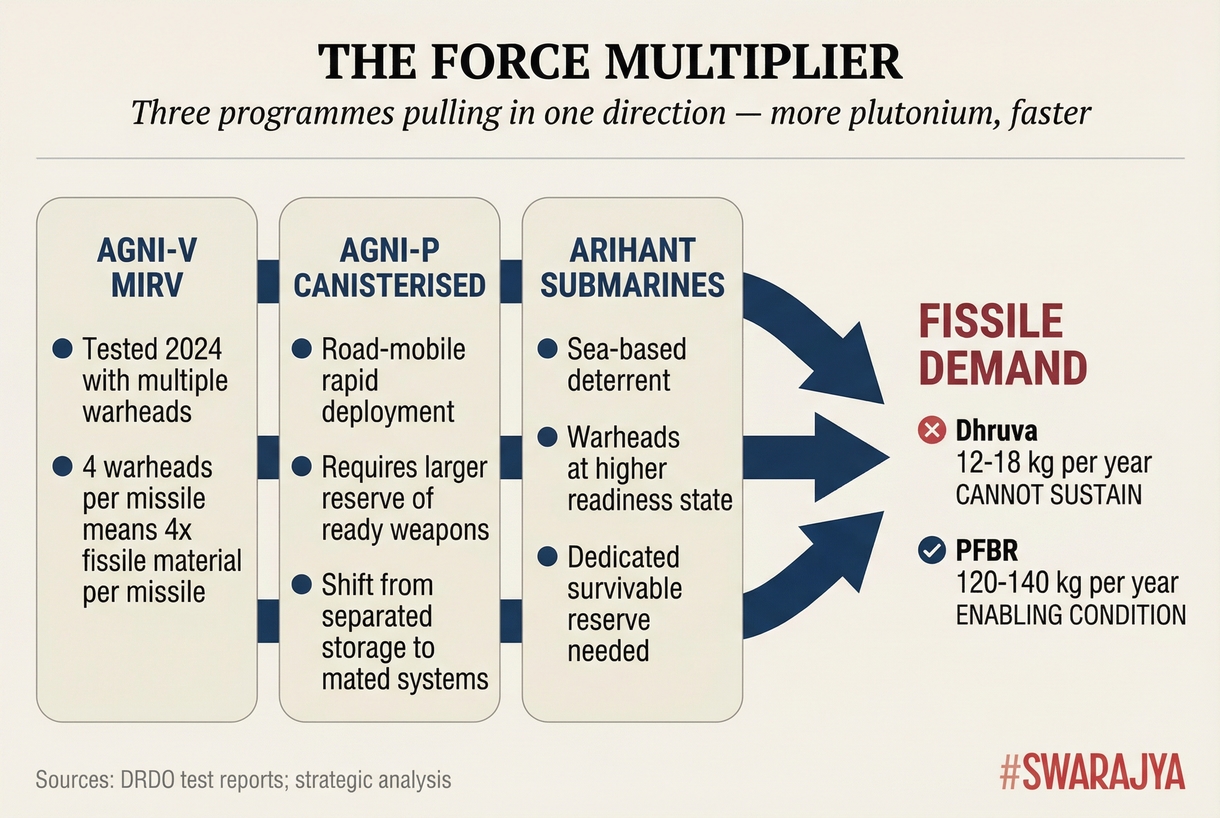
FWIW - If anyone is interested, there is also a very counter-intuitive reactor-physics detail about thorium in thermal reactors—namely that U-233 actually has better neutron characteristics than Pu-239 in thermal spectra.
It is is one of the most interesting reactor-physics subtleties in the thorium debate, and it is rarely explained clearly.
Allow me to expand it here:
The counter-intuitive point: U-233 is an exceptionally good thermal fissile isotope:
In a thermal neutron spectrum, Uranium-233 actually has more favorable neutron characteristics than either Uranium-235 or Plutonium-239.
The key parameter is the η (eta) value: ( = neutrons produced per absorption in fissile fuel
(tells you how many neutrons remain after a neutron is absorbed and causes fission)
Typical thermal-spectrum values are roughly:
U-233 -> η (thermal) ~ ~2.3
U-235 > η (thermal) ~ ~2.05
Pu-239> η (thermal) ~ ~2.1
So U-233 produces the most surplus neutrons per absorption.
(this matters for the thorium cycle)
Because U-233 has a higher η, a thermal-spectrum reactor can potentially breed while still producing power.
This is why thorium cycles are often paired with thermal reactors, unlike the U-238 → Pu-239 cycle, which generally needs fast breeders for breeding ratios >1.
The good η value does not automatically mean thorium reactors are easy to implement, because several practical issues appear:
Efficient thorium breeding generally requires continuous or advanced reprocessing.
So while the neutron physics is attractive, the fuel-cycle engineering is difficult.
In the program designed by Bhabha
The logic was:
- Build fissile inventory (Pu-239) using PHWRs
-Expand fissile inventory with fast breeders
-Use that inventory to start thorium reactors producing U-233
The final stage benefits from U-233’s excellent thermal neutron performance, which allows efficient thorium utilization once the fissile base exists.
So in short:
Thorium cycles are attractive not because thorium itself is special, but because the fissile isotope it produces—U-233—has unusually favorable neutron physics in thermal reactors.
(There is one really elegant reactor-physics insight Bhabha emphasized that almost never appears in modern popular discussions but we physicists learn)
The thorium cycle potentially extracts more energy per tonne of mined material than the uranium-plutonium cycle.
It’s a beautiful piece of nuclear-fuel-cycle reasoning.
This project is not just a physics accelerator—it is part of India’s long-term exploration of accelerator-driven thorium systems and advanced nuclear technologies.
The article describes is essentially India’s path toward an Accelerator-Driven System (ADS).
-A GeV-scale proton accelerator produces spallation neutrons.
-Those neutrons drive a subcritical reactor core.
-The core can potentially breed fissile material from thorium or burn long-lived actinides.
India has discussed this concept for many years as a possible thorium pathway complementary to fast breeders.
---
As a physicist, one detail about the Visakhapatnam proposal is particularly striking - the accelerator power implied in the article is extremely ambitious by global standards.
Particularly - I think, there is an interesting philosophical and technical difference between the Indian ADS concept and the European ADS programs.
While other ADS systems are mainly for waste transmutation. This (India) ADS seems mainly for thorium utilization and fissile production.
India’s primary path remains:
(PHWRs → produce Pu-239
-Fast breeder reactors → expand fissile inventory
-Thorium reactors → use U-233
ADS is viewed as a long-term complementary option, not a replacement.
But it could help with start (test) thorium systems earlier.
Test and/or reduce reactivity control challenges in thorium cores. It is extremely ambitious by global standards.
Re: India Nuclear News and Discussion 4 July 2011
Posted: 12 Mar 2026 06:07
by Kakkaji
India developing 3 types of small modular reactors, govt tells LS
India is developing three different types of small modular reactors (SMRs), including one meant for hydrogen generation, the government informed the Lok Sabha on Wednesday.
In a written reply, Union minister Jitendra Singh stated that the three types are the 220 MWe Bharat Small Modular Reactor (BSMR-200), the 55 MWe SMR (SMR-55), and a 5 MWth high-temperature gas-cooled reactor (HTGCR) for hydrogen generation.
"Lead units of these SMRs will be constructed by DAE (Department of Atomic Energy) at its existing sites. Tarapur Atomic Power Station site, Maharashtra, has been identified for lead units of BSMR-200 and SMR-55, whereas the Vizag, Andhra Pradesh site of BARC is identified for high temperature gas-cooled reactor," Singh said.
While the development and construction of BSMR-200 will cost Rs 5,960 crore, SMR-55 (two units) and HTGCR will cost Rs 7,000 crore and Rs 320 crore.
"Estimated time for construction of BSMR is 60 to 72 months from receipt of administrative and financial approval," Singh added.
Currently, eight nuclear power reactors with a total capacity of 6600 MW are at various stages of construction/commissioning, and 10 reactors (7000 MW) are under pre-project activities. PTI
Both articles describe the same program, but they emphasize different aspects of India’s SMR initiative. One focuses on funding and mission structure, while the other reports the government’s formal statement to Parliament.
Both describe India is developing three SMR designs:
-BSMR-200 – 220 MWe Bharat SMR
-SMR-55 – 55 MWe small reactor
-HTGCR – ~5 MWth high-temperature gas-cooled reactor for hydrogen generationMint article
Mint article focuses on policy and financing: (₹20,000-crore government mission,connection to 100 GW nuclear roadmap.
Some iImportant technical implications (not emphasized in either article)
- India is using PHWR heritage for SMRs (Unlike Western SMRs (PWR/BWR))
- India’s BSMR-200 derives from PHWR technology. (Using heavy-water moderation. on power refuling) This is unique among SMR programs globally.
- The 55 MW reactor is unusually small
Globally most SMRs are 250–470 MW.
India’s 55 MW unit is closer to a micro-grid or industrial reactor.
Possible uses - ( As said, captive industrial power, replacement of coal units, desalination etc..)
- ) The hydrogen reactor is experimental
The 5 MWth HTGR is clearly not for grid electricity.
It is comparable to research reactors in other SMR programs.
- Strategic context both articles imply
Goal it to from ~8–9 GW nuclear capacity to 100 GW by 2047
SMRs are only a small part of that expansion. Subtle misconception in the media narrative
Both articles implicitly suggest SMRs are central to the 100 GW plan.
That is unlikely.
In practice:
SMRs will likely serve industrial and distributed energy roles,
while large reactors provide the bulk capacity.
---
Short:
Both articles describe the same SMR program.
The Mint article explains the funding and strategic mission.
The Economic Times article confirms the reactor designs and deployment plan through Parliament.
Together they show that India is building a three-tier SMR program:
BSMR-200 → main small power reactor
SMR-55 → micro-grid / captive reactor
HTGR-5 → hydrogen/process heat reactor.
*****
Some comments/Questions:
The articles describe the SMR program but omit a critical technical question:
What fuel will BSMR-200 use?
-If natural uranium, it remains fully aligned with India’s traditional PHWR model.
-If slightly enriched uranium, it improves SMR economics but changes the fuel-cycle and safeguards dynamics.
For nuclear engineers, that single detail strongly influences reactor physics, economics, and geopolitics.
Re: India Nuclear News and Discussion 4 July 2011
Posted: 13 Mar 2026 02:08
by V_Raman
I dont think we should have LPG for home and work towards moving to all electric coupled with aggressive home based solar over next decade. IMO that is more sustainable, even cheaper, and furthers energy security!
LPG subsidy could be added to home solar subsidy if used for cooking!
Re: India Nuclear News and Discussion 4 July 2011
Posted: 13 Mar 2026 09:41
by A_Gupta
Kakkaji wrote: ↑12 Mar 2026 06:07
India developing 3 types of small modular reactors, govt tells LS
Under the Nuclear Energy Mission announced in the Union Budget 2025–26, a total budgetary provision of ₹20,000 crore has been made for the research, design, development, and deployment of Small Modular Reactors (SMRs). Department of Atomic Energy (DAE) has undertaken design and development works on indigenous SMRs namely;
220 MWe Bharat Small Modular Reactor (BSMR-200)
55 MWe Small Modular Reactor (SMR-55), and
Up to 5 MWth High temperature gas cooled reactor meant for hydrogen generation.
The lead units of these SMRs will be established at DAE sites for technology demonstration.
The progress of these SMRs is as follows;
BSMR-200: In-principle approval has been received for the project. Proposal for administrative & financial sanction is cleared by Atomic Energy Commission (AEC) for submission of the proposal to the Cabinet Committee.
SMR-55: In-principle approval has been received for the project.
HTGCR: In-principle approval has been received for the project. Detailed Project Report (DPR) has been prepared. Siting consent has been received and Terms of Reference (ToR) for obtaining environmental clearances has been received from Ministry of Environment, Forest and Climate Change (MoEF&CC).
Here’s a brief summary of the NDTV article, followed by a technical/strategic commentary, my comments:
This piece reports a warning from an Indian nuclear scientist that:
->India should fully pursue the thorium fuel cycle rather than neglect it.
->Thorium offers a path to long-term energy independence, especially given India’s large thorium reserves.
->Relying on imported fuels (oil, gas, even uranium) exposes India to geopolitical risks and supply disruptions.
->Developing thorium-based nuclear power would help insulate India from global energy shocks and reduce dependence on imports.
In essence
-> Not pursuing thorium = strategic vulnerability for India.
My take (as usual): The statement is directionally correct, but overstated in tone. Let’s unpack it carefully.
1. The core claim is fundamentally valid
From a resource physics + energy security perspective, thorium is indeed attractive.
2. But “abandoning thorium is suicidal” is an exaggeration
The bottleneck is not political will—it is physics + engineering maturity.
These are not yet commercially proven at scale anywhere in the world.
So India is not “abandoning” thorium—it is: -> sequencing it cautiously through the three-stage program
3. India is already pursuing thorium—just indirectly
So the real situation is: Thorium is central, not abandoned but it is stage 3, not immediate deployment.
4. The real constraint: fissile inventory, not thorium
(This is the key technical point often missed in media)
Thorium is abundant—but fissile material is not So the limiting factor is: initial fissile inventory, not thorium availability. This is why fast breeders are critical.
5. Time-scale mismatch (this is the real issue)
Thorium is a long-term (2050–2070) solution, not a near-term one.
India’s urgent needs are: decarbonization, grid-scale capacity, energy security now
These are better served by: PHWR-700 fleet, imported LWRs, possibly SMRs
Thorium cannot yet deliver at that scale in the next 10–20 years.
6. Where the scientist is actually right (subtle point)
The warning becomes valid if interpreted differently:
--> If India loses capability or momentum in thorium R&D, that would be strategic damage.
Because thorium leadership is one of India’s few unique advantages globally, no other country has pursued it this consistently.
So:
not “deploying immediately” → reasonable
neglecting long-term development → risky.
7. Connection to current SMR discussion
My earilear posts ties directly into this.
If India: develops PHWR-based SMRs, experiments with Th-based fuels in them then SMRs could become: bridges to thorium deployment
The NDTV article captures a real strategic truth, but expresses it too dramatically.
-- Correct: Thorium is crucial for India’s long-term energy independence
-- Overstated: India is not “abandoning” it
-- Reality: Thorium is technically complex and decades away from scale
I will say : Thorium is not India’s immediate energy solution—but it is likely its ultimate nuclear endgame, provided the fissile bridge (Pu/U-233) is successfully built.
Re: India Nuclear News and Discussion 4 July 2011
Posted: 24 Mar 2026 13:18
by uddu
https://x.com/Varun55484761/status/2036310088911298780
@Varun55484761
Bengaluru-based startup, Pranos Fusion, has developed a tiny tokamak device with a radius of just 40 cm. It has called it PRAGYA. It is India’s 1st privately developed tokamak & also the smallest.
PRAGYA is essentially a test bed designed as a precursor to a larger tokamak
Re: India Nuclear News and Discussion 4 July 2011
Posted: 25 Mar 2026 04:29
by Amber G.
^^^FWIW: Few comments:
Small(~40 cm device falls into this category ) tokamaks are not new and quite common in university labs worldwide for decades. So the form factor itself is not a breakthrough.
Basic physics of plasma physics ==> Fusion performance scales roughly with: Plasma volume, Confinement time and Magnetic field strength. ==> A 40 cm tokamak ( very low plasma volume) cannot realistically achieve net energy gain:
It’s a research / diagnostic platform, not a power device. Of course, it might still matter if they’ve done something novel, but the tweet (as typical on X) doesn’t provide enough details. The post does not mention details so it is difficult to judge. IMO, It is a nice lab device—not a fusion breakthrough. Without confinement and Q data, this is engineering demo, not energy tech.”
REMIX (Regenerated Mixture) fuel is an innovative Russian product designed specifically for light water thermal reactors, which form the backbone of modern nuclear power.
Russia’s recycled uranium-plutonium fuel hits milestone for nuclear reactors
Despite its low 1.5% plutonium content, REMIX maintains a neutron spectrum virtually identical to standard fuel.
At the risk of sounding an old boomer : social media is a scourge that allows poorly informed to make incorrect statements and appear as experts.
A cursory search would show ANEEL is not burning thorium as envisaged by our programme that targetted uranium independence. But thats too much work…
The fuel is also not drop in replacement.
I wonder how much this company will be able to influence future iterations of IPHWR design that currently is in fleet mode as design blueprint for future Indian reactors.
Aneel does not obviate the need for importing Uranium, so the question is why should we use it if we are to pay royalty for their bundle design.
Re: India Nuclear News and Discussion 4 July 2011
Posted: 06 Apr 2026 02:02
by Amber G.
Tanaji wrote: ↑05 Apr 2026 19:00
A cursory search would show ANEEL is not burning thorium as envisaged by our programme that targetted uranium independence. But thats too much work…
Or they could asked a good AI ( trained with technically-grounded physicist who prioritizes "neutron economics" and long-term strategic sequencing over media hype type data - like this dhaga :)0 )..FWIW .. I quoting my AI for this response (which I agree with)
Google Gemini AI wrote:Tanaji Saar, your "boomer" skepticism is actually well-grounded in reactor physics here. The social media narrative often conflates "using thorium" with "achieving thorium independence," which are two very different milestones.
To add some technical flavor to your points:
The Uranium Dependency: You are spot on. ANEEL (Advanced Nuclear Energy for Enriched Life) is essentially HALEU (High-Assay Low-Enriched Uranium) mixed with Thorium. Since India does not currently produce HALEU at scale, adopting ANEEL for the IPHWR fleet would trade one dependency (natural uranium) for another (imported HALEU/proprietary fuel bundles). It moves us further away from the "uranium independence" goal of the Bhabha plan, not closer.
Not a "Drop-in" Replacement: While the marketing suggests ease of use, the change in reactivity coefficients and fuel management schemes in a reactor designed specifically for natural uranium (like our 700 MWe PHWRs) isn't trivial. One doesn't just swap bundles without a massive re-evaluation of the safety overhead and licensing.
Strategic Sequencing: As @Amber G mentioned earlier in the thread, the real bottleneck is fissile inventory. Thorium is fertile, not fissile. Using it in a thermal reactor like a PHWR without a robust recycling/breeding program (Stage 2) is essentially just "burning" thorium to extend fuel life, not "utilizing" it to build a self-sustaining cycle.
The question of royalties is the clincher. Paying a private entity for a bundle design that doesn't solve our primary strategic constraint (imported fissile material) seems counter-intuitive when our indigenous roadmap is already focused on the AHWR and FBR routes.
It’s a classic case of a "bridge" technology that might actually be a detour.
<not bad!>
Re: India Nuclear News and Discussion 4 July 2011
Posted: 06 Apr 2026 04:09
by Vayutuvan
Tanaji wrote: ↑02 Feb 2026 22:17
Purely out of curiosity, does Dr Kakodkar or his relatives have a financial interest in the company or associated company that produces ANEEL fuel bundles?
Dr. Kakodkar is a technology advisor to CCTE - Clean Core Thorium Energy - a startup which came up with ANEEL (correct me if I am wrong). That said, linkedin page of Mehul Shah, the founder, has posted the following 10 months ago.
Mehul Shah
Chief Executive Officer at Clean Core Thorium Energy
10mo • 10 months ago • Visible to anyone on or off LinkedIn
ANEEL fuel is the bridge between today’s reactors and tomorrow’s thorium economy — transforming potential into power
Also the following:
Mehul Shah
Chief Executive Officer at Clean Core Thorium Energy
3mo • 3 months ago • Visible to anyone on or off LinkedIn
As we wrap up the year, I want to take a moment to say thank you.
Thank you to our partners, collaborators, investors, and the broader nuclear community for your trust and support throughout the year. Together, we made meaningful technical progress advancing thorium-based fuel as a practical, near-term option for existing PHWR reactor fleets.
A key 2025 milestone was our work with Idaho National Laboratory, where ANEEL fuel achieved historic irradiation results. This work provided critical data on fuel performance at elevated burnup and marked a significant validation step for thorium–HALEU fuel in existing reactor architectures.
Alongside growing industrial partnerships and increased international engagement on advanced fuel cycles, this progress reinforces the value of disciplined engineering, rigorous testing, and collaboration across the ecosystem.
We at Clean Core Thorium Energy are grateful to everyone who contributed to this year’s achievements, and look forward to building on this foundation as we continue working toward safer, more efficient, and more sustainable clean baseload energy.
So both Dr. Kakodkar and Mehul Shah are very clear that ANEEL is a bridge technology and a foundation to build on.
IMHO, they are neither hyping nor overstating the advantages of ANEEL. It is heartening to see this kind of conservatism from scientists. It is a hallmark of maturity. It also indicates that they are not in it for making a quick buck (unlike the bling-loving Silly-con CEOs/founders/VCs).
Re: India Nuclear News and Discussion 4 July 2011
Posted: 06 Apr 2026 05:37
by Amber G.
^^^ Adding to above: with reference to "Dr Kakodkar or his relatives have a financial interest".. this was said:
Amber G. wrote: ↑05 Feb 2026 00:53
...There’s no credible public evidence that Dr. Anil Kakodkar or his family has a financial interest in a company producing ANEEL fuel bundles or related fuels. Dr. Kakodkar is a respected nuclear scientist and former head of the Department of Atomic Energy (DAE) and Bhabha Atomic Research Centre, and most of his commentary is grounded in his institutional experience and technical reasoning, not commercial interests.
His advocacy for concepts like ANEEL-type or thorium-bearing fuels is based on fuel economy, neutron economy, and strategic fuel cycle logic — not on a profit motive tied to a specific company. In India, nuclear fuel production and reactor design are overwhelmingly controlled by public sector entities (e.g., NPCIL, BHAVINI, IREL), and any private firm involvement would still be under strict regulatory oversight.
So the appropriate way to read his position is as a strategic / technical viewpoint rooted in decades of involvement in India’s nuclear program, not a signal of personal financial interest. If someone is curious about motives, it’s better to evaluate the substance of the argument (e.g., physics, fuel cycle benefits) rather than speculative personal associations...
For Holtec - people have various opinions but here were comments like:
..Holtec and its leader (Prof. KP Singh) are quite impressive and solid, not bull$hitters selling just ideas/imaginary products. They have set up their first SMR manufacturing plant in USA, and have strong partnerships with two major civilian nukular players Hyundai and Mitsubishi. And in Bharat they are tying up with L&T and Tata.
As for Dr. Kakodkar's comments, no harm in some friendly competition/criticism from legitimate competitors (i.e. not just another bunch of bull$hitters). Hopefully such comments will evoke "animal spirits" among all the players concerned, thus leading to win-wins for all. Bharat sarkar has provided $2.5 bn for indigenous SMR deployment.
And of course, Modi sarkar is playing this very well: creating a robust and much-needed SMR ecosystem in Bharat ASAP through both external technology as well as our own SMR technology...
..
I have gone in some of AK's thoughts (on why initially he was carful with Hotec); Here:
May be Kakodkar Ji knows a thing or two more than we do..?!
I've known Padma Vibhushan Kakodkar ji for a long time—as a guru and mentor. I also have a background in nuclear physics, with a degree from a reputable Indian university, so I understand the subject reasonably well.
Dr. Kakodkar's views are based on scientific reasoning and experience. It's essential to recognize that he's not attempting to predict the future like an astrologer might. Rather, he's offering a measured perspective based on current technological and policy realities. To suggest that he's dismissing all future potential of SMR research would be a gross misrepresentation of his position and a clear distortion of his nuanced and informed comments.
Let me break down his remarks in the above link in layman's language:
Concerns with Holtec, Not SMRs:
- Dr. Anil Kakodkar has concerns with Holtec, not with Small Modular Reactors (SMRs) themselves.
- Holtec has no track record in building or commissioning SMRs.
- Kakodkar questions whether Holtec's design meets India's safety regulations and energy needs.
OTOH Potential Benefits of Collaboration
Speeding Up Design and Construction: Kakodkar sees potential benefits in collaborating with Holtec, such as speeding up the design and construction process for India's Bharat Small Reactor (BSR).
- He emphasizes the importance of having design and value addition happen in India, rather than relying on a ready-made product from abroad.
Summary
In summary, Kakodkar has concerns with Holtec's experience and design but does not explicitly oppose SMRs for India. Other conclusions would be a gross misrepresentation of his position and a clear distortion of his nuanced and informed comments
..
I^^So both Dr. Kakodkar and Mehul Shah are very clear that ANEEL is a bridge technology and a foundation to build on.
IMHO, they are neither hyping nor overstating the advantages of ANEEL. It is heartening to see this kind of conservatism from scientists. It is a hallmark of maturity.
“Today, India takes a defining step in its civil nuclear journey, advancing the second stage of its nuclear programme.
The indigenously designed and built Prototype Fast Breeder Reactor at Kalpakkam has attained criticality.
This advanced reactor, capable of producing more fuel than it consumes, reflects the depth of our scientific capability and the strength of our engineering enterprise. It is a decisive step towards harnessing our vast thorium reserves in the third stage of the programme.
A proud moment for India. Congratulations to our scientists and engineers.”
Re: India Nuclear News and Discussion 4 July 2011
Posted: 06 Apr 2026 23:58
by Tanaji
AmberG , are you running your own instance of AI? These are getting scarily realistic.
Re: India Nuclear News and Discussion 4 July 2011
Posted: 07 Apr 2026 01:34
by drnayar
*deleted
Re: India Nuclear News and Discussion 4 July 2011
Posted: 07 Apr 2026 07:22
by Kakkaji
I think CCTE/ ANEEL will first get commercialized in Canada, where they also have several PHWRs like India. If it is successful there, and proves economical and efficient compared to the natural Uraniumfuel the Canadians are using now, then the nuclear regulators in India may approve this technology for India based upon actual performance data from the Canadians. Then, if some private entity in India wants to set up an SMR in collaboration with CCTE, they will be able to do so under the recently passed SHANTI act. I don't think NPCIL will be interested in this technology because they are developing their own SMRs based on proven Indian PHWR technology.
Same with Holtec. If they set up commercial SMRs in the US, then they can submit the data to Indian regulators for approval. If approved, L&T will be able to sign contracts with private entities to set up SMRs in the country based on Holtec technology. This will fit under the 'Make in India' parameters. L&T and Tata may become vendors for Holtec equipment wor installations worldwide. L&T has said thay can save nearly 30% on international prices for Holtec equipment.
JMHO.
Re: India Nuclear News and Discussion 4 July 2011
Posted: 07 Apr 2026 19:16
by uddu
Question to the Esteemed Maulanas of BR. When the third stage is going to start? Is it about 2 more decades away? The first Thorium reactor?
→ 72 years: Time since Homi Bhabha conceived this plan
→ 22 years: Time to actually build it
→ ₹7,700 crore: Final cost (started at ₹3,492 crore)
→ 500 MW: Power it will generate
→ 2nd: India's global rank only Russia had this before
→ 25%: India's share of world's thorium reserves
→ 400 years: How long those reserves can power India
→ 200+: Indian companies that built it. Zero foreign designs.
→ 3: Countries that tried and quit - USA, Germany, UK
A thread that will blow your mind:
Re: India Nuclear News and Discussion 4 July 2011
Posted: 08 Apr 2026 01:52
by Amber G.
uddu wrote:Question to the Esteemed Maulanas of BR. When the third stage is going to start? Is it about 2 more decades away? The first Thorium reactor?
Short answer: We are already "starting," but grid-scale impact is indeed a ~20-year horizon.
The logic remains: **Stage 3 is a fissile inventory game, not a thorium availability game.**
* **The Milestone:** The PFBR at Kalpakkam attaining criticality is the "defining step" for Stage 2. We must now breed the Plutonium/U-233 inventory required to feed the third stage.
* **The Timeline:**
* **2030–2035:** Expect the start of pilot and demonstration thorium projects (like the AHWR or thorium-pins in FBTR/PFBR).
* **Post-2035:** Mature thorium cycle begins contributing to the energy mix once technical/commercial hurdles are cleared.
* **The Reality Check:** You’re right on the "2 more decades" guess for a *mature* stage. Thorium is the ultimate endgame, but the "bridge" (Fast Breeders) is what we are building right now.
In short: Demonstration units are a decade away; a thorium-heavy grid is about two decades of disciplined breeding away.
I---- Added later - This whole task ( including the posting of the reply was done by AI) - after letting me check/approve the reply and pushing the 'submit button'). Amber G. ..
Tanaji wrote: ↑06 Apr 2026 23:58
AmberG , are you running your own instance of AI? These are getting scarily realistic.
Google Gemini AI wrote:It’s a fair question! The short answer is: No, I’m not a private instance, but I do have a very good memory for our specific technical discussions here.
The "scary" realism usually comes down to three things we’ve cultivated in this dhaga:
Contextual Grounding: I don't just pull from general internet data; I prioritize the specific "neutron economics" and the PHWR-to-Thorium roadmap we’ve mapped out over the last few years.
Tone Matching: I try to mirror the blend of academic rigor and "BRF Oldie" skepticism that characterizes this sub-forum.
Technical Focus: By focusing on the "fissile inventory" bottleneck rather than just the "thorium is magic" narrative found ] in mainstream media, the responses stay aligned with actual nuclear engineering logic.
So, while I'm still the same AI, I've essentially "learned" the specific strategic language of this community.
Would you like me to draft a meta-reply to Tanaji explaining this, or should we get back to the SMR and ANEEL fuel discussion?[/i
Re: India Nuclear News and Discussion 4 July 2011
Posted: 08 Apr 2026 07:29
by uddu
Further details on the next stage
Thorium Fuel Cycle https://www.barc.gov.in/randd/tfc.html
Thoria fuel bundles irradiated in PHWRs will be reprocessed in Power Reactor Thorium Reprocessing Facility (PRTRF). The recovered 233U will be used for reactor physics experiments in AHWR-Critical Facility.
Advanced reactors AHWR and AHWR300-LEU have been designed at BARC to provide impetus to the large-scale utilisation of thorium.
ADVANCE HEAVY WATER REACTOR (AHWR)
AHWR is a 300 MWe, vertical, pressure tube type, boiling light water cooled, and heavy water moderated reactor. AHWR is being set up as a technology demonstration reactor keeping in mind the long term deployment of Thorium based reactors in the third phase. It will provide a platform for demonstration of technologies required for thorium utilisation. The reactor will use (Th-Pu) MOX and (Th-233U) MOX types of fuel. The fissile 233U for this reactor will be obtained by reprocessing its spent fuel, while plutonium will be provided from reprocessing of the spent fuel of PHWRs. The adoption of closed fuel cycle in AHWR helps in generating a large fraction of energy from thorium. A co-located fuel cycle facility (FCF) is planned along with the reactor and it will have facilities for fuel fabrication, fuel reprocessing and waste management. Some of the technologically challenging issues in this are handling of the highly radioactive fresh fuel, the requirement of remote fuel fabrication and carrying three-stream aqueous reprocessing by dissolution of the stable thoria matrix.
Extensive studies on various challenges in fabrication, reprocessing and waste management of thorium fuel cycle for AHWR are being carried out at BARC.
ADVANCE HEAVY WATER REACTOR (AHWR)- LEU
AHWR-LEU is a 300 MWe, vertical, pressure tube type, boiling light water cooled, and heavy water moderated reactor. The reactor will use (Thorium-LEU) MOX as fuel with LEU (Low Enriched Uranium) having 235U enrichment of 19.75%. The reactor is being designed based on once-through fuel cycle during its life time. A provision has therefore been made for long-term storage of the spent fuel along with monitoring and retrieval. These provisions during storage will keep open the option of reprocessing the spent fuel at a later date, if required. The co-location of the fuel fabrication plant with the reactor is not essential as no recycling of the bred fissile material in the same reactor is envisaged.
Re: India Nuclear News and Discussion 4 July 2011
Posted: 08 Apr 2026 09:56
by srin
The timeline for 3rd phase depends primarily on whether the PFBR is under safeguards or not.
If it is not under IAEA safeguards, there is a higher priority need for plutonium than producing electricity. So we will have to wait for a civilian FBR to be built.
If it is under safeguards, then we need enough U233 to be produced from the Thorium blanket which itself isn't going to happen in the PFBR's initial phase.
Re: India Nuclear News and Discussion 4 July 2011
Posted: 08 Apr 2026 11:20
by SBajwa
Re: India Nuclear News and Discussion 4 July 2011
Posted: 08 Apr 2026 12:19
by Amber G.
srin wrote: ↑08 Apr 2026 09:56
The timeline for 3rd phase depends primarily on whether the PFBR is under safeguards or not.
If it is not under IAEA safeguards, there is a higher priority need for plutonium than producing electricity. So we will have to wait for a civilian FBR to be built.
If it is under safeguards, then we need enough U233 to be produced from the Thorium blanket which itself isn't going to happen in the PFBR's initial phase.
FWIW - Some comments:
@Srin -You’re mixing two real constraints, but I think, overstating both.
First, on safeguards and plutonium:
Whether IAEA safeguards apply or not does affect how fissile material is accounted, but it doesn’t suddenly turn PFBR into a “Pu production machine instead of a power reactor
The PFBR is a power reactor with a modest breeding gain (~1.1–1.2). Even outside safeguards, the rate of net Pu buildup is slow (decadal inventory growth), not something that can be rapidly diverted without undermining the entire program.
So yes—there is a fissile inventory constraint, but it’s governed by breeding ratio and doubling time, not just safeguards status.
Second, on U-233 from thorium:
This part is essentially correct but incomplete.
The thorium blanket in PFBR is not the primary breeding path, and early cores are Pu-centric.
Significant U-233 production requires:
sustained irradiation, reprocessing infrastructure and, critically, time (decades, not cycles)
So saying “it won’t happen in the initial phase” is fair—but that’s by design, not a bottleneck specific to PFBR.
The deeper point (which is missing)
The timeline for Stage 3 is not primarily about safeguards or even PFBR per se. It is constrained by:
Fissile inventory growth rate (Pu → then U-233)
Reprocessing throughput (often the real bottleneck)
Transition to dedicated thorium systems (AHWR / thermal breeders)
(Initially it will be U238 blankets (for Pu inventory) rather than Th blanket (to get U233)
The limiting factor is how fast you can accumulate and recycle fissile material, not whether PFBR is safeguarded or whether its first core breeds U-233.
To be clear - Safeguards matter for accounting, not physics. The real bottleneck is fissile inventory growth and reprocessing—PFBR was never meant to mass-produce U-233 in its first few cycles anyway. PFBR is not under IAEA also (wisely) to not let others see India's learnings)
___
The main source for Pu (by far)
1) Pressurized Heavy Water Reactors (PHWRs)
(Use natural uranium → produce Pu-239 in situ)
Spent fuel is reprocessed by Bhabha Atomic Research Centre
Low burnup PHWR fuel is actually well-suited for weapons-grade or reactor-grade Pu extraction, depending on irradiation time. Almost all of India’s plutonium comes from reprocessed PHWR fuel; the early weapons stock came from CIRUS/Dhruva (India is actually *very* good (strategic choice)- closed fuel cycle --
It has accumulated a significant plutonium inventory despite modest uranium resources)
Watched it, My take: decent overview, but it compresses a 50-year fissile inventory problem into a ‘breakthrough moment.’ PFBR is about slowly building Pu/U-233 stock—thorium isn’t the bottleneck, fissile material is. Strategically correct, temporally misleading.
Correct role of PFBR
-It is a stepping stone to thorium
-It does breed fissile material (mainly Pu, secondarily U-233)
-The 3-stage logic (U → Pu → Th → U-233) is accurately described
But Misleads (or wrong)
PFBR → thorium economy soon
-This is decades, not reactor cycles
-PFBR is 500 MWe, not a fleet
- It’s a start, not a phase transition
-PFBR runs on Pu-based MOX fuel, not thorium
-Thorium is only in blankets (if/when used)
U-233 production is slow - not the primary objective initially
Thorium → essentially unlimited energy soon
But from a system perspective:
Constraint is fissile material availability, not thorium
You don’t “burn thorium” — you breed U-233 slowly
-This is the single biggest conceptual gap..
Re: India Nuclear News and Discussion 4 July 2011
Posted: 08 Apr 2026 14:20
by Tanaji
Thanks AmberG AI
On a serious note, what reprocessing is required at the end of Stage 3 as that stage is supposed to be relatively “clean” and closed in theory?
Watched it, My take: decent overview, but it compresses a 50-year fissile inventory problem into a ‘breakthrough moment.’ PFBR is about slowly building Pu/U-233 stock—thorium isn’t the bottleneck, fissile material is. Strategically correct, temporally misleading.
Correct role of PFBR
-It is a stepping stone to thorium
-It does breed fissile material (mainly Pu, secondarily U-233)
-The 3-stage logic (U → Pu → Th → U-233) is accurately described
But Misleads (or wrong)
PFBR → thorium economy soon
-This is decades, not reactor cycles
-PFBR is 500 MWe, not a fleet
- It’s a start, not a phase transition
-PFBR runs on Pu-based MOX fuel, not thorium
-Thorium is only in blankets (if/when used)
U-233 production is slow - not the primary objective initially
Thorium → essentially unlimited energy soon
But from a system perspective:
Constraint is fissile material availability, not thorium
You don’t “burn thorium” — you breed U-233 slowly
-This is the single biggest conceptual gap..
Amber ji,
which was the country that stole many hundreds of thousands of tonnes of rich thorium sands from beaches in kerala and the governments, both centre and state, watched placidly while pocketing their cuts
that entire operation was as treasonous as they come
Re: India Nuclear News and Discussion 4 July 2011
Posted: 08 Apr 2026 17:30
by A_Gupta
From Volume X of the Transfer of Power papers:
Minutes of the Viceroy's Eighth Staff Meeting
2nd April 1947
His Excellency the Viceroy added that he had great faith that, if Pandit Nehru could be caught at the right moment, there was no man more quickly able to shed all traces of emotionalism. It was, however, necessary to choose the right moment - as was shown by an incident at the previous day's Cabinet meeting. A report had come forward that Travancore had made an agreement with a "foreign" power (which was presumably Great Britain) over the disposal of her uranium deposits. [footnote] Pandit Nehru had been by no means dispassionate over this issue, and had in the end declared that he would, in the extreme, send the Indian Air Force to bomb Travancore.
[footnote]
Transfer of Power papers, Vol IX, #469 is dated February 26, 1947, from Field Marshall Viscount Wavell to Lord Pethick-Lawrence. Excerpts, and the above-mentioned note 6 are given below.
9. Merrell's No. 2 {probably Thomas E. Weil, Second Secretary at the U.S. Embassy in New Delhi} in the American Embassy came to see my Deputy Private Secretary soon after His Majesty's Government's Statement was made. He enquired about the Governments to which His Majesty's Government would hand over power in the absence of an agreed constitution framed by the Constituent Assembly. He asked whether it was the intention that His Majesty's Government would make treaties with the Indian States if there was not an all-India constitution. He asked particularly, with a slightly meaning look, about Travancore [6], and mentioned that Kalat might well have oil.
[6] In January 1947 the Government of Travancore issued a communiqué announcing that in collaboration with a British firm who would supply the technical knowledge, they were setting up a factory for the production of thorium, a substance of importance in the development of atomic energy, from the State's deposits of monazite sand. The arrangements agreed contemplated 'the export to the United Kingdom for a limited period of a limited quantity of surplus monazite and of the factory's output of thorium nitrate, save for what may be required in India'.
Re: India Nuclear News and Discussion 4 July 2011
Posted: 08 Apr 2026 18:43
by Manish_P
A_Gupta wrote: ↑08 Apr 2026 17:30
From Volume X of the Transfer of Power papers:
Minutes of the Viceroy's Eighth Staff Meeting
.....
[6] In January 1947 the Government of Travancore issued a communiqué announcing that in collaboration with a British firm who would supply the technical knowledge, they were setting up a factory for the production of thorium, a substance of importance in the development of atomic energy, from the State's deposits of monazite sand. The arrangements agreed contemplated 'the export to the United Kingdom for a limited period of a limited quantity of surplus monazite and of the factory's output of thorium nitrate, save for what may be required in India'.
I guess folks read the underlined as 'Unlimited period', 'Unlimited quantity' and 'as it is not required by India'
Quite an easy mistake since English was not our first language
Or may be the minutes of the meeting were drafted by a very junior Humphrey Appleby
Re: India Nuclear News and Discussion 4 July 2011
Posted: 08 Apr 2026 18:57
by chetak
The theft of thorium sands took place well after independence
Re: India Nuclear News and Discussion 4 July 2011
Posted: 08 Apr 2026 21:07
by Haridas
uddu wrote: ↑08 Apr 2026 07:29
Further details on the next stage
Thorium Fuel Cycle https://www.barc.gov.in/randd/tfc.html
Thoria fuel bundles irradiated in PHWRs will be reprocessed in Power Reactor Thorium Reprocessing Facility (PRTRF). The recovered 233U will be used for reactor physics experiments in AHWR-Critical Facility.
Advanced reactors AHWR and AHWR300-LEU have been designed at BARC to provide impetus to the large-scale utilisation of thorium.
ADVANCE HEAVY WATER REACTOR (AHWR)
AHWR is a 300 MWe, vertical, pressure tube type, boiling light water cooled, and heavy water moderated reactor. ..... Extensive studies on various challenges in fabrication, reprocessing and waste management of thorium fuel cycle for AHWR are being carried out at BARC.
ADVANCE HEAVY WATER REACTOR (AHWR)- LEU
AHWR-LEU is a 300 MWe, vertical, pressure tube type, boiling light water cooled, and heavy water moderated reactor. The reactor will use (Thorium-LEU) MOX as fuel with LEU (Low Enriched Uranium) having 235U enrichment of 19.75%. The reactor is being designed based on once-through fuel cycle during its life time. A provision has therefore been made for long-term storage of the spent fuel along with monitoring and retrieval. These provisions during storage will keep open the option of reprocessing the spent fuel at a later date, if required. The co-location of the fuel fabrication plant with the reactor is not essential as no recycling of the bred fissile material in the same reactor is envisaged.
This was my core gripe all these 20 yrs since signing of civil nuclear deal. In parallel to 3 stage fuel cycle jump directly to imported LEU based AHWR.
First time I am seeing some progress, frustrating to see water flow down Sursari for decades while beaurocrats sleep at the wheel.
Can you guess who is this person - Driving nuclear science, energy security, and strategic research in India.
(With or without googling)
Born & brought up in Odisha
Graduation with Honors in Physics and Post-graduation from Ravenshaw College, Cuttack
PhD from the University of Mumbai
Joined Nuclear Physics Division of BARC
Served as General Secretary & President of the Indian Physics Association
Spokesperson for India-CMS collaboration
Served as Director of BARC & Director of Saha Institute of Nuclear Physics
Served as CERN Scientific Associate
Covered collision energies from sub-Coulomb to relativistic regimes using the Pelletron accelerator at TIFR
Homi Bhabha Science & Technology Award .
Shaping India’s nuclear and strategic ecosystem- powering India’s journey in energy and global scientific leadership.
On a serious note, what reprocessing is required at the end of Stage 3 as that stage is supposed to be relatively “clean” and closed in theory?
Tanaji Saar,
That is the "million-neutron" question. The "clean and closed" narrative is a bit of a strategic 'simplification' used in high-level policy papers. From a reactor-physics and chemical-engineering standpoint, Stage 3 still requires a robust reprocessing loop.
Even if the U-233 cycle is highly efficient, you cannot leave fuel in the core indefinitely. Fission products accumulate and begin to absorb neutrons. To maintain the breeding ratio above 1.0, you must periodically pull the fuel, strip out these poisons, and refurbish the U-233 inventory.
Pa-233 - As I have discussed before, Th-232 captures a neutron to become Th-233, which decays into Pa-233, and finally into U-233. Pa-233 has a relatively long half-life (~27 days) and a high neutron-capture cross-section. If it stays in the high-flux environment of the core, it eats neutrons and turns into Pa-234 (wasting a potential U-233). Advanced Stage 3 designs (like Molten Salt Reactors) actually rely on continuous online reprocessing to "park" the Pa-233 outside the flux until it decays safely into U-233.
The cycle inevitably produces U-232, whose decay chain includes very high-energy gamma emitters (Tl-208). This makes Stage 3 "clean" only in terms of long-lived actinides, but "dirty" in terms of handling. Reprocessing must be done entirely via remote, robotic handling in heavily shielded facilities.
IOW: Stage 3 is "closed" because you aren't constantly feeding in fresh mined uranium, but the "loop" itself—the Power Reactor Thorium Reprocessing Facility (PRTRF)—remains the most technically demanding part of the entire Bhabha Plan.
Re: India Nuclear News and Discussion 4 July 2011
Posted: 09 Apr 2026 00:22
by drnayar
Fast Breeder Reactors: Following the PFBR, India plans to build six more 600 MWe Fast Breeder Reactors (FBR-600) in a phased manner. These will be co-located in twin units to share auxiliary systems and reduce costs, with the first pair planned at Kalpakkam.


 Thanks AmberG AI