Why the biggest Baloch attack in decades is a wake-up call for US, China
A series of coordinated attacks by BLA rebels across Pakistan's province of Balochistan is a wake-up call to both the US and China. Both countries have high stakes in Balochistan centred around resource extraction and access to alternative trade routes. These moves are fuelling the wave of BLA attacks that have struck Pakistan in the past few years.
Pakistan saw one of its largest attacks by Baloch rebels in decades on Saturday, when across Balochistan, rebels from the Balochistan Liberation Army (BLA) carried out coordinated suicide bombings and attacks targeting civilians, police, military, and paramilitary installations, marking one of the deadliest days in the province.The scale of the assault serves as a warning for the US and China, both with significant stakes in the region. Despite being underdeveloped, Balochistan holds vast reserves of natural gas and rare minerals, attracting heavy investment from Pakistan, China (via CPEC infrastructure), and growing US interest in critical minerals.
Today's attacks in Balochistan should serve as a wake-up call to those, including in the White House, keen to invest in Pakistan's critical mineral reserves. One of the BLA's core grievances is external exploitation of local resources. The Balochistan Liberation Army (BLA) on Saturday launched coordinated bombings and attacks, dubbing it "Herof 2". Herof is a Balochi literary term meaning "black storm", commonly used in Baloch poetry, including by veteran poet Karim Dashti, according to the news outlet, The Native Voices.
While Herof 1, launched in 2024, largely restricted BLA activity to attacks on security personnel, the scale and scope of Herof 2 were wider. According to the South Asia Terrorism Portal, citing The Express Tribune and Pakistani military statements, synchronised gun and bombing attacks struck Quetta, Noshki, Mastung, Dalbandin, Kalat, Kharan, Panjgur, Gwadar, Pasni, Turbat, Tump, Buleda, Mangochar, Lasbela, Kech, and Awaran, targeting government buildings, security installations and civilians.
An officer from Pakistan's Intelligence Bureau in Quetta told The Native Voices that between 800 and 1,000 fighters, including a few women, might have been involved in the coordinated attacks. The BLA has not confirmed anything about these figures.
In Quetta, heavily armed rebels attacked multiple police stations and mobile units, detonated explosives in Hockey Chowk and also struck multiple key arterial roads in the city .In Mastung, rebels struck the Central Prison with gun and bomb attacks, managing to free at least 30 prisoners. In Gwadar, rebels targeted a camp housing migrant workers, killing 11 people, including women and children, a senior police officer told Reuters. Clashes were reported near the Deputy Commissioner's headquarters and Police Lines in Kalat, while in Nushki, rebels abducted Deputy Commissioner Hussain Hazara and his family.
A Coast Guard post in Pasni was attacked, highways were shut in Bolan, Lak Pass and Qila Saifullah-Rakhni, and explosives planted on a railway line in Nasirabad were defused. Media reports put the death toll as reaching 200. The figure includes at least 31 civilians and 17 security service personnel, the region's Chief Minister Sarfraz Bugti said, while the military claimed it killed at least 145 BLA rebels.BLA spokesperson Jeeyand Baloch rejected these claims, saying 84 personnel of the Pakistani army, police, intelligence agencies and CTD were killed and 18 captured alive, while seven BLA fighters died, including four who carried out fidayeen attacks inside military facilities, according to a report from The Balochistan Times.
WHY IS BALOCHISTAN IMPORTANT TO PAKISTAN?
Balochistan, Pakistan's largest province by area, holds major strategic importance because of its location, bordering Iran and Afghanistan and providing access to the Arabian Sea. According to Risk Intelligence, this geography makes the province a key gateway for regional trade and connectivity. The deep-sea port at Gwadar, developed under the China-Pakistan Economic Corridor (CPEC), is positioned as a hub linking China, Central Asia and the Middle East, strengthening Pakistan's role in global trade and energy routes.The province is also rich in natural resources. According to EBSCO Research Starters, Balochistan holds significant reserves of natural gas, coal, copper, gold and rare earth minerals, including the Sui gas field, a major contributor to Pakistan's energy supply.
The Baloch Liberation Movement is a crisis which has been decades in the making. Since 1948, Pakistani security forces have repeatedly clashed with Baloch rebels in their bid to suppress sentiments of independence rife in Balochistan. Despite this, the Baloch Liberation movement is at its strongest ever, as evidenced by multiple attacks by BLA rebels since 2020. The BLA have given many reasons to justify their desire to liberate Balochistan from Pakistan. And one of them particularly stands out. One of the BLA's core grievances is external exploitation of local resources. The BLA opposes Pakistan largely because it views the central government as exploiting the province's vast natural resources, including natural gas from the Sui fields, copper, gold, and other minerals — while delivering minimal benefits to the local Baloch population.
Balochistan is Pakistan's poorest province, with low royalties for Balochi resources reaching the local population (around 12.5% for gas) often reduced further, fuelling perceptions of colonial-style extraction by the Punjab-dominated Islamabad. The primary motivation driving their interests in the region is the extraction of resources to fuel their industries, something the BLA is opposed to. This was made clear, for instance, when in 2023, BLA rebels ambushed a convoy of Chinese engineers in Balochistan, killing at least four Chinese nationals. Similarly, another convoy was ambushed by BLA rebels in 2024, killing at least two Chinese nationals.The scale of the BLA's attacks show that economic ambitions in Balochistan cannot be separated from the region's grievances.
Terroristan - March 31, 2022
Re: Terroristan - March 31, 2022
There was an extract from the speech of ADG Strat Communications in some forum that was tweeted by ANI last week. He talked about the sheer deluge of cyber attacks and 'Misinformation, Disinformation and Malinformation' by Pakistan right from the word go. 3 crore cyber attacks on NSE itself were recorded. I think it is time to consider the Pakistani Info and Cyber Warfare setups also as legitimate targets for kinetic operations in the next round.
Have shared some thoughts on that along with some media.
Twitter Link
Blog Link
Have shared some thoughts on that along with some media.
Twitter Link
Blog Link
On Blurring the Line Between Cognitive and Kinetic Warfare
What caught my attention was the very specific statistics that General Sharda put out in his talk.
However, the most interesting part was the fact that the attacks were launched within 30-40 minutes.
THIS is what caught my interest.
Let me explain why.
The sheer numbers of attacks and their ‘bombardment’ through cyberspace within 30-40 minutes means that the Paakis were already prepared even before the first Indian munition was fired on 7th May 2025.
They knew India would attack. And they were prepared for it.
They were prepared not only militarily, but also in terms of info warfare and cyber attacks. I think it would be a fair assumption that such planning would already have been in place since long. And when the time came, it all was let loose in a torrent.
This was the same template that they let loose during Balakot when the then Propagandu-in-Chief was the first one to announce the strikes, thereby taking the initiative in the war of narratives.
First ‘true visuals’ of the strike too were let out on social media by the same Propagandu-in-Chief soon thereafter. In doing so, Bhikharistan took a lead on the narrative front.
How effective that was the long run, I shall discuss later in this article.
My reason for bringing that out all over again was to highlight the fact that Paakis flooded the social media landscape with so many falsehoods and different versions of actual truth that true facts virtually drowned in that deluge.
As Maj Gen Sharda mentioned in his video embedded in the first tweet, we were bombarded with ‘Misinformation, Disinformation and Malinformation’ on the first day of Op Sindoor.
Hereinafter, as per Paaki plan, we were to once again be playing catch-up on narrative front while military facts would get obliterated under this flood of ‘Misinformation, Disinformation and Malinformation.’
Unfortunately, Paakis were once again caught fighting the previous war!
This time, there was no questions of missing visuals of Indian attacks and utter and complete impotence of the Brown Panted Ones to either prevent them or retaliate against them.
This time the Awaam themselves provided proof.
.
.
Btw, don’t miss what is said in the video above.
A minister in Pakistan Govt announces publicly in their very SENATE that they have attacked Indian Dams via a cyber attack.
What bigger a smoking gun can we ask for?
IMO, in this instance of Op Sindoor, the battle was convincingly won by India both in the Kinetic as well as the Cognitive Domain.
However, fact remains that even though Kinetic engagements may have petered down, attacks in the Cognitive domain still continue. The good General himself says so.
This is where I come to the question that triggered this chain of thoughts :
Is it time to consider Kinetic actions against warriors of the Cognitive domain as well, whenever the inevitable next round comes?
Mull over it for a moment before moving ahead.
Personally, I most definitely believe that time has come to physically eliminate the IW infrastructure, including its manpower, whenever the next opportunity presents itself.
A keyboard warrior in today’s world is just as lethal as one with a rifle in his hand.
Period.
.
.
It is a given that info warfare is a highly delegated operation with multiple nerve-centres feeding millions of individual social media users. However, fact remains that nerve centres play a highly important role in setting narratives and giving course-corrections wherever needed. While Info Warfare goes on unabated across national boundaries and without any distinction between uniformed and non-uniformed ‘warriors’, official information channels still play a key role in providing critical raw material for manipulation on social media.
These nerve-centres are what are identifiable on ground & should ideally form part of the target list whenever the next Indian missiles & bombs fly Westwards. By choking the flow of info from official channels thru physical elimination, Info Ops on the other side will definitely be hobbled.
.
.
The beast needs to be dealt with, not just in the same coin, but with brute physical force.
Once again, as General Sharda mentioned in the video above : ‘War is about making the adversary submit to your Will.’
To that I shall add that any & every means towards achieving that end is justifiable. Even if it means physically destroying the network supplying narratives & inputs to Info Warriors, as well as Info Warriors themselves.
THIS is the sum total of what I want to say via this blog post.
As far as the ‘FANTASTIC’ Bhikharistani win of Feb 2019 goes, it did them a fat load of good barely 6 months later when India abrogated Article 370 and all that they could do was make a song and dance about it!
Re: Terroristan - March 31, 2022
Meanwhile, some social media handles were reporting of attacks on Chinese compounds in Gwadar as well yesterday.
Re: Terroristan - March 31, 2022
Most indications are that Pakistan is excluded from the February 4, 2026 Critical Minerals Ministerial meeting being hosted by the US Secretary of State, Marco Rubio.

Re: Terroristan - March 31, 2022
They are just a Bunch of thugs
And OM is a super-T, he wont get fooled.
And OM is a super-T, he wont get fooled.
Re: Terroristan - March 31, 2022
Also anyone read Venkat Dhulipala's book : Creating a new Pudina (sorry Venkatji)
In the introduction he writes about these guys and their post Independence prevarications about the state of affairs in the shitistan!!
The period is post Djinnah's meeting the 72.
At a very high level a seance is conducted to seek guidance from the Jinn of Djinnah!!. I am not joking. He came acroos a document to this effect in the British archives on India Papers (how tht document found its way to Bratanistan nobody knows!!)
Anyways back to the Oujah board:
The medium politely welcomes the Jinn and asks him to take a seat.Djinnah tersely says he has already seated!!.
The medium then enquires about his stay and health upstairs as last time they spoke Djinnah had mentioned he was in a dark and cold place.
Jinn says he is in a bright warm place and comfortable now!!

The question is then put to the jinn how can pakistan navigate through difficult period (in the 50's ) and what does he forsee for the Riyasate Pudina!!
Djinnah says he sees dark future and hardship. He says people holding the helm are not selfless. He exhorts Selfless Selfless Selfless to save Pudina.
I found this hilarious that they were doing Jinn magic right after the independence!! and asking for Jinn intervention to save the bunch of Pudina!!
In the introduction he writes about these guys and their post Independence prevarications about the state of affairs in the shitistan!!
The period is post Djinnah's meeting the 72.
At a very high level a seance is conducted to seek guidance from the Jinn of Djinnah!!. I am not joking. He came acroos a document to this effect in the British archives on India Papers (how tht document found its way to Bratanistan nobody knows!!)
Anyways back to the Oujah board:
The medium politely welcomes the Jinn and asks him to take a seat.Djinnah tersely says he has already seated!!.
The medium then enquires about his stay and health upstairs as last time they spoke Djinnah had mentioned he was in a dark and cold place.
Jinn says he is in a bright warm place and comfortable now!!
The question is then put to the jinn how can pakistan navigate through difficult period (in the 50's ) and what does he forsee for the Riyasate Pudina!!
Djinnah says he sees dark future and hardship. He says people holding the helm are not selfless. He exhorts Selfless Selfless Selfless to save Pudina.
I found this hilarious that they were doing Jinn magic right after the independence!! and asking for Jinn intervention to save the bunch of Pudina!!
Re: Terroristan - March 31, 2022
https://www.indiatoday.in/sports/cricke ... 2026-02-04
T20 World Cup: Pakistan PM confirms no change in India boycott stance
Pakistan Prime Minister Shahbaz Sharif confirmed that Pakistan will not play against India in the T20 World Cup 2026 group stage.
Amar Sunil Panicker, India Today Sports Desk, Feb 5, 2026
The Pakistan Prime Minister once again confirmed that their senior men's national cricket team would not be playing India in the upcoming ICC Men's T20 World Cup 2026, co-hosted by India and Sri Lanka, during the group stages.
Speaking while addressing the federal cabinet in Islamabad, he iterated how they wanted to take a clear stand regarding the matter and would not play India.
“We have taken a clear stand regarding the T20 World Cup that we will not play the match against India,” the Pakistan Prime Minister said.
“We have taken this stand after deliberating on it carefully,” he said, calling it an “appropriate decision."
India is meant to play Pakistan on Sunday, February 15, at the R Premadasa Stadium in Colombo. Following the group-stage fixture, the two teams could be up against each other in the final as well. Although it remains unclear what Pakistan's stance is if they play India for the title.
......
Gautam
I hope ICC makes this decision expensive for Pakistan.
T20 World Cup: Pakistan PM confirms no change in India boycott stance
Pakistan Prime Minister Shahbaz Sharif confirmed that Pakistan will not play against India in the T20 World Cup 2026 group stage.
Amar Sunil Panicker, India Today Sports Desk, Feb 5, 2026
The Pakistan Prime Minister once again confirmed that their senior men's national cricket team would not be playing India in the upcoming ICC Men's T20 World Cup 2026, co-hosted by India and Sri Lanka, during the group stages.
Speaking while addressing the federal cabinet in Islamabad, he iterated how they wanted to take a clear stand regarding the matter and would not play India.
“We have taken a clear stand regarding the T20 World Cup that we will not play the match against India,” the Pakistan Prime Minister said.
“We have taken this stand after deliberating on it carefully,” he said, calling it an “appropriate decision."
India is meant to play Pakistan on Sunday, February 15, at the R Premadasa Stadium in Colombo. Following the group-stage fixture, the two teams could be up against each other in the final as well. Although it remains unclear what Pakistan's stance is if they play India for the title.
......
Gautam
I hope ICC makes this decision expensive for Pakistan.
Re: Terroristan - March 31, 2022
Here we go Green and Green on Friidin'' started again!.
Shias attacked.
This is used to be norm in early 90's
Had eased up because they were asked to join together (Shias, Sunnis and Ahmadiyas) and attack India given that Congis had given them a free rein!!
Now you know why Pakis, Echosystem, western liberals were against CAA.
Pakistan should have been named Pakjabistan or Punjistan or Punkistan.
They used the UP Momeens specifically (but momeens elsewhere as well) to get an independent state.
Djinnah was a sly fellow who amanaged to merge MUB, AIMC, Unionist party muslim members, NAP muslim members to join ML ultimately.
The Nawabzadas,Nawabs, Zamindars all wanted to save the land holding as INC wanted to bring in Land reforms. ML did not promise land reforms
Now back to Green on Green: They dont want any non punjabi speaking Sunnis, Shias and Ahmadiyas more so.
CAA would stop them from coming to their so called Watan!!
Shias attacked.
This is used to be norm in early 90's
Had eased up because they were asked to join together (Shias, Sunnis and Ahmadiyas) and attack India given that Congis had given them a free rein!!
Now you know why Pakis, Echosystem, western liberals were against CAA.
Pakistan should have been named Pakjabistan or Punjistan or Punkistan.
They used the UP Momeens specifically (but momeens elsewhere as well) to get an independent state.
Djinnah was a sly fellow who amanaged to merge MUB, AIMC, Unionist party muslim members, NAP muslim members to join ML ultimately.
The Nawabzadas,Nawabs, Zamindars all wanted to save the land holding as INC wanted to bring in Land reforms. ML did not promise land reforms
Now back to Green on Green: They dont want any non punjabi speaking Sunnis, Shias and Ahmadiyas more so.
CAA would stop them from coming to their so called Watan!!
Re: Terroristan - March 31, 2022
Gautam ji, Pakistan is putting up a show to impress BD and other Muslim countries and it might still buckle in the last minute trying to get the best of both the worlds. However, ICC shouldn't need to plead with it. It must leave it to its own devices and non-existent wisdom.
Re: Terroristan - March 31, 2022
^^^^
The boycott match will sink Pakistan cricket further into mediocrity or worse. Their share of future ICC revenues is hugely at risk. Seriously dumb move with zero upside for them.
The boycott match will sink Pakistan cricket further into mediocrity or worse. Their share of future ICC revenues is hugely at risk. Seriously dumb move with zero upside for them.
Re: Terroristan - March 31, 2022
https://www.aljazeera.com/news/2026/2/6 ... -islamabad
Back to normal Fridays in Pak, after a lull.
A successful attack in the most heavily policed area in Pak.
Back to normal Fridays in Pak, after a lull.
A successful attack in the most heavily policed area in Pak.
Re: Terroristan - March 31, 2022
^^^ Any insight into the timing of the attack on Shias? (or why the lull?)
And of course, "Defence minister points finger at India and Afghanistan".
And of course, "Defence minister points finger at India and Afghanistan".
Re: Terroristan - March 31, 2022
^^^ Guptaji
to answer you need to know two things:
1. Who funds the various groups?
2. Why so now?? these fractures
Historical fact : Gen Zia went full Sunni in the 80's. This was both a military tactic and get much needed funding for modernisation of Army.
Soviet cooupation gave him huge opportunity: funding from not only the Muslim world but also from West ioncluding legitimacy for his government and its actions.
Remeber muslim funding was from both the major branches of islam during the initial phase of american action of soviet occupation.
But as days went by he turned more Nizam e Mustapha and more Sunni.
Iran continued but covertly to the shia groups. KSA likewise for the Sunni.
So questuon 1. Who funds:
States: KSA, UAE, Iran, Oman and Qatar.
Non State : Private funding from Individuals or groups from Gulf countries with a religious itch.
WEstern : covertly through shady organisation.
2. Coming to the question why now??
There is so much angst in the Muslim world about Pakistan actions as a state : Sudden U turns, Sucking up to China and silent on Uyghurs, RE aligbnment with USA given the Paletine deaths and destruction and most unholy to take up arms against Hamas (potentially)
So this is a way of weaking the state without actually attacking
So think about :
Identity fracture : Shia , Sunni, Ahmadiaya
deligitimizing the state as : Western Puppet, Taghut, Enemy of Ummah
Institutionally incoherent: constant u turns and presenting the arse either to China or USA
Economically Weak
No Legal writ of the state.
So all in all a failed state wihout being labelled a 'Failed State'
Will other regional coutries want it: Hell Yes
India definitely
Afghans have never really recognised Durand Line
Iran: given pakistan perfidy or perceived perfidy in allowing US to start certain activites
And in this one fundamental Issue you have to remmber is : Pakistan was collection of motley group with n o real cohesion when it came about. Even Djinnah complained about the Moth eaten state he inherited. Take the Nara e takbeer out, there is nothing unifying them
They are constantly looking for an identity and unifying factor.
There is an interesting photo circulating in Facebook : Pakistan claiming they have first University before the West. The hae a photo of Momeens and Ayweshas sitting infornt of a Hafiz or Shayak teaching. And the title says Taxilla University in Paksitan
to answer you need to know two things:
1. Who funds the various groups?
2. Why so now?? these fractures
Historical fact : Gen Zia went full Sunni in the 80's. This was both a military tactic and get much needed funding for modernisation of Army.
Soviet cooupation gave him huge opportunity: funding from not only the Muslim world but also from West ioncluding legitimacy for his government and its actions.
Remeber muslim funding was from both the major branches of islam during the initial phase of american action of soviet occupation.
But as days went by he turned more Nizam e Mustapha and more Sunni.
Iran continued but covertly to the shia groups. KSA likewise for the Sunni.
So questuon 1. Who funds:
States: KSA, UAE, Iran, Oman and Qatar.
Non State : Private funding from Individuals or groups from Gulf countries with a religious itch.
WEstern : covertly through shady organisation.
2. Coming to the question why now??
There is so much angst in the Muslim world about Pakistan actions as a state : Sudden U turns, Sucking up to China and silent on Uyghurs, RE aligbnment with USA given the Paletine deaths and destruction and most unholy to take up arms against Hamas (potentially)
So this is a way of weaking the state without actually attacking
So think about :
Identity fracture : Shia , Sunni, Ahmadiaya
deligitimizing the state as : Western Puppet, Taghut, Enemy of Ummah
Institutionally incoherent: constant u turns and presenting the arse either to China or USA
Economically Weak
No Legal writ of the state.
So all in all a failed state wihout being labelled a 'Failed State'
Will other regional coutries want it: Hell Yes
India definitely
Afghans have never really recognised Durand Line
Iran: given pakistan perfidy or perceived perfidy in allowing US to start certain activites
And in this one fundamental Issue you have to remmber is : Pakistan was collection of motley group with n o real cohesion when it came about. Even Djinnah complained about the Moth eaten state he inherited. Take the Nara e takbeer out, there is nothing unifying them
They are constantly looking for an identity and unifying factor.
There is an interesting photo circulating in Facebook : Pakistan claiming they have first University before the West. The hae a photo of Momeens and Ayweshas sitting infornt of a Hafiz or Shayak teaching. And the title says Taxilla University in Paksitan
Re: Terroristan - March 31, 2022
^^^ pakis claiming Taxila as their heritage is hilarious.
Re: Terroristan - March 31, 2022
“ The Islamic State Khorasan Province (ISKP) has claimed responsibility for the fidayeen suicide bombing” - I am not sure how reliable this is.
___
Azernews says: (Azerbaijani news)
https://www.azernews.az/region/254062.html
___
Azernews says: (Azerbaijani news)
https://www.azernews.az/region/254062.html
The smoke has cleared from the ruins of the Khadijatul Kubra Mosque, but the acrid stench of failure now hangs over the entire capital.
…
This atrocity is no mere "isolated incident"it is a searing indictment of the Shehbaz Sharif government's catastrophic incompetence, a regime that prioritizes political survival over the sanctity of human life.
..
The 2023 Peshawar mosque bombing, which obliterated over 100 lives inside a purportedly fortified police compound, should have been the catalyst for sweeping reforms. Instead, it revealed the same festering decay: intelligence blackouts, woefully inadequate protections for vulnerable sites, and a government entangled in political intrigue rather than resolute counter terrorism.
Today's carnage in Islamabad, the epicenter of national power, housing federal institutions, foreign embassies, and military bastions—lays bare the depths of this negligence. Despite a labyrinth of checkpoints, surveillance networks, and patrols that ostensibly safeguard the elite, a bomber infiltrated a mosque during peak prayers, exposing a security perimeter as porous as it is performative. Shia leaders had issued repeated alerts about escalating threats, including suspicious loitering around religious sites, yet security provisions remained superficial at best. The Islamabad Police's delayed arrival, hampered by "jurisdictional hurdles" in a city engineered for rapid response, is nothing short of criminal dereliction. How could explosives breach the capital's defenses? The answer reeks of misplaced priorities: billions siphoned into military escapades against phantom external foes, while domestic militancy thrives amid economic collapse and political paralysis.
..
Law enforcement institutions, gorged on taxpayer funds yet riddled with corruption and cronyism, share the bloodstained blame. The Punjab Police and federal agencies boast a sordid history of dismissing minority pleas for safeguards, as evidenced by assaults on Ahmadiyya mosques where officers have not only failed to intervene but occasionally spearheaded the vandalism.
..
At the apex of this institutional rot stands Interior Minister Mohsin Naqvi, whose stewardship of internal security has proven disastrously inept. Appointed in March 2024 amid controversy over his media empire and concurrent role as chairman of the Pakistan Cricket Board, Naqvi's divided loyalties symbolize the government's frivolity—prioritizing cricket spectacles over countering terror.
Re: Terroristan - March 31, 2022
^^ Saar
ISKP are the new tool of the TSP!!
They were placed in Balochistan to counter BLA but have been batted out by BLA.
Likewise TTP are hitting them on both sides of the Durand Line.
This could be :
1. to take the world attention off Baloch attacks ( and the usual rhona of we are the victims of terrorism)
2. Trial runs to what is to come in future.
They are being now based in Gilgit as per some reliable sources. People living in certain parts of Gilgit have been given days to vacate their villages and leave.
Also remember you had Hamas entering POK.
Please expect attacks on both sides of Gilgit, meaning Northern Afghanistan, ??Tajikistan and of course Kasmir valley.
Failed Marshall is calcularting on non-state actors to create enough issues around TSP borders to take the world attention off Balochistan!!
ISKP are the new tool of the TSP!!
They were placed in Balochistan to counter BLA but have been batted out by BLA.
Likewise TTP are hitting them on both sides of the Durand Line.
This could be :
1. to take the world attention off Baloch attacks ( and the usual rhona of we are the victims of terrorism)
2. Trial runs to what is to come in future.
They are being now based in Gilgit as per some reliable sources. People living in certain parts of Gilgit have been given days to vacate their villages and leave.
Also remember you had Hamas entering POK.
Please expect attacks on both sides of Gilgit, meaning Northern Afghanistan, ??Tajikistan and of course Kasmir valley.
Failed Marshall is calcularting on non-state actors to create enough issues around TSP borders to take the world attention off Balochistan!!
Re: Terroristan - March 31, 2022
SRajesh wrote: ↑08 Feb 2026 15:09 ^^ Saar
ISKP are the new tool of the TSP!!
They were placed in Balochistan to counter BLA but have been batted out by BLA.
Likewise TTP are hitting them on both sides of the Durand Line.
This could be :
1. to take the world attention off Baloch attacks ( and the usual rhona of we are the victims of terrorism)
2. Trial runs to what is to come in future.
They are being now based in Gilgit as per some reliable sources. People living in certain parts of Gilgit have been given days to vacate their villages and leave.
Also remember you had Hamas entering POK.
Please expect attacks on both sides of Gilgit, meaning Northern Afghanistan, ??Tajikistan and of course Kasmir valley.
Failed Marshall is calcularting on non-state actors to create enough issues around TSP borders to take the world attention off Balochistan!!
SRajesh ji,
mohsin naqvi, (federal minister for interior and narcotics control) and bilawal bhutto are shias
the failed marshal is married into a shia family
The attacks on the shia mosques are a standard diversionary tactic of the paki army
trump seems to have abandoned the pakis, leading to a lot of churning in the jihadi ecosystem
when the pakis jubilantly thought that they were playing trump, he was playing them, leaving sharif and munir with egg on their faces
two conmen countries and each thought that they were playing the other.
trump is doing the same with zelenski and he tried to do the same with Modi ji
The jaffar express train, for the first time has now been attacked in sindh (on 26 jan). The paki army is now actually scared to enter many of these areas in sindh as well as, baluchistan
the cheen may well have fled gwadar
Many IOUs will become payable very soon. UAE is insisting on the immediate return of it's some $billions given to the pakis, along with interest.
baluchistan and sindh are increasingly looking like a "buy one get one free" offer
katora kammandos have already reached the UAE and are desperately begging for an "extension", after signing a mutual defence treaty with the saudis against the UAE
closer home, it looks like both rana ayub and tharoor's son ishan have been sacked by wapo during the recent purge
Re: Terroristan - March 31, 2022
A_Gupta ji,
there are goras pushing this point of view.
There is a serious effort to insinuate that Hindu and jihadi have a shared civilizational ancestry and culture so that even if the Hindu's were to be wiped out, the jihadi part would still safeguard and protect that Indian civilizational structure, so nothing is lost if the Hindus were to cease to exist
these very same gora creeps do not dare to flip this argument
If anyone here has ever flown any international PIA flight, they will attest to the fact that the jihadi hostesses stress this ancient India heritage very strongly and suggestively. In fact many wretched pakis are of the view that the very name "INDIA" is their civilizational property and the "cunning" Hindus have stolen it from under their noses
-
S_Madhukar
- BRFite
- Posts: 1127
- Joined: 27 Mar 2019 18:15
Re: Terroristan - March 31, 2022
Well they recently celebrated Basant, sucking up to Banga for some loans, …. In fact recently saw the great drunkard Nissar dreaming he wished the 3 N powers of S Asia would sit together and talk instead of licking American boots.. there would be peace etc etc.. all points to them trying to claim they have stopped drinking while the addicts are somewhere else… next stop will be like Pappoz embrace or feet touching of Mudi…
Re: Terroristan - March 31, 2022
Cross posting from sports dhaaga:
The OG katora chhaaps tried to shakedown the ICC and BCCI using the OG ingrates as a pawn. The ICC refused to buckle down and showed them their aukaat… Jay Shah didn’t even deign to go and meet the cup thief in all of this and sent his lackeys.
Katori laals have backed down and will now play India as agreed.
The OG katora chhaaps tried to shakedown the ICC and BCCI using the OG ingrates as a pawn. The ICC refused to buckle down and showed them their aukaat… Jay Shah didn’t even deign to go and meet the cup thief in all of this and sent his lackeys.
Katori laals have backed down and will now play India as agreed.
Re: Terroristan - March 31, 2022
Tanaji wrote: ↑10 Feb 2026 00:19 Cross posting from sports dhaaga:
The OG katora chhaaps tried to shakedown the ICC and BCCI using the OG ingrates as a pawn. The ICC refused to buckle down and showed them their aukaat… Jay Shah didn’t even deign to go and meet the cup thief in all of this and sent his lackeys.
Katori laals have backed down and will now play India as agreed.
Tanaji saar,
These katoras have shown their true aukat and also their utter lack of institutional character
Na Biwi Na Bachha Na Baap Bada Na Maiyan,
The Whole Thing Is That Ke Bhaiya Sabse Bada Rupaiya
Re: Terroristan - March 31, 2022
Jinn Time
https://timesofindia.indiatimes.com/wor ... 861884.cms
In a bizarre case, police in Pakistan’s Rawalpindi district registered a case on Sunday of abduction against a “jinn” (supernatural spirit) following the disappearance of an 11-year-old boy, news agency ANI reported, citing ARY News.The incident occurred in the garrison city when the boy went missing from his home on January 21. After ten days without any sign of the child, his father approached the Taxila Police Station and filed a First Information Report (FIR).In the FIR, the father alleged that supernatural entities, known locally as jinns, had forced his son to run away
https://timesofindia.indiatimes.com/wor ... 861884.cms
In a bizarre case, police in Pakistan’s Rawalpindi district registered a case on Sunday of abduction against a “jinn” (supernatural spirit) following the disappearance of an 11-year-old boy, news agency ANI reported, citing ARY News.The incident occurred in the garrison city when the boy went missing from his home on January 21. After ten days without any sign of the child, his father approached the Taxila Police Station and filed a First Information Report (FIR).In the FIR, the father alleged that supernatural entities, known locally as jinns, had forced his son to run away
Re: Terroristan - March 31, 2022
https://www.rediff.com/cricket/report/t ... 260209.htm
T20 World Cup: Pakistan Govt Withdraws Boycott Of India Match
Harish Kotian, February 10, 2026
The India vs Pakistan match in the T20 World Cup will go ahead as scheduled after Pakistan's government on Monday decided to withdraw its boycott call following persuasion from Bangladesh and Sri Lanka, ending an impasse that cast a shadow on the ongoing tournament.
The eagerly-anticipated match of the T20 World Cup will be held in Colombo on February 15.
"In view of the outcomes achieved in multilateral discussions, as well as the request of friendly countries, the Government of Pakistan hereby directs the Pakistan National Cricket Team to take the field on February 15, 2026, for its scheduled fixture in the ICC Men's T20 World Cup," the Pakistan government stated in a press release.
It was clear that Pakistan Cricket Board would withdraw the boycott after Bangladesh Cricket Board chief Aminul Islam issued a statement in Dhaka urging Pakistan to take the field for the greater good of the game.
"...this decision has been taken with the aim of protecting the spirit of cricket, and to support the continuity of this global sport in all participating nations," the statement from Pakistan government added.
Pakistan Prime Minister Shehbaz Sharif also received a call from Sri Lanka President Anura Kumara Dissanayake, who too urged him to allow the team to play the match.
"The Sri Lankan President requested the Prime Minister to accord serious consideration to amicably resolve the current impasse.".
......
Gautam
Jo maza thuk ke chatne mein hain, wo maza Cousin se shaadi mein bhi nahin, Allhumdullilah.
T20 World Cup: Pakistan Govt Withdraws Boycott Of India Match
Harish Kotian, February 10, 2026
The India vs Pakistan match in the T20 World Cup will go ahead as scheduled after Pakistan's government on Monday decided to withdraw its boycott call following persuasion from Bangladesh and Sri Lanka, ending an impasse that cast a shadow on the ongoing tournament.
The eagerly-anticipated match of the T20 World Cup will be held in Colombo on February 15.
"In view of the outcomes achieved in multilateral discussions, as well as the request of friendly countries, the Government of Pakistan hereby directs the Pakistan National Cricket Team to take the field on February 15, 2026, for its scheduled fixture in the ICC Men's T20 World Cup," the Pakistan government stated in a press release.
It was clear that Pakistan Cricket Board would withdraw the boycott after Bangladesh Cricket Board chief Aminul Islam issued a statement in Dhaka urging Pakistan to take the field for the greater good of the game.
"...this decision has been taken with the aim of protecting the spirit of cricket, and to support the continuity of this global sport in all participating nations," the statement from Pakistan government added.
Pakistan Prime Minister Shehbaz Sharif also received a call from Sri Lanka President Anura Kumara Dissanayake, who too urged him to allow the team to play the match.
"The Sri Lankan President requested the Prime Minister to accord serious consideration to amicably resolve the current impasse.".
......
Gautam
Jo maza thuk ke chatne mein hain, wo maza Cousin se shaadi mein bhi nahin, Allhumdullilah.
Re: Terroristan - March 31, 2022
Dr. Nayarji,drnayar wrote: ↑10 Feb 2026 00:35 Jinn Time
https://timesofindia.indiatimes.com/wor ... 861884.cms
In a bizarre case, police in Pakistan’s Rawalpindi district registered a case on Sunday of abduction against a “jinn” (supernatural spirit) following the disappearance of an 11-year-old boy, news agency ANI reported, citing ARY News.The incident occurred in the garrison city when the boy went missing from his home on January 21. After ten days without any sign of the child, his father approached the Taxila Police Station and filed a First Information Report (FIR).In the FIR, the father alleged that supernatural entities, known locally as jinns, had forced his son to run away
You have to accept the Aasmani Qitab with Djinns. Also, Paigambar Muhammad (PBUH) flew to Behest on a horse. Jesus walked on water and turned water to wine. If you do not, then you will remain a superstitious Hindu.
Gautam
Re: Terroristan - March 31, 2022
^^^ belief in angels, too.
Re: Terroristan - March 31, 2022
For record :Pakistan Government directs the Pakistan National Cricket Team to take the field on February 15, 2026 for its scheduled match in the ICC Men's T20 World Cup against India. Decision taken after meeting with ICC/BCB. Juvenile PCB/Pak forced to play match against India.


Re: Terroristan - March 31, 2022
Meanwhile

Re: Terroristan - March 31, 2022
https://timesofindia.indiatimes.com/wor ... rld%20Desk
Here we go!!
After recommending OM for Nobel, Defence Minister now claims they are used like toilet paper.
Listen to his speech in NA.
he is now blaming previous dictators for turning country into a faith first Islamic republic!!
This is sinking into the ruling classes as well that they climbed into the back of a Djinn and cannot get off, unless one wants to be gobbled up!!
This is the beginning of the end, and another decade even their Fauj wont be able to hold things together.
But the question remains if things to south from here (which looks like it will), who would be willing to absorb the frothing at mouth mob!!
Hope we have the nationalist government which will stop them at the borders
Here we go!!
After recommending OM for Nobel, Defence Minister now claims they are used like toilet paper.
Listen to his speech in NA.
he is now blaming previous dictators for turning country into a faith first Islamic republic!!
This is sinking into the ruling classes as well that they climbed into the back of a Djinn and cannot get off, unless one wants to be gobbled up!!
This is the beginning of the end, and another decade even their Fauj wont be able to hold things together.
But the question remains if things to south from here (which looks like it will), who would be willing to absorb the frothing at mouth mob!!
Hope we have the nationalist government which will stop them at the borders
Re: Terroristan - March 31, 2022
Multiple reports show Pakistan is facing food crisis.
Production of wheat has fallen short of 10-15% depending of which report you read.
Likewise for cotton and sugarcane.
Multfacotrial crisis in the making.
Common man facing huge hardships. Wheat flour of 20kg bag almost touching 3000 rupees.
Even though World agency have not declared it as crisis or famine, its fast approaching that state!!
The summer is going to be ghetto one that broke the 'Camel's Back' if its a harsh summer.
Add water to this and Friddin KFC Dhamaka every week, its going to be perfect storm!!
Production of wheat has fallen short of 10-15% depending of which report you read.
Likewise for cotton and sugarcane.
Multfacotrial crisis in the making.
Common man facing huge hardships. Wheat flour of 20kg bag almost touching 3000 rupees.
Even though World agency have not declared it as crisis or famine, its fast approaching that state!!
The summer is going to be ghetto one that broke the 'Camel's Back' if its a harsh summer.
Add water to this and Friddin KFC Dhamaka every week, its going to be perfect storm!!
Re: Terroristan - March 31, 2022
https://timesofindia.indiatimes.com/wor ... 797530.cmsSRajesh wrote: ↑11 Feb 2026 16:31 Multiple reports show Pakistan is facing food crisis.
Production of wheat has fallen short of 10-15% depending of which report you read.
Likewise for cotton and sugarcane.
Multfacotrial crisis in the making.
Common man facing huge hardships. Wheat flour of 20kg bag almost touching 3000 rupees.
Even though World agency have not declared it as crisis or famine, its fast approaching that state!!
The summer is going to be ghetto one that broke the 'Camel's Back' if its a harsh summer.
Add water to this and Friddin KFC Dhamaka every week, its going to be perfect storm!!
Re: Terroristan - March 31, 2022
uddu wrote: ↑11 Feb 2026 16:37https://timesofindia.indiatimes.com/wor ... 797530.cmsSRajesh wrote: ↑11 Feb 2026 16:31 Multiple reports show Pakistan is facing food crisis.
Production of wheat has fallen short of 10-15% depending of which report you read.
Likewise for cotton and sugarcane.
Multfacotrial crisis in the making.
Common man facing huge hardships. Wheat flour of 20kg bag almost touching 3000 rupees.
Even though World agency have not declared it as crisis or famine, its fast approaching that state!!
The summer is going to be ghetto one that broke the 'Camel's Back' if its a harsh summer.
Add water to this and Friddin KFC Dhamaka every week, its going to be perfect storm!!
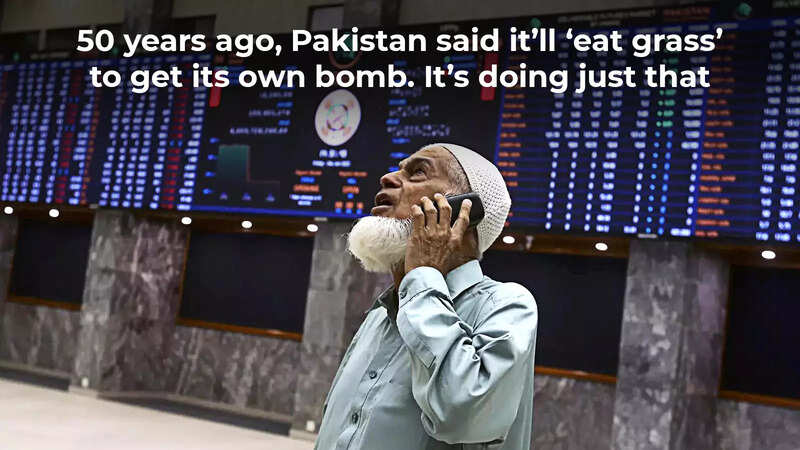
Grasshoppers eating grass
Re: Terroristan - March 31, 2022
American's keep going back to Pakistan for one more pull of the Toilet paper.
Palki's advice to Pakistan: Islamabad is one day away from a coup or a bankruptcy. So keep the politics to cricket world up or ICC board rooms. Leave geopolitical battle field to stronger countries.
Pakistan
Tissue Paper
Toilet Paper
Khawaja Asif Admits Pakistan Treated "Worse Than Toilet Paper" | Vantage with Palki Sharma
Pakistan's Defence Minister Khawaja Asif has admitted that his country was used and thrown away "like toilet paper" by the Americans. Asif was talking about Pakistan's decision to partner with America in their war on terror. Can Pakistan really complain after years of betrayals and tacit terror support? Palki Sharma tells you.
Palki's advice to Pakistan: Islamabad is one day away from a coup or a bankruptcy. So keep the politics to cricket world up or ICC board rooms. Leave geopolitical battle field to stronger countries.
Pakistan
Tissue Paper

Toilet Paper

Khawaja Asif Admits Pakistan Treated "Worse Than Toilet Paper" | Vantage with Palki Sharma
Pakistan's Defence Minister Khawaja Asif has admitted that his country was used and thrown away "like toilet paper" by the Americans. Asif was talking about Pakistan's decision to partner with America in their war on terror. Can Pakistan really complain after years of betrayals and tacit terror support? Palki Sharma tells you.
Re: Terroristan - March 31, 2022
UNSC 1267 S/2026/24
https://digitallibrary.un.org/record/4102022
Transmits 37th report of the Analytical Support and Sanctions Monitoring Team pursuant to Security Council resolutions 1526 (2004) and 2253 (2015) concerning Islamic State in Iraq and the Levant (Da'esh), Al-Qaida and Associated Individuals, Groups, Undertakings and Entities.
https://www.wionews.com/world/-jaish-e- ... 0911320040
https://digitallibrary.un.org/record/4102022
Transmits 37th report of the Analytical Support and Sanctions Monitoring Team pursuant to Security Council resolutions 1526 (2004) and 2253 (2015) concerning Islamic State in Iraq and the Levant (Da'esh), Al-Qaida and Associated Individuals, Groups, Undertakings and Entities.
Now this is what the news says:95. One Member State noted that Jaish-i-Mohammed (JiM, QDe.019) had claimed
responsibility for a series of attacks. It was also reported to be linked to an attack on
the Red Fort in New Delhi on 9 November that killed 15 people. On 8 October,
Jaish-i-Mohammed leader Mohammed Masood Azhar Alvi (QDi.422) formally
announced the establishment of a women-only wing, Jamaat ul-Muminat (not listed),
which was aimed at supporting terrorist attacks. Another Member State reported that
Jaish-i-Mohammed was defunct. Separately, it was reported that on 28 July, three
individuals allegedly involved in the attack perpetrated in Pahalgam, in Jammu and
Kashmir, were killed.
96. The Baloch Liberation Army (not listed) conducted a series of attacks against
Pakistani security forces and projects in the China-Pakistan Economic Corridor
(CPEC). On 16 September, the Baloch Liberation Army ambushed a Pakistani
military convoy patrolling the Corridor, killing 32 troops. While counter-terrorism
operations by Pakistan restricted the Baloch Liberation Army’s operational space, it
remained active. Some Member States reported that the Baloch Liberation Army
collaborated with TTP and ISIL-K through shared training camps and resources,
coordinating attacks and meetings between commanders. Some Member States
assessed that there was neither an association nor growing ties between the Baloch
Liberation Army and Al-Qaida or ISIL (Da’esh).
https://www.wionews.com/world/-jaish-e- ... 0911320040
Last edited by A_Gupta on 13 Feb 2026 18:38, edited 1 time in total.
Re: Terroristan - March 31, 2022
https://youtu.be/d4OZLXpAUQI
Here Coupta's take on Toilet Paper!!
Also a question to all forum members:
What are the Jihadi's imbing these days and what are they planning??
The reason I ask is because I see a series of strange happenings in a Mard e Momeen land:
1. Basant on celebrated on large scale and yet their brothers on the easterns front were giving openly call to ban any celebrations in BAngla Desh.
2. K Asif making Toiletry in National Assembly. and cursing that they named missiles on invaders
3. Multiple youtubers and Army selected one making vidoes of Basant
4. Again usual suspects talking of Punjab and Secular, shia/sunni equal equal etc.
5. People on SM media now claiming that Indus flows in their lands, And Greeks came in contact with them first and they are India nt US.
6. Super historians now claiming that Central asia/persia/afghan/pakistan present state were all populated by people of common stocks Aryans!!!
I dont know what churan they have sold to some of the Sikh separatist they are talking the same things,
Wonder what is their agenda this time???
Here Coupta's take on Toilet Paper!!
Also a question to all forum members:
What are the Jihadi's imbing these days and what are they planning??
The reason I ask is because I see a series of strange happenings in a Mard e Momeen land:
1. Basant on celebrated on large scale and yet their brothers on the easterns front were giving openly call to ban any celebrations in BAngla Desh.
2. K Asif making Toiletry in National Assembly. and cursing that they named missiles on invaders
3. Multiple youtubers and Army selected one making vidoes of Basant
4. Again usual suspects talking of Punjab and Secular, shia/sunni equal equal etc.
5. People on SM media now claiming that Indus flows in their lands, And Greeks came in contact with them first and they are India nt US.
6. Super historians now claiming that Central asia/persia/afghan/pakistan present state were all populated by people of common stocks Aryans!!!
I dont know what churan they have sold to some of the Sikh separatist they are talking the same things,
Wonder what is their agenda this time???
Re: Terroristan - March 31, 2022
“cultural heritage and festivals become political acts of defiance against extremist homogenization”.
-
sanjaykumar
- BRF Oldie
- Posts: 6799
- Joined: 16 Oct 2005 05:51
Re: Terroristan - March 31, 2022
India has extreme racial heterogeneity. I actually had to learn from experience how extreme.
It has gradations of skin tone, physiognomy. Some of the most beautiful people in the world and some of the ugliest.
Yes I know beauty is in the eye of the beholder.
Pakistan’s obsession is to demonstrate panjabis esp Sikhs are closer to them than other Indians.
Sorry but I would prefer to identify with some dark skinned dude who does not speak my ethnic tongue or some chinaman looking Noreasterner. Perhaps because I live in the west, I have little to no regard for this hobby of less nonwhite than my neighbour. I live amongst real white people
It has gradations of skin tone, physiognomy. Some of the most beautiful people in the world and some of the ugliest.
Yes I know beauty is in the eye of the beholder.
Pakistan’s obsession is to demonstrate panjabis esp Sikhs are closer to them than other Indians.
Sorry but I would prefer to identify with some dark skinned dude who does not speak my ethnic tongue or some chinaman looking Noreasterner. Perhaps because I live in the west, I have little to no regard for this hobby of less nonwhite than my neighbour. I live amongst real white people
-
sanjaykumar
- BRF Oldie
- Posts: 6799
- Joined: 16 Oct 2005 05:51
Re: Terroristan - March 31, 2022
This is nothing unique to India. I have been making some observations on the Chinese lately.
Many Chinese I see at the university can be attractive. I suspected this is a heavily biased sample. Given that most have economic and therefore political credit (literally for the Chinese). Of course the extreme gracilisation displayed by some Chinese females skull shape ( eg virtual absence of supraorbital ridges and unusual waist slenderness is not to everyone’s appeal).
I happened to come across the stereotypical Chinese in a fast food place recently. Where they sat as a loud group quarrelling in Chinese and alternatively guffawing loudly. They were closer to four foot tall than five with a physiognomy that was shall we say unconventional.
That’s my eugenics adjacent thought for the day hehehe
Many Chinese I see at the university can be attractive. I suspected this is a heavily biased sample. Given that most have economic and therefore political credit (literally for the Chinese). Of course the extreme gracilisation displayed by some Chinese females skull shape ( eg virtual absence of supraorbital ridges and unusual waist slenderness is not to everyone’s appeal).
I happened to come across the stereotypical Chinese in a fast food place recently. Where they sat as a loud group quarrelling in Chinese and alternatively guffawing loudly. They were closer to four foot tall than five with a physiognomy that was shall we say unconventional.
That’s my eugenics adjacent thought for the day hehehe

-
sanjaykumar
- BRF Oldie
- Posts: 6799
- Joined: 16 Oct 2005 05:51
Re: Terroristan - March 31, 2022
These few posts are a great example of the variety on this forum. Which keeps it interesting.
Re: Terroristan - March 31, 2022
https://www.rediff.com/cricket/report/t ... 260215.htm
T20 World Cup: Clinical India hammer Pakistan to qualify for Super 8s
Aadharsh A V, February 15, 2026'
.....
Gautam
It is time to break your old TV sets and get new ones, Allhumdullilah.
T20 World Cup: Clinical India hammer Pakistan to qualify for Super 8s
Aadharsh A V, February 15, 2026'
.....
Gautam
It is time to break your old TV sets and get new ones, Allhumdullilah.