Re: Climate Change: Propaganda Vs Reality
Posted: 18 Apr 2026 03:09
There’s a certain elegance to how none of that connects... 
Consortium of Indian Defence Websites
https://forums.bharat-rakshak.com/
I knew, you did not think that was propaganda, that why I made serious comments. Just leave this for you:

I don't have a problem with the paper nor am I a climate change skeptic. I certainly am a climate change solutions skeptic, especially if the solutions are coming from Western/Eurotrash. I am also including those who want to hold the entire world hostage to feel good about themselves, that they are doing something about it. Their real interests are to protect their nice houses in coastal areas.
They are also the ones who objected most strenuously to nuclear power. In the US it was the NIMBY factor. In Europe, due to wrong priorities. Germany is a case in point.The Netherlands fallacy refers to an error Paul R. Ehrlich and his co-authors claim others make in assuming that the environmental impacts of the Netherlands and other rich nations are contained within their national borders.[1]
Environmentalists since the late 20th century have analyzed the environmental sink status and sink capacities of poor nations. As polluting industries migrate from rich to poor nations, the national ecological footprint of rich nations shrinks, whereas the international ecological footprint may increase or also decrease. The nature of the fallacy is to ignore increasing environmental damage in many developing nations and in international waters attributable to the imported goods or changes in the economy of such nations directly due to developed nations.
Such an approach may lead to incorrect assertions such as the environmental impact of a particular developed country is reducing, when a holistic, international approach suggests the opposite. This may in turn support over-optimistic predictions toward the improvement of global environmental conditions.[2]
The Netherlands has had a huge impact regarding leaving water footprints across the world. They have made this footprint by importing water from other countries, leaving increasingly scarce regions. Water footprints of a country can come from either water resources used internally or resources that are outsourced. Dutch consumers have left most of their water footprint through agricultural goods and industrial goods.[3]
The translation, is quite accurate.. Thanks.(From memory) Following is the Telugu translation of the above by Ēnugu Lakṣmaṇakavi
తివిరి ఇసుమున తైలంబు తీయవచ్చు | దవిలి మృగతృష్ణలో నీరు త్రాగవచ్చు |
తిరిగి కుందేటికొమ్ము సాధించవచ్చు | జేరి మూర్ఖుల మనసు రంజింప రాదు ||
I up the ante since the game is being played with insults as the currency.
One who knows he knows not is ignorant; teach him.
One who knows not he knows is sleeping; wake him up.
One who knows he knows is a wiseman; follow him.
One who knows not he knows not is a knave; shun him.
 .. as I recall someone said {I am recalling, my Telugu is a little rusty} in Osmania..
Rough Translation:జ్ఞానం అనేది ఒక పాత్ర వంటిది; దాని మూత తెరిచి ఉంటేనే అది నిండుతుంది. కానీ మూర్ఖుడికి ఆ మూత కేవలం మూసివేయబడటమే కాదు, అది పూర్తిగా అతుక్కుపోయి (వెల్డింగ్ చేయబడి) ఉంటుంది. ఆ పద్యం చెప్పినట్లుగా, అసాధ్యమైన 'కుందేటి కొమ్ము' (శశవిషాణం) కోసం వెతకడం మేలు; అంతేకానీ మూర్ఖుడిని ఒప్పించడానికి ప్రయత్నించడం మన సమయాన్ని వృథా చేసుకోవడమే!"
It is not popular as such. Telugu poetry is required reading in Telugu classes. We had to memorize a few important ones from Niti Shataka (the most famous translation is by Enugu Lakshmana Kavi), Sumati shatakamu, Vemana shatakam, Bhaskara shatakamu, ...
Thanks. FWIW saw something you may enjoy it (In math dhaga I wrote about this father - son pair - a legend too)
It's a terrific paper, poster "Amber G" has summarized the takeaways.Jay wrote: ↑15 Apr 2026 23:51 The scientific journal 'Nature' recently published a scientific paper saying newer varieties of rice are not evolving as fast as the global temperatures are raising and in about 50 years South Asia and East Asia are predicted to exceed 40c threshold in the rice belt. They say this temperature threshold is crucial because this is where cultivation of rice will start to dwindle.
https://www.nature.com/articles/s43247-025-03108-0
So, if one is a policy planner, farmer, or an investor how will this paper guide you? Should this be addressed as a potential issue, or just be ignored as climate change propaganda?
I did read it. Very interesting.Amber G. wrote: ↑19 Apr 2026 03:46 Thanks. FWIW saw something you may enjoy it (In math dhaga I wrote about this father - son pair - a legend too)
In Rocket movie, Dr. Nambi Narayanan of ISRO mentioned that to get stability in rocket trajectory some instability is required (actually it is induced) to make the flight stable. This is similar to what M. Vidyasagar concluded in control theory which is great. There is the other Upadrasta Vidyasagar musician from AP who is an outstanding composer, many of his song compositions I like.
Glad you liked it ..some posts about this father - son pair <here and nearby in math dhaga> and among others eg Prof Bruce Berndt and other familiar names to you..Vayutuvan wrote: ↑19 Apr 2026 05:35I did read it. Very interesting.Amber G. wrote: ↑19 Apr 2026 03:46 Thanks. FWIW saw something you may enjoy it (In math dhaga I wrote about this father - son pair - a legend too)
Where is the hypocrisy coming from? Almost all the lectures that come from the western world now a days are reserved for US, and some for china as most correctly understand that these two are the biggest culprits, especially the US.
No, no, no. Some Eurogreens were giving lectures to India as well right after the Paris Accord. Some of these activists are elite folks having a large following on SM. They did not want nor did they like India being given until 2032 (?) to reduce her GHG emissions. Both the US and China can thumb their noses at these jokers, but India cannot. Rajiv Malhotra pointed out in one of his debates that India gets hurt more disproportionately, even though attackers attack all three countries with equal force. Same with Soros funding USD 1 billion to effect a regime change in India.
its a funny take, never read such angles explored before:bala wrote: ↑19 Apr 2026 01:30 The hypocrisy on climate change is a sight to behold. All the lectures on CO2 and its effects on climate. Climate itself is due to 100s if not 1000s of factors and is very hard to predict reliably. However the climate debate has turned into a religion from pompous people. Let us review facts:
US consumes 20 million gallons of crude per day, China around 17 million per day and India around 5+ million per day. So you can gauge who is the worst of the lot in generating C02. Furthermore the Coal fired plants that generate electricity are the highest in US, then China (maybe even more than the US) and then India. The latter two nations are moving towards renewable energy since they are in the favorable sun belt. On a per capita basis the same ranking holds - US, China and then India (which in the world is very very tiny). This per capita consumption includes aircrafts that directly spew C02 in the atmosphere and cause all kinds of issues including depleting the ozone layer of the earth. Then there are sprays like CFC which have a direct bearing on ozone layer. I haven't talked about EU collectively but they rank up there with the rest.
India has a tradition of minimal usage and also using biodegradable products - banana leaves, et al. Plastics, bottles, aluminum cans and other packaging material are a nightmare in terms of recycling worldwide. Most of them are a result of US or Europe in terms of origination of such materials. These things are not going away soon but have to be managed sensibly by collection and recycling.
You are a virus.
That’s what they told you.
Hollywood said it first.
In The Matrix, humans are a disease.
In Avatar, humans are parasites.
In Interstellar, Earth is dying because of us.
Billions spent.
To make you feel guilty for existing.
Now pause.
Ask one question.
Who funded these stories?
Now let’s talk science.
Earth’s surface: 510 million km².
Ocean: 361 million km².
Land: 149 million km².
Of that land.
33% desert.
10% ice.
24% mountains.
Habitable: ~71 million http://sq.km.
Population: 8 billion.
Each person gets ~9,000 sq.m.
That is not crisis.
That is space.
Now food.
We produce enough for 10 billion.
Yet 32% wasted.
That's not shortage.
Distribution failure.
Political failure.
Now population truth.
South Korea: 0.72.
Japan: 1.2.
China: 1.01.
Italy.
Spain.
Germany.
Below 1.5.
Russia shrinking.
Eastern Europe emptying.
Brazil: 1.7.
India: 2.0.
Thailand: 1.3.
Iran: 1.7.
By 2100.
183 countries below replacement.
We are not exploding.
We are dying.
So how did the world come to believe the opposite?
1974.
Henry Kissinger signs NSSM 200.
CIA.
Pentagon.
NSA.
State Department.
Same room.
Claim: Population threatens limited Resources.
Reality: Threatens control over resources.
Threatens American Corporation Interests.
Solution: reduce populations.
They called it “family planning”.
It was resource strategy.
Then came the machinery.
USAID.
Rockefeller Foundation.
Ford Foundation.
Open Society Foundations.
Gates Foundation.
They funded research.
They funded governments.
They funded guilt.
Then the UN stepped in.
UNFPA was born.
World Bank added pressure.
Loans became conditions.
Adopt population control.
Or lose funding.
Pharma entered.
Contraceptives scaled.
Hormonal drugs.
IUDs.
Sold as aid.
Priced as profit.
Now psychology.
They don’t hate humans.
They don’t care.
To them.
You are a unit.
A unit that consumes.
A unit that demands wages.
A unit that resists when it grows.
Fewer units.
Fewer problems.
Just arithmetic.
Then came automation.
AI.
Robotics.
Built quietly.
Not to assist humans.
To replace humans.
When machines produce.
Humans become liability.
Capital stops needing labour.
Capital stops needing consumers.
Only controlled population remains.
That is the endgame.
Now guilt programming.
Top 100 companies.
71% emissions.
But message to you?
Have fewer children.
Use less water.
Don’t celebrate.
Your existence is the problem.
Educated class absorbed it.
Delay children.
Limit families.
Parenthood made expensive.
They built the cage.
Then said you chose it.
Now Mother Earth itself.
4.5 billion years old.
Survived extinction.
Asteroids.
Volcanoes.
Ice ages.
It does not need saving.
It will outlive foundations.
The planet is fine.
What is dying…
is your belief to exist.
So the real question is not…
Can Earth sustain us?
The real question is…
Who decided… it shouldn’t?
Yes indeed and thanks for the article!Manish_Sharma wrote: ↑08 May 2026 07:27
Now Mother Earth itself.
4.5 billion years old.
Survived extinction.
Asteroids.
Volcanoes.
Ice ages.
It does not need saving.
It will outlive foundations.
The planet is fine.
The real question is…
Who decided… it shouldn’t?
 What can we do so that we do not lose our way of life and face mass problems. Planet Earth does not give a shit about one way or another.
A_Gupta ji, what an excellent post. Pranam.
Vayu saar, do you have any news on your projects?
Careful, A_Gupta ji—you know what happens when you 'count on' me to correct things! It might end up rewriting the entire Lagrangian for the Atlantic circulation!
Lagrangian density L, which for geophysical fluid dynamics involves the kinetic energy of the ocean currents minus the potential energy (incorporating density gradients and gravity), plus terms for the Earth's rotation (Coriolis force):How does one solve that Lagrangian?
Yes, in a very high-level 30K feet view.
Bala ji, We have been on this “gobar gas” train for about 50 years now, and it is just as inefficient and boutique today as it was back then. There seems to be an unhealthy obsession with it, even though it is a dead-end technology. This particular plant produces fuel for roughly 850 vehicles from 100 tons of raw material, which is highly inefficient. Unless there are no other fuel sources available, or this is the best way for a farm to dispose of byproducts from livestock farming, there is little reason for mass adoption of this technology.
Bala ji, what I gathered from that video is that their primary output is organic manure. Methane is secondary and correctly so. Gobar is too wet. Due to water content, it has low energy density. One needs to transport low-energy-density input using a higher-energy-density fuel.
I would even say that it is a 300K foot view.Amber G. wrote: ↑15 May 2026 08:28 ^^^ FWIW: The 30k-foot view is just the map - the actual terrain is a swamp of non-linearity. To get into the weeds, solving a Lagrangian for a system as chaotic as the AMOC, obviously involves more than just writing down $\delta S = 0$. (In practice, You have to parameterize sub-grid scale processes (like small eddies) that the Lagrangian doesn't explicitly capture.. etc
 )
)Of course, the page was last updated in 2015. Since then, most probably, more and more processes are included in the models. Accuracy might have been improved.Model accuracy
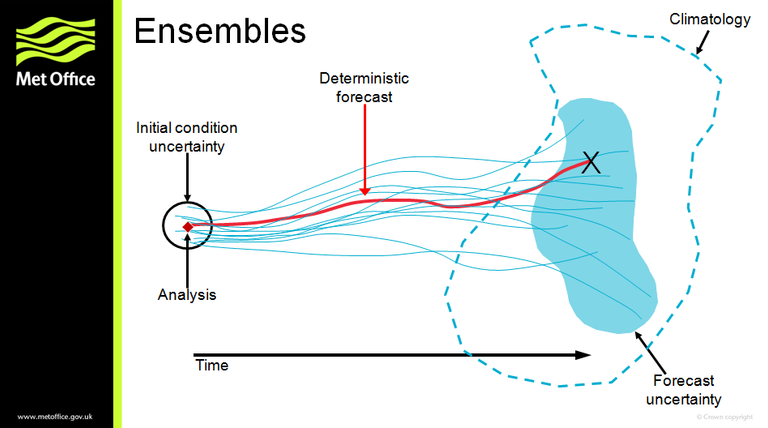
AOGCMs internalise as many processes as are sufficiently understood. However, they are still under development and significant uncertainties remain. They may be coupled to models of other processes in Earth system models, such as the carbon cycle, so as to better model feedback. Most recent simulations show "plausible" agreement with the measured temperature anomalies over the past 150 years, when driven by observed changes in greenhouse gases and aerosols. Agreement improves by including both natural and anthropogenic forcings.[23][24][25]
Imperfect models may nevertheless produce useful results. GCMs are capable of reproducing the general features of the observed global temperature over the past century.[23]
A debate over how to reconcile climate model predictions that upper air (tropospheric) warming should be greater than observed surface warming, some of which appeared to show otherwise,[26] was resolved in favour of the models, following data revisions.
Cloud effects are a significant area of uncertainty in climate models. Clouds have competing effects on climate. They cool the surface by reflecting sunlight into space; they warm it by increasing the amount of infrared radiation transmitted from the atmosphere to the surface.[27] In the 2001 IPCC report possible changes in cloud cover were highlighted as a major uncertainty in predicting climate.[28][29]
Climate researchers around the world use climate models to understand the climate system. Thousands of papers have been published about model-based studies. Part of this research is to improve the models.
In 2000, a comparison between measurements and dozens of GCM simulations of ENSO-driven tropical precipitation, water vapor, temperature, and outgoing longwave radiation found similarity between measurements and simulation of most factors. However, the simulated change in precipitation was about one-fourth less than what was observed. Errors in simulated precipitation imply errors in other processes, such as errors in the evaporation rate that provides moisture to create precipitation. The other possibility is that the satellite-based measurements are in error. Either indicates progress is required in order to monitor and predict such changes.[30]
The precise magnitude of future changes in climate is still uncertain;[31] for the end of the 21st century (2071 to 2100), for SRES scenario A2, the change of global average SAT change from AOGCMs compared with 1961 to 1990 is +3.0 °C (5.4 °F) and the range is +1.3 to +4.5 °C (+2.3 to 8.1 °F).
The IPCC's Fifth Assessment Report asserted "very high confidence that models reproduce the general features of the global-scale annual mean surface temperature increase over the historical period". However, the report also observed that the rate of warming over the period 1998–2012 was lower than that predicted by 111 out of 114 Coupled Model Intercomparison Project climate models.
...
Link to "Sustainable Energy – Without the Hot Air" is https://www.withouthotair.com/. This book touches on all the points we are discussing here in this thread, but missing one notable sustainable tech, i.e., Biomass (and Biomethane).In 2003, his book Information Theory, Inference, and Learning Algorithms[29] was published. (Ed: It is available online)
...
In 2008 he completed a book on energy consumption and energy production without fossil fuels called Sustainable Energy – Without the Hot Air. MacKay used £10,000 of his own money to publish the book, and the initial print run of 5,000 sold within days.[30] The book received praise from The Economist,[31] The Guardian,[30] and Bill Gates, who called it "one of the best books on energy that has been written."[32][33] Like his textbook on Information theory, MacKay made the book available for free online.[34] In March 2012 he gave a TED talk on renewable energy.[35]
...