Physics Discussion Thread

The Technology & Economic Forum is a venue to discuss issues pertaining to Technological and Economic developments in India. We request members to kindly stay within the mandate of this forum and keep their exchanges of views, on a civilised level, however vehemently any disagreement may be felt. All feedback regarding forum usage may be sent to the moderators using the Feedback Form or by clicking the Report Post Icon in any objectionable post for proper action. Please note that the views expressed by the Members and Moderators on these discussion boards are that of the individuals only and do not reflect the official policy or view of the Bharat-Rakshak.com Website. Copyright Violation is strictly prohibited and may result in revocation of your posting rights - please read the FAQ for full details. Users must also abide by the Forum Guidelines at all times.
Amber G.
BRF Oldie
Posts: 11923
Joined: 17 Dec 2002 12:31
Location: Ohio, USA

Re: Physics Discussion Thread

Post by Amber G. »

Amber G. wrote: 18 Oct 2025 22:44 A personal note on the passing of Professor C. N. Yang (1922–2025)

Deeply saddened to hear of the passing of Professor Chen Ning (C. N.) Yang at the age of 103.
Sharing: a beautiful tribute. TsinghuaRen gathered at the Institute for Advanced Study to mourn the passing of Prof. Chen Ning Yang. They offered their respects, remembering his remarkable legacy and lifelong dedication to science and education. Prof. Chen Ning Yang will be forever remembered.

--On Yang's retirement from SUNY in 1999, Freeman Dyson called Yang "the pre-eminent stylist" of 20th-century physics alongside Albert Einstein and Paul Dirac, citing how Yang "turns his least important calculations into miniature works of art, and turns his deeper speculations into masterpieces.
...
With non-Abelian gauge fields generating nontrivial Lie algebras, the possible forms of interaction between fields become unique, so that symmetry dictates interaction. This idea is Yang's greatest contribution to physics. It is a contribution of a bird flying high over the rain forest of little problems in which most of us spend our lives.
(As an American citizen he was very much respected in US, was pre-cursor to Nixon - China thaw (1970) (His father was ill then , and US allowed him to travel to China when there was virtually no contact between these two nations - which followed later with Nixon's travel to China).. he later became Chinese citizen but had very high respect in US)
bala
BRF Oldie
Posts: 3303
Joined: 02 Sep 1999 11:31
Location: Office Lounge

Re: Physics Discussion Thread

Post by bala »

Biggest Physics Breakthrough in Decades: Scientists Catch Dark Matter in Action

Dark matter, the mysterious substance making up 85% of cosmic mass, has been detected through a stunning gamma-ray signal. Join us as we break down the research by a University of Tokyo astrophysicist who believes he has caught WIMP particles destroying each other a finding that redefines our place in the cosmos.

https://www.youtube.com/watch?v=Q3cm-l6f2Co

// my comments: as usual this requires cross verification and validation.
Amber G.
BRF Oldie
Posts: 11923
Joined: 17 Dec 2002 12:31
Location: Ohio, USA

Re: Physics Discussion Thread

Post by Amber G. »

Okay - some serious Physics!

Why is a dosa crispy outside and soft inside? Because our grandmothers used physics. When water dances on a hot tawa, IIT Madras calls it the Leidenfrost Effect- the sign that the pan is perfect and the batter won’t stick. A good dosa is all about physics

Read all about it!
Image

IIT-Madras professor reveals the 18th-century German phenomenon behind perfect 'crispy' dosa

Key scientific / food-science studies on dosa (and related):

Analysis of modes of heat transfer in baking Indian rice pan cake (Dosa,) (Venkateshmurthy & Raghavarao, J Food Sci Technol, 2011). (<link>

This is perhaps the most important “physics of dosa” paper. The authors analyze the different modes of heat transfer (conduction, radiation, evaporation) when a dosa is baked on a hot plate / griddle.

- They find that conduction from the hot plate is the dominant heat-transfer mode (~98% of heat transfer), while radiation plays only a minor role (~1–2%).

- They experimentally measure temperature profiles across the thickness of the dosa during cooking, and estimate the thermal conductivity of dosa (≈ 0.42 W/m·K), along with its emissivity (≈ 0.31).
(PubMed Article)

Their analysis includes the relative contributions of sensible heat (heating solids and water in the batter) and latent heat (evaporation of water). Evaporation is substantial — contributing significantly to the heat absorbed by the batter, which affects texture.

They also studied how different hot-plate materials (cast iron, stainless steel, teflon-coated aluminum, etc.) influence the final dosa surface finish and texture — finding stainless steel gave “good surface finish”.
This is a quantitative, engineering-style study of how heat and moisture interact in dosa cooking, giving a physical basis for what cooks do by intuition (heat the tawa, spread batter, get crisp + soft texture).

Evaluation of Functional Quality of Indian Dosa Batter (Snehal V. et al., 2020)

This paper looks at physicochemical and textural properties of dosa batter and resulting dosa, when using different ingredient blends (rice, black gram, horse gram, etc.).

They report hardness (texture) differences, changes in moisture, texture, and proximate composition (protein, fiber, etc.). For example: replacing or supplementing traditional ingredients can significantly alter nutritional value and final dosa texture / softness.

Their findings highlight how batter formulation — not just cooking temperature — influences the final sensory and nutritional qualities.

: This shows the “other half” of dosa science beyond heat transfer — how batter composition (fermentation, ingredients) matters for texture, softness, nutrition, digestibility.

<arxiv>: Broader food-science / cooking-physics context: heat & mass transfer in thermal cooking

Because there are relatively few papers devoted exclusively to dosa, broader studies on heat and mass transfer in cooking/baking/frying provide useful context.

Modelling approaches to capture role of gelatinization in texture changes during thermal processing of food (Sinha & Bhargav, 2018) — This study models how starch gelatinization during thermal processing influences texture changes (softening, crust formation) in starchy foods, by tracking moisture content, structural mechanics (e.g. Young’s modulus) etc.

Texture development in flatbreads, pancakes, etc., often involves interplay of moisture loss, starch gelatinization, evaporation, conduction — all ingredients relevant to dosa. Such modelling work helps generalize principles seen in dosa-specific research.

On the “Recent Paper about dosa + Leidenfrost effect (2025)”

The recent popular-press articles (e.g. a write-up from IIT Madras summarized by media outlets) attribute the crispiness of dosa to the Leidenfrost effect: When water is flicked onto a hot tawa, droplets hover on a thin vapour layer and “dance,” indicating the pan has reached a temperature where batter won’t stick and will crisp properly.

According to those articles, the research was presented by Mahesh Panchagnula (IIT Madras) and calls this observation a “scientific explanation” for traditional dosa cooking technique.


So, Putting together the rigorous food-engineering studies and the popular-physics reinterpretation gives a deeper understanding of dosa as both tradition and applied science:

Amber G/ (BRF) Some truths need no peer review — only a hot tawa.
saip
BRF Oldie
Posts: 4451
Joined: 17 Jan 2003 12:31
Location: USA

Re: Physics Discussion Thread

Post by saip »

American Physics team seems to have won ALL the FIVE GOLDS in the Olympiad. Congratulations. From the names of team members all appear to be Immigrants' children (including one of Indian descent). What does the OM have to say about this (robbing gold medals from true white Americans)?
Agastya Goel
Allen Li
Joshua Wang
Feodor Yevtushenko
Brian Zhang
Even one of the coaches seem to be of Indian descent (Rishab Pardhasarathy and probably an Indian Immigrant)
Amber G.
BRF Oldie
Posts: 11923
Joined: 17 Dec 2002 12:31
Location: Ohio, USA

Re: Physics Discussion Thread

Post by Amber G. »

^^^^
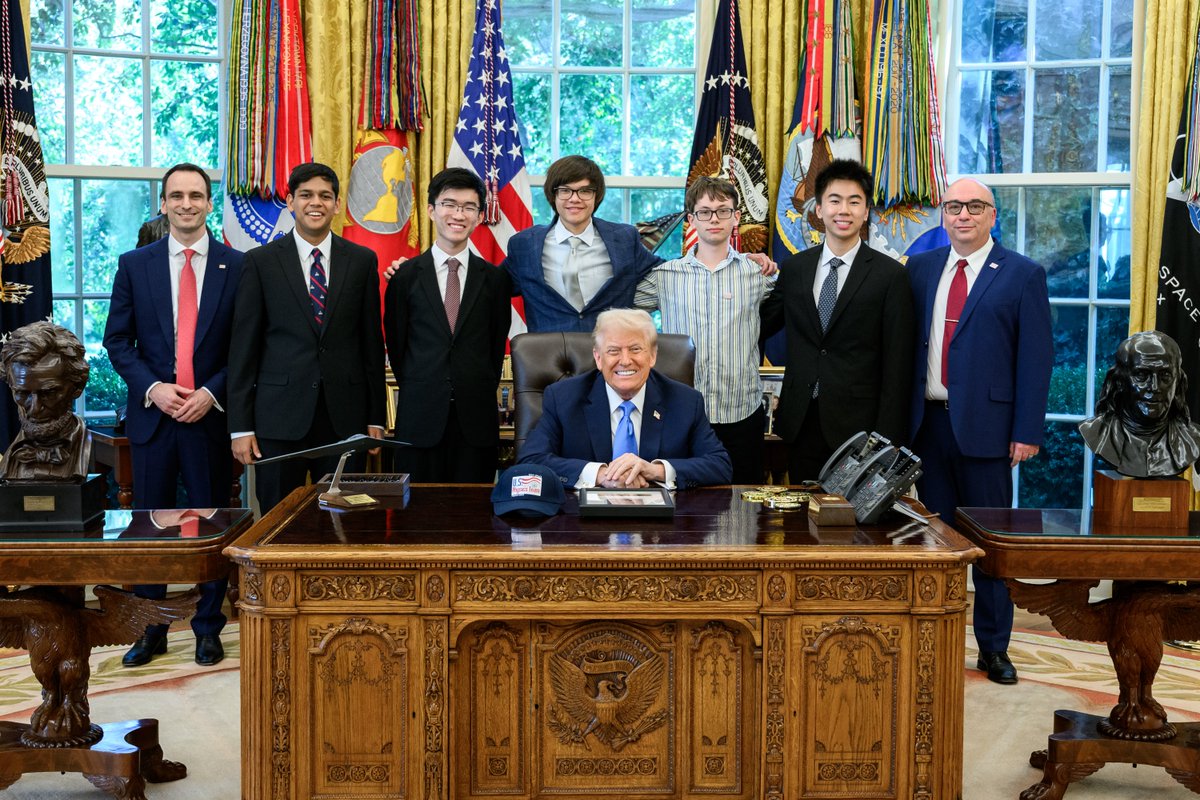
Trump ( while going after H1B Visa) was proud to welcome the 2025 World Champion USA Physics Team to the White House

(The White House, via a senior aide Michael Kratsios posted on SM)
"These incredible geniuses DOMINATED at the International Physics Olympiad in July, bringing home a record FIVE gold medals — the greatest performance in team history"
Image

(AFAIK - I’m not aware of any public statement by Trump or senior MAGA leaders explicitly addressing or endorsing the idea that “immigrant-background” Americans shouldn’t represent the U.S. in competitions, or condemning the team based on background or attacking the team as “not real Americans” or saying the medals were “robbed.”

Lot in SM and others had lot of discussion - an example: Why Trump's pic with Physics Olympiad team is causing furore

Achievements like this should be celebrated by all. The IPhO is difficult: it tests deep understanding, creativity in physics, problem-solving, hard work, not birthright or lineage. The fact that someone of Indian origin, or mixed heritage — wins should be proof that the U.S. continues to attract (or produce) top-level talent — and that “American scientific success” can continue precisely because of such diversity.

We (US) is in serious danger of loosing this if we do not cherish this.
---

A word about Agastya-

Agastya Goel comes across as one of those gifted but also completely well-rounded kids, and the family story explains a lot. He’s a junior at Gunn High School in Palo Alto, already a two-time IOI gold medalist, top-ranked in USACO for years, a physics Olympiad star, and somehow still finds time for choir, piano, guitar, tennis, hiking, and board games.

His physics spark apparently came his family. His father, (a friend), Ashish Goel (IIT Kanpur CS, Stanford), is a well-known professor working on algorithms, social networks, and computational economics; the whole household seems steeped in curiosity and academic life. It’s a classic Palo Alto–meets-IIT story: lots of intellectual oxygen, and a kid who has run with all of it.
Amber G.
BRF Oldie
Posts: 11923
Joined: 17 Dec 2002 12:31
Location: Ohio, USA

Re: Physics Discussion Thread

Post by Amber G. »

OTD in 1942, "the Atomic Age began inside an enormous tent on a squash court under the stands of the U of Chicagos Stagg Field. There, headed by Italian scientist Enrico Fermi, the first controlled nuclear fission chain reaction was engineered."

Today in History - December 2- Nuclear Fisson
Amber G.
BRF Oldie
Posts: 11923
Joined: 17 Dec 2002 12:31
Location: Ohio, USA

Re: Physics Discussion Thread

Post by Amber G. »

Optical clock sets new accuracy record, bringing us closer to a new definition of the second
The official definition of the second is set to be updated for the first time in decades. The change will be based on new optical clocks, which are far more precise than today's standards.

Now, researchers at VTT MIKES have demonstrated a strontium single-ion optical clock with an exceptionally low systematic uncertainty of 7.9×10⁻¹⁹, among the lowest ever reported.... The study is published in Physical Review Applied.
Amber G.
BRF Oldie
Posts: 11923
Joined: 17 Dec 2002 12:31
Location: Ohio, USA

Re: Physics Discussion Thread

Post by Amber G. »

CMS Experiment CERN @CMSExperiment Fourth time's the charm!

The CMS Collaboration has identified a family of all-charm tetraquark states consistent with a pairing of two quarks and two antiquarks. Read the CMS briefing: https://cms.cern/news/cms-gets-acquaint ... etraquarks
-And the @Nature article: https://nature.com/articles/d41586-025-03591-7

--
CMS reports that it has identified a family of three “all-charm” tetraquark states, meaning particles made of two charm quarks and two charm antiquarks — i.e. four charm constituents in total.

This is a milestone result: the first definitive measurement of spin and parity for a family of fully-charmed tetraquarks. How the strong force (Quantum Chromodynamics) binds quarks beyond the familiar proton-neutron–meson world.
Post Reply