Here is the Chinese imbalance, and how it is pushing that imbalance onto the world.
https://youtu.be/tCGHT00pjto?si=BQ6L5_BPQL3nL0Xg
Basically, China needs to show growth, and the only viable avenue, given the CCP's unwillingness/inability to increase the consumption capacity of its own people, is exports. But the rich economies are cutting off access. So China is dumping on a massive scale to the Third World, reducing the profitability of its firms. In turn, the firms are squeezing the workers, making them work longer hours and with cutting wages. But the Third World has only so much consumption capacity and the Chinese people are reaching their limit of endurance.
Geopolitics/Geoeconomics Thread - June 2015
Re: Geopolitics/Geoeconomics Thread - June 2015
China became the first country to hit a $1T trade surplus last year and this year they hit that number much faster, in November itself and is on track to hit $1.15T. China is also opening manufacturing in other nations because it's workforce is also moving up the ladder. It's internal consumption is also growing so its expanding on that side as well. All of this means it's internal contradictions might be less drastic than what the video says it is.A_Gupta wrote: ↑09 Dec 2025 06:53 Here is the Chinese imbalance, and how it is pushing that imbalance onto the world.
Basically, China needs to show growth, and the only viable avenue, given the CCP's unwillingness/inability to increase the consumption capacity of its own people, is exports. But the rich economies are cutting off access. So China is dumping on a massive scale to the Third World, reducing the profitability of its firms. In turn, the firms are squeezing the workers, making them work longer hours and with cutting wages. But the Third World has only so much consumption capacity and the Chinese people are reaching their limit of endurance.
https://www.nytimes.com/2025/12/07/busi ... rplus.html
Re: Geopolitics/Geoeconomics Thread - June 2015
Jay wrote: ↑09 Dec 2025 21:10China became the first country to hit a $1T trade surplus last year and this year they hit that number much faster, in November itself and is on track to hit $1.15T. China is also opening manufacturing in other nations because it's workforce is also moving up the ladder. It's internal consumption is also growing so its expanding on that side as well. All of this means it's internal contradictions might be less drastic than what the video says it is.A_Gupta wrote: ↑09 Dec 2025 06:53 Here is the Chinese imbalance, and how it is pushing that imbalance onto the world.
Basically, China needs to show growth, and the only viable avenue, given the CCP's unwillingness/inability to increase the consumption capacity of its own people, is exports. But the rich economies are cutting off access. So China is dumping on a massive scale to the Third World, reducing the profitability of its firms. In turn, the firms are squeezing the workers, making them work longer hours and with cutting wages. But the Third World has only so much consumption capacity and the Chinese people are reaching their limit of endurance.
https://www.nytimes.com/2025/12/07/busi ... rplus.html
one third of the entire worlds manufacturing !
Re: Geopolitics/Geoeconomics Thread - June 2015
The Bankruptcy of Britain: The Secret Bill for WWII
We are taught that Britain "won" World War II. Financially, they lost everything.
While the history books focus on the victory in 1945, they rarely mention the secret economic collapse that followed. On December 31, 2006—more than 60 years after the war ended—the British government quietly made a final wire transfer of $83 million to the United States.
This was the last installment of the Anglo-American Loan, a desperate $4.33 billion lifeline negotiated by John Maynard Keynes to save a bankrupt nation from starvation.
The "Special Relationship" wasn't free. The abrupt end of Lend-Lease, the forced convertibility of the Sterling, and the "dollar gap" destroyed the British Empire's financial dominance and ushered in decades of austerity.
In this video, we breakdown:
The "Financial Dunkirk": Why Britain was technically insolvent in 1945 (with debt over 200% of GDP).
The 2006 Secret: Why it took six decades for the UK to finally pay off its war debt to the US and Canada.
The Keynes Failure: How the legendary economist tried (and failed) to get a grant, settling for a loan with "strings attached" that crushed the Pound.
The End of Empire: How this specific debt forced Britain to liquidate its global assets and hand the "Reserve Currency" crown to the Dollar.
or how the wealth looted from India got transferred to the US from the UK
Now Ukraine is the latest in line to sign up for the American lend lease program
(0:28) The Empire was not just bleeding soldiers, it was bleeding to death financially. Winston Churchill, the man whose voice was rallying the free world, sat at his desk in the underground cabinet war rooms to write one of the most important letters of his life. (0:42) It was addressed to Franklin Delano Roosevelt, the President of the United States.
Churchill was a master of the English language, a man who could turn a phrase into a weapon, but in this letter, he had to perform a delicate and humiliating dance. (0:53) He had to tell the leader of the world, its richest neutral nation, the Great Britain, the banker of the 19th century, the workshop of the world, the empire that had defeated Napoleon was completely and utterly broke. (1:05) The letter was long and detailed.
It described the strategic situation, the U-boat peril in the Atlantic and the desperate need for destroyers and aircraft, but the sting was in the tail. (1:15) Churchill wrote that the moment was approaching when the British treasury would no longer be able to pay cash for the supplies it needed to survive. (1:21) He wrote that the British people would fight on the beaches and the landing grounds, but they could not fight without ammunition, and they could no longer afford to buy it.
It was a plea for survival. It was an admission of insolvency. (1:32) To understand how the wealthiest empire in history reached this point of destitution, we have to look at the ruthless economics of total war.
(1:40) When the war began in September 1939, Britain was still a financial titan. It held billions of dollars in gold reserves. It owned a massive portfolio of overseas investments.
(1:50) British citizens owned railroads in Argentina, copper mines in Chile, and vast industrial concerns in the United States. The city of London was the hub of global insurance and shipping. (2:00) But the war that Hitler launched was different from any war that had come before.
It was a war of machines. It consumed steel, oil, aluminium, and rubber at a rate that defied all pre-war calculations. (2:10) And crucially, Britain had to import almost everything.
The blockade of the European continent meant that Britain could no longer trade with its neighbours. (2:17) It had to look across the Atlantic to the United States for its survival. At this stage in the war, the United States was officially neutral.
(2:25) The American public was isolationist. They remembered the First World War when American boys had died in European mud, and they were determined not to get dragged into another foreign slaughter. (2:34) Congress had passed the Neutrality Acts, which were designed to keep America out of the war.
These acts contained a specific clause known as cash and carry. (2:41) The cash and carry law stated that belligerent nations like Britain could buy American supplies, but they had to pay for them in cash immediately, and they had to transport them on their own ships. (2:50) There would be no loans.
There would be no credit. The Americans were happy to sell the weapons of war, but they demanded gold on the barrel head before the crates left the dock in New York. (2:59) For the first year of the war, Britain drained its treasury to meet these demands.
They liquidated their gold reserves. (3:04) In a secret operation known as Operation Fish, the British government loaded the entire gold wealth of the nation onto battleships. (3:11) And fastliners and shifted across the dangerous Atlantic to vaults in Canada.
It was the largest movement of physical wealth in history. (3:18) Billions of dollars in gold bars and negotiable securities were sent into exile to pay the American bill collectors. (3:24) By late 1940, the gold was gone.
The liquid cash was gone. (3:28) The British purchasing commission in Washington, which was responsible for buying planes and tanks, had contracts sitting on its desks that it could not sign because the treasury officials in London told them there were no dollars left to honour them. (3:40) When Roosevelt received Churchill's letter, he understood the stakes.
He knew that if Britain fell, the United States would be next, but he also faced a political problem. (3:47) He could not simply give money to Britain. The American laws forbade it, and the American public would be outraged.
(3:52) He needed a way to help Britain that looked like a hard-headed business deal, not a charity handout. He needed to sell the war effort to the American taxpayer. (4:00) This is where the concept of lend lease was born.
Roosevelt explained it to the press with the folksy analogy. (4:05) He said that if your neighbour's house is on fire, you don't haggle with him over the price of a garden hose, you lend him the hose and he gives it back when the fire is out. (4:13) It sounded simple.
It sounded generous. It sounded like a neighbourly act of assistance. (4:17) But the reality of the negotiations that took place behind closed doors in Washington was entirely different.
(4:24) It was not a conversation between neighbours. It was a foreclosure, proceeding between a bank and a bankrupt client. (4:30) The man in charge of the American treasury was Henry Morgenthau Jr. He was a staunch anti-fascist, and he wanted to help Britain defeat Hitler.
(4:38) But he was also the guardian of the American taxpayer. (4:40) He believed that before the United States gave a single dime of aid, Britain must prove that it had stripped itself of every last asset it possessed. (4:48) He wanted to make sure that the British weren't hiding any money.
Morgenthau demanded a full audit of the British Empire. (4:54) He demanded to see the list of every asset owned by the British government and every asset owned by private British citizens anywhere in the world. (5:02) He wanted to know the value of every shell casing, every woollen sock, and every share of stock.
(5:06) The British negotiators led by Sir Frederick Phillips were stunned. They were being asked to open their books to a foreign power. (5:13) They were being treated not as an ally, fighting a common enemy, but as a failed company in receivership.
(5:18) Phillips tried to argue. He explained that Britain had already sold off its gold. (5:22) He explained that selling off long-term investments in the middle of a war would be a fire sale that they would get pennies on the dollar.
(5:28) He argued that stripping Britain of its overseas income would leave the country destitute after the war, unable to feed its population or rebuild its cities. (5:37) Morgenthau was unmoved. His instructions from the president were clear.
The United States would not provide aid until Britain had scraped the bottom of the barrel. (5:45) The logic was brutal. If Britain still had assets in the United States, why should the American taxpayer subsidise the war? (5:53) Why should a farmer in Iowa pay for a tank for the British Army if a British lord still owned a factory in New Jersey? (5:58) The most painful symbol of this forced liquidation was the case of the American Viscos Corporation.
(6:04) American Viscos was a massive industrial giant. It was the largest manufacturer of rayon and artificial silk in the United States. (6:11) It was owned by a British company Courtauld's.
It was a jewel in the crown of British overseas investment. (6:15) It was highly profitable, generating millions of dollars a year in dividends that flowed back to London, helping to balance the British trade deficit. (6:23) Morgenthau identified American Viscos as a target.
He told the British negotiators that they had to sell it. (6:29) He wanted the cash from the sale to be deposited in the U.S. Treasury to pay for the existing orders of weapons. (6:34) The British resisted.
They knew the company was worth over $100 million to sell it in a rush during a war would be financial suicide. (6:42) But Morgenthau held the leverage. The lend lease bill was making its way through Congress.
(6:48) The isolationists were attacking it, arguing that Britain was actually rich and was trying to trick America into paying its bills. (6:54) Morgenthau needed a sacrificial lamb. He needed to show Congress that Britain was bleeding.
(6:59) He gave the British an ultimatum. Sell American Viscos or lend lease will die in committee. (7:04) On Sunday, March 15, 1941, under immense pressure from Washington, the British government seized the American Viscos Corporation from its owners Courtauld's.
(7:13) They did not ask permission. It was a compulsory purchase order issued under emergency war powers. (7:18) The sale was handled by a group of American investment bankers.
(7:21) Because the sale was distressed, because everyone knew the British had to sell, the bankers drove a merciless bargain. (7:26) The company was sold for roughly $54 million. It was a theft.
The company was worth at least double that amount. (7:32) The British government had to reimburse Courtauld's and pounds back in London, adding to their own internal debt. (7:38) While the dollars from the sale went straight into the US treasury to pay for rifles and aircraft engines.
(7:44) The sale of American Viscos was a turning point. It was the moment the British elite realised the true price of the special relationship. (7:51) They were not partners.
They were a junior entity being stripped of their assets to pay for their survival. (7:56) The United States was absorbing the wealth of the British Empire, not by conquest, but by contract. (8:01) But it wasn't just industrial assets.
The liquidation extended to the geopolitical foundations of the Empire itself. (8:08) While the financial negotiators were arguing over stock prices, another deal was being cut involving the Royal Navy. (8:14) Britain was desperate for destroyers.
The German U-boats were sinking merchant ships faster than British shipyards could replace them. (8:20) The lifeline to North America was being cut. Churchill begged Roosevelt for 50 old destroyers.
(8:25) These were World War I era ships sitting in mothballs in American naval yards. (8:30) They were obsolete rusting and of little value to the modern US Navy. (8:34) Roosevelt agreed to give them to Britain, but again there was a price.
He did not give them for free. He traded them. (8:40) In exchange for 50 rusting ships, the United States demanded 99-year leases on a string of British naval and air bases across the Atlantic.
(8:48) From Newfoundland and Canada to the Bahamas, Jamaica, St. Lucia, Trinidad, and British Guiana. (8:53) Think about the scale of that trade. Britain gave the United States a strategic footprint that covered the entire Western Hemisphere.
(9:01) They handed over the keys to the Caribbean and the North Atlantic. They allowed the United States to build military bases on British sovereign territory bases (9:08) that would project American power for a century, all for 50 old ships that were barely seaworthy. (9:14) It was a geopolitical fire sale.
Britain was trading its long-term strategic assets for short-term tactical survival. (9:20) It was the act of a desperate nation hawking the family silver to buy food. (9:24) By the time the Lend-Lease Act was finally signed into law in March 1941, Britain had been stripped clean.
(9:30) The gold was gone. The US investments were being sold off. The bases released.
(9:35) The British Treasury was empty. The Lend-Lease Act was hailed in public as the Arsenal of Democracy. (9:41) It was presented as a noble act of solidarity, and in many ways it was.
It provided the tanks, the planes, the oil, and the food that kept Britain alive. (9:48) Without it, the Nazis would likely have starved the British Isles into submission. (9:52) But the financial terms of the arrangement laid the groundwork for a post-war world where Britain would be a debtor, and America would be the creditor.
(10:00) The aid was not a gift. It was a lease. The underlying assumption was that there would be a reckoning.
There would be a consideration. (10:07) The text of the Lend-Lease agreement contained a clause known as Article VII. (10:12) It was a small paragraph written in dense diplomatic language, but it contained a poison pill for the British Empire.
(10:17) It stated that in return for the aid, Britain would agree to dismantle its Imperial preference system after the war. (10:25) Imperial preference was the economic wall that held the British Empire together. (10:29) It was a system of tariffs that favoured trade between Britain and its colonies, Canada, Australia, India, South Africa.
(10:36) It meant that British goods were cheaper in empire markets than American goods. (10:40) It was the mechanism that allowed British industry to survive against more efficient American competition. (10:45) By signing Article VII, Britain was agreeing to tear down its own economic defences.
(10:50) They were agreeing to open up their empire to American exporters. They were signing the death warrant of their own trading block. (10:55) The British negotiators fought against Article VII.
They knew it meant the end of the empire as an economic unit, but they had no choice. (11:02) The German bombers were overhead. The U-boats were in the Atlantic.
The cash was gone? They signed. (11:07) As 1941 turned into 1942, and the United States officially entered the war after Pearl Harbour, the dynamics shifted again. (11:15) Now Britain and America were fighting side by side.
American soldiers poured into Britain. (11:20) The island became an immense aircraft carrier for the U.S. Army Air Force, but the financial disparity only grew. (11:26) American industry fuelled by government spending exploded in size and efficiency.
(11:30) The U.S. economy grew by huge percentages every year. (11:33) Britain's economy, meanwhile, was being distorted and cannibalised by the war effort. Britain stopped exporting.
(11:39) It converted every single factory to war production. It abandoned its markets in Latin America and Asia. (11:44) And who stepped into those markets? American companies.
While British factories were making spitfires, American factories were making spitfires (11:51) and refrigerators and radios and cars for the global market, the United States was fighting the war while simultaneously stealing Britain's commercial future. (11:59) By 1944, the transfer of wealth was absolute. The gold reserves of the world had moved from London to Fort Knox.
(12:07) The financial centre of gravity had shifted across the Atlantic, but the final humiliation was yet to come. (12:12) The British believed that their sacrifice would be honoured. They believed that because they had fought alone against Hitler for two years, (12:19) because they had bankrupted themselves to save the world, the Americans would treat them with generosity after the war.
(12:23) They believed that lend lease would continue for a transition period. They believed there would be a soft landing. They were wrong.
(12:30) They had forgotten the lesson of the viscose sale. They had forgotten that in the world of high finance, gratitude is not a currency. (12:37) The moment the war ended, the bill would come due, and the shock of that moment would break the back of what little remained of British power.
(12:43) The story of the price of victory is the story of how a nation can win a war militarily but lose it economically. (12:49) Britain had defeated Germany, but in doing so, it had defeated itself. (12:53) It had spent its past to secure its present, and in the process, it had sold its future to its ally.
(12:58) On the 15th of August 1945, the news flashed around the world. Japan had surrendered. World War II was over.
(13:05) In London, the crowds gathered outside Buckingham Palace, chanting, we want the king. (13:10) Bonfires were lit. Strangers hugged in the streets.
It was a moment of pure, unadulterated joy. (13:15) The tyranny of the Axis powers had been crushed. The British Empire had stood alone against the darkness, and it had prevailed.
(13:22) But across the Atlantic Ocean in Washington, D.C., there was no sentimentality. (13:26) There was only a cold, bureaucratic machine that had been waiting for this exact moment to switch gears. (13:31) Seven days after the victory celebrations began, President Harry Truman signed a piece of paper that would devastate the British economy more effectively than any German bomb.
(13:39) He signed the order to terminate lend lease. The cutoff was brutal and immediate. It was absolute.
(13:44) The order stated that as of that moment, all aid stopped. There was no transition period. There was no grace period.
(13:51) In the middle of the Atlantic Ocean, American liberty ships loaded with wheat and meat and tools bound for Liverpool were ordered to turn around and sail back to the United States. (13:59) The lifeline was severed. The British government was paralysed by shock.
They had assumed that the aid would continue to help them rebuild. (14:05) They had assumed that their economy, which had been completely distorted to fight a common war, would be given time to adjust to peace. (14:12) John Maynard Keynes, the legendary economist and advisor to the government, looked at the numbers and saw the abyss.
(14:18) Britain was importing half its food in almost all its raw materials. It was paying for them with lend lease dollars. Without those dollars, Britain was bankrupt.
(14:26) Not in a year, not in a month. But instantly, Keynes calculated that Britain faced a financial Dunkirk. (14:33) The country would have to default on its payments.
It would have to stop importing food. The rations which had been meagre during the war would have to be cut to starvation levels. (14:41) The industries would have no raw materials to work with.
There would be mass unemployment and social collapse. There was only one option. Britain had to beg.
(14:50) In September 1945, a dying John Maynard Keynes boarded a ship for Washington. He was sick, exhausted and suffering from a heart condition that would soon kill him. (14:58) He was the greatest economic mind of the century, but he was going to America, not as an intellectual, but as a supplicant.
(15:05) Keynes believed he had a moral case. He planned to walk into the U.S. Treasury and argue that Britain had fought the war for two years alone, while America remained neutral. (15:14) He would argue that Britain had sacrificed its entire economy to save Western civilisation.
Therefore, the United States should give Britain a gift, a grant. (15:21) Six billion dollars. Not alone, but a retroactive payment for the blood and treasure Britain had spent holding the line.
He called it justice. (15:30) But when he arrived in Washington, he found that justice was not a currency the Americans recognised. The mood had changed.
The war was over. (15:37) The American public was tired of paying for Europe. The politicians in Congress were suspicious of the new Labour government in Britain, which had just been elected on a platform of socialism and nationalising industries.
(15:47) They didn't want to use American capitalist tax dollars to fund a British socialist experiment. The American negotiators led by Fred Vincent were hard-faced men. They looked at Keynes with cold eyes.
(15:57) They told him bluntly there would be no gift, there would be no grant, there would only be alone, and it would be alone on commercial terms with interest. (16:05) Keynes was devastated. He argued.
He pleaded. He warned them that if they crushed Britain financially, they would destroy a vital ally against the rising threat of the Soviet Union. (16:15) But the Americans held all the cards.
They knew Britain had no other place to go. They offered a loan of 3.75 billion dollars. It was barely enough to survive.
(16:24) And it came with strings attached strings that were designed to strangle the last remnants of the British Empire's economic independence. (16:31) The most poisonous condition was sterling convertibility. The Americans demanded that within one year of receiving the loan Britain must make the pound sterling fully convertible.
(16:40) This meant that anyone in the world who held British pounds could walk into a bank and exchange them for US dollars. The Americans framed this as free trade. They said they wanted to open up the global markets.
(16:50) But in reality, it was a way to break the sterling area. During the war, Britain had forced its colonies and trading partners to accept payments and pounds, but had forbidden them from exchanging those pounds for dollars. (17:00) This forced countries like India, Australia, and Egypt to buy British goods because their money was only good in Britain.
It was a closed loop that protected British industry. (17:10) The Americans wanted to smash that loop. They knew that if the pound became convertible, everyone holding pounds would immediately sell them to buy dollars because everyone wanted American goods, not British ones.
(17:20) American cars were better. American fridges were better. American machines were better.
Keynes knew this condition was a death trap. (17:26) He knew that the moment convertibility was introduced, there would be a run on the pound that would drain the loan in weeks. He fought against it until his health broke.
(17:35) But the alternative was starvation. Reluctantly bitterly, the British Parliament voted to accept the loan. They described it as a financial Munich.
They were appeasing the Americans to survive. (17:45) The loan agreement was signed in July 1946. Keynes died just a few months later, his heart finally giving out under the stress of trying to save his country from its closest ally.
(17:54) But the tragedy was just beginning. The winter of 1947 was the coldest in living memory. (18:00) Blizzard's buried the country in snow.
Coal stockpiles froze. Power stations shut down. Factories closed.
(18:07) People shivered in unheated homes lighting candles because there was no electricity. (18:11) It was in this frozen dark atmosphere that the reality of the victory came home to the British people. They had won the war, but their standard of living was plummeting.
(18:18) Bread, which had never been rationed even during the darkest days of the U-boat blockade, was rationed in peacetime. The age of austerity had begun. (18:26) And then the clock struck on the American condition.
On July 15, 1947, per the terms of the loan Britain made the pound sterling fully convertible. (18:35) The result was exactly what Keynes had predicted. It was a financial massacre.
(18:38) The moment the window opened, the world rushed to sell pounds. Countries that had been stockpiling sterling for years unloaded it to get their hands on precious U.S. dollars. (18:48) The money from the American loan, which was supposed to last for years, began to evaporate.
In just one month, Britain lost hundreds of millions of dollars. (18:55) The haemorrhage was so violent that the government watched in horror as their reserves vanished. They were bleeding to death.
(19:02) After just five weeks on August 20, 1947, the British government was forced to suspend convertibility. They slammed the window shut. (19:10) They had to go to the U.S. Treasury and admit total failure.
They had burned through a huge portion of the loan for nothing. (19:16) The humiliation was total. The British Empire had tried to play by American rules and had been crushed.
(19:21) This financial weakness had immediate geopolitical consequences. This was the moment the baton of world power was officially dropped by London and picked up by Washington. (19:29) In February 1947, the British government sent a secret telegram to the U.S. State Department.
It was a message of resignation. (19:37) For a century, Britain had been the guardian of Greece and Turkey, keeping the Russians out of the Mediterranean. (19:42) But now, with the treasury empty, Britain could no longer afford to pay the soldiers or subsidise the Greek government.
(19:48) The telegram essentially said, we are broke. We are leaving. If you want to stop the Communists, you have to do it.
(19:54) This telegram triggered the Truman Doctrine. The United States stepped in to fill the vacuum. (20:00) It was the formal acknowledgement that Britain was no longer a superpower, capable of shaping global events.
(20:05) It was a regional power trying to keep the lights on. The economic misery dragged on. (20:10) In 1949, with the economy still stagnant and the reserves low, the government was forced to devalue the pound.
(20:16) Before the war, the pound had been worth $4.86. In 1949, it was slashed to $2.80. (20:23) Overnight, the British people became 30% poor relative to the rest of the world. (20:27) Imports became more expensive. The cost of living rose.
(20:32) It was a recognition that the British economy was no longer competitive. (20:35) But the final bill for the war wasn't just paid in the 1940s. (20:39) It was a mortgage that spanned generations, the Anglo-American loan of 1946.
(20:44) The money borrowed to keep Britain from starving after the victory was not a gift. (20:48) It was a commercial debt with interest. (20:49) Every year for six decades, the British Treasury wrote a check to the United States Treasury.
(20:54) Through the boom of the 50s, the gloom of the 70s, the Thatcher years, and the Blair years, the payments continued. (20:59) The final payment was made on December 29th, 2006. Think about that.
(21:04) 60 years after the guns fell silent, 60 years after the victory parades. (21:08) The British taxpayers were still paying for the privilege of having survived World War II. (21:13) The story of the price of victory is the ultimate debunking of the idea that wars have winners.
(21:17) In the modern era, total war is a negative sum game. (21:21) Germany lost the war and was destroyed. But Britain won the war and was bankrupted.
(21:25) The only true winner was the United States, the US economy doubled in size during the war. (21:30) Its industry was untouched by bombs. It held two-thirds of the world's gold.
(21:34) And through the mechanisms of land lease and the post-war loans, (21:36) it successfully dismantled the trading preferences of the British Empire, (21:40) opening up global markets for American goods. (21:43) The United States didn't conquer the British Empire with armies. It bought it.
(21:46) It acquired the assets, the bases, and the geopolitical influence (21:49) in a distressed asset sale managed by the US Treasury. (21:53) For the British people, the legacy of 1941 remained a scar on the national psyche. (21:58) It created a lingering sense of decline, a feeling that the best days were in the past.
(22:02) It fuelled the special relationship, which was always a polite euphemism for dependency. (22:07) When Winston Churchill wrote that letter to Roosevelt in December 1940, (22:10) he saved his country from Hitler. But he also signed the deed of sale.
(22:14) He traded the Empire for survival. It was a deal that had to be made. (22:19) There was no other choice.
But the cost was the future. (22:22) Britain emerged from the war as a moral giant, but an economic pygmy. (22:25) It had spent its inheritance to buy freedom for Europe.
(22:28) It was a noble sacrifice, perhaps the noblest in history. (22:31) But in the cold, hard light of economics, it was a liquidation. (22:35) The Empire didn't fall.
It was sold off piece by piece to pay the bill for doing the right thing.
-
sanjaykumar
- BRF Oldie
- Posts: 6795
- Joined: 16 Oct 2005 05:51
Re: Geopolitics/Geoeconomics Thread - June 2015
Very interesting. Do the British know the reality of the special relationship.
And the irony is that Britain did not win the war. It is shameful that the podcast steals the Soviet victories for Churchill to pin on his chest. But that is not new.
And the irony is that Britain did not win the war. It is shameful that the podcast steals the Soviet victories for Churchill to pin on his chest. But that is not new.
Re: Geopolitics/Geoeconomics Thread - June 2015
A few points. Churchill was a half American.
I read the post war negotiations between Courtalds who invented rayon and the post war UK govt written in the memoirs of Sir Patrick Hastings*.
It was a sorry tale.
Thanks for the reminder.
Also Len Deighton writes that the British owed about Pounds 1.5 B to America after WWI. This led to a weak financial state during the inter war years.
*Whereas by Sir Patrick Hastings.
I read the post war negotiations between Courtalds who invented rayon and the post war UK govt written in the memoirs of Sir Patrick Hastings*.
It was a sorry tale.
Thanks for the reminder.
Also Len Deighton writes that the British owed about Pounds 1.5 B to America after WWI. This led to a weak financial state during the inter war years.
*Whereas by Sir Patrick Hastings.
Re: Geopolitics/Geoeconomics Thread - June 2015
BTW Trump is offering to create Core-5 consisting of US, China, Russia, Japan and India
UCRJI sort of his own BRICS!
India should tell him to join BRICS
UCRJI sort of his own BRICS!
India should tell him to join BRICS
-
sanjaykumar
- BRF Oldie
- Posts: 6795
- Joined: 16 Oct 2005 05:51
Re: Geopolitics/Geoeconomics Thread - June 2015
Interesting. He is openly saying time to update the security counsel.
Re: Geopolitics/Geoeconomics Thread - June 2015
Looks like UCRIJ a phononym of Oakridge!

Re: Geopolitics/Geoeconomics Thread - June 2015
Your cited article itself says: “Some Chinese economists nonetheless say China must someday accept a narrower trade surplus to help its long-suffering consumers.”Jay wrote: ↑09 Dec 2025 21:10China became the first country to hit a $1T trade surplus last year and this year they hit that number much faster, in November itself and is on track to hit $1.15T. China is also opening manufacturing in other nations because it's workforce is also moving up the ladder. It's internal consumption is also growing so its expanding on that side as well. All of this means it's internal contradictions might be less drastic than what the video says it is.A_Gupta wrote: ↑09 Dec 2025 06:53 Here is the Chinese imbalance, and how it is pushing that imbalance onto the world.
Basically, China needs to show growth, and the only viable avenue, given the CCP's unwillingness/inability to increase the consumption capacity of its own people, is exports. But the rich economies are cutting off access. So China is dumping on a massive scale to the Third World, reducing the profitability of its firms. In turn, the firms are squeezing the workers, making them work longer hours and with cutting wages. But the Third World has only so much consumption capacity and the Chinese people are reaching their limit of endurance.
https://www.nytimes.com/2025/12/07/busi ... rplus.html
I leave you to figure out if that contradicts what my citations are saying.
Re: Geopolitics/Geoeconomics Thread - June 2015
I also recommend
https://youtu.be/hoSNdzfydRU?si=ulUqJY2AWOclet8-
In this episode of Monetary Matters, Jack sits down with Michael Pettis, Senior Fellow at the Carnegie Endowment, to deconstruct the massive economic imbalances between China and the rest of the world.
For decades, the global economy has relied on a specific mechanism: China suppresses domestic consumption to subsidize manufacturing, and the US runs massive deficits to absorb that excess supply. Pettis argues this model has reached its limit. They discuss the concept of "economic involution," why China’s shift from real estate bubbles to manufacturing bubbles is dangerous for Europe and the US, and why the current tariff regimes are merely shifting trade routes rather than solving the problem. If you want to understand why the trade deficit keeps growing despite political intervention, and what a "Great Rebalancing" actually looks like, this is a must-listen. Recorded on November 24, 2025.
https://youtu.be/hoSNdzfydRU?si=ulUqJY2AWOclet8-
In this episode of Monetary Matters, Jack sits down with Michael Pettis, Senior Fellow at the Carnegie Endowment, to deconstruct the massive economic imbalances between China and the rest of the world.
For decades, the global economy has relied on a specific mechanism: China suppresses domestic consumption to subsidize manufacturing, and the US runs massive deficits to absorb that excess supply. Pettis argues this model has reached its limit. They discuss the concept of "economic involution," why China’s shift from real estate bubbles to manufacturing bubbles is dangerous for Europe and the US, and why the current tariff regimes are merely shifting trade routes rather than solving the problem. If you want to understand why the trade deficit keeps growing despite political intervention, and what a "Great Rebalancing" actually looks like, this is a must-listen. Recorded on November 24, 2025.
Re: Geopolitics/Geoeconomics Thread - June 2015
And here is a Google AI summary, when asked about the Chinese trade surplus and consumer squeeze:
China's massive trade surplus, hitting $1 trillion in 2025, stems from strong global demand for its manufactured goods but highlights a domestic "consumer squeeze" with weak spending, a property slump, and cautious households, forcing reliance on exports and creating trade tensions with partners like the EU and US, who face competitive pressure and urge China to boost domestic consumption, says reports from Yahoo Finance, ABC News, and Barchart.com. This imbalance, intensified by US tariffs rerouting exports to other markets (Africa, Asia, Europe) and a weaker Yuan, pressures global industries and prompts calls for China to shift to domestic growth, according to analysis from The Week, CNN, and The Indian Express.
China's massive trade surplus, hitting $1 trillion in 2025, stems from strong global demand for its manufactured goods but highlights a domestic "consumer squeeze" with weak spending, a property slump, and cautious households, forcing reliance on exports and creating trade tensions with partners like the EU and US, who face competitive pressure and urge China to boost domestic consumption, says reports from Yahoo Finance, ABC News, and Barchart.com. This imbalance, intensified by US tariffs rerouting exports to other markets (Africa, Asia, Europe) and a weaker Yuan, pressures global industries and prompts calls for China to shift to domestic growth, according to analysis from The Week, CNN, and The Indian Express.
Re: Geopolitics/Geoeconomics Thread - June 2015
I agree, but the key word here is "SOMEDAY". Since 2008 crisis, we have been reading these chinese economic contraction articles non stop. We all would love for that to happen, but the reality is China has grown stronger all these years and with euro and american contraction all around, china is only poised to grow stronger, at least in the near term. Rich economies are also not cutting off access entirely. With US retreating, countries like canada, UK, and other euro nations are rethinking about engaging with china in a pragmatic way. This thinking will prevail unless trump/maga influence is curbed out of US's policy book and I do not see that happening any time soon.A_Gupta wrote: ↑12 Dec 2025 02:01Your cited article itself says: “Some Chinese economists nonetheless say China must someday accept a narrower trade surplus to help its long-suffering consumers.”Jay wrote: ↑09 Dec 2025 21:10
China became the first country to hit a $1T trade surplus last year and this year they hit that number much faster, in November itself and is on track to hit $1.15T. China is also opening manufacturing in other nations because it's workforce is also moving up the ladder. It's internal consumption is also growing so its expanding on that side as well. All of this means it's internal contradictions might be less drastic than what the video says it is.
https://www.nytimes.com/2025/12/07/busi ... rplus.html
I leave you to figure out if that contradicts what my citations are saying.
In the long run, only Bharath can challenge china's cancerous policy. After many a stumbling steps, we have slowly started walking down this path but we need to learn to run much sooner.
Re: Geopolitics/Geoeconomics Thread - June 2015
I don’t think anyone really expects China to collapse. The point is that China’s household consumption is 40% of GDP. In India it is 60%, in the US it is higher, and it is in range in the countries of the EU, but higher than China.
China’s nominal GDP is $18 trillion. If it increased its domestic consumption by 10% - $1.8 trillion, and services that consumption by its own manufacturing, or by increased imports (because the mix of goods China exports may not match what Chinese consumers buy), then
A. China’s huge trade surplus and the world disorder it contributes to, goes away.
B. There is no longer a huge USD surplus in China that ultimately goes into US Treasuries - there is nothing else that can absorb that amount of dollars. It thus forces a fiscal discipline on the US as well.
C. The Michael Pettis vision of the new world order where each country has reasonable balance in its national accounts can come about. Trade will go from beggaring your trade partners by dumping and subsidies back to happening for mutual benefit.
Trump’s tariffs, if executed better than he has done, would help with this goal.
China can also achieve this on its own - but it is a major structural reform which it seems the CCP does not have the will to do - probably it is politically impossible for them to do so.
In the meantime the Chinese situation continues to deteriorate- it continues to grow debt, and its property market won’t recover for years, even per Chinese officials.
Minor Indian analogy is all the bank Non-Performing Assets that had accumulated during the UPA (2002-2014). The NDA spent some political capital, and cleaned this up, and it ceased to weigh down the Indian economy. A timid government would have let the problem fester.
China’s nominal GDP is $18 trillion. If it increased its domestic consumption by 10% - $1.8 trillion, and services that consumption by its own manufacturing, or by increased imports (because the mix of goods China exports may not match what Chinese consumers buy), then
A. China’s huge trade surplus and the world disorder it contributes to, goes away.
B. There is no longer a huge USD surplus in China that ultimately goes into US Treasuries - there is nothing else that can absorb that amount of dollars. It thus forces a fiscal discipline on the US as well.
C. The Michael Pettis vision of the new world order where each country has reasonable balance in its national accounts can come about. Trade will go from beggaring your trade partners by dumping and subsidies back to happening for mutual benefit.
Trump’s tariffs, if executed better than he has done, would help with this goal.
China can also achieve this on its own - but it is a major structural reform which it seems the CCP does not have the will to do - probably it is politically impossible for them to do so.
In the meantime the Chinese situation continues to deteriorate- it continues to grow debt, and its property market won’t recover for years, even per Chinese officials.
Minor Indian analogy is all the bank Non-Performing Assets that had accumulated during the UPA (2002-2014). The NDA spent some political capital, and cleaned this up, and it ceased to weigh down the Indian economy. A timid government would have let the problem fester.
Re: Geopolitics/Geoeconomics Thread - June 2015
In simple terms, China’s current strategy makes piles of dollars that remains as paper assets and does not improve the quality of life of the Chinese people.
Other goals, such as turning around the demographic situation, requires China to address the ease of life for its people, instead of the monomaniacal focus on ease of business.
Other goals, such as turning around the demographic situation, requires China to address the ease of life for its people, instead of the monomaniacal focus on ease of business.
Re: Geopolitics/Geoeconomics Thread - June 2015
It looks like Britain owed India money and it was written off by British govt. does anyone know the details
Re: Geopolitics/Geoeconomics Thread - June 2015
https://youtu.be/lbW1YgwPW-U?si=WAQ_voUV9FwECikuIn a nutshell, China's latest big push to rev up spending? It's a head-scratcher. Six top government outfits just dropped a blueprint to flood the market with more stuff—trillions in green gadgets, health fads, and kid toys—by cranking up factories with AI magic. Sounds swell, right? Except economists here are high-fiving like it's genius, blind to the real glitch: we've got too much junk piling up, not enough wallets to buy it.
Flash back: Crises hit when machines outpace paychecks, sparking everything from colonies to world wars. America kept the peace by snapping up our exports—until their debt mountain said "enough." Now, with trade walls rising, Beijing's fix? Make even more. It's like curing a hangover by chugging another round, rooted in 5,000 years of famine fears. Folks, this scarcity ghost is about to haunt us all over again. Wake-up call? Overdue.
Re: Geopolitics/Geoeconomics Thread - June 2015
fanne ji,
one britshit Sir Wilfred Eady, warned India about it, though the warning was cryptic, it was, nevertheless, a warning. They told our guy B.K. Nehru "watch your dollars" but our guy was too dumb to understand or even decode the information
B.K. Nehru, that inbred joker, a nepotistic appointment by the great opening batsman neverwho, simply did not have the intellectual firepower to decipher or even understand what was being said to him.
The statement "watch your dollars" was a piece of advice given to the Indian representative, B.K. Nehru, by a British official, Sir Wilfred Eady, just before Britain suspended the convertibility of the pound sterling in August 1947.
Context of the Remark
The Date: On August 15, 1947 (the day of India's independence), India and Britain signed an agreement regarding the transfer of India's large sterling balances accumulated during World War II.
The Expectation: India expected the released pounds to be fully convertible into dollars, allowing them to purchase essential goods and equipment from the United States. The convertibility was a condition of a US loan to Britain under the Anglo-American Loan Agreement.
The Advice: During the final negotiations, the British official, Wilfred Eady, subtly told B.K. Nehru, "Watch your dollars".
The Outcome: Just five days later, on August 20, 1947, Britain suspended the convertibility of the pound sterling due to a severe balance of payments crisis and a rapid drain on its dollar reserves. This made India's sterling balances largely unusable for dollar-area purchases as intended, significantly diminishing their value.
Subsequent Devaluation: Britain further devalued the pound in 1949, which wiped off about a third of the value of India's sterling reserves, leading to significant economic implications for India.
The remark was a quiet hint from the British side that the convertibility would not last, and India should be careful with the dollars it managed to secure.
the britshits conspired with the amrikis to ensure that they were allowed and helped to slime out of paying back India for the wartime debts that they had racked up but did not want to return.
Today, this entire shameful episode has been deeply buried in some obscure documents that have been hidden away in some dusty repository, out of sight and out of mind
such was the quality of India's "leaders", a cohort of family members and sycophantic hangers on, including clueless clowns and illiterate family retainers, a bunch of ramu kakas and devious mullahs led by our fearless leader whose waking moments were spent chasing skirts and the nobel, rather than dollars and discharging his many onerous responsibilities
The loincloth clad partisan umpire, the eminence grise who held no official position and yet interfered in every aspect of India's governance adjudicated all disputes in favour of his golden child.
This was the double whammy landmine that the goras left behind, well assured that their unfinished agenda would henceforth be implemented by their loyal representatives such as these.
geopolitics was the thing that was furthest from their minds, because these clowns were more interested in the trappings of power, the pomp and the chance to grandstand, while gorging on the filet mignon and beluga caviar, washed down with fine tarra like moët impérial
Our fearless leader wasn't even aware of the concept of geopolitics and in his blissful ignorance, he went through his terms in office like a bull in a china shop, until mao zedong and zhou enlai shot the bull in the butt and removed the testimonials.
This is also why (and how) the britshits palmed off their second hand naval ships and other weapons to India and at enormous costs to India. They screwed us both coming and going
https://www.linkedin.com/pulse/how-indi ... h-mandal-1
How India Paid to Create the London of Today
Akash Mandal
Apr 20, 2017
A sudden change in the currency with which old debts to the colonies had to be paid helped Britain consolidate its status as a financial centre.
The UK is a tax haven closely connected to other tax havens it has set up. Its trade deficit is therefore offset by the money pouring in from its own tax havens. Almost 90% of net capital inflows to the UK come from just Guernsey, Jersey and the Isle of Man. So far, there has been no decline in such funds with the news of Brexit. Britain enjoys a significant measure of protection from the consequences of leaving the EU by virtue of this rush of cash.
How did London achieve this status of being a major financial centre?
Knowing this history might be useful, especially for Indians, as the country played a role in it, thanks to the steps taken by Prime Minister Clement Attlee’s Labour government in 1947, employing the resources of newly independent India.
As war broke out in 1939, the trade surpluses run up by India, Egypt, Brazil and others trading primarily in sterling, were withheld by Britain. Total debt to all such creditors (excluding the US, which obtained British businesses and naval and aircraft bases in return for cash) amounted to £3.48 billion. In addition, two and an half million Indian soldiers fighting in Italy, North Africa, the Middle East and the Far East were paid salaries; when any died, their widows were to be paid pensions by the government of India, which remained uncompensated even as the war ended. All this made India (which included the future state of Pakistan) the largest Allied creditor after the US. Britain owed her £1.335 billion ($5.23 billion, which is about $59 billion today). Britain owed the next largest creditor, Egypt, £450 million. At a conservative estimate, the debt to India amounted to about a fifth of the UK gross national product, or seventeen times the annual government of India revenue at highly depressed prices.
India, and other such creditor countries, expected that their future economic development could be significantly financed by the money owed by Britain. But with a run-down industrial economy in 1945, the UK had little that such countries needed.
What the creditors wanted was dollars. They expected, with the money to be released by Britain, to import the plant and machinery they needed from the new leading industrial power, the US.
White plan
There seemed, at first, to be a way to get such convertible currency. Harry Dexter White, the chief adviser to US treasury secretary Henry Morgenthau, framed a scheme for the purchase of these balances, in stages, by the new fund to be set up after the war, the subsequent injection of liquidity, and re-purchase.
But, as White was aware, if Britain honoured her enormous debts in this way, that might have meant a more rapid disbanding of the British occupation of Aden, Greece, Malaya and many African countries. The Royal Navy would not have had the resources to play a role of any significance, nor would Britain become a nuclear weapons state. India, Egypt, Brazil and others might have fared far better than Britain did. And, as will be become clear, London would not have become the new hub of international finance.
The celebrated economist John Maynard Keynes had been appointed by the UK government to negotiate post-war arrangements with the United States and other countries. He fiercely resisted this White Plan. He set out to make sure that the sterling balances could somehow be conjured away.
Over the next year, he lobbied effectively in Washington DC — his hard work seemed to pay off. So when the great conference took place at Bretton Woods in 1944 to lay out the post-war reconstruction of the global economy, and the sterling issue was raised by Egypt and by India, the US treasury team abandoned its own commitment to “liberate blocked balances”.
Another ray of hope
Yet after these creditor countries lost out at Bretton Woods, they drew hope from a key provision of the Anglo-American Loan Agreement. Under that treaty, the US provided a credit of $3.75 billion repayable over 50 years at 2% on the specific condition that Britain made the pound sterling convertible into any other currency for current transactions. Accordingly, the pound sterling was made convertible the July 17, 1947.
So as India negotiated the terms of these sterling balances in London over the course of August 1947, her team expected to convert their assets into dollars.
Hope betrayed
But the Indians were unaware how much had changed in Washington DC. The new president, Harry Truman, had changed virtually the entire cabinet he had inherited from Franklin Roosevelt. The people India had thought it could count on to keep Indian interests in mind had been replaced by determined Cold Warriors entirely unsympathetic to India, such as Dean Acheson. At the same time, these new hawkish Truman aides saw Britain – with her enormous network of bases all around the world and large armed forces everywhere – as the key ally.
Emboldened by her new status, Britain is said to have secretly sounded out the US, and received a discreet assurance that she could avoid repaying India, Pakistan, Egypt and others their wartime debt in convertible currency.
So, as India’s representative, B.K. Nehru wound up India’s negotiations in London for the transfer of the balances he was mystified by what his British counterpart murmured to him.
“Wilfred Eady ..said to me (August 15, 1947), ‘Watch your dollars’,” Nehru has written. Nehru did not understand.
“Why should he talk about dollars when the pound had become convertible? All the sterling would become available for purchases in the dollar area, so why did he want me to watch my dollars?”
He was to find out when Britain renounced the convertibility of the pound sterling on the current account within five days of signing the agreement with India.
As Nehru ruefully acknowledged, this “immediately changed the character of the agreement which we had entered into. The pounds released were no longer usable for what we wanted to buy.”
Britain then devalued the pound in 1949, diminishing the value of the claims of the creditor countries by thirty per cent.
What if?
Had Britain not defaulted on convertibility, many countries would have switched to the US dollar in order to finance their imports. Thereafter the central banks of the world would have cut back on their holdings, effectively exiting from the pound sterling.
It was not in Britain’s interest to allow that to happen. Given that the US dollar was the premier international currency, the pound sterling now had to survive at least as the secondary currency for the purpose of international settlement. So default on convertibility was the absolute precondition in order to ensure a gradual drawdown on sterling.
This gave London the time to re-invent itself. Since so many central banks around the world were compelled to hold sterling and therefore trade as much as they could with the UK, Britain survived as an important financial centre. As the stock of US dollars held outside the US grew, it was bound to attract the interest of innovative financiers, and the most innovative were in London. Merchant bankers in the city first saw the potential of trade and investment in this Eurodollar market. The enormous volume of transactions in the Eurodollar market enabled London to return to its role before the First World War, as the most important centre of international finance. Post-war Britain was on its way.
In the meantime, creditor countries such as India and Egypt had to settle for occasional drawings of pounds sterling that they could convert into no other currency. They therefore had to buy goods from nowhere else but the UK. But British industry however had in many areas ceased to be internationally competitive in terms of its prices or technology. So this arrangement suited not the holders of sterling, but the UK, in that she could sell them obsolete plant and machinery at higher prices than would been possible in any free market. The UK had found a captive export market for goods that could be exported nowhere else. India’s imports of the Ford Prefect, the Standard Vanguard, the Morris Oxford, the Indian Naval Ships Delhi and Mysore, all date from the golden age of sterling balances.
But as independent India faced acute food shortages, her stock of sterling could buy her none. She had to turn to the World Bank and IMF to make up the convertible currency she needed, and pay for imports of food courtesy the Aid India Consortium, composed of the World Bank and a group of countries that included, ironically, the UK.
Britain gained the opportunity to employ her former colonies, and possessions of the Crown, to organise capital flight from all around the world. The Cayman Islands, Cyprus, Dubai, Guernsey, Hong Kong, the Isle of Man, Jersey, Mauritius, Singapore and many other such tax havens enable wealthy individuals to conceal their liquid assets. Yet their close connection with London, that most efficient financial centre, enables the best possible returns for the super-rich. All this is possible because Britain avoided honouring her war time debts to India and other countries promptly, and in convertible currency. The enforced Indian loan acted as developmental finance to the UK economy. India’s sacrifices during the war and after may have benefited it but little. But they certainly made possible the London of today.
Kannan Srinivasan, who is working on a book on money laundering, wrote this article at the Wertheim Study, New York Public Library.
Re: Geopolitics/Geoeconomics Thread - June 2015
https://brusselssignal.eu/2025/12/a-new ... ut-europe/
posting here for one intriguing line of thought
- is this credible ability to successfully fight a great power war the only way to gauge a world pole
- more importantly, if the above line of reasoning be assumed to be correct, then what constitutes a great power war and where does india stand on comparative terms in successfully fighting readiness, i suppose small pissups with pakistan do not count as great power wars
- the us and china are assumed to be ones besides russia in this exclusive grouping, russia has been grinding it out for the better part of 3years?4? against the combined material and monetary machinery of the fdf so its inclusion seems alright
- the us, well it has been fighting goat herders with aircrafts for a couple of decades now, but it also the system glitch of infinite money and resources to funnel as long is necessary
- the chinese have been building up warships to one day overawe kinmen islands, they may have the resources for the systems and integrated infra but would they have the wherewithal, the doctrine, civic leadership / capacity / setup for a "great power war"? thats not considered here and its not an unimportant question when considering this global duopoly with a weak third pole
posting here for one intriguing line of thought
quite a straight forward assessment, the questions would be:In this context, the rather popular “multipolarity” framing appears to be ultimately mistaken, since none of the other presumed “poles” of power – such as Europe or India – displays a credible ability to successfully fight a great-power war, which is the best and only real benchmark for this kind of status.
- is this credible ability to successfully fight a great power war the only way to gauge a world pole
- more importantly, if the above line of reasoning be assumed to be correct, then what constitutes a great power war and where does india stand on comparative terms in successfully fighting readiness, i suppose small pissups with pakistan do not count as great power wars
- the us and china are assumed to be ones besides russia in this exclusive grouping, russia has been grinding it out for the better part of 3years?4? against the combined material and monetary machinery of the fdf so its inclusion seems alright
- the us, well it has been fighting goat herders with aircrafts for a couple of decades now, but it also the system glitch of infinite money and resources to funnel as long is necessary
- the chinese have been building up warships to one day overawe kinmen islands, they may have the resources for the systems and integrated infra but would they have the wherewithal, the doctrine, civic leadership / capacity / setup for a "great power war"? thats not considered here and its not an unimportant question when considering this global duopoly with a weak third pole
The problem is that now Russia seems to qualify as a front-rank power under this requirement, on account of its performance in the war since 2022. It is certainly not in the same league economically as China or the US, nor is its global political influence on par with theirs. But, on the other hand, neither does it seem accurate to rank Russia together with all the other main actors, including Europe, given what it has demonstrated militarily together with its diplomatic standing both with the US and China.
It would appear, therefore, that a better way to understand Russia’s position in the world system now, as it has evolved through four years of high-intensity warfare, is to assume – at least provisionally – that it might perhaps be closer to that of the two leading powers than to the rest, Europe included. If this were eventually proven to be true – and only the final result of the war can provide the definitive proof – then the obvious conclusion would be that the world structure of power is now tripolar, with Russia the weakest but nonetheless part of the three.
Re: Geopolitics/Geoeconomics Thread - June 2015
Russia's power comes from its natural resources and the fortitude of its people., quite similar to Bharat. But they should stay away from the western designs, especially the rapacious highway robber and pirate nation of America. , when looking for a "lasting" solution to Ukraine
Re: Geopolitics/Geoeconomics Thread - June 2015
We have to look at the dynamics of R U I C going forward. The two powers, US and China, are debt driven economies grappling with supply and demand of commerce items (mainly low value trinket type stuff). The rest of the world are into trinket gathering. The erstwhile entities of Soviet and US were the two great powers dominating the world. Russia is currently inheritor of Soviet power. It still has military heft and in many domains is equal to the US. China is only strengthening its economy based on demand by US for low cost trinket stuff. China is trying to shore up its military strength but I am afraid it does not measure upto the Soviet/US strength in many areas. India is a weak power but its economy will soon end up as #3. The economy is on sound footing and will only increase as the days go by. The military strength of India is evolving (many areas are still lacking in capability) but it has capable manpower. The recent camaraderie btwn Russia and India is upsetting the US and China big time. One area of more cooperation would be commercial aviation, need to break the chokehold of US and Euros in this sector. China has already copied Airbus but engines are a big hole for them.
-
S_Madhukar
- BRFite
- Posts: 1122
- Joined: 27 Mar 2019 18:15
Re: Geopolitics/Geoeconomics Thread - June 2015
China has passed a lot of qualifying and pre-final exams with flying colours but we don’t know how it will perform in a real exam … like that scholars kid who tops every exam the question is will this kid answer the questions of life when tested by US…
Russia is now standing again although on 1 leg because of weaker demographics… will need crutches of India and other powers
US everyone has now seen the Hole in its pants so doesn’t matter how expensive the suits are you can’t unsee what you have seen so will now be open to being tested by everyone … expect feathers to be pecked from the Baldy eagle , will it fight bravely or do a chicken run ?
India is the old new kid who has grown stronger and taller despite 3 tumours on its body -Pk, BD, 0.5. It might never be the best it can become but if it ends up 70-80% of its real potential can be world changing. Doctor advises micromanaging health with frequent injections and steroids.
Russia is now standing again although on 1 leg because of weaker demographics… will need crutches of India and other powers
US everyone has now seen the Hole in its pants so doesn’t matter how expensive the suits are you can’t unsee what you have seen so will now be open to being tested by everyone … expect feathers to be pecked from the Baldy eagle , will it fight bravely or do a chicken run ?
India is the old new kid who has grown stronger and taller despite 3 tumours on its body -Pk, BD, 0.5. It might never be the best it can become but if it ends up 70-80% of its real potential can be world changing. Doctor advises micromanaging health with frequent injections and steroids.
Re: Geopolitics/Geoeconomics Thread - June 2015
drnayar wrote: ↑13 Dec 2025 22:38 Russia's power comes from its natural resources and the fortitude of its people., quite similar to Bharat.But they should stay away from the western designs, especially the rapacious highway robber and pirate nation of America. , when looking for a "lasting" solution to Ukraine
ricky_v ji,
That is going to be a tad difficult, seeing as how the same forces opposing russia are also the very same ones opposing India.
These powers don't want India's financial stature shoring up russia as much as they do not want russia's technical might shoring up India's military stature.
Op Sindoor shocked many players, opened a lot of somnolent gora, paki, beedi and cheen eyes and resulted in a brutally realistic reassessment and upgrade of India's capabilities, as well as, scope to inflict various damage along a broad front and, if necessary, project some power into other theater(s) that may involve multidimensional operations in a combo of arenas.
papooze is pushing his vote chori agenda, helped by the international media, and he trying to rope in enough geopolitical traction for a renewed attempt at regime change and hopefully mumtaz bano will delay the bengal elections by precipitating large scale violence
This current parliamentary session, so far, hasn't gone too well for the mafioso famiglia
Re: Geopolitics/Geoeconomics Thread - June 2015
https://x.com/TrendingBitcoin/status/20 ... 1330720783
Russia just accused the US of using crypto to wipe out its $35T debt.
Putin’s adviser Kobyakov says Washington will shove debt into stablecoins, devalue it, and reset the system.
Are they going to devalue the USD ?
Russia just accused the US of using crypto to wipe out its $35T debt.
Putin’s adviser Kobyakov says Washington will shove debt into stablecoins, devalue it, and reset the system.
Are they going to devalue the USD ?
Re: Geopolitics/Geoeconomics Thread - June 2015
Tis the same trick the Britshits pulled of on India, Egypt, etc after WW-II! I used to wonder about shitty brit cars in India like Morris minor, standard herald (one that my dad owned), now I know how they ended up in India.drnayar wrote: ↑14 Dec 2025 16:35 https://x.com/TrendingBitcoin/status/20 ... 1330720783
Russia just accused the US of using crypto to wipe out its $35T debt.
Putin’s adviser Kobyakov says Washington will shove debt into stablecoins, devalue it, and reset the system.
Are they going to devalue the USD ?
Re: Geopolitics/Geoeconomics Thread - June 2015
Pax Silica declaration:
https://www.state.gov/pax-silica
I excerpt one paragraph:
- Software applications and platforms
- (AI) frontier foundation models
- information connectivity
- Network infrastructure
- Compute and semiconductors
- Advanced manufacturing
- Transportation logistics
- Minerals refining and processing
- Energy
https://www.state.gov/pax-silica
I excerpt one paragraph:
To enumerate the areas covered by Pax Silica:We encourage efforts to partner on strategic stacks of the global technology supply chain, including, but not limited to, software applications and platforms, frontier foundation models, information connectivity and network infrastructure, compute and semiconductors, advanced manufacturing, transportation logistics, minerals refining and processing, and energy.
- Software applications and platforms
- (AI) frontier foundation models
- information connectivity
- Network infrastructure
- Compute and semiconductors
- Advanced manufacturing
- Transportation logistics
- Minerals refining and processing
- Energy
Re: Geopolitics/Geoeconomics Thread - June 2015
How A Bankrupt Britain Seized Iran's Wealth
In the blistering heat of the Persian Gulf, sitting on a mud flat in the Shat Al-Arab waterway, stood the single most valuable piece of real estate in the British Empire. It was not a gold mine in South Africa. It was not a tea plantation in India. It was a sprawling tangle of steel pipes, cooling towers, and smoke stacks known as the Abdon refinery. In 1951, this facility was the largest oil refinery on the planet. It covered a square mile of desert. It processed 25 million tons of crude oil a year. And every single drop of that oil, every penny of profit generated by the black blood pumping through those pipes belonged to a company called the Anglo Iranian Oil Company.
To the British government, sitting 4,000 miles away in the gray drizzle of London, Abadan was not just an industrial asset. It was a life support machine. The British Empire had emerged from the Second World War victorious, but destitute. The national treasury was empty, drained to pay for the fight against Hitler. The country was drowning in debt owed to the United States. The British people were living on rations, eating powdered eggs, and wearing utility clothing. The only thing keeping the British economy from total collapse was the hard currency earned by its overseas assets. And by far the biggest earner was Iranian oil.
The Anglo-Iranian Oil Company, which we know today as BP, was essentially a state within a state. It generated millions of pounds in revenue that flowed directly into the British exchequer. It fuelled the Royal Navy. It provided the energy for the factories of the Midlands. It was the financial lung that allowed a shrinking empire to keep breathing.
But there was a problem. This massive engine of wealth was located in a country that was waking up. Iran was an ancient civilization with a proud history. But for the first half of the 20th century, it had been treated as little more than a colonial resource extraction zone. The British ran the oil industry in Iran with a level of arrogance that is difficult to comprehend today.
In Abdon, the British administrators lived in a segregated enclave that looked like an English suburb. They had cricket pitches, manicured lawns, swimming pools, and air-conditioned bungalows. They imported their food from London. They drank gin and tonics on verandas. Just outside the fence, the Iranian workers lived in shanty towns made of flattened oil drums. There was no running water. There was no electricity. The heat was unbearable, often reaching 120 degrees. The workers were paid pennies. They had no rights. They were treated as coolies in their own country.
The injustice was mathematical. In 1950 alone, the Anglo Iranian Oil Company made a profit of 170 million. They paid the Iranian government less than 16 million pounds in royalties. The British government collected more in taxes from the company than the Iranian government received for its own natural resource.
For decades, the Iranians had simmered with resentment. But in 1951, that resentment boiled over into a revolution. And the face of that revolution was a man named Muhammad Mosadig.
Mosadig was an aristocrat, a lawyer, and a passionate nationalist. He was an elderly man, frail, often prone to fainting spells and fits of weeping in public. He wore pajamas to diplomatic meetings. The British diplomats dismissed him as a hysteric, a clown, a madman. They made fun of his long nose and his emotional speeches, but they underestimated him completely.
Mosade was a brilliant politician who understood the one thing the British had forgotten: the power of dignity. Mosade argued a simple point. The oil under the Iranian soil belonged to the Iranian people. It was a gift from God to the nation, not a dividend for shareholders in London. He demanded that the books be opened. He demanded a fair split of the profits, 50/50, similar to the deal American oil companies had recently signed with Saudi Arabia.
The British refused. The chairman of the Anglo Iranian Oil Company, Sir William Fraser, was a man of the old imperial school. He believed that the Iranians were incapable of running the industry. He believed that any concession would be a sign of weakness. He treated the Iranian government like a rebellious employee. He refused to negotiate. He refused to open the books. He believed that if he just held firm, the Iranians would back down because they needed the British technicians to run the complex machinery of the refinery.
Fraser’s arrogance was the match that lit the fuse.
On March 15th, 1951, the Iranian parliament, the modulus, voted unanimously to nationalize the oil industry. A few weeks later, they elected Muhammad Mossadig as the new prime minister.
The news hit London like a seismic shock. It was unthinkable. A third world nation had simply seized the greatest asset of the British crown. It wasn’t just a theft. It was a humiliation. It was a signal to the world that the British lion was toothless.
In the cabinet room at Number 10 Downing Street, the Labor government of Clement Atley was paralyzed. They were terrified. They knew what this meant financially. If they lost the oil revenue, the British pound would collapse. The standard of living in Britain, which was already austere, would crash to third world levels. They would not be able to afford to import food.
The British military chiefs drew up plans for an invasion. They called it Operation Buccaneer. They planned to seize the island of Abdan by force, using paratroopers and marines to secure the refinery and the oil fields. They wanted to do what empires had always done when the natives got restless and send in the gunboats.
But the Treasury officials looked at the plan and shook their heads. They told the prime minister the brutal truth. We cannot afford a war. An invasion would cost millions. It would require occupying a country the size of Western Europe. It would turn the entire Muslim world against Britain. And most importantly, the United States wouldn’t support it.
President Harry Truman was bogged down in the Korean War. He didn’t want another conflict in the Middle East. He warned the British that if they invaded Iran, he would not back them up. Without American money, Britain couldn’t fight. The gunboats stayed in the harbor. Operation Buccaneer was shelved.
So instead of an invasion, Britain launched an economic war.
If they couldn't take the oil by force, they would make sure that no one else could have it. They organized a total blockade of Iranian oil. The Royal Navy patrolled the Persian Gulf. They announced that any tanker trying to buy Iranian oil would be treated as a buyer of stolen property. They threatened legal action against any company in the world that dared to touch Iranian crude. They froze Iranian assets in British banks. They stopped exporting steel and sugar to Iran. The British engineers and managers at Avidan were ordered to leave. In a scene of immense national drama, the British staff boarded the cruiser HMS Maitius and sailed away. The refinery, the largest in the world, fell silent. The pipes dried up. The storage tanks were full, but the tap was closed.
Britain was trying to strangle Iran into submission. They believed that without oil revenue, the Iranian economy would collapse. The people would starve and they would overthrow Mossadig and beg the British to return. But Mossad refused to break. He told his people that they would rather be poor and free than rich and enslaved. He called it an economy without oil. He issued bonds. He asked the people to endure hardship for the sake of sovereignty and the Iranian people responded. They rallied around him. He became a hero not just in Iran but across the developing world. He was the man who had stood up to the British Empire.
In October 1951, Winston Churchill returned to power as prime minister. Churchill was 77 years old. He was a man of the 19th century living in the nuclear age. He was the man who had personally converted the Royal Navy from coal to oil back in 1913. He viewed the Anglo-oran Oil Company not just as a business, but as his child. He saw the loss of Abdon not as a financial dispute, but as a personal insult. Churchill wanted blood. He hated the idea of being bullied by a man in pajamas. He ranted to his cabinet about the need to show strength. He wanted to dust off the invasion plans. He wanted to send the paratroopers.
But the economic reality had not changed. The British economy was still on life support. The gold reserves were dwindling. The Americans were still saying no to war. Churchill, the great warrior, realized with a bitter taste in his mouth that he was the leader of a second rate power. He could not order the fleet to sail because he couldn't pay for the fuel.
Churchill realized he needed a different kind of weapon. If he couldn't use the army, he had to use the shadows. He had to use spies. The British intelligence service MI6 began to plot a coup. They had a network of agents in Iran inside the military, the press, and the bizaars. They codenamed the operation Operation Boot. The plan was to use bribery and propaganda to create chaos in Thran, to turn the people against Mosadic, and to install a pro British general in his place.
But there was a snag. In 1952, Mosadic discovered the plot. He realized the British embassy in Thran was a nest of spies. In a bold move, he expelled all British diplomats from Iran. He kicked them out. MI6 lost its eyes and ears on the ground. Their network was headless. They couldn't run a coup from London. They needed someone inside Tran to hand out the cash and give the orders.
Churchill knew there was only one way to get back into Iran. He needed the Americans. He needed the CIA. But President Truman was still in the White House. And Truman had no interest in overthrowing a democratically elected leader just to save a British oil monopoly. Truman saw Msadig as a nationalist, not a communist. He sympathized with the Iranians desire to control their own resources. As long as Truman was president, the British were stuck.
But time was on Churchill's side. In November 1952, the United States elected a new president, Dwight D. Eisenhower, and more importantly, Eisenhower appointed two brothers to the key positions of power. John Foster Dulles became Secretary of State, and Alan Dulles became the director of the Central Intelligence Agency. The Dulles brothers were cold warriors. They saw the world in black and white. They saw a global chess board where every move was a struggle between the United States and the Soviet Union.
Churchill saw his opening. He knew he couldn't sell a coup to the Americans based on saving the Anglo-Iranian oil company. The Americans didn't care about British profits. In fact, American oil companies were quite happy to see the British monopoly broken. So, Churchill changed the narrative. He stopped talking about oil and started talking about communism.
He sent his best diplomats and spies to Washington. They spun a terrifying story to the Dulles brothers. They claimed that Mosade was weak. They claimed that as the British blockade destroyed the Iranian economy, the country was sliding into chaos. They argued that in this chaos, the two-day party, the Iranian Communist Party, would seize power. They painted a nightmare scenario. Iran would fall behind the Iron Curtain. The Soviet Union would gain control of the Persian Gulf. They would control the warm water ports they had sought for centuries. They would control the oil supply of the West.
It's not about our money, the British lied. It's about your security. If you don't act now, Thran will be Moscow by Christmas.
It was a masterful piece of manipulation. Churchill played on American paranoia. He used the fear of the red menace to get the Americans to do the dirty work of the British Empire. Eisenhower and the Dulles brothers bought it. They were terrified of a Soviet Iran. They agreed to a joint operation. The CIA would take the lead with MI6 providing the intelligence and the contacts. They renamed the plan. Operation Boot became Operation Ajax.
The budget was set, $1 million. A million dollars to overthrow a government and steal an oil industry worth billions. It was the highest return on investment in the history of espionage. The man chosen to run the operation was Kermit Roosevelt Jr., the grandson of Theodore Roosevelt. He was a romantic figure, a quintessential American spy.
In the summer of 1953, he slipped into Iran across the border from Iraq. He carried a fake passport in a suitcase. Inside the suitcase was not a bomb or a radio. It was cash, stacks of Iranian riyals and US dollars. The British had failed to invade with soldiers. They had failed to starve the country with sanctions. Now, they were going to try the oldest trick in the book. They were going to buy a revolution.
Kermit Roosevelt arrived in a town that was a powder keg. The British blockade had done its work. The economy was collapsing. Inflation was rampant. The middle class was wiping out. The people who had cheered Mosed two years ago were now hungry and anxious. The unity of the nationalist movement was fraying.
The stage was set. The script was written. The actors, generals, gangsters, journalists, and clerics were waiting in the wings for their payment.
Churchill sat in London smoking his cigar, waiting for the telegram that would tell him the gamble had paid off. He knew that this was the last roll of the dice for British power in the Middle East. If the coup failed, the British Empire was finished in the region. If it succeeded, they might just get their oil back.
But as Kermit Roosevelt opened his suitcase in a safe house in Tran, he wasn't just unleashing a coup. He was unleashing a ghost. He was about to start a chain reaction that would destroy the democratic hopes of a nation, radicalize a generation, and eventually lead to the very Islamic revolution that the West fears today.
The British wanted their dividend. They were about to purchase a 50-year nightmare.
In the sweltering August of 1953, the fate of the British Empire in the Middle East rested in the hands of a single American spy sitting in a basement in Thran. Kermit Roosevelt Jr. had arrived with a mission that was ostensibly political to stop communism, but was in reality purely financial to recover the stolen assets of the Anglo Iranian Oil Company. He had a budget of $1 million, cash and network of paid agitators, and a plan that relied less on military strategy than on theatrical chaos.
The operation code named Ajax was designed to look like a popular uprising. It was a fake revolution purchased by the barrel.
Roosevelt began by bribing the Iranian press. He handed out thick envelopes of cash to newspaper editors and columnists. Overnight, the Tehran papers began to print vicious attacks on Prime Minister Mosadig. They called him an atheist, a Jew, a British agent, and a communist spy all at the same time. The contradictions didn't matter. The goal was confusion.
Then Roosevelt turned to the streets. He hired gang leaders from the Zerkin, the traditional Persian houses of strength. These were musclemen, weightlifters, and wrestlers who commanded local respect and fear. For a few hundred dollars, they agreed to organize mobs. Roosevelt hired one mob to shout, “Long live Mosad,” and smash shop windows and beat up pedestrians. Then he hired another mob to attack the first mob shouting long live the sha. The idea was to create a sense of total anarchy to make the ordinary citizens of Thrron terrified of Mosadic’s rule.
The British agents who were still communicating with Roosevelt from the shadows provided the intelligence on which generals could be bought and which clerics could be persuaded to preach against the government.
But the coup had a mechanical trigger. It required the Sha of Iran, the young and indecisive monarch, to sign two royal decrees. One decree dismissed Mosadic as prime minister. The other appointed General Fazola Zahedi, a Nazi sympathizer and British asset, in his place.
The Shaw was terrified. He knew Misadic was popular. He knew that if the coup failed, he would lose his throne. He hesitated. He packed his bags, ready to flee at a moment's notice.
To stiffen his spine, the British Broadcasting Corporation, the BBC, played a crucial role. It was the Voice of London, and in 1953, it was weaponized. The Shaw had agreed to sign the decrees only if he received a specific signal confirming that the British government was behind the plan. The signal was to be broadcast on the BBC Persian service.
Usually at midnight, the announcer would say, “It is now midnight.” On the night of the coup, the announcer was instructed to say, “It is now exactly midnight.” The Sha heard the extra word. He signed the decrees.
On the night of August 15th, the coup began. An officer loyal to the Sha, the colonel of the Imperial Guard, drove to Masadic’s house to arrest him. But Masadic had been tipped off. The Tuda Party network had infiltrated the military, and they knew the coup was coming. When the colonel arrived, he didn't find a sleeping prime minister. He found himself surrounded by loyal pro-Mossadic troops and tanks. The arrest failed. The colonel was captured. The coup had collapsed before it even started.
Panic swept through the conspirators. The Shaw, hearing the news, fled the country instantly. He flew his private plane first to Baghdad and then to Rome, where he sat in a hotel lobby, depressed and convinced he would never see Iran again.
In Washington, the CIA was horrified. They sent a telegram to Kermit Roosevelt ordering him to evacuate immediately. Operation failed. The message read, “Get out while you can.”
But Roosevelt ignored the order. He was a gambler. He realized that while the military part of the coup had failed, the psychological part was still in play. He decided to double down. He decided to run the coup again, but this time he wouldn't use the army. He would use the mob.
For the next three days, Roosevelt flooded Tran with cash. He emptied his safe. He paid anyone who could hold a stick or a rock. He organized massive demonstrations. He paid fake communists to attack mosques, knowing this would enrage the religious population. He paid clerics to declare a holy war against the government.
On August 19th, the second wave hit. It was a tsunami of paid violence. Thousands of protesters marched on the government buildings. They burned the offices of the newspapers that supported Masade. They attacked the police stations.
Crucially, the army units that had remained neutral began to switch sides. They saw the momentum shifting. General Zahedi, who had been hiding in a CIA safe house, emerged riding atop a tank.
The final battle took place at 109 Cox Street, the home of Prime Minister Madig. It was a brutal, intimate siege. Proshaw tanks blasted the gates of the house. Mosadic's loyal guards fought back with machine guns and bazookas. For hours, the street was a war zone. Hundreds were killed. The house was pounded into rubble.
Finally, with his ammunition gone and his roof collapsing, Masada surrendered. He walked out of the ruins of his home. An old man in pajamas who had dared to tell the British Empire that Iran was not a gas station. He was arrested.
The radio station was seized. The announcer declared, “The government of Mosadic has been crushed. Long live the Sha.”
In Rome, the Sha was eating lunch when he heard the news. He turned pale. “I knew they loved me,” he reportedly said. He flew back to Tyran in triumph, greeted by the very generals who had sold out his country.
In London, Winston Churchill was ecstatic. He lit a fresh cigar. The gamble had paid off. The thief had been caught. The oil was safe. The British Empire had proven it could still topple governments and dictate terms to the third world.
But when the dust settled and the bankers arrived to divide the spoils, the British received a nasty shock. They had launched the coup to save the Anglo-Iranian oil company. They wanted their monopoly back. They wanted to return to the days when they owned 100% of Iranian oil.
But the Americans, who had done the heavy lifting, who had paid the bribes and organized the mobs, had a different idea. The United States government told Churchill bluntly that the old monopoly was dead. The days of exclusive British colonialism were over.
If the Iranian oil industry was going to be restarted, it had to be an international consortium. The deal that was signed in 1954 was a humiliation for Britain, masked as a victory. The Anglo-Iranian oil company was renamed British Petroleum, BP, but it was forced to give up 40% of its stake to a group of American oil giants, including Standard Oil and Texaco. Another 14% went to the Dutch and the French. Britain retained only 40% of the asset it had once owned completely.
Churchill had won the battle for Thrron, but he had lost the war for dominance. He had invited the American fox into the British hen house. The coup marked the definitive end of British supremacy in the Middle East and the beginning of the American era. The United States was no longer just a spectator in the region. It was now the landlord.
The financial cost of the operation was $1 million. It was arguably the most efficient investment in the history of covert action. For a million bucks, the West secured 25 years of cheap oil. The profits flowed again. The British Treasury was replenished. The dividends were paid. The crisis was over.
But the real bill for the coup would not come due for another 25 years. And it would not be paid in money.
By overthrowing a democratic secular nationalist leader, the British and Americans destroyed the political center of Iran. Msadic was not a communist. He was a liberal who wanted a constitution. By crushing him, the West sent a clear message to the Iranian people. Democratic change is impossible. If you want to change your country, you cannot use the ballot box because the CIA will just overturn it.
This left only one avenue for opposition, the mosque. The Sha, restored to his throne, became a dictator. He was paranoid knowing that he owed his crown to foreigners, not his own people. He created a secret police force known as Savak, trained by the CIA and the Israeli Mossad. Savak became notorious for its brutality. They hunted down communists, liberals, and anyone who whispered a word against the king.
For two decades, the Shaw ruled with an iron fist, fueled by the oil wealth that flowed from the new consortium. He modernized Iran, building highways and universities, but the wealth stayed at the top. The corruption was grotesque. The resentment grew.
And in the mosques, the clerics began to tell a story. They told the story of 1953. They told the story of how the great Satan America and the old fox Britain had stolen the country’s dignity. They turned Mosades into a martyr not of liberalism but of resistance.
The leader of this religious opposition was an exile named Ayatollah Kmeni. In 1979, the bill finally arrived. The Iranian revolution swept the Shaw from power. It was a revolution fueled by the delayed rage of 1953.
When the students stormed the US embassy in Thran and took 52 American diplomats hostage, they weren't just angry about the Sha’s cancer treatment. They were angry about Kermit Roosevelt. They were angry about the coup. They were refighting the battle of 1953, but this time they won.
The loss of Iran in 1979 was a geopolitical catastrophe for the West. It created an enemy regime that haunts the region to this day. It led to the Iran-Iraq war, the rise of Hezbollah, and the nuclear standoff we face now. All of this can be traced back to the decision made in London in 1951 to prioritize the balance sheet of an oil company over the sovereignty of a nation.
Winston Churchill believed he was saving the British economy. In the short term, he did. The oil money kept the welfare state afloat for another decade. It allowed Britain to pretend it was a superpower for a little while longer. But the price was the moral standing of the West.
The coup proved that for all the talk of democracy and freedom, when money was on the line, the British Empire was nothing more than a debt collection agency with a spy network. The oil heist was the last gasp of the old imperial way of doing business. It was a tactical success and a strategic disaster.
It taught the world that resources are a curse and that the hand that feeds you today might strangle you tomorrow if the profit margin drops. Britain lost its oil monopoly in 1954. It lost its influence in 1979, but it lost its honor in that basement in Tran in 1953.
The millions of pounds earned by BP in the intervening years were spent long ago, but the hatred sown in those hot August days is still yielding a bitter harvest.
This concludes the story of how Britain lost Iran. It is a story of how a desperate bankrupt empire tried to steal a future it could not afford and ended up paying a price that the whole world is still settling today.
Any parallels to the Ukraine /Russia war and the role of MI6/CIA is purely coincidental !!
-
sanjaykumar
- BRF Oldie
- Posts: 6795
- Joined: 16 Oct 2005 05:51
Re: Geopolitics/Geoeconomics Thread - June 2015
We’re not done with the Middle East yet. Is there one of these analyses on the suez canal 1956?
Re: Geopolitics/Geoeconomics Thread - June 2015
Germany: Pax Americana is over. Russia’s war on Ukraine is a war on Europe.
https://youtu.be/fdhsQrx-u0c?si=qP3CG6FrNGdTCFMM
https://youtu.be/fdhsQrx-u0c?si=qP3CG6FrNGdTCFMM
Re: Geopolitics/Geoeconomics Thread - June 2015
"George Soros is a system hacker. He is a genius at arbitrage. He figured out you could leverage small amt of money to create a non-profit then lobby politicians to send big money to it, then takes like a $10M donation & leverage that into a $1B NGO"
NGOs are the biggest scam.
https://x.com/cb_doge/status/2001587401932837179
NGOs are the biggest scam.
https://x.com/cb_doge/status/2001587401932837179
Re: Geopolitics/Geoeconomics Thread - June 2015
France investigates $310 million Niger uranium shipment as resource battle deepens in the Sahel | Business Insider
https://africa.businessinsider.com/loca ... le/gnrvfls
The dispute centres on the Somaïr uranium mine in Arlit, which Orano operated until June 2024, when the ruling junta took control nearly a year after seizing power in a coup. Orano says close to 1,600 tonnes of uranium concentrate, produced while it still ran the mine, were stockpiled there with an estimated market value of $310 million.
A French court ruled in September that the Nigerien state had no right to sell, transfer or facilitate the transfer of uranium produced by Somaïr prior to nationalisation.
https://africa.businessinsider.com/loca ... le/gnrvfls
The dispute centres on the Somaïr uranium mine in Arlit, which Orano operated until June 2024, when the ruling junta took control nearly a year after seizing power in a coup. Orano says close to 1,600 tonnes of uranium concentrate, produced while it still ran the mine, were stockpiled there with an estimated market value of $310 million.
A French court ruled in September that the Nigerien state had no right to sell, transfer or facilitate the transfer of uranium produced by Somaïr prior to nationalisation.
Re: Geopolitics/Geoeconomics Thread - June 2015
There was absolutely no doubt that India lost out when the British reneged on convertibility and then later devalued the pound. But here is another story.chetak wrote: ↑13 Dec 2025 09:01 B.K. Nehru, that inbred joker, a nepotistic appointment by the great opening batsman neverwho, simply did not have the intellectual firepower to decipher or even understand what was being said to him.
The statement "watch your dollars" was a piece of advice given to the Indian representative, B.K. Nehru, by a British official, Sir Wilfred Eady, just before Britain suspended the convertibility of the pound sterling in August 1947.
Context of the Remark
The Date: On August 15, 1947 (the day of India's independence), India and Britain signed an agreement regarding the transfer of India's large sterling balances accumulated during World War II.
The Expectation: India expected the released pounds to be fully convertible into dollars, allowing them to purchase essential goods and equipment from the United States. The convertibility was a condition of a US loan to Britain under the Anglo-American Loan Agreement.
The Advice: During the final negotiations, the British official, Wilfred Eady, subtly told B.K. Nehru, "Watch your dollars".
The Outcome: Just five days later, on August 20, 1947, Britain suspended the convertibility of the pound sterling due to a severe balance of payments crisis and a rapid drain on its dollar reserves. This made India's sterling balances largely unusable for dollar-area purchases as intended, significantly diminishing their value.
Subsequent Devaluation: Britain further devalued the pound in 1949, which wiped off about a third of the value of India's sterling reserves, leading to significant economic implications for India.
The remark was a quiet hint from the British side that the convertibility would not last, and India should be careful with the dollars it managed to secure.
[1] de Paiva Abreu, Marcelo (2015) : India as a creditor: sterling balances, 1940-1953, Texto para discussão, No. 643, Pontifícia Universidade Católica do Rio de Janeiro (PUC-Rio), Departamento de Economia, Rio de Janeiro
[2] Nice Guys Finish Second Memoirs by B.K. Nehru
[3] Web searches for confimation
[1] & [3] The agreement between Britain and India in August 1947, at the time of Indian independence, was not the “final negotiations”, it was a stopgap measure. It only involved releases of sterling balances and limits to dollar expenditures to be valid until the end of the year. In January 1948, a British mission led by Sir Jeremy Raisman visited Delhi to negotiate a new agreement. In August 1949, Harold Wilson, President of the Board of Trade, and Krishna Menon, Indian High Commissioner in London, signed a new agreement covering £81 million of advanced releases and defining releases of £50 million in 1949-50 and £50 million in 1950-1. There were further negotiations in 1952 under the new Conservative government in the UK on a final agreement on sterling balances on which negotiations had been started under the previous Labour government. It was a 6-year agreement up to 30 June 1957 in the framework of the Colombo Plan. The final agreement was reached in 1953. After 1957, the balance had been pretty much resolved.
[2] Sir Archibald Rowlands was appointed Finance Member, Viceroy’s Executive Council in 1945, succeeding Sir Jeremy Raisman. It was Rowlands who promoted B.K. Nehru to be Joint Secretary in the Department of Finance. It was in Sir Raisman’s tenure that “the sterling balances being such a highly sensitive political issue, it had been decided not to have any Englishman handling the negotiations with the British government” and it was decided that B.K. Nehru would be chosen for this.
[2] At the conclusion of the August 1947 negotiations, B.K. Nehru writes: “I was pleased at the end result of my negotiations. The Prime Minister said to me that if I was, he was too; he was frank enough to admit that he did not understand what it was all about. The pleasure was, however, short-lived. As I was saying goodbye Wilfrid Eady had said to me “Watch your dollars”. I did not understand this warning. Why should he talk about dollars when the pound had become convertible? All the sterling would be available for purchases in the dollar area, so why did he want me to watch my dollars? This became clear a couple of weeks later. The British Government, having taken the American money, had repudiated the convertibility clause which they said was impracticable…The denial of convertibility immediately changed the character of the agreement which we had entered into. The pounds released were no longer useable for what we wanted to buy. We were asked to send a delegation back to renegotiate the terms of the agreement, principally the amount that would be convertible, and I was supposed to go. {But refugees began to pour into Delhi, and B.K. Nehru could not leave his family}; Keith Roy was sent instead and did as good a job as he could under the altered circumstances. {Keith Roy had been Private Secretary to the Finance Member; post-Independence, he was Deputy Secretary, Ministry of Finance}.
[2] Regarding devaluation of the pound, B.K Nehru writes that Sir George Bolton at the Bank of England told him of a “theoretical” exercise of how the British might devalue the pound, and what the exchange rate would be. “The whole exercise was so obvious a forewarning that is more than clear to me and should have been clear to any objective mind that sterling was going to be devalued…I went home and reported the conversations in full to the Finance Minister. John Mathai….would not accept that so great a secret could possibly have been conveyed to a mere civil servant. He simply refused to accept that sterling would be devalued. He went on saying that if there had been any such proposal Stafford Cripps who was an honest man and a friend of his would have told him. {The arguments that a Finance Minister would not admit to an impending devaluation, and that the sterling was indeed overvalued did not sway him.} Even if he was convinced that there would be no devaluation, I said, he should at least start an exercise on what we should do if such an eventuality did arise…. This advice was not taken heed of. No steps of any kind were initiated to consider this possibility.
[2] {After the devaluation, George Bolton asked B.K Nehru what decision had been taken.} “I told him I had not been believed. This he himself could not believe!
Re: Geopolitics/Geoeconomics Thread - June 2015
How history repeats itself [ or for those who dont learn from it ! ]
https://bdnews24.com/bangladesh/nixon-w ... tim-weiner
Nixon was least bothered with 1971 genocide: Tim Weiner
''Former US president Richard Nixon did not give a fig for the genocide that was happening in present-day Bangladesh during 1971," says Pulitzer award winning New York Times journalist Tim Weiner.
“He didn't give a fig for the genocide that was being committed in present-day Bangladesh, for which people are still being tried and convicted. The origin of this is simply loyalty for Yayha for smuggling Kissinger to China."
https://bdnews24.com/bangladesh/nixon-w ... tim-weiner
Nixon was least bothered with 1971 genocide: Tim Weiner
''Former US president Richard Nixon did not give a fig for the genocide that was happening in present-day Bangladesh during 1971," says Pulitzer award winning New York Times journalist Tim Weiner.
“He didn't give a fig for the genocide that was being committed in present-day Bangladesh, for which people are still being tried and convicted. The origin of this is simply loyalty for Yayha for smuggling Kissinger to China."
Re: Geopolitics/Geoeconomics Thread - June 2015
Wow, what a contrast! Nixon's body language vs Yahya's body language.
(Added later)
Nixon looks like a supplicant while Yahya looks like an emperor granting the supplicant's wish.
(Added later)
Nixon looks like a supplicant while Yahya looks like an emperor granting the supplicant's wish.
Last edited by Vayutuvan on 28 Dec 2025 00:37, edited 1 time in total.
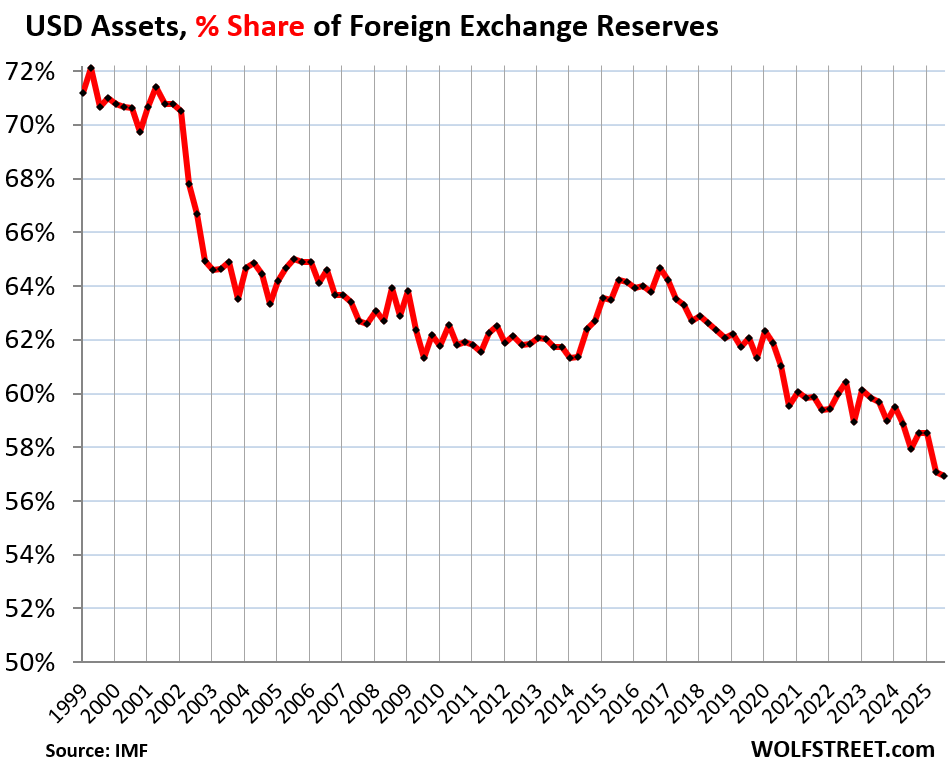
Re: Geopolitics/Geoeconomics Thread - June 2015
Ukraine "progrom" CIA involvement, very active
Break up Russia., over the long term counter China directly
THE narrative Russia is a threat to Europe getting louder, citizens being sensitised to the notion of actual war
Mike Pompeo in Ukraine defence firm advisory board[., financial incentive to keep war going/color]
Re: Geopolitics/Geoeconomics Thread - June 2015
The Actual Reason The EU Just Stopped the $105B Seizure of Russian Assets Explained
one sentence : it would bankrupt Belgium and Euro would lose its reserve currency status
Re: Geopolitics/Geoeconomics Thread - June 2015
@drnayar ji, now let us do Euro, Yen, Singapore $, Swiss Franc, Riyal, Pound Sterling, and Renmenbi. Did I miss any other major players?drnayar wrote: ↑27 Dec 2025 18:42 https://wolfstreet.com/2025/12/26/statu ... ince-1994/
[img...]https://wolfstreet.com/wp-content/uploa ... rterly.png[/img]
Source : https://wolfstreet.com/
-
S_Madhukar
- BRFite
- Posts: 1122
- Joined: 27 Mar 2019 18:15
Re: Geopolitics/Geoeconomics Thread - June 2015
Watch the photo closely, Nixon is clearly in awe of Yahyas twirled eyebrows
 In the presence of the Beast of Lawhore …