*A Quiet Storm in India: How SIR, CAA and the New IFA 2025 Are Reshaping National Security*
By *Kiran Pasunuri*
A silent but significant shift is unfolding across parts of India, especially in West Bengal. Streets appear normal, but there is growing unease beneath the surface. Many residents are suddenly leaving their homes, while others are moving toward the Bangladesh border.
The trigger is not just the recent SIR (Special Summary Revision) notices. The real concern is the deeper link between SIR and the newly implemented Immigration & Foreigners Act 2025.
SIR: A Routine Process Turning Into a Citizenship Signal
The SIR process usually handles corrections in the voter list.
This year, however, many in Bengal see it differently.
For them, SIR has become an indirect warning that their citizenship status may be reviewed.
This fear stems from the new national-level law—the Immigration & Foreigners Act (IFA) 2025.
IFA 2025: India’s Strongest Immigration Law Yet
Passed in March–April 2025 and enforced from September 1, 2025, the IFA introduces some of the toughest penalties India has ever seen for undocumented migration:
• Staying without valid passport/visa: 5 years jail + ₹5 lakh fine
• Fake documents: ₹10 lakh fine + immediate deportation
• Entry after deportation: Lifetime ban
The message is clear:
India is shutting the door on illegal immigration.
SIR + IFA: Why Panic Is Rising
In earlier years, missing from the voter list was not a major issue.
Now, missing from SIR is often interpreted as “citizenship under doubt”.
And once citizenship is questioned, IFA 2025 can apply.
This has created fear, leading to sudden disappearances and movement near border areas.
State governments have limited control. Matters related to citizenship, immigration, deportation and national security lie entirely with the central government.
CAA as a Protection Shield for Select Minorities
Communities from Pakistan, Bangladesh and Afghanistan—Hindus, Sikhs, Christians and Parsis—can apply for citizenship under the Citizenship Amendment Act (CAA).
IFA does not apply to them, providing a safety net for eligible groups.
This difference explains why some communities feel protected while others do not.
*A Larger National Strategy Unfolding*
The recent steps appear to be part of a long-term national security plan:
1. Legalising eligible minorities through CAA
2. Cracking down on illegal immigration via IFA 2025
3. Cleaning the voter list through SIR
4. Preparing for a nationwide NRC
5. Updating demographic and caste data
6. Future delimitation based on accurate population patterns
The central strategy is gradual, structured and layered.
India’s New Security Era
SIR is no longer just a voter list update.
It has become a trigger point for broader national action on citizenship and border control.
India is clearly moving into a new phase of security and demographic regulation, and not everyone is comfortable with these changes.
Elections Modi 3.0
Re: Elections Modi 3.0
VI@WA
Re: Elections Modi 3.0
India today has three relatively 'stable' categories of states. Members of these categories tend to remain in these categories because of political inertia; it will take major upheavals to move a state out of one of these categories.
Category 1- the Ganga plain heartland states (UP, MP)
Category 2- the peripheral satrapies of the heartland, which exercise some independence from political trends in the heartland at times, but eventually tend to arrive at harmony with the heartland through mutual negotiation and accommodation of existing leadership structures (Rajasthan, Himachal Pradesh, Haryana, Gujarat)
Category 3- the regional contrarian states, in which local power has traditionally stemmed from the degree of independence/divergence the leadership proclaims vis-a-vis the heartland (West Bengal, Tamil Nadu, Punjab, Kerala)
Other states reside in the spaces between Category 1 and 2 (1.5) or between 2 and 3 (2.5). However, they are NOT stable residents of these spaces-- rather, they are always in a state of dynamic flux between the three primary categories. Maharashtra for example was trending towards Category 3, but now is trending towards Category 2. Delhi was anomalously in Category 3 during the AAP period, but now is firmly Category 2 and trending towards category 1. Karnataka and Jharkhand may be trending more towards Category 3, while Telangana, Orissa, and Chhattisgarh are tending towards Category 2.
In Category 2 states, the local anti-BJP/NDA opposition parties have in general played second fiddle to the 'national opposition' party (thus far, Congress). In Category 3 states, the local anti-BJP/NDA opposition parties are generally in the driver's seat with Congress either allying with them for national elections or playing a 'frenemy' role in local elections.
What we saw in Bihar was the firm transition of a Category 1.5 state (it was Category 2.5 trending 3 ten years ago!) into a Category 1 state. That's why it was so significant. The local opposition party has been reduced to a marginal player, and the national opposition party has been wiped out.
Category 1- the Ganga plain heartland states (UP, MP)
Category 2- the peripheral satrapies of the heartland, which exercise some independence from political trends in the heartland at times, but eventually tend to arrive at harmony with the heartland through mutual negotiation and accommodation of existing leadership structures (Rajasthan, Himachal Pradesh, Haryana, Gujarat)
Category 3- the regional contrarian states, in which local power has traditionally stemmed from the degree of independence/divergence the leadership proclaims vis-a-vis the heartland (West Bengal, Tamil Nadu, Punjab, Kerala)
Other states reside in the spaces between Category 1 and 2 (1.5) or between 2 and 3 (2.5). However, they are NOT stable residents of these spaces-- rather, they are always in a state of dynamic flux between the three primary categories. Maharashtra for example was trending towards Category 3, but now is trending towards Category 2. Delhi was anomalously in Category 3 during the AAP period, but now is firmly Category 2 and trending towards category 1. Karnataka and Jharkhand may be trending more towards Category 3, while Telangana, Orissa, and Chhattisgarh are tending towards Category 2.
In Category 2 states, the local anti-BJP/NDA opposition parties have in general played second fiddle to the 'national opposition' party (thus far, Congress). In Category 3 states, the local anti-BJP/NDA opposition parties are generally in the driver's seat with Congress either allying with them for national elections or playing a 'frenemy' role in local elections.
What we saw in Bihar was the firm transition of a Category 1.5 state (it was Category 2.5 trending 3 ten years ago!) into a Category 1 state. That's why it was so significant. The local opposition party has been reduced to a marginal player, and the national opposition party has been wiped out.
Re: Elections Modi 3.0
Tejasvi increased its vote share compared to the 2020 tally.
Whereas, NDA consolidated its votes by taking Chirag and other small allies along with them, which made the difference.
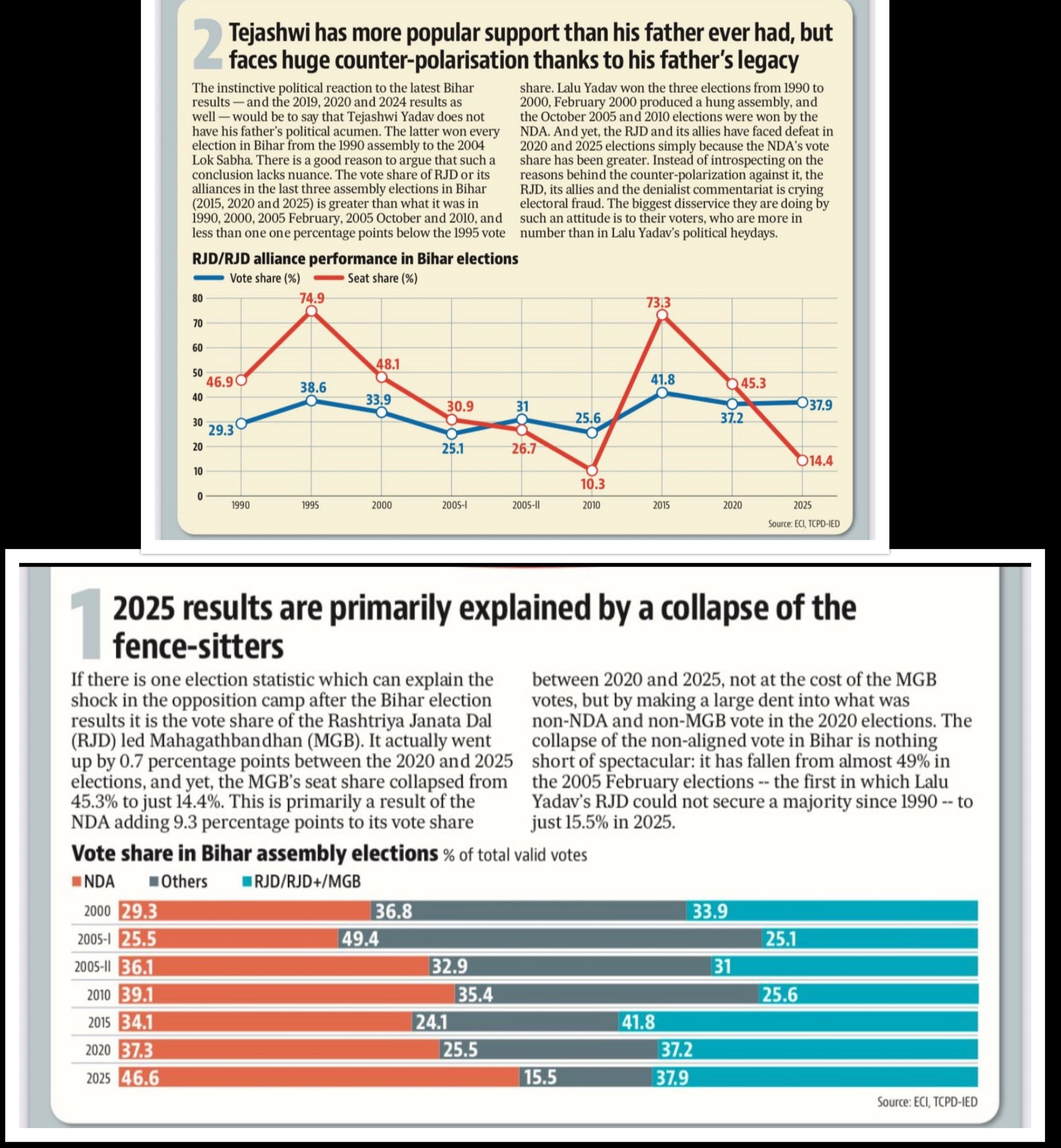
Whereas, NDA consolidated its votes by taking Chirag and other small allies along with them, which made the difference.
Re: Elections Modi 3.0
Well as per analysis, RJD contested more seats, 143, compared to BJP and JDU. So naturally they polled more votes.
Re: Elections Modi 3.0
The so called 37.9 is for the whole of INDI Alliance. RJD has 23. While BJP has 21. JDU about 19.25. Congress 8.7 and Chirag 5 percent. Since this is an alliance election, it can only be seen as such. And NDA increasing their tally massively compared to the stagnant position of INDI
https://results.eci.gov.in/ResultAcGenNov2025/index.htm
https://results.eci.gov.in/ResultAcGenNov2025/index.htm
Re: Elections Modi 3.0
https://x.com/rishibagree/status/1993659347021504704
@rishibagree
No discrepancies were found during the mandatory counting of VVPAT slips in the Bihar Assembly election.
Votes recorded in EVMs matched perfectly with VVPAT slips in all 243 constituencies.
Candidates' Reps were present during VVPAT verification.
The entire process was recorded on CCTV.
@rishibagree
No discrepancies were found during the mandatory counting of VVPAT slips in the Bihar Assembly election.
Votes recorded in EVMs matched perfectly with VVPAT slips in all 243 constituencies.
Candidates' Reps were present during VVPAT verification.
The entire process was recorded on CCTV.
Re: Elections Modi 3.0
Below is from the chat of pollster Savyasachi. Some interesting points.
Pollster Shreeramjvc initially gave 18% Yadav votes to NDA. But after polls and recently in an interview he corrected it to 23%. It matches with Savyasachi calculation of 25% Yadav votes to NDA. That is great news. Hopefully will also be in effect in the next Lok sabha elections also.
https://x.com/savvyasaachi/status/19910 ... 5gyrQ&s=19
Pollster Shreeramjvc initially gave 18% Yadav votes to NDA. But after polls and recently in an interview he corrected it to 23%. It matches with Savyasachi calculation of 25% Yadav votes to NDA. That is great news. Hopefully will also be in effect in the next Lok sabha elections also.
https://x.com/savvyasaachi/status/19910 ... 5gyrQ&s=19
Re: Elections Modi 3.0
Election Commission Directs BLOs To Verify All Voters 60+ In The 2002 SIR roll | Bengal | News18
Election Commission directs BLOs to verify all voters 60+ in the 2002 SIR roll
Election Commission directs BLOs to verify all voters 60+ in the 2002 SIR roll

Re: Elections Modi 3.0
Kerala was once considered as a zero chance and zero seat for BJP. Now after a single MP seat in 2024 Lok Sabha elections two pollsters are predicting upto 21% percent of votes in local body elections. Last time it was around 15% vote share.
From Dheeraj,
https://x.com/i/status/1999095402000494795
https://x.com/i/status/1998026367670366498
From Dheeraj,
https://x.com/i/status/1999095402000494795
From Savyasachi,my expectation from Kerala LB for BJP
2700 wards (2500-3000, 2020: ~1610)
18.6% vote (18.1%-19.1%, 2020: 15.8%, DP+M+MC vote)
80LB #1 or tied #1 (60-100, 2020: 32)
Trivandrum Corp absolute majority
At least 5 Municipalities #1
Significant gains across all other MCs,Ms,DPs and GPs
https://x.com/i/status/1998026367670366498
𝗞𝗘𝗥𝗔𝗟𝗔 𝗟𝗢𝗖𝗔𝗟 𝗕𝗢𝗗𝗬 𝗘𝗟𝗘𝗖𝗧𝗜𝗢𝗡(One of the intensively fought politically jelled LSGD POLL in India)
Since it is an LSGD election,V dont cover it in full due to lack of solid clients.Yet v do hv some data on it.Based on that
Quoting certain points over here
(1)
7.If luck favours,attaining No 1 position in 75+ local bodies is not an impossible task
50-80 local bodies as Single Largest Party is very much in line with winning 2.5K-3K total wards if fortune favour the brave attempt of NDA this time
8.Number of Local Bodies to go HUNG
(4)
9. In fact the votes, seats earn by NDA will decide the front runner of this election (whether it is UDF or LDF)
10. Last time LDF ruled 550+ GPs while UDF fell short of 340. This time UDF to improve its position and LDF to lose many
(5)
11.NDA gaining 18-21% voteshare is not a dream right now,after going thru the data that we hv, they may attain it,though it may proven wrong
12.LDF not to repeat its 2020 performance,UDF to better its position while NDA to be the absolute 3rd force in KL with improved might
(6)
𝗔 𝗩𝗜𝗘𝗪 𝗢𝗡 𝗣𝗥𝗘𝗦𝗘𝗡𝗧 𝗦𝗧𝗔𝗧𝗨𝗦 𝗢𝗙 𝗘𝗔𝗖𝗛 𝟭𝟰 𝗗𝗜𝗦𝗧𝗥𝗜𝗖𝗧𝗦 𝗜𝗡 𝗞𝗘𝗥𝗔𝗟𝗔
Disclaimer-Too difficult to forecast LSGD election. Limited samples,complicated trends etc are the restraints
𝗧𝗩𝗠- LDF EDGE, BJP-THE BIGGEST GAINER
(1) See Attached Tweets
Re: Elections Modi 3.0
KL local body elections showed good results for BJP/NDA.
All results summarized nicely here: https://en.wikipedia.org/wiki/2025_Kera ... _elections
Vote shares not yet available, but I would expect around 17-19% for NDA...about 2-4% points increase from 2020.
NDA has steadily increased its tally in all the categories. Wins are mostly in the Travancore (south KL) areas.
The one big win for BJP is in the Thiruvananthapuram corporation, which is the "most important" in KL. It looks like Rajeev Chandrasekhar has been working hard behind the scenes. Maybe also some outside "wink and nod" from Shashi Tharoor who is still hanging around in Tvm and isn't very pally with the local Congis.
The other good news is that the KL commies have had major losses in all categories. They seem to be slowly following the same path to oblivion as their comrades in other states. This outdated, useless, and failed western ideology foisted upon other countries needs to end in Bharat. Commie fade-out in KL would give rise to a BJP-INC contest (similar to KA and TG) in the coming years.
Interestingly, both Indian communism and INC have mostly retreated to dakshin bharat in the last decade, making it the most important battleground for sanatan dharma. All these rascals will have to be dealt with with utmost perserverance.
All results summarized nicely here: https://en.wikipedia.org/wiki/2025_Kera ... _elections
Vote shares not yet available, but I would expect around 17-19% for NDA...about 2-4% points increase from 2020.
NDA has steadily increased its tally in all the categories. Wins are mostly in the Travancore (south KL) areas.
The one big win for BJP is in the Thiruvananthapuram corporation, which is the "most important" in KL. It looks like Rajeev Chandrasekhar has been working hard behind the scenes. Maybe also some outside "wink and nod" from Shashi Tharoor who is still hanging around in Tvm and isn't very pally with the local Congis.
The other good news is that the KL commies have had major losses in all categories. They seem to be slowly following the same path to oblivion as their comrades in other states. This outdated, useless, and failed western ideology foisted upon other countries needs to end in Bharat. Commie fade-out in KL would give rise to a BJP-INC contest (similar to KA and TG) in the coming years.
Interestingly, both Indian communism and INC have mostly retreated to dakshin bharat in the last decade, making it the most important battleground for sanatan dharma. All these rascals will have to be dealt with with utmost perserverance.
Re: Elections Modi 3.0
Did you know? CECs of Indonesia, & South Africa observed Bihar's election.
From EVM Dispatch, to polling.
~ SA's CEC: "India's digital election system is way ahead of our nation. So much to learn"
Indonesian CEC: "Anybody could tell the polls were FREE & FAIR"
watch video here
https://x.com/i/status/2000573793040015610
From EVM Dispatch, to polling.
~ SA's CEC: "India's digital election system is way ahead of our nation. So much to learn"
Indonesian CEC: "Anybody could tell the polls were FREE & FAIR"
watch video here
https://x.com/i/status/2000573793040015610
Re: Elections Modi 3.0
Post-Election Clashes in Kerala: Violence, Vandalism, Injuries Reported Across State | NewsX
Kerala voted for change. The CPM responded with violence!
Commies attacked BJP office and BJP responded
https://www.youtube.com/watch?v=QaCf_pv8n8M
Muslim league VS Communists stone throwing
https://www.youtube.com/watch?v=VtbVOSYtodM
Kerala voted for change. The CPM responded with violence!
Commies attacked BJP office and BJP responded
https://www.youtube.com/watch?v=QaCf_pv8n8M
Muslim league VS Communists stone throwing
https://www.youtube.com/watch?v=VtbVOSYtodM
Re: Elections Modi 3.0
From pollster Dheeraj,
https://x.com/i/status/1999740550162092403
https://x.com/i/status/1999753435458207769
https://x.com/i/status/1999740550162092403
BJP has done well across the state in Kerala LB but underperformed my expectations due to lack of winnability perception, pro UDF trend as anti incumbency votes consolidated to main opposition.
In Tvm as i predicted clear majority for BJP as winnability perception there
Praise to Dheeraj from a pollster well known in India JVC Sreeram.Predicting at ward level is hazardous in a localized municipal election.
But I managed to get 75/100 wards correct in Trivandrum Corp
BJP at 50 vs my prediction of 58
LDF at 29 vs 22
UDF at 19 vs 20 predicted.
some local factors and candidates in several wards overrode trend
https://x.com/i/status/1999753435458207769
BJP almost winning the most prestigious seat of Kerala capital city Thiruvananthapuram Corporation sent shockwaves throughout the Kerala, even for BJP supporters. On reporting that election results day, Manorama news paper stated that the Communist party members who assembled in their newly built headquarters in Thiruvananthapuram were in disbelief on learning that they are now going to be under the BJP rule in the corporation.Kudos to you Dheeraj for your excellent insights on this election. Certainly the results were less than your expectations but your analysis were exceptional. Congrats.
Re: Elections Modi 3.0
Maharashtra local body election results LIVE: Trends show Mahayuti crossing 200-mark, MVA trails far behind
Maharashtra local body election results 2025 LIVE updates: Early trends from the Maharashtra civic elections show the ruling Mahayuti holding a clear edge, leading in 192 local bodies, with the Bharatiya Janata Party ahead in 107 bodies and the Shiv Sena led by Eknath Shinde leading in 48. The Opposition Maharashtra Vikas Aghadi (MVA) is currently leading in 46 bodies.
Counting is underway in 253 of the 288 municipal councils and nagar panchayats, with results from the remaining bodies awaited.
The BJP has already secured three seats unopposed, with members and presidents of the Dondaicha Municipal Council (Dhule) and Angar Nagar Panchayat (Solapur) elected without contest, while the poll for the Jammer municipal president also saw no opposition.
Together, the trends point to a strong early showing for the Mahayuti in the civic polls.
The results will mark the culmination of a two-phase civic poll held on December 2 and December 21. The results are expected to offer an early read on the balance of power between the ruling Mahayuti and the Opposition Maha Vikas Aghadi (MVA) at the grassroots level.
The contest turned multi-dimensional in several pockets, with alliance politics intersecting with local rivalries. In a number of towns, “friendly fights” emerged as partners within the ruling Mahayuti — the Bharatiya Janata Party, Eknath Shinde-led Shiv Sena, and Ajit Pawar's Nationalist Congress Party — fielded candidates against one another.
:
:
:
:
Re: Elections Modi 3.0
Looks like the two cousins are going to have a very public falling out soon 
There were reports of fighting over seats allocation but they were suppressed by the media owned by the onion merchants and their partners
There were reports of fighting over seats allocation but they were suppressed by the media owned by the onion merchants and their partners
Re: Elections Modi 3.0
I stilll dont understand what Raj brings to the table. He doesnt have financial muscle like onion merchants or UT has due to history. Mediation and vasooli can only bring do much. Despite oratory skills and cosplaying the senior T, he is unable to get more than 1-2 members elected to Assembly.
The marathi manoos card is appearing increasingly worn and shabby…
The marathi manoos card is appearing increasingly worn and shabby…
-
S_Madhukar
- BRFite
- Posts: 1219
- Joined: 27 Mar 2019 18:15
Re: Elections Modi 3.0
RT and UT are Pawarfools playthings. If the economy does well they are toast
Re: Elections Modi 3.0
Goa ZP election result 2025: BJP-led alliance wins 31 seats, Congress behind with 10 seats | Details
Panaji: Goa’s ruling alliance, led by the Bharatiya Janata Party (BJP), on Monday won over 31 of the 50 seats in the zilla panchayat elections held on December 20.
:
:
:

Re: Elections Modi 3.0
"Dhurandhar" Farnavis has a long-term plan of toasting all these characters together. Charade is already on last legs (literally). Uddhav, Raj, Aditya, Ajit, Supriya all will get toasted. Shinde will probably stick around unless he too gets secularitis.S_Madhukar wrote: ↑22 Dec 2025 13:45 RT and UT are Pawarfools playthings. If the economy does well they are toast
Re: Elections Modi 3.0
Achha hi hai (good only)....dis wuz da 'zilla election, now comez godzilla election on jan 15.VinodTK wrote: ↑22 Dec 2025 21:57 Goa ZP election result 2025: BJP-led alliance wins 31 seats, Congress behind with 10 seats | Details
Panaji: Goa’s ruling alliance, led by the Bharatiya Janata Party (BJP), on Monday won over 31 of the 50 seats in the zilla panchayat elections held on December 20.
:
:
:
Re: Elections Modi 3.0
Priyanka Gandhi's son Raihan Vadra gets engaged to girlfriend Aviva Baig
:
:
:
Who is Aviva Baig?
Meanwhile, Aviva completed her schooling at Modern School in Delhi before pursuing media communication and journalism at OP Jindal Global University.
She works as an interior designer, like her mother, and is also involved in photography and production, according to her Instagram bio. She has said that her work focuses on social issues and seeks to create positive change. Aviva is also reportedly a former national-level football player.
Aviva Baig and her family are based in Delhi. Her father, Imran Baig, is a businessman, and her mother, Nandita Baig, works as an interior designer, NDTV reported.
Re: Elections Modi 3.0
VinodTK wrote: ↑30 Dec 2025 18:15 Priyanka Gandhi's son Raihan Vadra gets engaged to girlfriend Aviva Baig:
:
:
Who is Aviva Baig?
Meanwhile, Aviva completed her schooling at Modern School in Delhi before pursuing media communication and journalism at OP Jindal Global University.
She works as an interior designer, like her mother, and is also involved in photography and production, according to her Instagram bio. She has said that her work focuses on social issues and seeks to create positive change. Aviva is also reportedly a former national-level football player.
Aviva Baig and her family are based in Delhi. Her father, Imran Baig, is a businessman, and her mother, Nandita Baig, works as an interior designer, NDTV reported.
VinodTK ji,
next stop parliament onlee

Re: Elections Modi 3.0
He is like 20 barely and already engaged ?
Also I wonder if baig realizes that aviva is a Hebrew name very popular in Israel . Wonder if the mullah realizes it's a very haraam name onlee
Also I wonder if baig realizes that aviva is a Hebrew name very popular in Israel . Wonder if the mullah realizes it's a very haraam name onlee
-
S_Madhukar
- BRFite
- Posts: 1219
- Joined: 27 Mar 2019 18:15
Re: Elections Modi 3.0
Badra papa securing real estate I suppose. Considering London shondon SOAS woke degree ₹₹ are needed for future. May be 2 duffers coming together
Re: Elections Modi 3.0
Finally, the realisation .....

This meme after #BiharElection2025

the congis cannot win in bihar and UP without destroying tejeswi and akaless
This meme after #BiharElection2025
the congis cannot win in bihar and UP without destroying tejeswi and akaless
Re: Elections Modi 3.0
Go to Supreme Court to oppose linking of Aadhar to Voter id, go to Supreme Court to allow Aadhar for voter verification.
Oppose linking Aadhar to Voter id in Parliament, pay influencers to question why the two aren't linked.
Are we witnessing a propaganda war to demoralise the population, stall the government & discredit institutions?
watch video
https://x.com/i/status/2006928888212132208
Re: Elections Modi 3.0
musings of the mount road marx and woke urban naxal
the desperation of the soreass commies is reaching panic proportions


but these liars deliberately missed this

the desperation of the soreass commies is reaching panic proportions
Accept Aadhaar as a voter’s identity, period — the Supreme Court of India reiterates its Order to the Election Commission of India.
It is disgraceful that the Election Commission has repeatedly flouted the instructions and orders of the Supreme Court.
As Senior Advocate Kapil Sibal pointed out to the Bench: “Your Lordships had clearly said several times that Aadhaar can be used as an alternative to any of the 11 documents. BLOs [block level officers] are still refusing.
The EC is penalising officers for accepting Aadhaar and issued show-cause notices to BLOs who have allowed Aadhaar...Disciplinary proceedings have already started against these officers.
There are no instructions from EC to officers to accept Aadhaar despite separate orders by this court... I have 24 affidavits from people from various districts who were unsuccessful in giving Aadhaar.
The EC's conduct amounts to gross contempt of this court's orders... We want Aadhaar to be used as proof of residence or identity, so that a person can vote. We want only 11 documents plus Aadhaar.”
And, yes, the Election Commission must be “named and shamed,” as Congress leader Jairam Ramesh has observed.
See these reports in The Hindu of September 9, 2025.
but these liars deliberately missed this
Re: Elections Modi 3.0
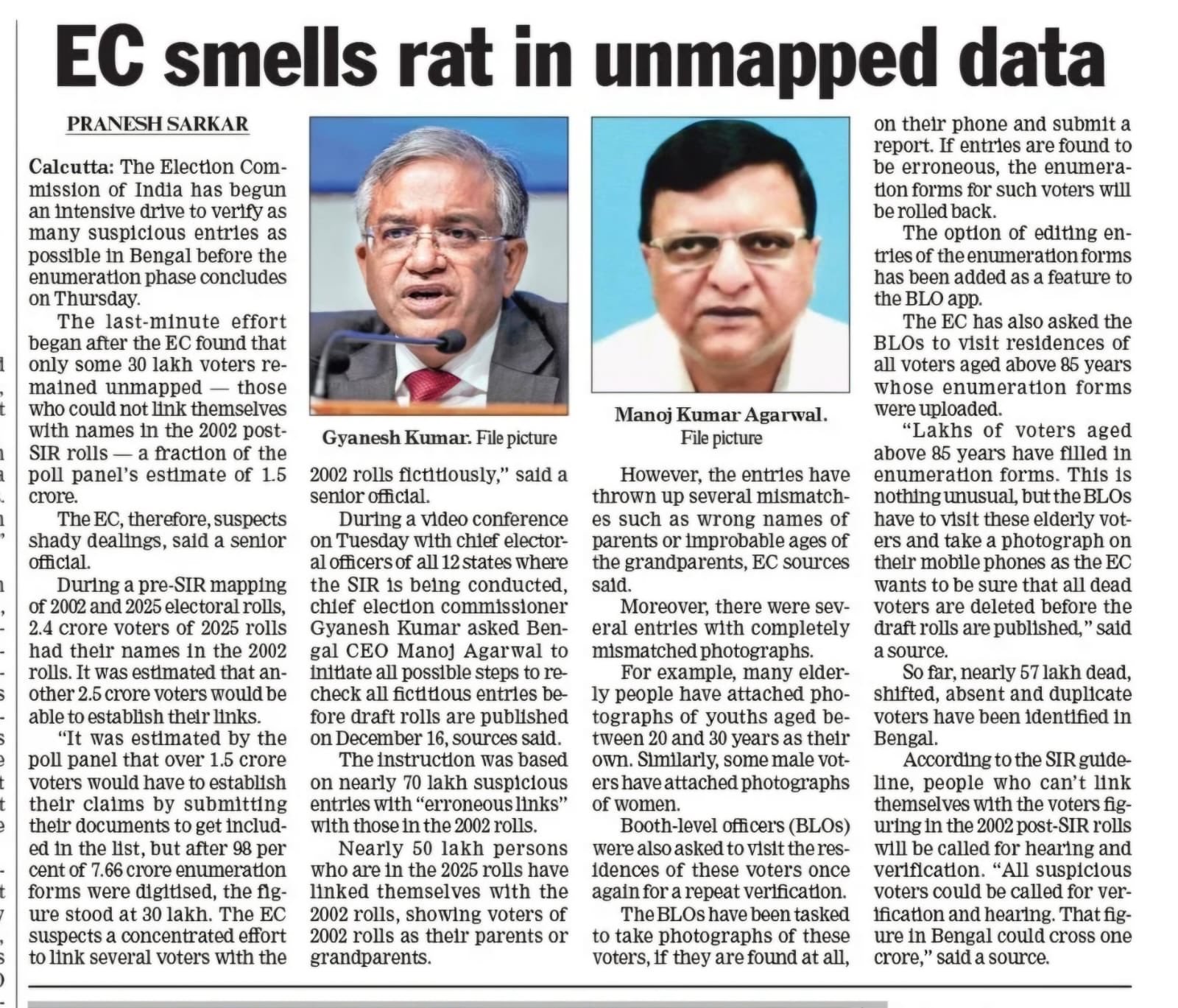
BENGAL SIR exposes MASSIVE voter-list anomalies
~ ECI has flagged 24 lakh voters for suspicious PROGENY mapping, sets of 6 or more linked to the same parent on the 2002 list, statistically IMPLAUSIBLE.
Another 11.95 lakh cite parents older by ≤15 years; 3.29 lakh link to grandparents <40 years older.
Verification calls begin.
This is NRC-like scrutiny, clean rolls, hard facts.
watch video
https://x.com/i/status/2007447917892976954
Re: Elections Modi 3.0
@bala ji, "harvard" faaw. He is an IITian. That takes precdence
Re: Elections Modi 3.0
Per wikipedia:
Jairam Ramesh got a B Tech in Mechanical Engineering from IIT Bombay in 1975.
MS in Public Policy and Public Management from Carnegie Mellon Univ in 1977.
1977 - 78 attended PhD program in technology policy, economics, engineering, and management at MIT but dropped out.
His dad was a prof of Civil Engineering at IIT B.
However, all that academic dazzle doesn't take away from this guy being a brown nosed, spineless boot licker of the Neverwho clan.
Re: Elections Modi 3.0
@RCase ji,
"MS in Public Policy and Public Management from Carnegie Mellon Univ in 1977"?!!! So, he couldn't get into CMU Mech, which is one of the top five departments in the US. CMU competes with MIT, Stanford, Berkeley, and UIUC (my alma mater, of which I am proud) in all engineering departments and Computer Science.
"1977 - 78 attended PhD program in technology policy, economics, engineering, and management at MIT but dropped out"!!! Sounds like a soft MS at MIT.
"MS in Public Policy and Public Management from Carnegie Mellon Univ in 1977"?!!! So, he couldn't get into CMU Mech, which is one of the top five departments in the US. CMU competes with MIT, Stanford, Berkeley, and UIUC (my alma mater, of which I am proud) in all engineering departments and Computer Science.
"1977 - 78 attended PhD program in technology policy, economics, engineering, and management at MIT but dropped out"!!! Sounds like a soft MS at MIT.
Re: Elections Modi 3.0
Again from Wikipedia:Vayutuvan wrote: ↑04 Jan 2026 09:21 @RCase ji,
"MS in Public Policy and Public Management from Carnegie Mellon Univ in 1977"?!!! So, he couldn't get into CMU Mech, which is one of the top five departments in the US. CMU competes with MIT, Stanford, Berkeley, and UIUC (my alma mater, of which I am proud) in all engineering departments and Computer Science.
"1977 - 78 attended PhD program in technology policy, economics, engineering, and management at MIT but dropped out"!!! Sounds like a soft MS at MIT.
My observations:When Ramesh was 17, in 1971, he read Asian Drama, one of the early books of Gunnar Myrdal and wrote to him at the Stockholm International Peace Research Institute.
In 1978, Jairam joined the World Bank for a short assignment. He returned to India in December 1979 and worked as assistant to economist Lovraj Kumar at the Bureau of Industrial Costs and Prices. From 1983 to 1985 he was Officer on Special Duty in the Advisory Board of Energy. He then worked in the Planning Commission (advisor to Abid Hussain), Ministry of Industry and other economic departments of the Central Government, including: analysing energy policy during 1983–85, reorganising the CSIR in 1986 and implementing technology missions during 1987–89.
- While he was in high school, he wrote to Gunnar Myrdal. How many of you during your high school days of that time, would even dream of writing to some phoren guy? Most of us were engrossed in preparing for board exams and entrance exams. Sending overseas mail itself was quite prohibitive. Remember the days of sending pre-apps in aerogrammes for US univs, and that too when we were a bit more mature nearing the end of college.
- Joining World Bank and landing government job in Bureau of Industrial Costs and Prices, planning commission etc. reeks of sifarish.
For most from that era, came to do STEM or Management degrees and invariably worked in industry in the US at for least a few years.
Typically guys with 'connections' were cultivated by the US and their children were doled out admissions to these top tier universities with financial support for floozie degrees.
Re: Elections Modi 3.0
My dad used to talk about Gunnar Myrdal etc. I was reading Alistair Maclean from a 10 paisa per day lending library around the corner. My dad tried to get me interested in humanities (he was in humanities) but I had no head for that. I wish I paid some attention to my dad.
Re: Elections Modi 3.0
Assam Congress tells interested candidates to pay 50000 upfront!!!
This is how Congress makes it clear to grassroots, do corruption or leave!!!!
