China-Taiwan Conflict: Combat Tactics & Strategy

The Military Issues & History Forum is a venue to discuss issues relating to the military aspects of the Indian Armed Forces, whether the past, present or future. We request members to kindly stay within the mandate of this forum and keep their exchanges of views, on a civilised level, however vehemently any disagreement may be felt. All feedback regarding forum usage may be sent to the moderators using the Feedback Form or by clicking the Report Post Icon in any objectionable post for proper action. Please note that the views expressed by the Members and Moderators on these discussion boards are that of the individuals only and do not reflect the official policy or view of the Bharat-Rakshak.com Website. Copyright Violation is strictly prohibited and may result in revocation of your posting rights - please read the FAQ for full details. Users must also abide by the Forum Guidelines at all times.
Rakesh
Forum Moderator
Posts: 22078
Joined: 15 Jan 2004 12:31
Location: Planet Earth
Contact:

Re: China-Taiwan Conflict: Combat Tactics & Strategy

Post by Rakesh »

I am posting a series of YT videos on Chinese strategies to invade Taiwan. I stumbled across Episode 19 while YT surfing and now I am working backwards :) Episode 19 has a really interesting story line. A must watch. Episode 19 is the last post on this page (for now!) and it starts off with Episode 15 (this post). I will post the subsequent episodes when they are published.

The Next World War | The Quarantine of Taiwan

China launches an invasion of the Kinmen Islands, inciting a reaction from Taiwan that serves to justify the PRC's complete quarantine of the island nation. There’s much to tell in this episode, laying the groundwork for the entire season - so for those looking for beginning-to-end action, this one is a slow-burn. To begin, I wanted to start with China’s “justification” for the quarantine and in a way that would be the most troublesome to Taiwan and its allies. In talking to my network of SMEs, an invasion of the Kinmen Islands - and in particular using unidentified forces (though clearly PRC), would do nicely. The difficult challenge for Taiwan, the US, Australia, UK and Japan would be how to respond without going kinetic. I also wanted to give a peek into the decision making process in Washington, most notably, their debate about Taiwan’s willingness to fight and the US commitment to Taiwan’s defense. Toward that, I wanted to insert a nod to the very small but important US State Department’s Bureau of Intelligence and Research (INR), who doesn’t receive much love, but from my own research… does some amazing work. Lastly, a ton of time went into the episode, from pouring through historical documents of NSC meetings, to interviews with subject matter experts, think tank white papers… the list goes on, all before the script, filming and editing even began. To speed up production, the creator of the YouTube Channel, FIXEDIT, offered his valuable time and knowledge of DCS, to film several of the scenes based on my script. A HUGE thank you to him. That, alone, cut my time in filming by a third. Otherwise, this episode would not have gone out until February.

Rakesh
Forum Moderator
Posts: 22078
Joined: 15 Jan 2004 12:31
Location: Planet Earth
Contact:

Re: China-Taiwan Conflict: Combat Tactics & Strategy

Post by Rakesh »

The Next World War | The Grey War

As China tightens its grip on Taiwan, a shadowy undersea Grey War escalates, forcing the United States toward a pivotal decision with deadly consequences. Background: A great deal is happening in this episode. The general idea behind it is that as the quarantine takes effect and with China moving to further isolate Taiwan, both the US and China begin to misunderstand and miscalculate the other and, under increasing pressure, make decisions that will have grave effects in this episode, and more importantly, the next. I also wanted to highlight the local and global economic impacts, the uncertainty of geopolitics when it comes to friends and allies in the region, and the technologies used in undersea ISR and sabotage. And though the script for this episode was planned many months ago... it has been outpaced by real-world current events in the Baltic Sea, North Sea and off Taiwan! It's hard to keep up and keep ahead.

Rakesh
Forum Moderator
Posts: 22078
Joined: 15 Jan 2004 12:31
Location: Planet Earth
Contact:

Re: China-Taiwan Conflict: Combat Tactics & Strategy

Post by Rakesh »

The Next World War | Short, Swift and Brutal

As an allied task force attempts to break the quarantine of Taiwan, missteps and miscalculations place China and the US on a fatal collision course. Background: What if the Berlin Airlift or the blockade of Cuba had not only failed, but ignited a war? This is what was in my mind when preparing for this episode. I also wanted to explore how, despite characters on both sides of the Pacific not wishing war, events can quickly spiral beyond control through miscommunication, mistakes and overconfidence. Lastly, I wanted to take a first, hard look at how fast and lethal a modern naval battle could be - in particular when in such close proximity where the benefits of range and SAMs are reduced. The 1980’s tanker war and the Falklands War both were great resources for this episode.

Rakesh
Forum Moderator
Posts: 22078
Joined: 15 Jan 2004 12:31
Location: Planet Earth
Contact:

Re: China-Taiwan Conflict: Combat Tactics & Strategy

Post by Rakesh »

The Next World War | Headlong Into War

In the aftermath of the disaster off Taiwan’s coast involving both the US and China, a storm of fury, misinformation and disinformation propels both nations toward fateful decisions, as momentum builds toward war. Background: This is the bridging episode that takes us from China's gamble regarding the quarantine, the US’s attempt to break it, and what comes next: open war. In this episode, I wanted to show how the momentum of events are affecting both sides and a behind-the-curtain look at how decisions were made. Within that, I was also looking to highlight how both sides misread the other while being influenced by their own agendas (personally and politically), as well by misinformation, disinformation and missteps. Definitely on my mind while writing this were events of late spring and summer of 1914 in the weeks leading to World War 1, where once Serbia and Austria-Hungary began to mobilize, momentum took over, spiraling Europe into war. Finally, I wanted to introduce the US Marines unit to the story, who we will revisit in much further detail later in the season! I know this one was a slower-paced episode, but it was really necessary to make that connection to all the episodes coming. In episode 19… things begin to cook.

Rakesh
Forum Moderator
Posts: 22078
Joined: 15 Jan 2004 12:31
Location: Planet Earth
Contact:

Re: China-Taiwan Conflict: Combat Tactics & Strategy

Post by Rakesh »

The Next World War | China’s Attack Begins

China carries out a massive, simultaneous and far-reaching attack to blind, confuse, disrupt and eliminate key leadership, infrastructure and defense systems across the Indo-Pacific - including a far-reaching attack that will reach into the very heart of INDOPACOM. Background: I think of this episode as H-Hour (minus 1). It is the attack that will pave the way for the next episode when the missile blitz begins. For this episode I wanted to highlight the vulnerabilities we face through cyberattacks, including how our own vehicles could be used against us. Also, I wanted to show how drones will be used ubiquitously and to illustrate that their reach will be far and used in ways we may not be prepared for (yet). There are no longer 'front lines'.

uddu
BRF Oldie
Posts: 4421
Joined: 15 Aug 2004 17:09

Re: China-Taiwan Conflict: Combat Tactics & Strategy

Post by uddu »

https://x.com/Varun55484761/status/1986736969284788498

@Varun55484761
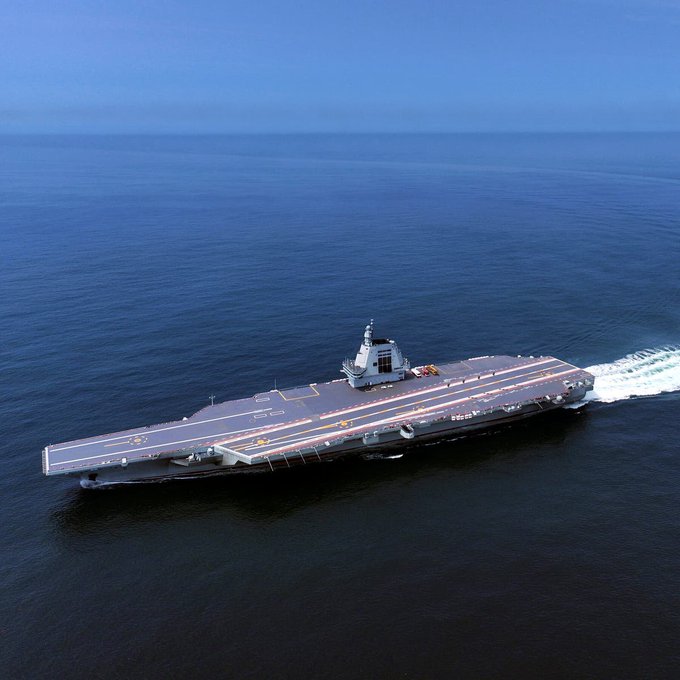
China’s newest and most advanced aircraft carrier, the Fujian, officially entered into service this week. The Fujian, which features an electromagnetic catapult system for launching and landing aircraft, was commissioned for service on Wednesday.

Image
Rakesh
Forum Moderator
Posts: 22078
Joined: 15 Jan 2004 12:31
Location: Planet Earth
Contact:

Re: China-Taiwan Conflict: Combat Tactics & Strategy

Post by Rakesh »

Japan Hits a Chinese Nerve: And why it’s good news for India
https://openthemagazine.com/world/japan ... -for-india
05 Dec 2025
It isn’t lost on the Chinese that Japanese Prime Minister Sanae Takaichi models herself on former British Prime Minister Margaret Thatcher who signed the Sino-British Joint Declaration in 1984, which gave Hong Kong autonomy from China till 2047
Tanaji
BRF Oldie
Posts: 5235
Joined: 21 Jun 2000 11:31

Re: China-Taiwan Conflict: Combat Tactics & Strategy

Post by Tanaji »

Rakesh wrote: 08 Nov 2025 02:36 The Next World War | China’s Attack Begins

[YouTube] .... [YouTube]
This was pretty good actually, some of it is quite believable and easily applicable to Indian context. I hope Indian planners are aware as well.

Thanks Rakeshji..
Rakesh
Forum Moderator
Posts: 22078
Joined: 15 Jan 2004 12:31
Location: Planet Earth
Contact:

Re: China-Taiwan Conflict: Combat Tactics & Strategy

Post by Rakesh »

Report to Congress on Military and Security Developments Involving the People’s Republic of China 2025
https://media.defense.gov/2025/Dec/23/2 ... A-2025.PDF

^^^^ https://x.com/DerekJGrossman/status/200 ... 84211?s=20 ---> Trump 2.0's first China military power report just dropped. The Preface is very conciliatory toward Beijing and clearly written by politicos. Relevant excerpts here:

"Under President Trump’s leadership, relations between the United States and China are stronger than they have been in many years, and the Department of War will support efforts to build on this progress. We will do so in part by opening a wider range of military-to-military communications with the PLA with a focus on strategic stability as well as de-confliction and de-escalation, more broadly. We will also seek other ways to make clear our peaceful intentions.

At the same time, we will ensure that the Joint Force is always ready and able to defend our nation’s interests in the Indo-Pacific. As we do so, it bears emphasizing that U.S. interests in the Indo-Pacific are fundamental—but also scoped and reasonable. We do not seek to strangle, dominate, or humiliate China. Rather, as laid out in President Trump’s National Security Strategy, we seek only to deny the ability of any country in the Indo-Pacific to dominate us or our allies. That means being so strong that aggression is not even considered, and that peace is therefore preferred and preserved. The Department of War will therefore prioritize bolstering deterrence in the Indo-Pacific through strength, not confrontation.

President Trump seeks a stable peace, fair trade, and respectful relations with China, and the Department of War will ensure that he is able to achieve these objectives from a position of military strength. In the process, we will forge and sustain a balance of power that will enable all of us to enjoy a decent peace in an Indo-Pacific—one in which trade flows openly and fairly, we can all prosper, and all nations’ interests are respected."
Rakesh
Forum Moderator
Posts: 22078
Joined: 15 Jan 2004 12:31
Location: Planet Earth
Contact:

Re: China-Taiwan Conflict: Combat Tactics & Strategy

Post by Rakesh »

^^^

Department of War Just Released 2025 China Military Power Report–Full Text & Key Points Here!
https://www.andrewerickson.com/2025/12/ ... ints-here/
23 Dec 2025
Rakesh
Forum Moderator
Posts: 22078
Joined: 15 Jan 2004 12:31
Location: Planet Earth
Contact:

Re: China-Taiwan Conflict: Combat Tactics & Strategy

Post by Rakesh »

Japan's Cabinet OKs record defense budget that aims to deter China
https://abcnews.go.com/International/wi ... -128697811
25 December 2025
Rakesh
Forum Moderator
Posts: 22078
Joined: 15 Jan 2004 12:31
Location: Planet Earth
Contact:

Re: China-Taiwan Conflict: Combat Tactics & Strategy

Post by Rakesh »

X-Post from the Chinese Armed Forces thread...
Rakesh wrote: 29 Dec 2025 07:12 YJ-20 hypersonic missile filmed launching from Type 055 large destroyer in Chinese media report
https://www.globaltimes.cn/page/202512/1351645.shtml
28 Dec 2025
https://x.com/Ignis_Rex/status/2005117504642072613?s=20 ---> The Hypersonic Deterrent: How the YJ-20 Makes Intervention in a Taiwan Crisis Untenable for US/Japan. The recent footage confirming the deployment of the YJ-20 hypersonic anti-ship missile from a Type 055 large destroyer is more than a technological achievement for China; it is a geostrategic game-changer that fundamentally rewrites the calculus of any potential military intervention in a Taiwan emergency by the United States and Japan. A single Type 055, positioned anywhere in the vast expanse of water between Guam and Taiwan, possesses the strike capability to effectively nullify the forward military presence of its adversaries. The YJ-20's combination of range, speed, and maneuverability creates a missile gap that is, for the moment, insurmountable—and this reality forms the basis of a potent and immediate deterrent.

The Tyranny of the 1,500-Kilometer Radius

The YJ-20, a hypersonic boost-glide vehicle, is estimated to have an operational range of up to 1,500 kilometers (930 miles). A Type 055 operating east of Taiwan transforms this vast, blue-water area into a no-go zone for high-value US and Japanese assets:

* Elimination of the First Island Chain: Major US and Japanese bases across the Ryukyu Islands, including the critical Kadena Air Base in Okinawa and Sasebo Naval Base, fall squarely within the strike envelope. The YJ-20 does not need to be fired from China's mainland; it is deployed from a stealthy, mobile platform that can choose its optimal firing position.

* Threatening the Second Island Chain: By pushing its operational position toward the Taiwan-Guam midpoint, the Type 055 brings the vital staging areas of Guam—home to Andersen Air Force Base and Naval Base Guam—to the very edge of the missile's range. The ability to hold Guam's runways and ports at risk from a ship hundreds of miles away means the critical hub for all Western Pacific operations can be rendered ineffective on day one.

In a conflict scenario, the immediate goal of US and Japanese forces would be to deploy air power and surface fleets to the theater. The YJ-20 makes this deployment suicidal. Any aircraft carrier, amphibious assault ship, or key land base attempting to stage or transit the area would be a vulnerable target.

The Inherent Vulnerability: No Interceptor, No Defense

The true potency of the YJ-20 is not just its offensive capability, but the lack of any proven, operational defense against it.

* Hypersonic Speed (Mach 5+): The sheer velocity of the YJ-20 drastically reduces the decision-making and engagement time for existing interceptors like the SM-3 or the PAC-3.

* Maneuverability: Unlike a predictable ballistic missile, the YJ-20's glide vehicle can perform complex, unpredictable maneuvers in the terminal phase of flight. This ability to change course negates the established intercept geometry used by current missile defense systems, which rely on predicting a target's fixed trajectory.

* The US Missile Gap: The United States is actively developing several hypersonic programs (like the LRHW and CPS), but none are deployed in significant numbers.

Crucially, the US does not yet field an operational weapon designed specifically to intercept a hypersonic glide vehicle. The Missile Defense Agency (MDA) is pursuing the Hypersonic and Ballistic Tracking Space Sensor (HBTSS) and the Glide Phase Interceptor (GPI), but these are still years away from full operational capability. For the purposes of a Taiwan contingency today, the US and Japan have no credible shield. To knowingly sail a multi-billion dollar aircraft carrier or deploy thousands of troops into the 1,500 km kill-zone of a missile that cannot be stopped is a risk no prudent military command can accept.

The Type 055 and its YJ-20 payload have created an Anti-Access/Area Denial (A2/AD) bubble of unprecedented scale and lethality in the Western Pacific. This capability transforms the concept of intervention from a strategic maneuver into an existential gamble, one that effectively deters the very military action it is designed to counter. For the foreseeable future, the mere presence of a single Type 055 in the waters between Taiwan and Guam represents a veto on Western Pacific intervention.

Image
Post Reply