The entire blame for Kaveri engine is on the 1 exam wonder boys/girls of IAS. BARC/ISRO have independent PMO level access/authority. That is how they progressed and made things to work. However MOD is beholden to these IAS duffers who are loathed to think big. Every little thing is a chore in approval cycle. You want a test bench to test things, it goes through an entire rigmarole of procedures and justification cycle. MOD babus whisper things into mantriji which makes it worse since most mantriji are clueless themselves.
Even now, there are things that can be salvaged on the engine front. Give Bharat Forge's Baba Kalyani full authority to fashion a jet engine (special project) with GTRE / DMRL reporting to him. We need engines for lower things like trainers, jaguars, turbo props, etc. Cut out the MOD babus from engines completely. We don't need these blokes. Also involve HAL who know about practical things for an engine.
Kaveri & Aero-Engine: News & Discussion
Re: Kaveri & Aero-Engine: News & Discussion
Isn’t GTRE a part of DRDO? Does this have the same insulation or lack thereof from MoD babus as any other part of DRDO?
Isn’t the Kaveri engine program a GTRE project?
Isn’t the Kaveri engine program a GTRE project?
Re: Kaveri & Aero-Engine: News & Discussion
At this point this seems incorrect. I do not believe in the story of "perceived helplessness" of the PMO or ministry in correcting the wrong and getting this program of national importance back on track. Either there is something happening that we are not privy to or the leadership is not competent in this area.
Last edited by Jay on 28 Jan 2026 02:29, edited 1 time in total.
Re: Kaveri & Aero-Engine: News & Discussion
Has the CAG report of 2011 named “Inordinate Delay in Fruition of Kaveri Engine” been discussed here on BRF?
Re: Kaveri & Aero-Engine: News & Discussion
There is a more fundamental problem in the induction of talent that has to do with the snail's pace progress in Jet Engines.
Societally, there has been a step-motherly, almost consolation prize attitude towards the following: Material Science/ Metallurgy, Chemical Engineering and Aeronautical Engineering. Do not mean any disrespect to those who have majored in these fields. As a thought exercise, let us find out how many JEE top 100 ranks opted for Metallurgy, Chemical, Aeronautical, Naval or Civil Engineering as their preferred choice - probably close to 0.
I can bet you that you can easily find an investment banker who is also among the top ranks of JEE. The malaise lays in the educational process that has (unfounded) biases, ending up with people getting slotted into areas with little or no aptitude for the specialization.
These fields need to be made 'cool' to attract and retain top notch talent.
Societally, there has been a step-motherly, almost consolation prize attitude towards the following: Material Science/ Metallurgy, Chemical Engineering and Aeronautical Engineering. Do not mean any disrespect to those who have majored in these fields. As a thought exercise, let us find out how many JEE top 100 ranks opted for Metallurgy, Chemical, Aeronautical, Naval or Civil Engineering as their preferred choice - probably close to 0.
I can bet you that you can easily find an investment banker who is also among the top ranks of JEE. The malaise lays in the educational process that has (unfounded) biases, ending up with people getting slotted into areas with little or no aptitude for the specialization.
These fields need to be made 'cool' to attract and retain top notch talent.
Re: Kaveri & Aero-Engine: News & Discussion
Delhi Defense Review, April 19, 2017 had this to say:
https://web.archive.org/web/20190302044 ... et-engine/The key problems encountered by the Kaveri design, according to sources who have formerly been associated with the program, are:
* Unacceptable levels of fan-blade flutter risk – It seems that the Kaveri intake may need some redesign to reduce the chances of stall inducing self-excited vibrations (flutter) being experienced by the engine’s duct fan blades.
* Reheat oscillations – Kaveri prototypes currently experience significant combustion oscillation in their augmentors/afterburners. This also has an impact on specific fuel consumption during reheat.
* First stage low-pressure compressor blade vibration – The Kaveri’s first stage low-pressure compressor is also experiencing worrisome levels of rotor blade vibrations at the moment.
Re: Kaveri & Aero-Engine: News & Discussion
This is the current status of Kaveri engine.
1st Series produced Kaveri Delivered | Tejas Mk2 FF in 2026
Kaveri Derivative Engine (KDE) Industrial Maturity Roadmap
Prototype Phase (K9, K10 series)
Hand-built by GTRE with partial industrial inputs.
Objective: Demonstrate core, afterburner, and durability of modules.
Outcome: Validated ~46 kN dry thrust (KDE baseline).
D-Series (Deliverable Units)
Built by Indian industry partners (Godrej, HAL, MIDHANI, Tata, BHEL, etc.) with GTRE design authority.
D-1 (2025) →
First production-standard engine, fully modular.
Objective: Validate industrial tooling repeatability.
Tests: baseline thrust, material integrity, accelerated endurance.
D-2 & D-3 (2026) →
Incorporate fixes from D-1 runs.
Objective: 150-hour endurance test.
Tests: mission-cycle runs, HATF / INDIRA altitude testing.
D-4 & D-5 (2027) →
Near-final config engines.
Objective: Qualification trials (300–500 hr).
Tests: vibration, thermal cycling, bird ingestion, FOD, icing.
Q-Series (Qualification Engines)
Certified hardware for flight trials.
Q-1 & Q-2 (2028) →
To be flown on a Flying Test Bed (IL-76 / Tejas testbed).
Objective: Real-world performance validation.
Q-3+ (2029–30) →
Integrated with UCAV (Ghatak/Warrior).
Objective: Weaponized platform clearance.
Kaveri with After burner | KDE completes UCAV Cycle run
Typical UCAV Mission Cycle (Engine Perspective)
Engine Start & Taxi
Ground start (APU or external air start) → idle.
Low thrust requirement, but must ensure reliable ignition and stable idle.
Take-off & Initial Climb
Full Military Thrust / Afterburner (if equipped) for a short duration.
High acceleration demand, similar to fighters, but UCAVs often optimize for low-observable climbs (moderate throttle).
Cruise / Transit Phase
Long endurance at mid-part throttle (typically 60–70% of military power).
Efficient fuel burn is critical → engine operates at optimum TSFC region.
This phase is longer in UCAVs than fighters.
Loiter / Surveillance
Engie cycles between low and mid-thrust.
Requires carefree throttle (no surge or stall when rapidly adjusting).
Heat management is critical for IR signature reduction.
Combat / Strike
Sudden throttle bursts (from cruise to near max military thrust).
Short afterburner bursts (if designed).
UCAVs need rapid thrust response for evasive maneuvers despite not being dogfighters.
Return Cruise
Back to fuel-efficient mid-power.
Engine thermal cycle repeats (important for fatigue testing).
Approach & Landing
Multiple throttle reductions, idle descent, then short thrust bursts for wave-off or correction.
Must maintain stable idle without flameout.
UCAV Mission Cycle Testing in ASEMT
When simulating UCAV missions in Accelerated Simulated Endurance Mission Test (ASEMT), the engine is stressed through:
Rapid throttle cycling → mimicking loiter → strike → loiter.
Thermal cycling → heating/cooling from thrust bursts.
High endurance runs at cruise power → tests TSFC efficiency.
IR suppression evaluation → nozzle + hot section coatings.
1st Series produced Kaveri Delivered | Tejas Mk2 FF in 2026
Kaveri Derivative Engine (KDE) Industrial Maturity Roadmap
Prototype Phase (K9, K10 series)
Hand-built by GTRE with partial industrial inputs.
Objective: Demonstrate core, afterburner, and durability of modules.
Outcome: Validated ~46 kN dry thrust (KDE baseline).
D-Series (Deliverable Units)
Built by Indian industry partners (Godrej, HAL, MIDHANI, Tata, BHEL, etc.) with GTRE design authority.
D-1 (2025) →
First production-standard engine, fully modular.
Objective: Validate industrial tooling repeatability.
Tests: baseline thrust, material integrity, accelerated endurance.
D-2 & D-3 (2026) →
Incorporate fixes from D-1 runs.
Objective: 150-hour endurance test.
Tests: mission-cycle runs, HATF / INDIRA altitude testing.
D-4 & D-5 (2027) →
Near-final config engines.
Objective: Qualification trials (300–500 hr).
Tests: vibration, thermal cycling, bird ingestion, FOD, icing.
Q-Series (Qualification Engines)
Certified hardware for flight trials.
Q-1 & Q-2 (2028) →
To be flown on a Flying Test Bed (IL-76 / Tejas testbed).
Objective: Real-world performance validation.
Q-3+ (2029–30) →
Integrated with UCAV (Ghatak/Warrior).
Objective: Weaponized platform clearance.
Kaveri with After burner | KDE completes UCAV Cycle run
Typical UCAV Mission Cycle (Engine Perspective)
Engine Start & Taxi
Ground start (APU or external air start) → idle.
Low thrust requirement, but must ensure reliable ignition and stable idle.
Take-off & Initial Climb
Full Military Thrust / Afterburner (if equipped) for a short duration.
High acceleration demand, similar to fighters, but UCAVs often optimize for low-observable climbs (moderate throttle).
Cruise / Transit Phase
Long endurance at mid-part throttle (typically 60–70% of military power).
Efficient fuel burn is critical → engine operates at optimum TSFC region.
This phase is longer in UCAVs than fighters.
Loiter / Surveillance
Engie cycles between low and mid-thrust.
Requires carefree throttle (no surge or stall when rapidly adjusting).
Heat management is critical for IR signature reduction.
Combat / Strike
Sudden throttle bursts (from cruise to near max military thrust).
Short afterburner bursts (if designed).
UCAVs need rapid thrust response for evasive maneuvers despite not being dogfighters.
Return Cruise
Back to fuel-efficient mid-power.
Engine thermal cycle repeats (important for fatigue testing).
Approach & Landing
Multiple throttle reductions, idle descent, then short thrust bursts for wave-off or correction.
Must maintain stable idle without flameout.
UCAV Mission Cycle Testing in ASEMT
When simulating UCAV missions in Accelerated Simulated Endurance Mission Test (ASEMT), the engine is stressed through:
Rapid throttle cycling → mimicking loiter → strike → loiter.
Thermal cycling → heating/cooling from thrust bursts.
High endurance runs at cruise power → tests TSFC efficiency.
IR suppression evaluation → nozzle + hot section coatings.
Re: Kaveri & Aero-Engine: News & Discussion
Thanks Uddu ji for the great update on Kaveri. I think we are way past CAG and flutter nonsense which is all old news. Many things were fixed in Kaveri and they are well documented.
The facilities for testing at altitude are missing and also things like bird-hit/environmental snow storm/hail/stones etc that pose hazards during real world flights. This requires a GE Ohio / Safran / Saturn type testing facility were things can be simulated and engine designers know the results of the test. Our IAS wonder babus don't want to sanction such facilities for test since they cost some thousands of crores, but India needs them desperately. ISRO has a test facility for rockets in Mahendragiri. The high altitude flight stuff requires modifying a four engine aircraft and wiring it up for testing 1 engine while flying on 3. This is another task which requires an aircraft and people willing to sell/modify such things. This is hugely tricky and we end up with Russia as the sole nation willing to do such a thing. I think the next best thing is ghatak type flying craft, since even if we loose the ghatak it is no big deal. Basically India is at stage wherein testing and certification are pending on Kaveri.
Re: Kaveri & Aero-Engine: News & Discussion
https://x.com/AjayshreeSamby3/status/20 ... 92704?s=20 ---> CSIR‑NAL, has signed an NDA with Russia's United Engine Corporation to collaborate on developing aircraft engines for CSIR‑NAL’s aerospace programs at Wings India 2026.

Re: Kaveri & Aero-Engine: News & Discussion
True. But the narrow set of skills tested in the JEE doesn’t predict lab/experimental/practical ability - I.e., you don’t need the top rankers.
Last edited by Rakesh on 29 Jan 2026 02:33, edited 1 time in total.
Reason: Please quote the poster when replying to a post. It helps readers better, who follow the thread. Your post has been edited.
Reason: Please quote the poster when replying to a post. It helps readers better, who follow the thread. Your post has been edited.
Re: Kaveri & Aero-Engine: News & Discussion
Will start a new thread on the new JV between GTRE & the chosen foreign OEM. For now posting this here...
GTRE–DRDO Kickstart “Desi High Thrust Engine”
https://alphadefense.in/index.php/2026/ ... rtnership/
29 Jan 2026
GTRE–DRDO Kickstart “Desi High Thrust Engine”
https://alphadefense.in/index.php/2026/ ... rtnership/
29 Jan 2026
Re: Kaveri & Aero-Engine: News & Discussion
GTRE Seeking Partners To Make A New Indigenous Jet Engine
The DRDO’s GTRE has issued an EoI seeking a Development‑cum‑Production Partner—governmental or private—to build an Indigenous Advanced High‑Thrust Aero Engine, addressing India’s strategic shortfall. The 3D‑designed engine comprises 11 sub‑systems, 34 assemblies, 125 subassemblies and 2,500 components (23,000 parts total). The partner must produce 18 test engines in 10 years and 200 in production. After Kaveri’s slow progress, gaps in superalloys, test facilities and precision manufacturing left India reliant on foreign engines for Tejas and risk AMCA delays; GTRE’s move aims to cut imports and secure autonomy, though timelines and technical risks remain high.
The DRDO’s GTRE has issued an EoI seeking a Development‑cum‑Production Partner—governmental or private—to build an Indigenous Advanced High‑Thrust Aero Engine, addressing India’s strategic shortfall. The 3D‑designed engine comprises 11 sub‑systems, 34 assemblies, 125 subassemblies and 2,500 components (23,000 parts total). The partner must produce 18 test engines in 10 years and 200 in production. After Kaveri’s slow progress, gaps in superalloys, test facilities and precision manufacturing left India reliant on foreign engines for Tejas and risk AMCA delays; GTRE’s move aims to cut imports and secure autonomy, though timelines and technical risks remain high.
Re: Kaveri & Aero-Engine: News & Discussion
Writing after a while ...
Frankly this constant rudali wrt Single Crystal blade (and vane) manufacturing capability, is quite depressing - especially so, even after almost constantly writing on this topic for decade+.
DMRL developed SCB has been exhibited, in each AI, from around AI 2003 onwards (here's one such example, from AI13), without any fail ... pls refer to the archives (and look for Shivji's post, if they have still survived).
Also refer to this old post of mine - this will explain why SCB is not at all a technical problem.
However we never developed this lab-level-technology (which is good for technical demonstration), to mass-manufacturing level - actually, not possible without adequate funding and a full-fledged mass-manufacturing program to justify that effort (again provided multiple examples on this very point, spanning years).
Of course, good luck, explaining such nuances to the Baboons - after all a degree in Medieval History will never equip one to such type of critical thinking.
Anyway, following are the point that most misses here, wrt this:
These 2 posts (here and here) will provide some glimpse on just one of the hugely complex technological steps involved in casting (actually pre-casting) of SX blades/vanes. And I didn't even go into that actual casting technology itself.
(those interested, may pls search "LAB" and "HAB in my old posts - will give a good glimpse one of myriad technological hurdles of casting involved)
2) Wrt this post-cast operations, for one step, say for vacuum heat treatment, just as an example, somebody (presumably DMRL, the original "SX superalloy metallurgy" designer of the SX being used) has to whisper in their ears, the exact post-cast-heat-treatment regime (heating-cooling-heating-cooling-heating... at different rates, and ofcourse upto different temp levels)
3) Does this make any of tasks less complex ... hell no, each is a technology in itself (refer to my earlier posts on each of these topics for eg the 6 part series on TBC). A casted-but-non-heat-treated turbine blade and vane will last maybe a few mins if added just like that in a modern TF turbine. And heat-treated but with no TBC ones will last - well, say an hour or two max.
4) Pls try and answer this question that I've asked (and answered) innumerable times now:
The raw-metal temp capability of 1st Gen SX of M88-2s HPT blades/vanes would be slightly inferior/very similar to that of DS ones in Kaveri/Kabini - ~1050/1060deg C levels. But then how come M88 achieves 1580deg C TeT while Kaveri "languishes" at 1455deg C - and AL-31FP at 1380deg C.
For hints, since have answered this innumerable times in the past, pls dig around my old posts .
5) So what is missing in these news items - film-cooling architecture design and laser drilling technology, that is absolutely vital to be finally able to "manufacture" a turbine blade/vane. Currently must be with GTRE ...
Frankly this constant rudali wrt Single Crystal blade (and vane) manufacturing capability, is quite depressing - especially so, even after almost constantly writing on this topic for decade+.
DMRL developed SCB has been exhibited, in each AI, from around AI 2003 onwards (here's one such example, from AI13), without any fail ... pls refer to the archives (and look for Shivji's post, if they have still survived).
Also refer to this old post of mine - this will explain why SCB is not at all a technical problem.
However we never developed this lab-level-technology (which is good for technical demonstration), to mass-manufacturing level - actually, not possible without adequate funding and a full-fledged mass-manufacturing program to justify that effort (again provided multiple examples on this very point, spanning years).
Of course, good luck, explaining such nuances to the Baboons - after all a degree in Medieval History will never equip one to such type of critical thinking.
A_Gupta-ji, this is old news, have been discussed in quite a bit of details here ...A_Gupta wrote: ↑27 Jan 2026 18:50 Single crystal blades:
India:
https://www.ptcil.com/PDF/Investors/pre ... m-GTRE.pdf
What they are:
https://www.asme.org/wwwasmeorg/media/r ... -blade.pdf
Anyway, following are the point that most misses here, wrt this:
1) So SX casting of the blades (and vanes) will be done by somebody else (most probably DMRL) - PTC industry will then take this already-casted SX blades (and vanes) and perform these "post-cast operations", before handing them over to GTRE to "join it" (another huge technologically complex endeavor) to the turbine disc.... Post-Cast Operations including machining, grinding, brazing, vacuum heat treatment, thermal barrier coating, and powder vapour deposition, of Single Crystal ‘Ready-to-Fit’ Turbine Blades ...
These 2 posts (here and here) will provide some glimpse on just one of the hugely complex technological steps involved in casting (actually pre-casting) of SX blades/vanes. And I didn't even go into that actual casting technology itself.
(those interested, may pls search "LAB" and "HAB in my old posts - will give a good glimpse one of myriad technological hurdles of casting involved)
2) Wrt this post-cast operations, for one step, say for vacuum heat treatment, just as an example, somebody (presumably DMRL, the original "SX superalloy metallurgy" designer of the SX being used) has to whisper in their ears, the exact post-cast-heat-treatment regime (heating-cooling-heating-cooling-heating... at different rates, and ofcourse upto different temp levels)
3) Does this make any of tasks less complex ... hell no, each is a technology in itself (refer to my earlier posts on each of these topics for eg the 6 part series on TBC). A casted-but-non-heat-treated turbine blade and vane will last maybe a few mins if added just like that in a modern TF turbine. And heat-treated but with no TBC ones will last - well, say an hour or two max.
4) Pls try and answer this question that I've asked (and answered) innumerable times now:
The raw-metal temp capability of 1st Gen SX of M88-2s HPT blades/vanes would be slightly inferior/very similar to that of DS ones in Kaveri/Kabini - ~1050/1060deg C levels. But then how come M88 achieves 1580deg C TeT while Kaveri "languishes" at 1455deg C - and AL-31FP at 1380deg C.
For hints, since have answered this innumerable times in the past, pls dig around my old posts .
5) So what is missing in these news items - film-cooling architecture design and laser drilling technology, that is absolutely vital to be finally able to "manufacture" a turbine blade/vane. Currently must be with GTRE ...
Last edited by maitya on 30 Jan 2026 23:58, edited 6 times in total.
Re: Kaveri & Aero-Engine: News & Discussion
^^^ Thanks!
Isn't all of DRDO subject to the same Baboons, not just GTRE? So what accounts for some successes and other not-so-sucessful ventures?Of course, good luck, explaining such nuances to the Baboons - after all a degree in Medieval History will never equip one to such type of critical thinking.
Re: Kaveri & Aero-Engine: News & Discussion
The 2011 audit of the Kaveri program included:
Audit scrutiny revealed that in so far as turbo fan technology of engines, GTRE had only a very limited experience of the GTX engine behind it. At the time of sanctioning of the project, GTRE had to nearly double its sanctioned strength of trained manpower to cope with the target. Even today, the institute is beset by shortages in the scientific and technical branch personnel which are affecting the progress of the project. Owing to inadequate planning, many elements of the project viz. Flight Test Bed Trials and altitude testing were not conceptualised /included in the initial project proposal and were added later only at the insistence of the IAF.
Accepting the facts, the Ministry of Defence (Ministry) stated, in January 2009, manpower was an issue and that the depleting strength of skilled and expert manpower could not be replenished at the same rate.
Now it is 2026 - are these issues behind India? Has the industrial eco-system of people's skills, experience, expertise, and industrial and laboratory infrastructure reached where it needs to be? What are the gaps?Audit found that critical tests for components have not been carried out owing to the absence of facilities.
Re: Kaveri & Aero-Engine: News & Discussion
I would argue that the manpower shortage issue is even bigger problem now that global aero giants have setup shop in Bangalore. Most of the manpower that could have been working at GTRE, NAL, etc. are working in Collins, Honeywell etc.A_Gupta wrote: ↑02 Feb 2026 01:44 The 2011 audit of the Kaveri program included:
Audit scrutiny revealed that in so far as turbo fan technology of engines, GTRE had only a very limited experience of the GTX engine behind it. At the time of sanctioning of the project, GTRE had to nearly double its sanctioned strength of trained manpower to cope with the target. Even today, the institute is beset by shortages in the scientific and technical branch personnel which are affecting the progress of the project. Owing to inadequate planning, many elements of the project viz. Flight Test Bed Trials and altitude testing were not conceptualised /included in the initial project proposal and were added later only at the insistence of the IAF.Accepting the facts, the Ministry of Defence (Ministry) stated, in January 2009, manpower was an issue and that the depleting strength of skilled and expert manpower could not be replenished at the same rate.Now it is 2026 - are these issues behind India? Has the industrial eco-system of people's skills, experience, expertise, and industrial and laboratory infrastructure reached where it needs to be? What are the gaps?Audit found that critical tests for components have not been carried out owing to the absence of facilities.
Re: Kaveri & Aero-Engine: News & Discussion
Then we need to organize with better pay and benefits, management structure and challenging work environment to lure them.
Re: Kaveri & Aero-Engine: News & Discussion
This from DRDO boss Sunil V Kamat on kaveri engine and where it will be deployed..
https://www.youtube.com/watch?v=u7vJQ50tgdM
https://www.youtube.com/watch?v=u7vJQ50tgdM
Re: Kaveri & Aero-Engine: News & Discussion
"The Indian Institute of Space Science and Technology (IIST) is a premier academic institution dedicated to the study and research of Space science and technology in India. It is located in Valiamala, Thiruvananthapuram, Kerala, and was established in 2007 to promote higher education and research in space sciences, technology, and engineering."
Does IIST produce output relevant to aeronautical engine engineering?
Does IIST produce output relevant to aeronautical engine engineering?
Re: Kaveri & Aero-Engine: News & Discussion
VIDEO: https://x.com/ANI/status/2018250672588939478?s=20 ---> On aero-engines, DRDO Chairman Samir V Kamat says, "An engine development is a long-drawn process. If you look at globally also, any engine development program takes between 10-13 years to reach maturity before it can be integrated with the platform. So, if the CCS gives a sanction this year, I would assume that by 2035-2036, the engine would be ready for integration. Then it would go through the acceptance trials. We will do the development trials of the engine much before with the platform but the final acceptance trials will start at 2035. The first two squadrons of AMCA will be delivered with a GE F414 engine. This will come only subsequently. AMCA delivery should start by 2034-2035."
^^^^^^^^^^^^
https://x.com/cvkrishnan/status/2018678 ... 12610?s=20 ---> If the CCS gives sanction for the Safran-GTRE JV this year, we can look at 2038 as the realistic timeline for a certified functioning engine be in production fighter aircraft. That’s the long gestation period for a jet engine development prototyping testing integration and certification.
^^^^^^^^^^^^
https://x.com/cvkrishnan/status/2018678 ... 12610?s=20 ---> If the CCS gives sanction for the Safran-GTRE JV this year, we can look at 2038 as the realistic timeline for a certified functioning engine be in production fighter aircraft. That’s the long gestation period for a jet engine development prototyping testing integration and certification.
Re: Kaveri & Aero-Engine: News & Discussion
I think this is the crux of the issue in the Kaveri engine saga. I can contrast this with LCA program. From the initial days till its first flight it was headed by Dr Kota Harinarayana. I remember in one of his earliest interviews (to Flight Global - url given below) he mentioned that the LCA was first aircraft in Asia to be built from ground up. In the LCA program, every test rig had to be certified and each of it was a project by itself. This was the kind of challenge they were facing. I am guessing he had the vision, drive, patience and leadership to push things through. I can only hope and pray we get this kind of leader for the Kaveri program, going forward.
"We have developed numerous rigs - a dynamic avionics integration rig, iron bird for testing flight controls, environmental control system rig, fuel control system rig, and the like," he explains. Certification of each rig was a major project in itself, he says,
Re: Kaveri & Aero-Engine: News & Discussion
If India Wants to Build a Jet Engine, It Should Know What China Endured
https://swarajyamag.com/commentary/if-i ... na-endured
06 Feb 2026
https://swarajyamag.com/commentary/if-i ... na-endured
06 Feb 2026
Beijing spent $42 billion, endured four decades of failure, and lost test pilots in the process, because there are no shortcuts to a jet engine.
Today, China fields fifth-generation stealth fighters powered entirely by domestically designed and manufactured engines. The journey from dependence to self-sufficiency cost more than $42 billion in direct investment, consumed four decades of continuous effort, and demanded a tolerance for catastrophic failure — including the deaths of test pilots and engineers — that few nations could sustain. For India, which faces its own jet engine gap with no indigenous powerplant for its fighters, the Chinese experience offers both inspiration and warning. Self-sufficiency is achievable. The price is higher than most democracies may be willing to pay.
Re: Kaveri & Aero-Engine: News & Discussion
This does get to the crux of the matter.
Long as the IAF is seen as a defensive force, there is no need to develop an engine. Whether China occupies Taiwan or not, it has served as justification for developing tech even if not the state of the art.
Long as the IAF is seen as a defensive force, there is no need to develop an engine. Whether China occupies Taiwan or not, it has served as justification for developing tech even if not the state of the art.
Re: Kaveri & Aero-Engine: News & Discussion
is the achieved Kaveri thrust not even enough for empty LCA to take off/land/fly dry thrust mode? if it can, has it reached the state of reliability where it can be installed on an LCA for trials?
Re: Kaveri & Aero-Engine: News & Discussion
If this is true, we get to know about it by Mid 2026
Indigenous Kaveri Turbofan Development Program Enters Critical New Phase
https://www.indiandefensenews.in/2025/0 ... pment.html
If the next eight months go as scheduled, the Kaveri’s successful integration onto the TEJAS platform could pave the way for its certification and eventual acceptance as an indigenous propulsion solution.
The ongoing phase is crucial since data analysis and integration trials will establish whether the Kaveri can consistently meet thrust, endurance, and reliability requirements across multiple flight regimes. The program’s recent trajectory and rectification of previous flaws indicate a stronger chance of achieving operational qualification in the near term.
Early 2025
IAF Acceptance for Integration With improved reliability, IAF approved TEJAS prototype integration. HAL assigned as integration partner for afterburner-equipped variant.
Mid 2025
50 Flight-Hour Data Accumulated Approximately 50 hours of flight data collected. First two months allocated to data analysis for refining performance.
2025–2026 (Ongoing)
TEJAS Integration Phase
Eight-month window for integration. After initial 2 months of analysis, progressive flight integration trials with HAL are underway. Target: Demonstrate compatibility and performance envelope.
Post-2026 (Projected)
Operational Qualification Subject to successful TEJAS trials, the Kaveri afterburner variant could move toward certification for combat platforms, securing an indigenous engine option for fighters and UCAVs.
Indigenous Kaveri Turbofan Development Program Enters Critical New Phase
https://www.indiandefensenews.in/2025/0 ... pment.html
If the next eight months go as scheduled, the Kaveri’s successful integration onto the TEJAS platform could pave the way for its certification and eventual acceptance as an indigenous propulsion solution.
The ongoing phase is crucial since data analysis and integration trials will establish whether the Kaveri can consistently meet thrust, endurance, and reliability requirements across multiple flight regimes. The program’s recent trajectory and rectification of previous flaws indicate a stronger chance of achieving operational qualification in the near term.
Early 2025
IAF Acceptance for Integration With improved reliability, IAF approved TEJAS prototype integration. HAL assigned as integration partner for afterburner-equipped variant.
Mid 2025
50 Flight-Hour Data Accumulated Approximately 50 hours of flight data collected. First two months allocated to data analysis for refining performance.
2025–2026 (Ongoing)
TEJAS Integration Phase
Eight-month window for integration. After initial 2 months of analysis, progressive flight integration trials with HAL are underway. Target: Demonstrate compatibility and performance envelope.
Post-2026 (Projected)
Operational Qualification Subject to successful TEJAS trials, the Kaveri afterburner variant could move toward certification for combat platforms, securing an indigenous engine option for fighters and UCAVs.
Re: Kaveri & Aero-Engine: News & Discussion
BLOODY YES!!! FINALLY!!!
Mega Defence Procurements Likely to Get DAC Nod Next Week; Rafale, P-8I, Indigenous Engines on Agenda
https://bharatshakti.in/mega-defence-pr ... on-agenda/
07 Feb 2026

Mega Defence Procurements Likely to Get DAC Nod Next Week; Rafale, P-8I, Indigenous Engines on Agenda
https://bharatshakti.in/mega-defence-pr ... on-agenda/
07 Feb 2026
https://x.com/alpha_defense/status/2020 ... 01758?s=20 ---> As highlighted by @Arun_Golaya sir, the Indian Navy views Indian industry as partners, not merely vendors. Kudos to the Indian Navy for spearheading a Gas Turbine project, an initiative that clearly reflects its strong technical depth, willingness to take risks, and exemplary leadership.Indigenous marine gas turbine engines
The DAC is also expected to consider a major indigenisation proposal for developing marine gas turbine engines for the Indian Navy under the MAKE-I category. The programme aims to reduce dependence on imported propulsion systems and support the Navy’s long-term shipbuilding plans. The focus is on developing a 24–28 megawatt marine gas turbine to power future destroyers and frigates. Navy Chief Admiral Dinesh K. Tripathi has repeatedly underlined the importance of indigenous propulsion systems. He has said the effort is critical to cutting reliance on foreign suppliers such as the US-made GE LM2500 and Ukrainian Zorya engines. Sources said the Navy is working with DRDO’s Gas Turbine Research Establishment, Bharat Heavy Electricals Limited, and Hindustan Aeronautics Limited. Four prototype engines are planned under the programme. Alongside conventional gas turbines, the Navy is also studying full electric propulsion for future warships to improve efficiency and reduce life-cycle costs. Officials said the upcoming DAC meeting is significant, as it signals a renewed push on big-ticket acquisitions while simultaneously accelerating self-reliance in critical technologies.
Re: Kaveri & Aero-Engine: News & Discussion
An interview with Dr BalaMuraliKrishna of Defence Matallurgical Research Laboratory (DMRL) where he lays out DMRL's contributions to Atmanirbharata and the challenges.
Interview with DMRL director Dr BalaMuraliKrishna
Interview with DMRL director Dr BalaMuraliKrishna
Re: Kaveri & Aero-Engine: News & Discussion
Isn't it time to get a concerted effort under PMO for engine development for India, this is priority # 1. Currently DMRL, GTRE are involved in major effort to get the single crystal blade and developing the cooling tech. Private companies like Godrej have joined the effort with afterburner work. The last mile is usually the most difficult and we need all hands on deck. Get the other private players like bharat forge and L&T. Also ISRO and DRDO missile group have enough expertize on high temperature, high pressure systems. We need immediate flying on Ghatak to characterize the core engine completely. The Navy is charging full steam ahead with the marine version of kaveri. I am hoping and praying that one day India goes over the hump and has Kaveri working and deployed on fighter jets.
Re: Kaveri & Aero-Engine: News & Discussion
https://x.com/Tracking_Live/status/2022 ... 51062?s=20 ---> New notice issue for the indigenous 120 kN jet engine for AMCA.

Re: Kaveri & Aero-Engine: News & Discussion
Whoa!
https://x.com/DefenceMinIndia/status/20 ... 95260?s=20 ---> You are conducting a joint study with the UK for Aero engine development. This is a very good initiative. In addition, with France as well, for Aero engines, we have already initiated the process under the National Aero Engine Mission: Defence Minister Shri Rajnath Singh.
https://x.com/DefenceMinIndia/status/20 ... 21101?s=20 ---> France and UK, both countries have been very advanced in aero engine technology. This collaboration with them will not only give us the opportunity to learn new technologies but will also help us understand those challenges that they have faced in the past decades: Defense Minister Shri Rajnath Singh.
https://x.com/DefenceMinIndia/status/20 ... 68369?s=20 ---> We will also have to look towards the future. We cannot remain limited just to 5th generation engines. The development of 6th generation and advanced technologies too, we will have to start as soon as possible. Research on that is the demand of the times. As technology is changing in the world, the use of Artificial Intelligence, Machine Learning, and New Materials is increasing, we will have to stay ahead in them: Defense Minister Shri Rajnath Singh.
https://x.com/DefenceMinIndia/status/20 ... 89528?s=20 ---> If it takes 25 years to develop an engine, then given India's current situation, our strategic needs, and our ambitions, you should assume that your 20 years are already over and now you only have 5 years left. This isn't something to be shocked or surprised about; it's a challenge. We have to achieve in these 5 years what other countries do in 20 years. This is where we need to give our best: Defense Minister Shri Rajnath Singh.
https://x.com/DefenceMinIndia/status/20 ... 95260?s=20 ---> You are conducting a joint study with the UK for Aero engine development. This is a very good initiative. In addition, with France as well, for Aero engines, we have already initiated the process under the National Aero Engine Mission: Defence Minister Shri Rajnath Singh.
https://x.com/DefenceMinIndia/status/20 ... 21101?s=20 ---> France and UK, both countries have been very advanced in aero engine technology. This collaboration with them will not only give us the opportunity to learn new technologies but will also help us understand those challenges that they have faced in the past decades: Defense Minister Shri Rajnath Singh.
https://x.com/DefenceMinIndia/status/20 ... 68369?s=20 ---> We will also have to look towards the future. We cannot remain limited just to 5th generation engines. The development of 6th generation and advanced technologies too, we will have to start as soon as possible. Research on that is the demand of the times. As technology is changing in the world, the use of Artificial Intelligence, Machine Learning, and New Materials is increasing, we will have to stay ahead in them: Defense Minister Shri Rajnath Singh.
https://x.com/DefenceMinIndia/status/20 ... 89528?s=20 ---> If it takes 25 years to develop an engine, then given India's current situation, our strategic needs, and our ambitions, you should assume that your 20 years are already over and now you only have 5 years left. This isn't something to be shocked or surprised about; it's a challenge. We have to achieve in these 5 years what other countries do in 20 years. This is where we need to give our best: Defense Minister Shri Rajnath Singh.
Re: Kaveri & Aero-Engine: News & Discussion
https://x.com/rajnathsingh/status/2023325150117269808
@rajnathsingh
Visited @DRDO_India’s Gas Turbine Research Establishment (GTRE) facility in Bengaluru and reviewed the status of ongoing projects relating to indigenous military gas turbine engine development.
The GTRE’s efforts in critical technology domain is praiseworthy. Exhorted the team of scientists to strive and focus on next generation engines by building a nationwide robust ecosystem and achieve self-reliance in aero engines.
KDE


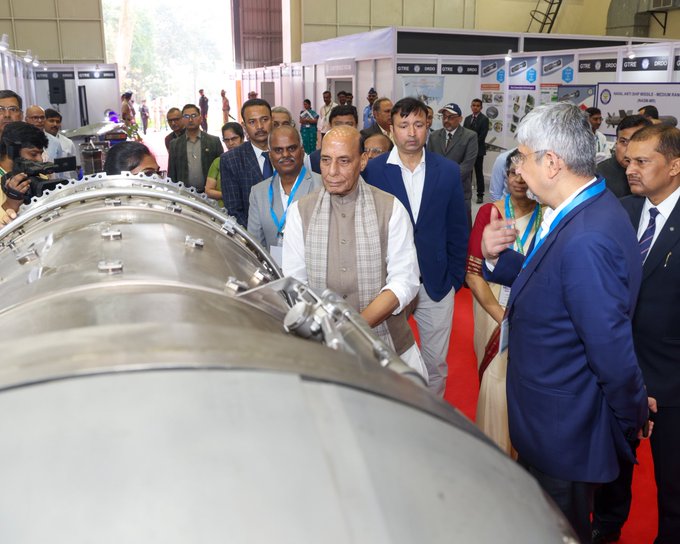
@rajnathsingh
Visited @DRDO_India’s Gas Turbine Research Establishment (GTRE) facility in Bengaluru and reviewed the status of ongoing projects relating to indigenous military gas turbine engine development.
The GTRE’s efforts in critical technology domain is praiseworthy. Exhorted the team of scientists to strive and focus on next generation engines by building a nationwide robust ecosystem and achieve self-reliance in aero engines.
KDE
Re: Kaveri & Aero-Engine: News & Discussion
Thanks for the pep talk. But what about the test facilities for engines. India has poor infra for testing and MOD babus don't sanction any funds. I would say if India had such facilities, the engine would have been ready long ago. Getting feedback from actual testing is worth a goldmine and people quickly learn from their mistakes. This is true R&D. Cooling a high temp blade requires all kinds of tricks and techniques some known, some unknown. The unknown part is not shared with anyone. Certification of engines requires extreme real world testing, india has no such facility so far.This is where we need to give our best: Defense Minister Shri Rajnath Singh.
Re: Kaveri & Aero-Engine: News & Discussion
As I mentioned before, we need Scientific and Technical Leadership to start something like IGMDP (Today we need IEDP - Integrated Engine Development Programme). I am reading the speech transcript and DM does not know every R&D house in the WEST is already using ML and few of their products use ML in the areas of quality control, autonomous power management etc. We cannot constantly play catchup. There is enough literature, conferences, debates etc. Shouldn't we be flying a rudimentary FTB by now? or Is that information classified? Perhaps we have no idea. I saw some budgeted numbers I think this year. So hopefully things are moving forward.bala wrote: ↑16 Feb 2026 21:33Thanks for the pep talk. But what about the test facilities for engines. India has poor infra for testing and MOD babus don't sanction any funds. I would say if India had such facilities, the engine would have been ready long ago. Getting feedback from actual testing is worth a goldmine and people quickly learn from their mistakes. This is true R&D. Cooling a high temp blade requires all kinds of tricks and techniques some known, some unknown. The unknown part is not shared with anyone. Certification of engines requires extreme real world testing, india has no such facility so far.This is where we need to give our best: Defense Minister Shri Rajnath Singh.
Re: Kaveri & Aero-Engine: News & Discussion
I newer out of the box approach is required to be successful. I posit that the calculus of 25 years to develop an engine should no longer hold true. Using SpaceX as an example, they were able to design their launch vehicles in a lot shorter time as a private company - challenging all existing timeline estimates. In fact SpaceX has been coming up with more cutting edge solutions with a lot smaller team.Rakesh wrote: ↑16 Feb 2026 18:40 https://x.com/DefenceMinIndia/status/20 ... 89528?s=20 ---> If it takes 25 years to develop an engine, then given India's current situation, our strategic needs, and our ambitions, you should assume that your 20 years are already over and now you only have 5 years left. This isn't something to be shocked or surprised about; it's a challenge. We have to achieve in these 5 years what other countries do in 20 years. This is where we need to give our best: Defense Minister Shri Rajnath Singh.
Maybe it might be worthwhile to pursue a startup mode philosophy and not a governmental organization form like GTRE, which has hiring and compensation restrictions. Hire the best and the brightest from around the world with competitive compensation. This has to be on a mission mode. We cannot have bureaucrats with a chalta hai attitude clocking in their time and waiting for their pensions.
Re: Kaveri & Aero-Engine: News & Discussion
RM needs to put up or shut up. Show us the money otherwise it’s just a cruel joke.
Re: Kaveri & Aero-Engine: News & Discussion
https://www.pib.gov.in/PressReleasePage ... g=3&lang=1
Raksha Mantri reviews projects of indigenous military gas turbine engine development during visit to DRDO’s GTRE in Bengaluru
Raksha Mantri reviews projects of indigenous military gas turbine engine development during visit to DRDO’s GTRE in Bengaluru
Really?....and witnessed the full afterburner engine test of the Kaveri engine.
Re: Kaveri & Aero-Engine: News & Discussion
“Supply chains are breaking and new ecosystems are developing. Nations possessing indigenous critical technologies will remain safe, secure, and sustain themselves,” he stated, reiterating Prime Minister Shri Narendra Modi-led Government’s commitment to achieving self-reliance in every field.A_Gupta wrote: ↑17 Feb 2026 06:16 https://www.pib.gov.in/PressReleasePage ... g=3&lang=1
Raksha Mantri reviews projects of indigenous military gas turbine engine development during visit to DRDO’s GTRE in Bengaluru
Really?....and witnessed the full afterburner engine test of the Kaveri engine.
He added that “We are rapidly moving towards the design and development of the Advanced Medium Combat Aircraft (AMCA). We have made numerous attempts in the past to achieve expertise in the field of aero engines. Now, the time has come to complete those efforts."
He also referred to his recent meeting with the Defence Minister of Greece, who he said, views India not as an emerging power, but as a superpower.