The Military Issues & History Forum is a venue to discuss issues relating to the military aspects of the Indian Armed Forces, whether the past, present or future. We request members to kindly stay within the mandate of this forum and keep their exchanges of views, on a civilised level, however vehemently any disagreement may be felt. All feedback regarding forum usage may be sent to the moderators using the Feedback Form or by clicking the Report Post Icon in any objectionable post for proper action. Please note that the views expressed by the Members and Moderators on these discussion boards are that of the individuals only and do not reflect the official policy or view of the Bharat-Rakshak.com Website. Copyright Violation is strictly prohibited and may result in revocation of your posting rights - please read the FAQ for full details. Users must also abide by the Forum Guidelines at all times.
Rakesh wrote: ↑08 Jan 2026 20:00
^^^ Yes, this is S4. But two names are floating around - Arisudan and Arijit. Let's see which one gets assigned or perhaps a whole other name!
Arisudan (or Arisudana) is a Sanskrit name meaning "killer of enemies," "destroyer of demons" or "protector."
Arijit is a popular Indian male name of Sanskrit origin, meaning "one who has conquered his enemies" or a "victorious conqueror."
Yes Sir. The names are apt and powerful. I was just pointing out the error in the tweet that wrongly mentioned S4* as S4. People think its S1, S2, S3, S4 while the S1 is land based and the remaining S2, S3, S4 and S4* being the numbers. Yes as you know S4 and S4* being the elongated Arihant.
Wrong thread but mentioning one more news that came out, is the name given to ATAGS is Amogh. Google search for baby names Amogh suggest these
"The epitome of perfection– One who is blessed by divine grace."
The rare and special masculine given name Amogh is of Indian origin and finds its roots in the Telugu language. The name, when translated into Sanskrit, means ‘invincible’ and ‘unerring.’ Amogh is also associated with Lord Ganesha, revered as the Lord of all Wealth and Wisdom.
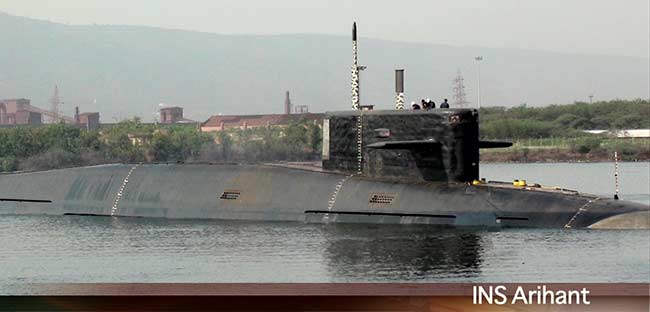
India’s sea-based nuclear deterrent will be strengthened soon as the country’s third indigenous Arihant-class nuclear-powered ballistic missile submarine (SSBN), INS Aridhaman (designated S4), is likely to be commissioned by April-May. “The commissioning of INS Aridhaman is expected by this summer as the submarine is currently in the final stages of sea trial,” a defence source told TOI.
Last Dec, Navy chief Admiral D K Tripathi had said that INS Aridhaman would be commissioned this year.INS Aridhaman, built under the Advanced Technology Vessel (ATV) project at the Ship Building Centre in Visakhapatnam, will be larger (7,000 tonne) than predecessors INS Arihant and INS Arighaat (6,000 tonne), featuring enhanced capability to carry long-range K-4 missiles.
INS Aridhaman will be armed with 24 K-15 Sagarika SLBMs (750 km range) and eight K-4 SLBMs (3,500 km range), which are capable of reaching most parts of Asia.
Once it enters service, India will have three operational ballistic missile submarines under the Strategic Forces Command (SFC) at sea for the first time, moving the country closer to achieving ‘Continuous At-Sea Deterrence’, a strategic defence policy where a nation maintains at least one SSBN on patrol 365 days a year.
As a stealthy underwater platform, INS Aridhaman boosts India’s “second-strike” capability—the ability to retaliate after a nuclear attack. It is designed to carry more long-range nuclear-tipped missiles than its predecessors INS Arihant and INS Arighaat.
In addition to INS Aridhaman, the Indian Navy is securing an Akula-class SSN nuclear-powered attack submarine from Russia, commonly referred to as “Chakra III”, with expected delivery by 2027 or early 2028. Besides these submarine projects, India and Germany are in the final stages of negotiating a $8-10 billion Project-75(I) deal to build six advanced, conventional diesel-electric submarines equipped with Air-Independent Propulsion (AIP) technology.
The new submarine acquisitions are timely as Pakistan is acquiring eight advanced Hangor-class diesel-electric attack submarines from China under a $5 billion 2015 deal to bolster its naval capabilities.
INS Aridhaman is equipped with an 83 MW pressurised water reactor and advanced sonar suites, possesses indigenous USHUS and Panchendriya sonar systems for better target detection and has improved acoustic damping with anechoic tiles to reduce noise, making it harder to detect. Once operational, it will be based at Project Varsha, a high-security facility with underground pens near Visakhapatnam.
What’s the point of loading K15 when K4 is available… I thought the option was there as they are proportionate in size as 2:1 …so K4 or 2X as many K15?
S_Madhukar wrote: ↑20 Feb 2026 06:02
What’s the point of loading K15 when K4 is available… I thought the option was there as they are proportionate in size as 2:1 …so K4 or 2X as many K15?
sound less threatening in press to everyone. Load outs are always dependent on mission.
S_Madhukar wrote: ↑20 Feb 2026 06:02
What’s the point of loading K15 when K4 is available… I thought the option was there as they are proportionate in size as 2:1 …so K4 or 2X as many K15?
These are assumption by the press. What used to be on Arihant, they are calculating and mentioning the same to tell us how many K15's it can have. Not that IN will be using the K15'S.
Only five nations have ever built a nuclear-powered ballistic missile submarine. In 2009, India became the sixth. This is the complete engineering breakdown of INS Arihant — from a miniaturized nuclear reactor to underwater missile launches to the crisis that nearly destroyed it all.
0:00 — The Impossible Machine
0:32 — The Heart: Nuclear Reactor
1:18 — The Weapons: Missile Launch System
2:02 — The Ghost: Stealth & Silence
2:45 — The Crisis: Near Destruction
3:18 — The Fleet: Deterrent Patrol
bala wrote: ↑04 Mar 2026 11:23INS Arihant: How India Built the Impossible
• 2017 flooding incident & recovery
2:45 — The Crisis: Near Destruction
This is a fake news peddled by Pakistani channels at that time to express their jealousy.
Usually in any test at berth, it's not done like some war diving scenario. There are total monitoring from Inside and outside and the process is very slow and controlled diving at the dock. If a hatch is opened, it will be visible to so many eyes at the dock standing outside. Such a submerge test at a dock must take 10's of minutes if not an hour plus rather than emergency dive in an ocean. The story is as fake as it sounds.
A video to demonstrate how it will look at the berth and how the slow process is even to submerge or to surface by pumping in/out the water. And the number of people watching such an event. Video could be A.I but this is how it works. Witness the mighty submarine docking!
Here you could see the timelapse, the submerging also takes almost similar amount of time as Floating them. Nuclear Submarine Dry Docks Inside Floating Dry Dock - Time-lapse Video
For better animations try these even though these are of SSN videos of U.S subs and Typhoon SSBN Submarine Nuclear Power | Engineering behind it Nuclear Reactor How it Works
US Navy & Submarine Destroyed Iran's Fleet | Explained
How does a Submarine work? / Typhoon-class submarine // The worlds largest submarine ever built.