Sure...KSA in it's current political entity started sometime in the 1930's and secured american/western protection around WW2 timeline. Jewish settlement in Palestine has a similar trajectory around the similar timelines and also has explicit american support. If the deepstate is represented and guided by only one virtue. i.e. the accumulation and control of wealth then why did they relinquish control of India, and Africa around this same time? Wouldn't it have made this group of individuals more wealthy and quicker by having a direct say in how the enormous resources of these lands are used for their benefit? How did the deepstate willingly participate in the raise of china to their own detriment?Vayutuvan wrote: ↑20 Apr 2026 22:33It is not too dissimilar to attributing every conflict to Sona Bandar and viewing it ... grating ... wacky.
Who is "deepstate"? The richest people in the world, and most of them are in the US. The whole point of MIC is to make money off of wars. Riddle me this. Why was Arabia made into KSA? The installation of Shah in Iran? Settlement of Jewish in Palestine?
This is how capitalism rolls.
West Asia Crisis — Discussion, Developments, and Bharat’s Strategy
Re: West Asia Crisis — Discussion, Developments, and Bharat’s Strategy
Re: West Asia Crisis — Discussion, Developments, and Bharat’s Strategy
Going off topic here: What is the context of this statement from Swami ji?A_Gupta wrote: ↑20 Apr 2026 21:21 Swami Vivekananda’s “"Was there ever a sillier thing before the world than what I saw in Malabar country? The poor Pariah is not allowed to pass through the same street as the high-caste man... The whole of Malabar is a lunatic asylum and the people are all mad."” was still 36 years in the future.
Re: West Asia Crisis — Discussion, Developments, and Bharat’s Strategy
Americans were the new Europeans. They did ally with Western Europeans and shared the loot (resource extraction from Africa and oil from West Asia). Where is the reason for the European Jews to be settled in Semitic lands? Xtism is big business, and that is where the roots of that religion are. Power brings control, which is essential for becoming rich. Only idiot megalomaniacs like OM and Ross Perot want to become presidents, thinking that they don't have to answer to anybody.Jay wrote: ↑20 Apr 2026 23:41Sure...KSA in it's current political entity started sometime in the 1930's and secured american/western protection around WW2 timeline. Jewish settlement in Palestine has a similar trajectory around the similar timelines and also has explicit american support. If the deepstate is represented and guided by only one virtue. i.e. the accumulation and control of wealth then why did they relinquish control of India, and Africa around this same time? Wouldn't it have made this group of individuals more wealthy and quicker by having a direct say in how the enormous resources of these lands are used for their benefit? How did the deepstate willingly participate in the raise of china to their own detriment?Vayutuvan wrote: ↑20 Apr 2026 22:33
It is not too dissimilar to attributing every conflict to Sona Bandar and viewing it ... grating ... wacky.
Who is "deepstate"? The richest people in the world, and most of them are in the US. The whole point of MIC is to make money off of wars. Riddle me this. Why was Arabia made into KSA? The installation of Shah in Iran? Settlement of Jewish in Palestine?
This is how capitalism rolls.
That is where "deep state" comes in. They want their cut. That is the reason why Trump is acting the way he is. He is finding out there are limits to his power, even when COTUS is not doing its job of reining him in.
Even Si Valley is controlled by Europeans. Look at the largest VC firms in Si Valley. Founders and top executives are European.
Re: West Asia Crisis — Discussion, Developments, and Bharat’s Strategy
@Jay gaaru, by not objecting to my "It is not too dissimilar to attributing every conflict to Sona Bandar and viewing it ... grating ...", you seem to be agreeing with me.
Re: West Asia Crisis — Discussion, Developments, and Bharat’s Strategy
Women's suffrage in Switzerland
https://en.wikipedia.org/wiki/Women%27s ... witzerland
Women were barred from Columbia College till 1974 (IIRC).Women in Switzerland gained the right to vote in federal elections after a referendum in February 1971.[1] The first federal vote in which women were able to participate was the 31 October 1971 election of the Federal Assembly.[2] However it was not until a 1990 decision by the Federal Supreme Court of Switzerland that women gained full voting rights in the final Swiss canton of Appenzell Innerrhoden.[3]
An earlier referendum on women's suffrage was held on 1 February 1959 and was rejected by the majority (67%) of Switzerland's men. Despite this, in some French-speaking cantons women obtained the right to vote in cantonal referendums.[4] The first Swiss woman to hold political office, Trudy Späth-Schweizer, was elected to the municipal government of Riehen in 1958.[5]
Re: West Asia Crisis — Discussion, Developments, and Bharat’s Strategy
Trita Parsi of the Quincy Institute- a repeated pattern - Iran sent a de-escalatory signal, say to the GCC; and is expecting a corresponding response. But Trump truth-socials in the middle that his coercion worked, he has won a great victory. Iran then withdraws.
Re: West Asia Crisis — Discussion, Developments, and Bharat’s Strategy
My context is the state of human rights and the lack of relevance of 1861 to today’s conflicts.Jay wrote: ↑20 Apr 2026 23:43Going off topic here: What is the context of this statement from Swami ji?A_Gupta wrote: ↑20 Apr 2026 21:21 Swami Vivekananda’s “"Was there ever a sillier thing before the world than what I saw in Malabar country? The poor Pariah is not allowed to pass through the same street as the high-caste man... The whole of Malabar is a lunatic asylum and the people are all mad."” was still 36 years in the future.
Swamiji -The Future of India - https://www.ramakrishnavivekananda.info ... _india.htm
Re: West Asia Crisis — Discussion, Developments, and Bharat’s Strategy
AI:
The Kingdom of Saudi Arabia was formed through:
The legacy of earlier Saudi states (1727 onward)
Ibn Saud’s recapture of Riyadh in 1902
A 30‑year campaign unifying central, eastern, western, and southern Arabia
The official proclamation of the kingdom in 1932.
Saudi Arabia emerged because:
Ottoman decline created a power vacuum
British strategy favored strong local allies
Hashemite weakness opened the Hejaz
Ibn Saud’s military skill and tribal diplomacy unified the peninsula
It was a perfect storm of global empire decline, regional rivalry, and local leadership.
The Kingdom of Saudi Arabia was formed through:
The legacy of earlier Saudi states (1727 onward)
Ibn Saud’s recapture of Riyadh in 1902
A 30‑year campaign unifying central, eastern, western, and southern Arabia
The official proclamation of the kingdom in 1932.
Saudi Arabia emerged because:
Ottoman decline created a power vacuum
British strategy favored strong local allies
Hashemite weakness opened the Hejaz
Ibn Saud’s military skill and tribal diplomacy unified the peninsula
It was a perfect storm of global empire decline, regional rivalry, and local leadership.
Re: West Asia Crisis — Discussion, Developments, and Bharat’s Strategy
I forgot to add: What role did the USA play in the formation of the Kingdom of Saudi Arabia 1903-1932?
AI:
To understand the U.S. role in the formation of the Kingdom of Saudi Arabia (KSA) between 1903 and 1932, it is helpful to first clear up a common misconception: the United States was largely a bystander.
While the U.S.-Saudi relationship eventually became one of the most significant alliances of the 20th century, during the actual period of unification, the U.S. played a very minor, secondary role compared to the British Empire.
1. Minimal Engagement (1902–1920s)
During the early years of Ibn Saud’s (Abdulaziz Al Saud) campaign to recapture Riyadh and expand his influence, the United States practiced a policy of non-interference in the Middle East.
British Dominance: The British were the primary Western power in the region. They backed various leaders through subsidies and treaties (like the Treaty of Darin in 1915) to secure their route to India.
American Isolationism: Post-WWI, the U.S. was largely focused on domestic issues and was wary of becoming entangled in the complex tribal politics of the Arabian Peninsula.
2. The Turning Point: The Crane-Twitchell Mission (1931)
The first real "American" footprint appeared just before the formal declaration of the Kingdom. Ibn Saud was facing a severe financial crisis due to a decline in pilgrims during the Great Depression. He needed to find natural resources—specifically water and minerals.
Charles Crane: A wealthy American philanthropist and former diplomat, Crane met with Ibn Saud in 1931. Crane was interested in the region and offered to fund a geological survey.
Karl Twitchell: Crane sent American mining engineer Karl Twitchell to explore the Hejaz and Nejd regions. While Twitchell was looking for water and gold, his reports eventually hinted at the massive petroleum potential of the Eastern Province.
3. Formal Recognition (1931)
The United States officially recognized the "Kingdom of the Hejaz and Nejd and its Dependencies" (the precursor name to KSA) in May 1931.
This was a significant diplomatic step, as it acknowledged Ibn Saud’s sovereignty independently of British influence.
However, the U.S. did not even establish a permanent legation or embassy in the country at that time; diplomatic matters were handled through the U.S. embassy in Cairo.
4. The 1932 Transition
When the Kingdom of Saudi Arabia was officially proclaimed in September 1932, the U.S. role remained primarily private and commercial rather than governmental.
The Oil Factor: As the Kingdom formed, Ibn Saud began looking for partners to develop his resources who weren't the British (to avoid becoming a de facto colony). The U.S. was the perfect "third party"—technologically advanced but without a history of regional imperialism.
Standard Oil of California (SOCAL): While the major oil deals were signed in 1933 (just after your 1932 cutoff), the groundwork for American corporate entry into the Kingdom was laid during the final months of the unification process.
AI:
To understand the U.S. role in the formation of the Kingdom of Saudi Arabia (KSA) between 1903 and 1932, it is helpful to first clear up a common misconception: the United States was largely a bystander.
While the U.S.-Saudi relationship eventually became one of the most significant alliances of the 20th century, during the actual period of unification, the U.S. played a very minor, secondary role compared to the British Empire.
1. Minimal Engagement (1902–1920s)
During the early years of Ibn Saud’s (Abdulaziz Al Saud) campaign to recapture Riyadh and expand his influence, the United States practiced a policy of non-interference in the Middle East.
British Dominance: The British were the primary Western power in the region. They backed various leaders through subsidies and treaties (like the Treaty of Darin in 1915) to secure their route to India.
American Isolationism: Post-WWI, the U.S. was largely focused on domestic issues and was wary of becoming entangled in the complex tribal politics of the Arabian Peninsula.
2. The Turning Point: The Crane-Twitchell Mission (1931)
The first real "American" footprint appeared just before the formal declaration of the Kingdom. Ibn Saud was facing a severe financial crisis due to a decline in pilgrims during the Great Depression. He needed to find natural resources—specifically water and minerals.
Charles Crane: A wealthy American philanthropist and former diplomat, Crane met with Ibn Saud in 1931. Crane was interested in the region and offered to fund a geological survey.
Karl Twitchell: Crane sent American mining engineer Karl Twitchell to explore the Hejaz and Nejd regions. While Twitchell was looking for water and gold, his reports eventually hinted at the massive petroleum potential of the Eastern Province.
3. Formal Recognition (1931)
The United States officially recognized the "Kingdom of the Hejaz and Nejd and its Dependencies" (the precursor name to KSA) in May 1931.
This was a significant diplomatic step, as it acknowledged Ibn Saud’s sovereignty independently of British influence.
However, the U.S. did not even establish a permanent legation or embassy in the country at that time; diplomatic matters were handled through the U.S. embassy in Cairo.
4. The 1932 Transition
When the Kingdom of Saudi Arabia was officially proclaimed in September 1932, the U.S. role remained primarily private and commercial rather than governmental.
The Oil Factor: As the Kingdom formed, Ibn Saud began looking for partners to develop his resources who weren't the British (to avoid becoming a de facto colony). The U.S. was the perfect "third party"—technologically advanced but without a history of regional imperialism.
Standard Oil of California (SOCAL): While the major oil deals were signed in 1933 (just after your 1932 cutoff), the groundwork for American corporate entry into the Kingdom was laid during the final months of the unification process.
Re: West Asia Crisis — Discussion, Developments, and Bharat’s Strategy
Of course..A_Gupta wrote: ↑19 Apr 2026 07:10 If you read online summaries of JCPOA, they invariably omit this:
"Iran reaffirms that under no circumstances will Iran ever seek, develop or acquire any nuclear weapons".
They also never mention this motivation for the US to eventually walk out of the agreement:...
..
It’s amusing and fascinating to watch some folks here work themselves into a lather over nicknames like "Obummer" and talking about "JCPOA is a completely non-sensical agreement that Obummer thrust upon the world" and more laughable claim.

While this fan fiction, and sheer ignorance of even the basic understanding about enrichment and what JCPOA deal was or was not it is entertaining, back in the world of actual geopolitics, the current President just released his 'truth' post quoting JCPOA..

Looking at Trump's latest post, something is clearly shifting:
The tone is a complete 180 from the last 48 hours. The "no more Mr. Nice Guy" rhetoric and threats to power plants have vanished. Instead, he’s pivotally building a comparison with Obama's JCPOA, claiming his deal will be "far better." When a President starts explaining why his deal beats his predecessor's, it’s a classic signal that a such deal may be not that bad..
Notice the "dogs that aren't barking" in his post. There is no mention of uranium transfer to the US, no "zero enrichment" demands, and no "no money exchanged" hardlines—all the points Iran publicly rejected. He’s quietly dropping the maximalist positions without admitting it.
My read: Trump is already pre-selling the deal that's coming. By framing it against the JCPOA, he’s preparing the ground for an agreement that will likely look more like the original JCPOA than he’ll ever admit—some monitoring, some enrichment limits, but packaged as "the greatest deal in history" for domestic consumption! One can't even make this up!

-
Cain Marko
- BRF Oldie
- Posts: 5710
- Joined: 26 Jun 2005 10:26
Re: West Asia Crisis — Discussion, Developments, and Bharat’s Strategy

Re: West Asia Crisis — Discussion, Developments, and Bharat’s Strategy
Anything that goes into Iran through Iranian ships can be blocked. Also any Chinese Vessels and companies supplying Iran could be sanctioned by U.S in supplying to the U.S or western markets. Chinese can allow one small single company to be sancitoned and keep supplying to Iran.
How US Marines Seized a 900-Foot Iranian Container Ship
How US Marines Seized a 900-Foot Iranian Container Ship
Re: West Asia Crisis — Discussion, Developments, and Bharat’s Strategy
Trump narrative ahead of second phase of Islamabad Talks?

Re: West Asia Crisis — Discussion, Developments, and Bharat’s Strategy
Question - all the Islamic countries are performatively anti-Israel; in practice, only Iran actually is in conflict - why is this? The easy answers I know; I am missing deeper insights.
Re: West Asia Crisis — Discussion, Developments, and Bharat’s Strategy
From: Mykhailo Rohoza
Wow! Among my circle, many noticed this before and now Iran just invoked the Budapest Memorandum in its nuclear talks with USA.
Pause on that for a moment.
A country currently under U.S. military pressure is pointing negotiators back to America’s own past commitments—specifically, the 1994 assurances given to Ukraine when it agreed to surrender the world’s third-largest nuclear arsenal.
And the track record since then? Hard to call it reassuring.
Ukraine gave up roughly 1,900 nuclear warheads in exchange for security guarantees. What followed: the annexation of Crimea, further territorial losses, and prolonged uncertainty about military support when it mattered most. The gap between promise and outcome is now part of the global strategic memory.
Tehran is clearly paying attention. So is every state quietly evaluating the trade-offs between nuclear restraint and national security.
Here’s the uncomfortable reality: when Iran can credibly cite precedent to question the durability of U.S. guarantees—while negotiations are still ongoing—it suggests something deeper than routine diplomatic friction. It points to a credibility problem.
There was a time when an American security assurance could reshape decisions at the highest level—ending programs, stabilizing regions, closing chapters.
Today, those same assurances are being quoted back across negotiating tables—not as foundations of trust, but as exhibits in an argument!!!
I am seeing this kind of comparisons:

or
During talks between U.S. and Iranian delegations in Pakistan, the topic of Ukraine unexpectedly came up.
While discussing U.S. guarantees in the event that Iran halts uranium enrichment and abandons the development of nuclear weapons, the Iranian side asked how the United States is fulfilling the 1994 Budapest Memorandum, in which it pledged to respect and protect Ukraine’s sovereignty.
The U.S. delegation left the question unanswered.
Wow! Among my circle, many noticed this before and now Iran just invoked the Budapest Memorandum in its nuclear talks with USA.
Pause on that for a moment.
A country currently under U.S. military pressure is pointing negotiators back to America’s own past commitments—specifically, the 1994 assurances given to Ukraine when it agreed to surrender the world’s third-largest nuclear arsenal.
And the track record since then? Hard to call it reassuring.
Ukraine gave up roughly 1,900 nuclear warheads in exchange for security guarantees. What followed: the annexation of Crimea, further territorial losses, and prolonged uncertainty about military support when it mattered most. The gap between promise and outcome is now part of the global strategic memory.
Tehran is clearly paying attention. So is every state quietly evaluating the trade-offs between nuclear restraint and national security.
Here’s the uncomfortable reality: when Iran can credibly cite precedent to question the durability of U.S. guarantees—while negotiations are still ongoing—it suggests something deeper than routine diplomatic friction. It points to a credibility problem.
There was a time when an American security assurance could reshape decisions at the highest level—ending programs, stabilizing regions, closing chapters.
Today, those same assurances are being quoted back across negotiating tables—not as foundations of trust, but as exhibits in an argument!!!
I am seeing this kind of comparisons:
or
Iran just quoted the Budapest Memorandum at American negotiators. Their own guarantee. Their own signature. Worth nothing.
The nuclear lesson every nation just learned:
Libya gave up its weapons — destroyed.
Iraq had none — destroyed.
Iran had none — bombed.
Ukraine gave up 1,900 warheads for a US promise — invaded.
North Korea kept them — untouched.
.... And Iran just cited the receipt.
Re: West Asia Crisis — Discussion, Developments, and Bharat’s Strategy
For those who who have not heard of Budapest Memorandum?..
Here's Marco Rubio to explain.. (priceless 4 minute video clip)
{ Added late:
In this speech, Senator Marco Rubio emphasizes the critical importance of supporting Ukraine's stability and defense capabilities in the face of Russian aggression. He frames the situation as having global implications for nuclear non-proliferation and international security.
-Rubio advocates for a cost-benefit approach to foreign policy, arguing that helping Ukraine stabilize its economy and governance is essential despite any imperfections in legislative language.
He highlights the need for pragmatic decision-making that serves the interests of the U.S. and its allies.
- Rubio points to the 1994 Budapest Memorandum, where Ukraine surrendered the world's third-largest nuclear stockpile in exchange for security assurances from the U.S., UK, and Russia.
He warns that Russia's invasion undermines these promises, sending a dangerous message to other nations (e.g., South Korea, Japan, Saudi Arabia) that they may need to develop their own nuclear weapons for self-defense if international assurances are no longer credible.
Here's Marco Rubio to explain.. (priceless 4 minute video clip)
{ Added late:
In this speech, Senator Marco Rubio emphasizes the critical importance of supporting Ukraine's stability and defense capabilities in the face of Russian aggression. He frames the situation as having global implications for nuclear non-proliferation and international security.
-Rubio advocates for a cost-benefit approach to foreign policy, arguing that helping Ukraine stabilize its economy and governance is essential despite any imperfections in legislative language.
He highlights the need for pragmatic decision-making that serves the interests of the U.S. and its allies.
- Rubio points to the 1994 Budapest Memorandum, where Ukraine surrendered the world's third-largest nuclear stockpile in exchange for security assurances from the U.S., UK, and Russia.
He warns that Russia's invasion undermines these promises, sending a dangerous message to other nations (e.g., South Korea, Japan, Saudi Arabia) that they may need to develop their own nuclear weapons for self-defense if international assurances are no longer credible.
Re: West Asia Crisis — Discussion, Developments, and Bharat’s Strategy
Ukraine never had control i..e the launch codes of the nuclear weapons in its possession. In this case, possession <> ownership.Amber G. wrote: ↑21 Apr 2026 23:28 For those who who have not heard of Budapest Memorandum?..
...
He warns that Russia's invasion undermines these promises, sending a dangerous message to other nations (e.g., South Korea, Japan, Saudi Arabia) that they may need to develop their own nuclear weapons for self-defense if international assurances are no longer credible. [/i]
There were several unkept commitments from all sides which muddied the waters since 1991.
Comical question for Iran to ask. Do they really think they will get such a commitment from the US if they surrender their nuclear weapons program and the US will defend Iran from say Israeli nuclear weapons?
Re: West Asia Crisis — Discussion, Developments, and Bharat’s Strategy
Ukraine traded in its sovereignty the moment it gave up its nuclear weapons. A mere 10 years later, the US and NATO staged the Orange Revolution in that country, removing the elected PM Yanukovych (for being "too close to Moscow") with a Western stooge named Yuschenko.
Unfortunately for Washington and the EU, democracy in Ukraine really did work in a robust manner and Yanukovych was elected again-- this time as President-- in a free and fair election in 2010.
The same Yanukovych was targeted by the US and NATO once again in 2014 for wanting to do business with both Russia and the EU instead of cutting out Russia entirely. This was the Maidan Colour Revolution-- leveraging the full power of social media platforms like twitter and facebook which hadn't been available as disinformation channels in 2004. It brought in a succession of Western stooges-- first Poroschenko and then the current Kejriwal-ensky.
The CIA had not been idle between those two revolutions. Using proxies like the noxious Yulia Timoschenko, a sustained propaganda campaign to channelize Catholic Western Ukrainian ethnic hostility against the Orthodox, Russian-speaking Eastern Ukrainian population was put into effect. After the Maidan intervention, this was ratcheted up to a full-bore militarized campaign of ethnic cleansing against the Eastern Ukrainians.
Today, conveniently, we are only reminded about the 'seizure of Crimea' and the 2022 invasion by Russia... but in truth, none of the events that set these incidents in motion would have happened if the Ukrainians hadn't traded in their nuclear weapons for "security guarantees from the USA and UK". The effect of that trade was to perforate Ukrainian sovereignty to the extent that it was irreparably compromised.
Unfortunately for Washington and the EU, democracy in Ukraine really did work in a robust manner and Yanukovych was elected again-- this time as President-- in a free and fair election in 2010.
The same Yanukovych was targeted by the US and NATO once again in 2014 for wanting to do business with both Russia and the EU instead of cutting out Russia entirely. This was the Maidan Colour Revolution-- leveraging the full power of social media platforms like twitter and facebook which hadn't been available as disinformation channels in 2004. It brought in a succession of Western stooges-- first Poroschenko and then the current Kejriwal-ensky.
The CIA had not been idle between those two revolutions. Using proxies like the noxious Yulia Timoschenko, a sustained propaganda campaign to channelize Catholic Western Ukrainian ethnic hostility against the Orthodox, Russian-speaking Eastern Ukrainian population was put into effect. After the Maidan intervention, this was ratcheted up to a full-bore militarized campaign of ethnic cleansing against the Eastern Ukrainians.
Today, conveniently, we are only reminded about the 'seizure of Crimea' and the 2022 invasion by Russia... but in truth, none of the events that set these incidents in motion would have happened if the Ukrainians hadn't traded in their nuclear weapons for "security guarantees from the USA and UK". The effect of that trade was to perforate Ukrainian sovereignty to the extent that it was irreparably compromised.
Re: West Asia Crisis — Discussion, Developments, and Bharat’s Strategy
Short reply : Without sounding impolite and with due respect - the 'lack of control' argument is a common trope that misses the strategic reality. Ukraine—home to institutions like Kharkiv and *MANY* physicists/engineer like great legendary Landau—possessed world-class nuclear expertise and the technical capacity to establish operational control if they had chosen to. Dismissing the Memorandum now as 'comical' ignores why it remains a sobering case study for nations currently weighing the actual value of international security guarantees.skumar wrote: ↑22 Apr 2026 00:25Ukraine never had control i..e the launch codes of the nuclear weapons in its possession. In this case, possession <> ownership.Amber G. wrote: ↑21 Apr 2026 23:28 For those who who have not heard of Budapest Memorandum?..
...
He warns that Russia's invasion undermines these promises, sending a dangerous message to other nations (e.g., South Korea, Japan, Saudi Arabia) that they may need to develop their own nuclear weapons for self-defense if international assurances are no longer credible. [/i]
There were several unkept commitments from all sides which muddied the waters since 1991.
Comical question for Iran to ask. Do they really think they will get such a commitment from the US if they surrender their nuclear weapons program and the US will defend Iran from say Israeli nuclear weapons?
Re: West Asia Crisis — Discussion, Developments, and Bharat’s Strategy
Mean while
Tim Cook is stepping down as CEO of Apple.
I wish Trump would also step down.
Of course, I’m comparing apples to oranges.
Tim Cook is stepping down as CEO of Apple.
I wish Trump would also step down.
Of course, I’m comparing apples to oranges.
Re: West Asia Crisis — Discussion, Developments, and Bharat’s Strategy
AI points out: A critical point of historical debate is the wording of the Memorandum. Ukraine pushed for "security guarantees" (implying a legal obligation for military intervention, similar to NATO's Article 5). However, U.S. and Russian negotiators insisted on "security assurances"—a weaker diplomatic term that lacked a specific enforcement mechanism.
Re: West Asia Crisis — Discussion, Developments, and Bharat’s Strategy
This still has no answer!!
REPORTER: Any evidence Iran was about to attack the U.S.?
WHITE HOUSE: The president had a feeling.
50 DAYS OF GLOBAL CHAOS… ALL FOR A FEELING.
<video clip>
REPORTER: Any evidence Iran was about to attack the U.S.?
WHITE HOUSE: The president had a feeling.
50 DAYS OF GLOBAL CHAOS… ALL FOR A FEELING.
<video clip>
Re: West Asia Crisis — Discussion, Developments, and Bharat’s Strategy
Noting new.. Trump extends Iran ceasefire..
Thanks Munir.. and Terroristan ...
JAI HO!
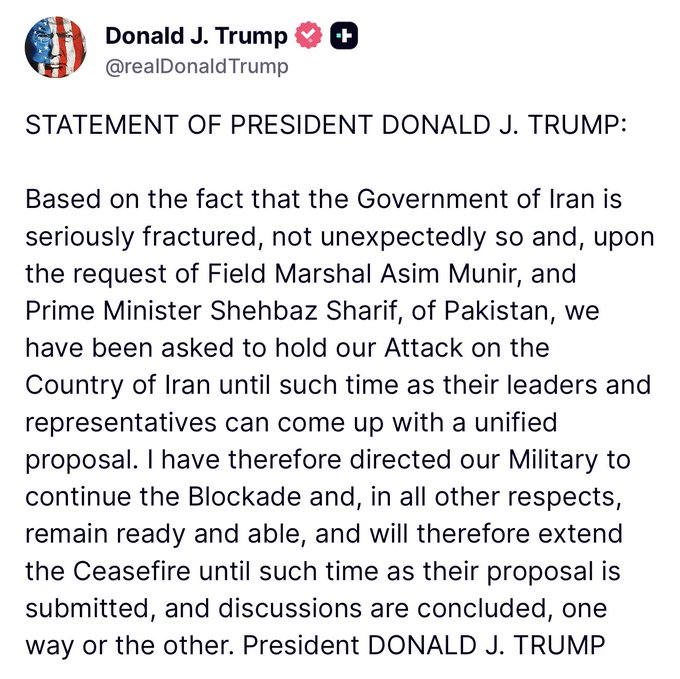
Thanks Munir.. and Terroristan ...
JAI HO!
Re: West Asia Crisis — Discussion, Developments, and Bharat’s Strategy
Above all let us NOt forget - this thread is for "Discussion, Developments, and Bharat’s Strategy"
When boundaries of humanity are crossed, the response is decisive.
Justice is Served.
India Stands United.
Sindoo Anniversary

When boundaries of humanity are crossed, the response is decisive.
Justice is Served.
India Stands United.
Sindoo Anniversary
Re: West Asia Crisis — Discussion, Developments, and Bharat’s Strategy
We are digressing but here goes my last post on this.Amber G. wrote: ↑22 Apr 2026 01:40 Short reply : Without sounding impolite and with due respect - the 'lack of control' argument is a common trope that misses the strategic reality. Ukraine—home to institutions like Kharkiv and *MANY* physicists/engineer like great legendary Landau—possessed world-class nuclear expertise and the technical capacity to establish operational control if they had chosen to.
Ukraine had 2 options to operationalize the nuclear arsenal in its possession without Russian support -
- Hack the nuclear weapon - possessing world class nuclear expertise is different from hacking a nuclear weapon.
- Reuse the nuclear material and some components to produce bombs of their own.
So I will reiterate, Ukraine had close to zero chances of having an operational nuclear arsenal of its own in the immediate future then. It was a practical decision accepting the realities. Hence attributing any noble intentions to Ukraine is misplaced.
You read the line incorrectly. I was not dismissing the Budapest Memorandum as comical - it was valid for its time. I was dismissing as comical Iran's reference to the Bucharest Memorandum in the context of the US-Israel-Iran love triangle to highlight (by Iran) US' default of its obligations. There are 10s of other examples and referencing this specifically can only be wrt assumptions underlying US guarantees on its security - Iran bringing this up was comical.
Iran was not smart to sign the NPT which institutionalized discrimination - a non-nuclear power signing it basically signed off that they were not responsible enough to handle nuclear weapons while the existing declared nuclear powers (one of which had used it twice) somehow possessed the judgement/virtues of a sage/saint.
Last edited by skumar on 22 Apr 2026 04:52, edited 2 times in total.
Re: West Asia Crisis — Discussion, Developments, and Bharat’s Strategy
TACO again.
S Jaishankar very aptly described Pakistan as a dalal nation, no other words to describe it.
A raunchy version of "Raat akeli hain ... jo bhi chahiye kahiye ..jo bhi ..." comes to mind.
S Jaishankar very aptly described Pakistan as a dalal nation, no other words to describe it.
A raunchy version of "Raat akeli hain ... jo bhi chahiye kahiye ..jo bhi ..." comes to mind.
Re: West Asia Crisis — Discussion, Developments, and Bharat’s Strategy
skumar wrote: ↑22 Apr 2026 03:42
We are digressing but here goes my last post on this.
Ukraine had 2 options to operationalize the nuclear arsenal in its possession without Russian support -Apart from the technical challenges, there is an ongoing cost to maintain these weapons which a new country like Ukraine could not practically afford, especially without support from its parent (USSR/Russia) which would also not allow any other country (like US) to help Ukraine.
- Hack the nuclear weapon - possessing world class nuclear expertise is different from hacking a nuclear weapon.
- Reuse the nuclear material and some components to produce bombs of their own.
So I will reiterate, Ukraine had close to zero chances of having an operational nuclear arsenal of its own in the immediate future then. It was a practical decision accepting the realities. Hence attributing any noble intentions to Ukraine is misplaced.
Perhaps we are digressing, but to address the technical side - I have spent decades teaching nuclear physics and am quite familiar with the Ukrainian scientific and engineering landscape. From a purely physics perspective, the "zero chance" assessment is, put modestly, not valid.
While Moscow held the PALs (launch codes), the physical hardware and fissile material were on Ukrainian soil. Ukraine was home to the famous Kharkiv Institute of Physics and Technology, and also Kyiv Institute for Nuclear Research and the expertise of legendary figures like Lev Landau's group. They had the world-class expertise required to either bypass existing command-and-control systems or simply replace them with domestic modules. It wasn't a matter of "hacking" a Russian box; it was a matter of replacing the box entirely—a task well within their technical capacity at the time.
***** Just for those who are interested some technical details - putting my physics hat -- skip if not interested ***
At the time of the 1994 Budapest Memorandum, Ukraine had -
- ~1,900 strategic nuclear warheads
~2,500–4,000 tactical nuclear weapons
-Total often cited: ~4,500–5,000 nuclear weapons
- This made it the world’s 3rd largest nuclear arsenal at the time.
Delivery systems:
176 ICBMs
130 × SS-19 (6 warheads each)
46 × SS-24 (10 warheads each)
~44 heavy bombers (Tu-95, Tu-160 class)
Also:
- Some HIGHLY enriched uranium (HEU) ( > 200 Kg was removed)
Large civilian nuclear fuel cycle (power reactors)
- ~15 nuclear power reactors (~50% of electricity from nuclear power)
World famous: Kharkiv Institute of Physics & Technology, & Kyiv Institute for Nuclear Research (Lot of famous scientists from India and US spent time at Kharkiv)
Ukraine was a core industrial/scientific region of the USSR
-Missile design (e.g., Yuzhmash / Dnipro complex)
-Thousands (Yes)of nuclear engineers, physicists, weapons-adjacent specialists
- Lev Landau -Nobel Prize founded the Kharkiv theoretical physics school
George Gamow-Big Bang nucleosynthesis pioneer
Igor Tamm - Nobel Prize , Cherenkov radiation theory
Alexander Akhiezer - Plasma physics, nuclear theory
Nikolay Bogolyubov - Quantum field theory, statistical mechanics
He was very approachable, and traveled a lot in India (Delhi Univ, IIT's, TIFR)—he genuinely engaged with us had strong overlaps with Soviet-era theoretical physics traditions to India, so those interactions often went quite deep.
***** End ***
On the diplomatic front, I would argue that Iran’s invocation of the Budapest Memorandum is actually quite noteworthy and far from comical. It hits the mark exactly where it matters most: the credibility of Western security guarantees.I was dismissing as comical Iran's reference to the Bucharest Memorandum... Iran bringing this up was comical.
By citing 1994, Iran is positioning itself as a "logical" and "pragmatic" student of history rather than a rogue actor. They are effectively highlighting a massive legal and strategic loophole: the fact that the U.S. and Russia insisted on "security assurances" rather than "guarantees" to avoid a binding military obligation.
This isn't just for the benefit of the negotiators in the room. It is a signal to other nations—and to US allies—that a signature on a denuclearization deal has a shelf life. By pointing to the "receipt" of Ukraine’s current situation, Iran is making a very reasonable case to the global community that skepticism isn't just a tactic; it is a necessity for their national survival.
Re: West Asia Crisis — Discussion, Developments, and Bharat’s Strategy
> It is a signal to other nations—and to US allies—that a signature on a denuclearization deal has a shelf life.
JCPOA proved that, too.
JCPOA proved that, too.
Re: West Asia Crisis — Discussion, Developments, and Bharat’s Strategy
They could have read posts here in BRF..
>>Even if a deal existed, moving or removing the material would be a complex international operation combining nuclear engineering, diplomacy, and security logistics—not just transportation.
<NPR>:How to move 1,000 pounds of enriched uranium out of Iran
>>Even if a deal existed, moving or removing the material would be a complex international operation combining nuclear engineering, diplomacy, and security logistics—not just transportation.
<NPR>:How to move 1,000 pounds of enriched uranium out of Iran