From Waste to Fuel! IIT Bombay Scientists Turn Dry Leaves into Clean Cooking Energy
In a breakthrough for sustainable living, researchers from IIT Bombay have developed an innovative method to convert dry fallen leaves into clean cooking fuel — offering a smart, eco-friendly alternative to traditional fuels like LPG. This cutting-edge solution not only helps manage organic waste but also significantly reduces dependence on fossil fuels. By transforming discarded biomass into usable energy, the technology addresses two major challenges: urban waste management and affordable clean cooking.
The innovation could be a game-changer, especially for rural and semi-urban areas where access to clean fuel remains limited. It also aligns with India’s broader sustainability goals, promoting circular economy practices and reducing carbon emissions.
Renewable Sources of Energy
Re: Renewable Sources of Energy
Still need power during the monsoon somehow.
Solar energy, cheap battery storage can meet 90% of India's power demand at affordable costs
Solar energy, cheap battery storage can meet 90% of India's power demand at affordable costs
Re: Renewable Sources of Energy
X from PM Modiji:
Link: Cabinet approves Investment Proposal for construction of 1200 MW Kalai-II Hydro Electric Project in Anjaw District of Arunachal Pradesh with an outlay of Rs.14105.83 croreA major boost to clean energy and development in the Northeast! The approval of the Kalai-II Hydro Electric Project in Arunachal Pradesh will strengthen power supply, generate sustainable energy and bring infrastructure and opportunities to the region.
Re: Renewable Sources of Energy
India pulls off a power miracle. A big thanks to the Sun
When India's power demand surged to a record high, it wasn't only the coal-fired plants that kept the lights and fans on. The Sun quietly blessed and delivered its share. Amid the searing heatwave, the country saw power demand soar to an all-time high of 256 gigawatt (GW), which was achieved without a shortage. Even as thermal power dominated with a 66% contribution, solar stepped in a big way with a 21% share. The country's energy story is beginning to reflect a subtle but significant shift towards cleaner, daylight-driven power
Re: Renewable Sources of Energy
How Adani Turned Khavda Desert Into World's LARGEST Solar Farm | $18 Billion Mega Project
Discover how India is building the world’s largest solar and wind park in the Rann of Kutch. This $18 billion Khavda project will generate 30 GW clean energy - enough to power entire countries. Learn why this desert location was chosen, the challenges of extreme climate, and how advanced tech like TOPCon solar panels, wind turbines, and robotic cleaning systems are transforming energy production.
Discover how India is building the world’s largest solar and wind park in the Rann of Kutch. This $18 billion Khavda project will generate 30 GW clean energy - enough to power entire countries. Learn why this desert location was chosen, the challenges of extreme climate, and how advanced tech like TOPCon solar panels, wind turbines, and robotic cleaning systems are transforming energy production.
Re: Renewable Sources of Energy
Josh Marshall at talkingpointsmemo.com opines:
AI says that Egypt today depends on natural gas, and has been badly hit by the current crisis. The plan is to get to 45% renewables with huge help from China.But the deeper impact of this crisis, one entirely of Trump’s own making, has been to convince many countries, especially but not only in East Asia, that oil and gas are too vulnerable to price shocks and supply instability. Meanwhile, renewables like solar and wind have now crossed the threshold where they are not only simply cheaper than fossils fuels but, as a tech product, will continue to get cheaper over time. Wind and solar energy can be produced entirely within your sovereign borders. So the Strait crisis is looking like it may be a turning point in the climate/renewables energy transition.
As is often the case with such transitions, the building blocks are already in place. The economics of renewables are already unstoppable just on a cost basis. They’re cheaper. You also have a superpower, China, heavily, heavily invested in electro-power and eager, both for economic and geopolitical reasons, to export the technology around the world. So the building blocks are there. But a crisis can force everyone to consider the matter afresh, with the new facts of the Strait crisis, coming just a few years after the start of the Ukraine war, to spur different energy strategies for cost and supply stability into the future.
The key dimension to all of this is that none of this debate or conversation outside the United States, so far as I can tell, is driven by climate. It’s there in the background of course. But Egypt isn’t on a crash course to shift from 10% to 45% of its electricity from renewables in two years because it’s concerned about the future of the planet. Its government is focused on reliability and cost. Beyond what I’m gently calling climate concerns, none of this global conversation is embedded in what in the U.S. we might call “woke” politics, either for or against. That’s all a U.S. thing. Or, the U.S. is the only place where culture war politics trump the nuts and bolts of which source of energy is cheaper and more reliable.
Re: Renewable Sources of Energy
IOW,
1. China will continue to build coal-fired power plants
2. Germany will restart their nuclear power program (if it is possible at all). There were solid scientific studies on the effects of windmills in Germany. The empirical evidence points to parts of Germany (NE, IIRC) turning semi-arid. So windmills have unintended consequences. The same is probably true with Solar. We will know in a few years.
3. The way out for India is twofold - short term through increasing the efficiency of current power plants, improving the grid to reduce transmission losses, solar, wind, and biogas, and long term Biogas replacing NG, hydrogen through nuclear power and nuclear power itself, and possibly new renewable sources due to some breakthrough in basic sciences.
1. China will continue to build coal-fired power plants
2. Germany will restart their nuclear power program (if it is possible at all). There were solid scientific studies on the effects of windmills in Germany. The empirical evidence points to parts of Germany (NE, IIRC) turning semi-arid. So windmills have unintended consequences. The same is probably true with Solar. We will know in a few years.
3. The way out for India is twofold - short term through increasing the efficiency of current power plants, improving the grid to reduce transmission losses, solar, wind, and biogas, and long term Biogas replacing NG, hydrogen through nuclear power and nuclear power itself, and possibly new renewable sources due to some breakthrough in basic sciences.
Re: Renewable Sources of Energy
By what definition are solar and wind renewables? The only ones to me are hydro and biomass.
Re: Renewable Sources of Energy
Solar and wind are defined as renewables because they rely on replenishable natural flux—the sun’s fusion and atmospheric pressure gradients—which aren't depleted by use. While hydro and biomass store this energy in matter (water/carbon), solar and wind capture the same "income" energy directly from the source.
Re: Renewable Sources of Energy
Hydro - build a dam and generate energy for decades and rivers will replenish the water
Biomass - build a biogas plant and use for decades, agriculture and waste management will replenish the mass. Local generation and use.
Solar - depends on where you are on the planet, solar panels are not renewables and have to be subsidized and last 5-10 years max.
Recycling of panels is not economically viable.
Also needs precious metals. Maintenance is required to keep panels clean. Creates grid instability.
Wind - depends on where you are on the planet, generation is dependent on a specific range of wind speed. EU data show about 21% of generated electricity wrt installed capacity. Recycling is a nightmare. Needs rare earths and magnets. Maintenance is expensive. Creates grid instability.
I would call Solar and wind as intermittent energy sources, unless panels and windmills are recyclable or last for decades before replacement, which they are not.
No amount of sophisticated mumbo jumbo can change the basic nature of these technologies.
Biomass - build a biogas plant and use for decades, agriculture and waste management will replenish the mass. Local generation and use.
Solar - depends on where you are on the planet, solar panels are not renewables and have to be subsidized and last 5-10 years max.
Recycling of panels is not economically viable.
Also needs precious metals. Maintenance is required to keep panels clean. Creates grid instability.
Wind - depends on where you are on the planet, generation is dependent on a specific range of wind speed. EU data show about 21% of generated electricity wrt installed capacity. Recycling is a nightmare. Needs rare earths and magnets. Maintenance is expensive. Creates grid instability.
I would call Solar and wind as intermittent energy sources, unless panels and windmills are recyclable or last for decades before replacement, which they are not.
No amount of sophisticated mumbo jumbo can change the basic nature of these technologies.
Re: Renewable Sources of Energy
BTW Tesla and Australia are leading the way towards battery storage for power
Link
// with Ola producing 4860 cells in India, Ola can aspire to supply storage to balance the grid power in India.
Link
// with Ola producing 4860 cells in India, Ola can aspire to supply storage to balance the grid power in India.
Re: Renewable Sources of Energy
It feels like twisting of logic and ignorance of basic facts to arrive at this conclusion.
And bio gas is even less efficient and incredibly stupid to implement at a large scale. How do one collect organic matter on a large scale to supply a power plant and generate electricity even for a small town's needs? There is a reason why none of this is scaled and within India's context "gober gas" is even more impractical than other means.
As against where Hydro dams? Hydro dams are limited by even more geographic constraints than solar. They take an order of magnitude more resources to build and maintain over solar and costs a lot more too.Solar - depends on where you are on the planet
And bio gas is even less efficient and incredibly stupid to implement at a large scale. How do one collect organic matter on a large scale to supply a power plant and generate electricity even for a small town's needs? There is a reason why none of this is scaled and within India's context "gober gas" is even more impractical than other means.
Incorrect. The industry standard is most manufacturers offer 25-year warranties that guarantee at least 80% efficiency and for industrial scale this is even longer. Subsidy for solar panels to reach cost parity with other sources has not been true for close to a decade now. Compare that with hydro where you need to subside land acquisition costs to the tune of thousands of acres and it becomes clear why the cost to generate a MW of electricity is cheaper with solar than other sources.solar panels are not renewables and have to be subsidized and last 5-10 years max.
Try recycling a dam then. There is a reason why building new hydro plants have slowed down significantly in the last decade.Recycling of panels is not economically viable.
Except for nuclear, coal and other fuel based power generation, the same constraint would apply for Hydro too.Wind - depends on where you are on the planet,
Compared to hydro or bio plants, it is not.Recycling is a nightmare.
Wind and solar are just a power generation sources and they are not the causes of instability. Badly built transmission infra is the source of grid instability and losses.Creates grid instability.
Even though the word rare is used here, these rare earth materials are not rare nor exotic. Like every mineral, they need to be mined just as copper used in hydro power generation is also mined. This is a nothing burger.Needs rare earths and magnets.
Re: Renewable Sources of Energy
@Cyrano, @Jay - it seems we are tripping over the definition of 'hardware' versus 'fuel.' If we disqualified energy sources based on the expiration date of their machinery, even your beloved dams would fail the test—silt happens!
To put Jay’s excellent points into perspective: - claiming solar is 'geographically limited' while championing hydro is like complaining about the cost of a flashlight while standing in a canyon you had to flood just to turn on a bulb. And as for the '5-year' lifespan—if that were true, the industry’s 25-year warranties would be the greatest collective hallucination in financial history.
Pesh hai:
The Jingle: The Harvest vs. The Hoard
The Hydro-Hording Blues
You’ll flood a valley, move a town,
To keep the turbine spinning ‘round.
You call it 'constant,' 'firm,' and 'sure,'
While solar’s deemed a 'tech impure.'
The 5-Year Myth
You say the panels fade and die,
A five-year blink, a techno-lie?
The warranty says twenty-five,
While 'gober gas' can barely thrive.
The Geography Gap
'The sun won't shine in every spot!'
(As if a dam works where it’s hot?)
A river needs a mountain's face,
But photons rain down every place.
The Moral
The 'rare' in earths is just a name,
(Like copper in your hydro frame).
The source is flux, the gear is finite,
Don't blame the sun for grid-loss twilight!
A Quick Technical Note ( Amber G. Addendum - Thanks Jay.)
The "grid instability" argument is often a transmission problem, not a generation one. Think of it like this: if a city’s pipes burst because everyone took a shower at once, you wouldn’t blame the water—you’d blame the plumbing. High-voltage DC lines and better storage (like the pumped hydro you like!) are the "plumbing" fixes for the "income" energy of wind and sun.
To put Jay’s excellent points into perspective: - claiming solar is 'geographically limited' while championing hydro is like complaining about the cost of a flashlight while standing in a canyon you had to flood just to turn on a bulb. And as for the '5-year' lifespan—if that were true, the industry’s 25-year warranties would be the greatest collective hallucination in financial history.
Pesh hai:
The Jingle: The Harvest vs. The Hoard
The Hydro-Hording Blues
You’ll flood a valley, move a town,
To keep the turbine spinning ‘round.
You call it 'constant,' 'firm,' and 'sure,'
While solar’s deemed a 'tech impure.'
The 5-Year Myth
You say the panels fade and die,
A five-year blink, a techno-lie?
The warranty says twenty-five,
While 'gober gas' can barely thrive.
The Geography Gap
'The sun won't shine in every spot!'
(As if a dam works where it’s hot?)
A river needs a mountain's face,
But photons rain down every place.
The Moral
The 'rare' in earths is just a name,
(Like copper in your hydro frame).
The source is flux, the gear is finite,
Don't blame the sun for grid-loss twilight!
A Quick Technical Note ( Amber G. Addendum - Thanks Jay.)
The "grid instability" argument is often a transmission problem, not a generation one. Think of it like this: if a city’s pipes burst because everyone took a shower at once, you wouldn’t blame the water—you’d blame the plumbing. High-voltage DC lines and better storage (like the pumped hydro you like!) are the "plumbing" fixes for the "income" energy of wind and sun.
Re: Renewable Sources of Energy
There are only 3 sources of energy on Earth: solar, nuclear, and gravity. All are fundamentally nearly inexhaustible. However, some of their manifestations/carriers are not easily "renewable" in a reasonable time.Amber G. wrote: ↑07 May 2026 05:04Solar and wind are defined as renewables because they rely on replenishable natural flux—the sun’s fusion and atmospheric pressure gradients—which aren't depleted by use. While hydro and biomass store this energy in matter (water/carbon), solar and wind capture the same "income" energy directly from the source.
1) Solar (direct radiation, and indirect wind/hydro/biomass) (all renewable)
2) Nuclear (direct fission from surface-mined resources is currently not renewable, but things like >90% recycling or fusion could make it effectively renewable)
3) Gravity (plays a role in geothermal and fossil energy, also tidal energy due to lunar gravity)
Additionally, there are some combinations of the above:
- Geothermal energy is a combination of nuclear (decays inside the earth) plus gravitational (compression increasing pressure and temperature). it's effectively renewable.
- Fossil energy is a mix of solar (which is stored in the biomass deposits), gravity (which pulls the deposits down to high pressure), and nuclear (which provides geothermal heat). This takes a very long time, making it non-renewable.
Re: Renewable Sources of Energy
A First Among Major Nations, India Is Industrializing With Solar: https://e360.yale.edu/features/india-solar
Also, useful documents from the India Energy & Climate Center at UC Berkeley (see Resources section): https://live-iecc-gspp.pantheon.berkeley.edu/
Also, useful documents from the India Energy & Climate Center at UC Berkeley (see Resources section): https://live-iecc-gspp.pantheon.berkeley.edu/
Re: Renewable Sources of Energy
On biogas:
https://www.worldbiogasassociation.org/ ... et-report/
LNG Crunch Nudges India To Fast-Track Compressed Biogas Programme
As LNG supplies tighten due to the West Asia conflict, India is fast-tracking compressed biogas (CBG) as a domestic alternative. With 40–45% of LNG imports coming from Qatar, disruptions pose a major energy risk. The government is now scaling up CBG through a unified policy push, expanding schemes like SATAT and promoting gas blending—similar to ethanol. Made from waste, CBG offers a cleaner, homegrown solution. Can it reduce India’s dependence on global gas markets?
https://youtu.be/ci46PHBscLA?si=bVo_H3V1VzTJruKb
https://www.worldbiogasassociation.org/ ... et-report/
India has an estimated sustainable compressed biogas (CBG) production potential of up to 90 billion cubic meters (bcm) equivalent (bcme) per year, equivalent to around 120% of the country’s natural gas demand in 2024, highlighting the scale of domestic renewable gas resources available.
The report highlights that digestate, referred to as Fermented Organic Matter (FOM), contains key nutrients but has variable composition, making it better suited as a supplement to chemical fertilisers currently rather than a full replacement. With improved soil health, it is possible to gradually reduce chemical fertiliser use in the future. Farmer awareness of FOM remains low. As such, CBG producers are promoting FOM through trials and outreach, with some developing enriched products like PROM to enhance value.
-----Plant utilisation rates (how efficiently the biogas produced at a facility) are identified as a key constraint on delivery, with average utilisation currently around 35%. The IEA notes that improving utilisation to around 44% could enable 2030 blending targets to be met without the need for additional plants.
LNG Crunch Nudges India To Fast-Track Compressed Biogas Programme
As LNG supplies tighten due to the West Asia conflict, India is fast-tracking compressed biogas (CBG) as a domestic alternative. With 40–45% of LNG imports coming from Qatar, disruptions pose a major energy risk. The government is now scaling up CBG through a unified policy push, expanding schemes like SATAT and promoting gas blending—similar to ethanol. Made from waste, CBG offers a cleaner, homegrown solution. Can it reduce India’s dependence on global gas markets?
https://youtu.be/ci46PHBscLA?si=bVo_H3V1VzTJruKb
Re: Renewable Sources of Energy
@Cyrano gaaru, nice.Cyrano wrote: ↑24 May 2026 12:42 Vayutuvan garu,
This may interest you
https://www.thehindu.com/news/national/ ... 010761.ece
I hope they succeed in those efforts to scale up. The article glosses over the details for obvious reasons. It is just news being reported.
Broadly, the factors that make or break the process are
- How clean is the Biogas, i.e., is it grid-ready? Also, is it good for industrial use where the gas comes into contact with the material being processed?
- How do they plan to dispose of the digestate? No plant has enough space to keep the digestate for a long period of time at the plant site. Transporting the digestate to the site of usage consumes energy (money).
Re: Renewable Sources of Energy
IMO Biogas cycle can be implemented at smaller scale as a local production for households, apartment complexes and village communities. You just create a waste disposal system where enough organic materials accumulate and fulfill the house hold cooking requirements. The kind of biogas that you want to produce for industries can be done in similar fashion but again disciplined waste disposal cycle is the key. Digestate can become liquid and soild fertilizer components. Hence the full cycle needs to be managed as a well defined process. In terms of grid readiness. I would first forget the grid until the processes are established. We can add to the grid as the adoption mass reaches the critical stage. BTW this will also solve the methane emission issue. Some people say there will be CO2 emission. You are going to have CO2 emission in any case for other fuel sources too.Vayutuvan wrote: ↑24 May 2026 23:30@Cyrano gaaru, nice.Cyrano wrote: ↑24 May 2026 12:42 Vayutuvan garu,
This may interest you
https://www.thehindu.com/news/national/ ... 010761.ece
I hope they succeed in those efforts to scale up. The article glosses over the details for obvious reasons. It is just news being reported.
Broadly, the factors that make or break the process are
- How clean is the Biogas, i.e., is it grid-ready? Also, is it good for industrial use where the gas comes into contact with the material being processed?
- How do they plan to dispose of the digestate? No plant has enough space to keep the digestate for a long period of time at the plant site. Transporting the digestate to the site of usage consumes energy (money).
Re: Renewable Sources of Energy
@Williams ji,
We started on a 125KG PD pilot plant back in 2015. What these labs are claiming is what we did in 2015 itself. By the way, their metric of how much feedstock is consumed is an incorrect metric as it doesn't give any indication of the Biogas output. The correct metric is how much output for how much input. One can compute in terms of Biogas weight vs per Biomass weight or in monetary terms. I prefer the latter as that shows what the payback period is. Payback period has to be a fraction of plant life (including Opex, depreciation, and sinking fund for replacement of the plant at the EOL).
Biogas for transportation/industry/electricity generation/grid-ready is regulated in India. Our company lobbied the GoI to allow Biogas usage on par with NG. The regulation is that Biogas has to be purified to 95% (IIRC) with a minimal amount of H2S. There are requirements on N content. These are tighter than NG which sits 92.5%. That gives a leg up for the GoI for the time being. Another reason might be that Biogas manufacturers might do some 2 numberigiri to improve their profits. So they have built in a cushion to keep the industry going.
But the real problem is a severe investment crunch. People are willing to give unsecured loans but are unwilling to invest in R&D. Banks require collateral. Big guys like Malya and a diamond merchant got loans through inflating their asset valuations.
Most Institutional FDI and VCs in India are drawn to more "sexy" technologies like IT - Amazon/FB/Twitter copycats, or the latest feeding frenzy on AI startups.
We do have several commercial plants operating right now. Parkalam.
We started on a 125KG PD pilot plant back in 2015. What these labs are claiming is what we did in 2015 itself. By the way, their metric of how much feedstock is consumed is an incorrect metric as it doesn't give any indication of the Biogas output. The correct metric is how much output for how much input. One can compute in terms of Biogas weight vs per Biomass weight or in monetary terms. I prefer the latter as that shows what the payback period is. Payback period has to be a fraction of plant life (including Opex, depreciation, and sinking fund for replacement of the plant at the EOL).
Biogas for transportation/industry/electricity generation/grid-ready is regulated in India. Our company lobbied the GoI to allow Biogas usage on par with NG. The regulation is that Biogas has to be purified to 95% (IIRC) with a minimal amount of H2S. There are requirements on N content. These are tighter than NG which sits 92.5%. That gives a leg up for the GoI for the time being. Another reason might be that Biogas manufacturers might do some 2 numberigiri to improve their profits. So they have built in a cushion to keep the industry going.
But the real problem is a severe investment crunch. People are willing to give unsecured loans but are unwilling to invest in R&D. Banks require collateral. Big guys like Malya and a diamond merchant got loans through inflating their asset valuations.
Most Institutional FDI and VCs in India are drawn to more "sexy" technologies like IT - Amazon/FB/Twitter copycats, or the latest feeding frenzy on AI startups.
We do have several commercial plants operating right now. Parkalam.
Re: Renewable Sources of Energy
For people interested in knowing more about our company, here is a link. (others ignore)
https://www.primove.in/media/
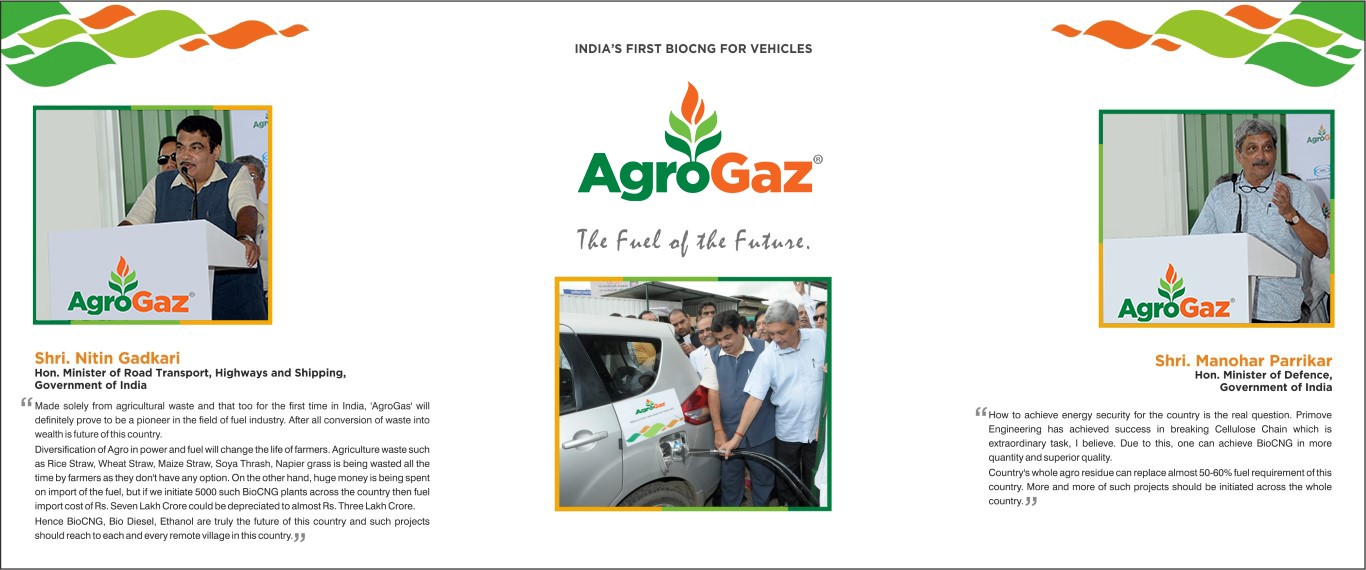
https://www.primove.in/media/
Re: Renewable Sources of Energy
Nitin Gadkari Unveils Ethanol Stove Push As India Expands Biofuel Drive Beyond Petrol Blending
May 27, 2026
Union Minister Nitin Gadkari has unveiled a new ethanol-based cooking stove that he claims can make household cooking cheaper than LPG cylinders.The technology mixes ethanol with water to generate a clean flame and is fully indigenous. Gadkari presented it as part of India’s aggressive push towards biofuels and reducing dependence on imported fossil fuels.India currently imports nearly 87% of its crude oil. Meanwhile, ethanol blending in petrol has surged from 1.5% in 2014 to nearly 20% in 2025.This ethanol stove could reduce indoor air pollution, support farmers growing sugarcane, and lower cooking costs for millions of households.
https://www.youtube.com/watch?v=pztxUZZb7uY
May 27, 2026
Union Minister Nitin Gadkari has unveiled a new ethanol-based cooking stove that he claims can make household cooking cheaper than LPG cylinders.The technology mixes ethanol with water to generate a clean flame and is fully indigenous. Gadkari presented it as part of India’s aggressive push towards biofuels and reducing dependence on imported fossil fuels.India currently imports nearly 87% of its crude oil. Meanwhile, ethanol blending in petrol has surged from 1.5% in 2014 to nearly 20% in 2025.This ethanol stove could reduce indoor air pollution, support farmers growing sugarcane, and lower cooking costs for millions of households.
https://www.youtube.com/watch?v=pztxUZZb7uY
Re: Renewable Sources of Energy
Adani's 3.37 GWh Gujarat Battery Is Now the World's Largest Outside China
AIM Network May 27, 2026
We explore the world's largest battery storage system, a significant step forward in renewable energy. This megaproject showcases advanced energy storage system technology, capable of powering a million homes. It highlights India's growing commitment to clean energy stocks and sustainable electricity solutions.
https://www.youtube.com/watch?v=31zg9P-dCX8
AIM Network May 27, 2026
We explore the world's largest battery storage system, a significant step forward in renewable energy. This megaproject showcases advanced energy storage system technology, capable of powering a million homes. It highlights India's growing commitment to clean energy stocks and sustainable electricity solutions.
https://www.youtube.com/watch?v=31zg9P-dCX8