Know Your India

The Technology & Economic Forum is a venue to discuss issues pertaining to Technological and Economic developments in India. We request members to kindly stay within the mandate of this forum and keep their exchanges of views, on a civilised level, however vehemently any disagreement may be felt. All feedback regarding forum usage may be sent to the moderators using the Feedback Form or by clicking the Report Post Icon in any objectionable post for proper action. Please note that the views expressed by the Members and Moderators on these discussion boards are that of the individuals only and do not reflect the official policy or view of the Bharat-Rakshak.com Website. Copyright Violation is strictly prohibited and may result in revocation of your posting rights - please read the FAQ for full details. Users must also abide by the Forum Guidelines at all times.
Amber G.
BRF Oldie
Posts: 12933
Joined: 17 Dec 2002 12:31
Location: Ohio, USA

Re: Know Your India

Post by Amber G. »

Tanaji wrote: 04 Apr 2026 19:14 Is it Raghav Chaddha given how it is lately? :mrgreen:

Its either Prof Suman Chakraborty or Dr Mondal coinventors of COVIRAP.
I have to admit, took google (AI) help to know to know 'my India'. :-o
In the context of the Bharat Rakshak forum thread, the mention of Raghav Chadha is a tongue-in-cheek political joke by the user Tanaji.
The Context:
  • The user Amber G. had posted a "challenge" asking forum members to identify a scientist based on several prestigious achievements (Director of IIT Kharagpur, inventor of COVIRAP, etc.).
Tanaji replied:
  • "Is it Raghav Chaddha given how it is lately? :mrgreen: Its either Prof Suman Chakraborty or Dr Mondal coinventors of COVIRAP."
  • The "Lately" Reference: Raghav Chadha is a prominent young politician from the Aam Aadmi Party (AAP) and a Member of Parliament. At the time of these posts, he was frequently in the news regarding various political controversies or appointments.
  • The Contrast: The joke plays on the absurdity of suggesting a high-profile, often-discussed politician for a specialized scientific achievement.
The use of the :mrgreen: emoji (a standard forum "grinning" face) indicates he is being sarcastic before providing the actual serious answer: Prof. Suman Chakraborty.

Prof. Suman Chakraborty is indeed the correct answer to the challenge, as he is the Director of IIT Kharagpur and a lead inventor of the COVIRAP diagnostic technology.
*****************
"Dr. Mondal" refers to Dr. Arindam Mondal.
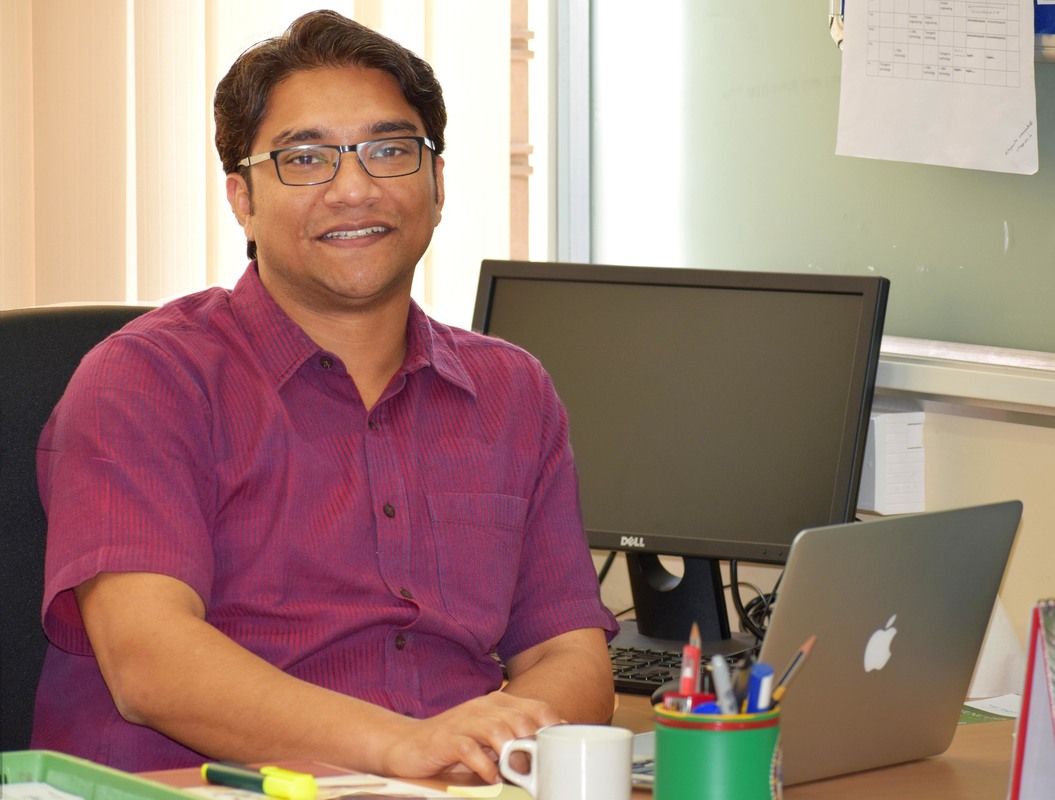
Image
(Photo Credit: iitkgpbioscience)

He is an Associate Professor at the School of Bio Science at IIT Kharagpur and the lead co-inventor of the COVIRAP diagnostic technology alongside Prof. Suman Chakraborty.
  • Expertise: He is a specialist in Molecular Virology and Biochemistry. His research focuses on host-pathogen interactions, particularly how RNA viruses (like influenza and SARS-CoV-2) replicate within host cells.
  • Role in COVIRAP: While Prof. Suman Chakraborty (a mechanical engineer) led the microfluidics and device engineering aspect, Dr. Mondal provided the essential biological and virological expertise to develop the isothermal nucleic acid-based testing method that COVIRAP uses
.
  • He heads the Molecular Virology Lab (IITkgpAMlab) at IIT Kharagpur, where his team works on developing prophylactic and therapeutic strategies against various epidemic-prone infections.
  • He completed his PhD at the University of Wisconsin-Madison and conducted postdoctoral research at several prestigious institutions before joining IIT Kharagpur.
Thanks. All.
Last edited by Amber G. on 05 Apr 2026 07:28, edited 1 time in total.
Amber G.
BRF Oldie
Posts: 12933
Joined: 17 Dec 2002 12:31
Location: Ohio, USA

Re: Know Your India

Post by Amber G. »

Thanks all ..

Here are the answers to the challenges found on Know Your India forum thread

1. The Three Giants of Relativity
In a rare photo taken at the Raman Research Institute (RRI), the three physicists are:
• C.V. Vishveshwara: Known as the "Black Hole Man of India."
• Amal Kumar Raychaudhuri: Famous for the Raychaudhuri equation, which is foundational to singularity theorems.
• Jayant Narlikar: Renowned astrophysicist and proponent of the Hoyle–Narlikar theory.

2. The World-Famous Doctor (Oncologist)
The doctor whose birth anniversary is March 11 and who has two Nobel Laureates in her family (uncle C.V. Raman and cousin S. Chandrasekhar) is:
• Dr. V. Shanta: The legendary oncologist and former director of the Adyar Cancer Institute in Chennai.
________________________________________
3. The Boltzmann Medal Winner
The legendary theoretical physicist described as the first Indian to win the Boltzmann Medal (2022) and an expert in statistical physics is:
• Deepak Dhar: Currently a Distinguished Professor at ICTS-TIFR, known for his work on self-organized criticality and fractals.

4. The "Paper Strip" Scientist
The scientist who became the Director of IIT Kharagpur in 2025 and invented low-cost diagnostic tools like COVIRAP is:
• Prof. Suman Chakraborty: A pioneer in microfluidics who developed medical tests costing less than 2 rupees for resource-limited settings.

5. The Soft Matter Physicist turned Actor
The physicist who won an Obie Award for a one-act play about her life is Bulbul Chakraborty (prominent physicist at Brandeis University ). The play was written and directed by Chakraborty’s son Shayok Misha Chowdhury.
Anoop
BRFite
Posts: 664
Joined: 16 May 2002 11:31

Re: Know Your India

Post by Anoop »

Amber G. wrote: Raychaudhuri is famous for the Raychaudhuri equation, fundamental to the singularity theorems of Hawking and Penrose
An interesting connection with BRF - the late Brig. Raychaudhuri, who used to post as RayC here, was a nephew of Raychaudhuri.
Amber G.
BRF Oldie
Posts: 12933
Joined: 17 Dec 2002 12:31
Location: Ohio, USA

Re: Know Your India

Post by Amber G. »

^^^ Thanks!
bala
BRF Oldie
Posts: 3826
Joined: 02 Sep 1999 11:31
Location: Office Lounge

Re: Know Your India

Post by bala »

Did Europe Steal Mathematics From India? Prof CK Raju

C. K. Raju explains why Ganita and modern Western mathematics are fundamentally different systems of thought. From ancient Indian calculation methods to the history of Greek mathematics, colonial education systems, axiomatic logic, and India’s forgotten scientific legacy—this episode challenges mainstream narratives.

Host: Vishal is an IIT Graduate who founded shikshanam.in

Chapter-
00:00:00 Explosive Highlights
00:02:23 Meet Prof C K Raju
00:04:56 European Maths vs Indian Ganita
00:12:51 Why is Ganita Superior?
00:18:37 West Advanced Despite Backward History?
00:33:28 Decimal Place Value in Vedas?
00:52:20 Europe Superiority Myth Busted
00:57:11 Were Greek Really Smart?
01:02:53 How Sanskrit Reached Greece
01:07:02 Why Smarter India got Colonised?
01:11:47 Newton Stole Calculus! Proof?
01:32:49 C K Raju Must Read Books
01:34:56 Final Powerful Words!


// Euclid is a fake guy the greeks created. Pythogoras is another fake whether he existed.
// BTW the book Foundations of Geometry of David Hilbert in 1899 organized Euclid stuff in a systematic manner with axiomatic proof!
bala
BRF Oldie
Posts: 3826
Joined: 02 Sep 1999 11:31
Location: Office Lounge

Re: Know Your India

Post by bala »

Sugriva’s Atlas: Proof of the Ramayana? ‪NileshOak

Nilesh Ji to explore the fascinating research behind Sugriva’s Atlas and its connection with the geographical references mentioned in the Ramayana. We discuss its authenticity, the North, South, East, and West directions described by Sugriva, and possible links to places like Himalaya, Kailash, Andes, Alps, and South America.

We also dive into Patanjali, ancient texts, decoded books, and why understanding Sugriva’s Atlas can reignite pride in Bharat’s ancient knowledge and civilizational wisdom.


// BTW Nilesh reiterates that Vanaras are not monkeys but humans. I believe the same.
bala
BRF Oldie
Posts: 3826
Joined: 02 Sep 1999 11:31
Location: Office Lounge

Re: Know Your India

Post by bala »

The Math Behind Every Fluid in the Universe Has an Indian Name

In 1822, French engineer Claude-Louis Navier wrote down five terms that describe every fluid motion in the universe — from blood in your veins to weather systems to the air over an aircraft wing. Two hundred years later, the Navier-Stokes equation remains unsolved in three dimensions. The Clay Mathematics Institute will pay one million dollars for a proof. Nobody has claimed it. Meanwhile, the numerical methods every modern CFD simulation uses to approximate solutions are built on infinite series that Madhava of Sangamagrama wrote down in Sanskrit verse in Kerala around 1400 CE — three hundred years before Brook Taylor published the "Taylor series" in 1715. And the qualitative physics of vortex motion that breaks the Navier-Stokes equation — turbulence — has a Sanskrit word that goes back to the Rig Veda: āvarta. This is the story of an equation Europe formalised, cannot solve, and built on mathematics it never credited.


// Sanskrit आवर्त meaning whirlpool (of life). प्रवहवायु motion of wind or pro-vector wind. avarta - vortex; bhrami - vorticity ; vayu - velocity field.
// Charles Matthew Whish (1794–1833) was an English civil servant in the Madras Establishment of the East India Company. Whish was the first to bring to the notice of the western mathematical scholarship the achievements of the Kerala school of astronomy and mathematics.
// Madhava of Sangamagrama (c. 1340–1425) derived infinite series for sine, cosine, arctan, and π centuries before Newton, Leibniz, or Taylor.
sudarshan
BRF Oldie
Posts: 3048
Joined: 09 Aug 2008 08:56

Re: Know Your India

Post by sudarshan »

bala wrote: 06 May 2026 00:39 The Math Behind Every Fluid in the Universe Has an Indian Name

In 1822, French engineer Claude-Louis Navier...
Ooh you too found this one. Here's another:

sudarshan
BRF Oldie
Posts: 3048
Joined: 09 Aug 2008 08:56

Re: Know Your India

Post by sudarshan »

I frankly wasn't as impressed by that Navier-Stokes equation video, the other video I posted was much more persuasive, IMO.

This comment from the N-S equation video sums up the video pretty well, and I agree with the comment for the most part:
This video is really making two claims that sit on very different footings.

The solid bit is the math: Sanskrit astronomy from Aryabhata through the Kerala school is clearly grinding out more and more sophisticated ways to handle non‑uniform motion and continuous change. You can see that in the trigonometry, the handling of extrema, and the series machinery they build up around eclipses and planetary anomalies. That story holds up even if you ignore all the cosmic metaphors; it’s just a technically serious, computation‑heavy tradition doing real work on dynamical problems.

The spicier move is the “the cosmos is fundamentally vortex‑centred and Aryabhata basically had the modern vortex intuition” line. That’s where things get wobbly. The evidence there is a handful of evocative phrases (Avata, *pravaha vayu*) and some whirl/vortex imagery being read back through a very specific 20th/21st‑century turbulence lens, where “vortex as protagonist” is itself just one research program, not settled truth. While it’s totally possible that this imagery reflects a genuine gut‑level sense of the world as coherent flow, it’s a big leap from that to “this whole tradition is vortex‑centric” or “Aryabhata already had something recognizably like our vortex theory” in any strong sense.

So the reasonable takeaway is: yes, this tradition clearly nails powerful tools for non‑uniform motion and continuous change; but the stronger claim that it’s fundamentally “vortex‑centred,” or that Aryabhata had a proto‑modern vortex theory, feels more like a cool interpretive move than something the evidence actually forces you to accept.
bala
BRF Oldie
Posts: 3826
Joined: 02 Sep 1999 11:31
Location: Office Lounge

Re: Know Your India

Post by bala »

Newton of apple fame, lifted Vaisesika Sutra lock stock and barrel as his own. Calculus is another area of this shameless scientist of Britain.

Has any mathematician in this forum dealt with Mock Theta functions of Ramanujam. These are supposedly connected with black holes. I don't believe Stephen Hawking got them right though the entire physics world believes in him.
bala
BRF Oldie
Posts: 3826
Joined: 02 Sep 1999 11:31
Location: Office Lounge

Re: Know Your India

Post by bala »

7 Nobel prizes the British discredited — and the 4 trillion-dollar industries it built

Seven Bengali scientists between 1876 and 1924 wrote the foundational papers behind modern pharma, wireless, spectroscopy, and quantum computing. Six were erased by the British scientific establishment. The seventh, a poet, got the only Nobel that ever made it back to Bengal — and what he did with the prize money is the twist that ends this video. Mahendralal Sircar founded India's first science institute in 1876 after the Royal Society dismissed his methods as "unfamiliar." Prafulla Chandra Ray synthesised mercurous nitrite in 1896. Upendranath Brahmachari cured kala-azar in 1922 and saved half a million lives. Meghnad Saha's 1920 ionisation equation is running on the James Webb Space Telescope right now. J.C. Bose patented the diode (developed the self-recovering mercury coherer, a pioneering solid-state diode detector, which significantly advanced early wireless telegraphy) in 1904 — Marconi got the 1909 Nobel. S.N. Bose invented bosonic statistics in 1924; seven subsequent Nobels were awarded for work using his framework. Rabindranath Tagore got the 1913 Literature Nobel and spent the money funding the others.

In 1924, a young physics lecturer in Dhaka sent a groundbreaking four-page letter to Albert Einstein, fundamentally shaping modern physics. This video explores this pivotal moment in science history, detailing how Einstein's swift recognition and translation propelled a new understanding of physics topics. It's a compelling piece of science education that sheds light on the origins of quantum physics.

sudarshan
BRF Oldie
Posts: 3048
Joined: 09 Aug 2008 08:56

Re: Know Your India

Post by sudarshan »

This is the 1834 paper by Charles M. Whish to the Royal Asiatic Society of GB and Ireland:

https://www.jstor.org/stable/25581775?seq=1

On the Hindú Quadrature of the Circle, and the Infinite Series of the Proportion of the Circumference to the Diameter Exhibited in the Four S'ástras, the Tantra Sangraham, Yucti Bháshá, Carana Padhati, and Sadratnamála

Transactions of the Royal Asiatic Society of Great Britain and Ireland, Vol. 3, No. 3 (1834), pp. 509-523 (15 pages)

The video I posted has a reference to this paper. Charles Whish (according to the video) was posted in India, and came across manuscripts from the Kerala school of mathematics. He realized the significance of what he was reading, and wrote a paper to inform the Royal Asiatic Society that so-called European mathematical discoveries were pre-dated by discoveries from India. Sounds like an honest man, but his paper was quietly buried.

I was trying to fact-check the video, and it seems factually accurate on this count. Please go through the paper yourselves, it's pretty fascinating.
Manish_Sharma
BRF Oldie
Posts: 5316
Joined: 07 Sep 2009 16:17

Re: Know Your India

Post by Manish_Sharma »

https://x.com/Fintech03/status/2052200997037195427?s=20
1 man found 3 yellow grains in the mud & spent 5 yrs protecting them from wild pigs. A trader named the result after his favorite watch brand to prove its quality, while a university stole the seeds to claim the credit. He fed millions, but worked as a daily wage laborer on his own soil. Discover the Ghost Farmer behind India's favorite thin rice.

While the world was looking at high-tech labs for the next green revolution, a school dropout named Dadaji Ramaji Khobragade was standing in his small 1.5 acre plot in Nanded, Maharashtra. While harvesting his usual Patel 3 rice, Dadaji noticed 3 yellow-seeded spikes (lomb) that looked different. Most farmers would have ignored them as impurities.

Dadaji picked those 3 spikes & stored them in a simple plastic bag. For the next 5 yrs, he painstakingly bred them in a tiny patch, protecting them from wild pigs with a fence of thorny bushes. He created a variety that was thinner, smelled better, & yielded 80% more than the conventional seeds.

Dadaji did not have a marketing team/a brand name. In 1990, a large landowner bought 150 kg of these seeds & sold the harvest to a local trader. At that time, HMT Watches were the ultimate symbol of Gold Standard & Reliability in India. The trader, who had recently bought a new HMT watch & was obsessed with it, decided to call the rice HMT Rice simply to signal that this rice was as High Quality as the watch.

The name stuck so hard that people today think HMT Rice was developed by the govt corporation (Hindustan Machine Tools), but the company had absolutely nothing to do with it!

In 1994, the Punjabrao Krishi Vidyapeeth (PKV), an agricultural university, approached Dadaji. They took 5 kg of his seeds under the pretext of experimenting. A few yrs later, the university released a new"variety called PKV-HMT. They claimed Dadaji’s original seeds were impure & that they had purified them.

They took the credit, the patents, & the glory. For yrs, the man who actually did the 5 yrs of backbreaking research was left working as a daily wage laborer on other people’s farms just to feed his family.

Dadaji Khobragade lived in poverty for decades while HMT Rice became a multi-crore industry across Maharashtra, Andhra Pradesh, & Chhattisgarh. It was only much later that the National Innovation Foundation (NIF) stepped in. They proved that the university’s new rice was genetically identical to Dadaji’s.

In 2010, Forbes magazine named him 1 of the most powerful Rural Entrepreneurs, & he finally received a National Award. But by then, he had already sold his own land to pay for his son’s medical treatment. Next time you eat a bowl of thin, aromatic HMT rice, remember it is not the product of a sanitized government lab. It is the result of a man who looked at three tiny yellow grains in the mud & saw a future that the PhDs missed.

The HMT in the rice does not stand for Hindustan Machine Tools; it stands for the Honesty of a Marginalized Toiler. Dadaji Khobragade proved that you do not need a degree to be a scientist; you just need an eye that can see the extraordinary in the ordinary.

A trader's love for a wristwatch gave the rice its name, but a farmer’s love for his land gave the rice its soul. 1 became a brand; the other remained a Ghost in his own fields.
Amber G.
BRF Oldie
Posts: 12933
Joined: 17 Dec 2002 12:31
Location: Ohio, USA

Re: Know Your India

Post by Amber G. »

sudarshan wrote: 07 May 2026 07:58 This is the 1834 paper by Charles M. Whish to the Royal Asiatic Society of GB and Ireland:

https://www.jstor.org/stable/25581775?seq=1

On the Hindú Quadrature of the Circle, and the Infinite Series of the Proportion of the Circumference to the Diameter Exhibited in the Four S'ástras, the Tantra Sangraham, Yucti Bháshá, Carana Padhati, and Sadratnamála

Transactions of the Royal Asiatic Society of Great Britain and Ireland, Vol. 3, No. 3 (1834), pp. 509-523 (15 pages)

The video I posted has a reference to this paper. Charles Whish (according to the video) was posted in India, and came across manuscripts from the Kerala school of mathematics. He realized the significance of what he was reading, and wrote a paper to inform the Royal Asiatic Society that so-called European mathematical discoveries were pre-dated by discoveries from India. Sounds like an honest man, but his paper was quietly buried.

I was trying to fact-check the video, and it seems factually accurate on this count. Please go through the paper yourselves, it's pretty fascinating.
@sudarshan - welcome - nice to see this post I have commented *several* times in details about Kerala school and Madhava's series in math dhaga .. (see my notes later)

These work are well known now..perhaps it is new to Europe but as I have said, before most of my students know about art tan series as Madhava's series etc. I did not read this 1834 Whish’s paper before so thanks.

So some comments - Hopefully it will be of interest - (putting my math teacher's hat :))

Charles M. Whish’s 1834 paper, you linked - "On the Hindú Quadrature of the Circle," is a landmark document in the history of science for Europeans/US because it represents the first time European scholarship was formally presented with evidence of the Kerala School of Astronomy and Mathematics.

Your assessment of Whish as an "honest man" aligns with the historical record; he was a civil servant in the East India Company who gained proficiency in Sanskrit and Malayalam, allowing him to recognize that the manuscripts he encountered pre-dated European calculus.

Math Facts and Historical Context
  • Whish identified that the infinite series for pi , sine, and cosine—typically attributed to 17th-century Europeans like Gregory, Leibniz, and Newton—were actually present in Indian texts from the 14th to 16th centuries . These included works such as the Tantra Sangraham and Yucti Bháshá . This is now accepted fact.
  • Initial Skepticism - When Whish first shared his findings with colleagues in Madras, he was met with dismissal. One contemporary, Dr. Hyne, argued that because the Indian astronomers could not demonstrate the proofs to him on the spot, they must have learned the math from modern Europeans
(
  • Whish died in 1833 at the age of 41. His paper was published posthumously in 1834. Because he was no longer alive to defend or expand on his findings, the paper lost much of its momentum
Historians(Western) note that despite the paper's publication in a prestigious journal, it was largely ignored or actively
  • denigrated by the British academic establishment for over a century
( No surprise , 'Indologists" during the late 19th century chose not to include these findings in their standard histories in western text books)

The work of the Kerala School was only "rediscovered" and rigorously studied by the broader mathematical community in the 1940s, thanks to scholars like C.T. Rajagopal Today, it is widely accepted that the Kerala School developed foundational elements of calculus—such as power series expansions—nearly 250 years before Newton and Leibniz ).

If you see my posts in BRF <this from 6 years back goes in details - over the years there are many more >. When I interacted with my students.. arc tan series was credited as Madhava's series.

Here is the old post:
Amber G. wrote: 18 May 2020 22:09
Dumal wrote:

:shock: That's the first time I have ever got this far with the problems posted here all this time! 8)

Will look forward to any formal solution you may be posting and especially how π comes into play. Thanks Amber-ji!
Thanks. Nice to see interest in Math here..:)

Yes, to me, " π comes into play" in plain looking series is still a joy. As you will see below, math part is not hard, just fun.
(Dumai has done the work - Next post I will fill the gaps and give the solution in formal way)

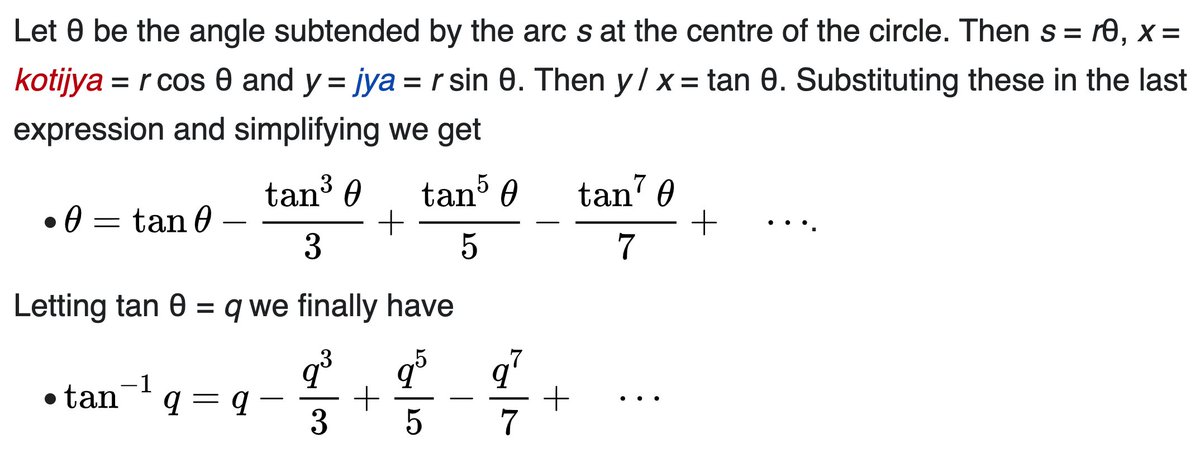
One of the great mathematician I admire is Madhava from Kerala, who did his work centuries before Newton (in 1300-1400). Some of the books written by his students and other people from that Kerala school were taken to Europe and has influenced many mathematicians. Among such work is series expansion of sin, cos, etc - centuries before Taylor, Newton, Libenitz or Gregory. Only in last few decades, these are now known as Madhava series - (When I was in school, the text books did not give credit to Madhava -- only current books call them "Madhava series" (or Madhava-Newton or Madhava-Gregory etc).

Any way where π comes in this problem, is from the famous Madhava series (also called Gregory series in old textbooks). Here is a cut and paste from Wiki: ( see Madhava Series

Image

If you substitute θ = π/4

You get π/4 = 1 -1/3 + 1/5 - 1/7 + 1/9 - ....

This is beautiful as on RHS you see just plain odd numbers, and LHS you see Pi...

(This, and similar series can be used to calculate Pi - In late 60's when I got my hands on a computer - IIT Kanpur (probably than the only computer in an academic school in India) - I used a similar series to calculate pi up to few hundred places of decimals)

****

The above problem can be reduced to this series. :) ..
sudarshan
BRF Oldie
Posts: 3048
Joined: 09 Aug 2008 08:56

Re: Know Your India

Post by sudarshan »

Amber G. wrote: 09 May 2026 12:01 ...
Amber ji, yes, I remember all your old posts regarding the Kerala school of mathematics. The paper by Whish however was something I was not aware of earlier, that's why I posted that. It was great to be able to find it online and fact-check the video which I linked :).

Also, the video talks about other Indian contributors, such as Pingala (binary notation), and Mahavira (systematic combinatorics) which I hadn't come across earlier, including on BRF. The video mentions seven different Indian contributors, and I remember, you've talked about five of them in your previous posts on BRF (Aryabhatta, Brahmagupta, Bhaskara II, Madhava, Ramanujam).

This particular youtuber seems to be currently on a spree, making many similar videos. Here's one more, about Kautilya's Arthashastra and game theory by Nash.

Vayutuvan
BRF Oldie
Posts: 14961
Joined: 20 Jun 2011 04:36

Re: Know Your India

Post by Vayutuvan »

sudarshan wrote: 09 May 2026 18:47 such as Pingala (binary notation), ...
@sudarshan ji, Pingala's contributions to combinatorics are well known. Knuth has an extended discussion in AoCP Vol 4 (IIRC). He used to publish fascicles while the book was in preparation. But now that the book has been printed, he has to remove all the free material he previously posted on his website.

De Bruijn rediscovered Pingala's Sanskrit prosodic meter, now known as the De Bruijn Sequence. You can look up this Wikipedia page

https://en.wikipedia.org/wiki/De_Bruijn_sequence

I had that fascicle saved. I can't find it on my desktop. Otherwise, I would have posted an excerpt from that book. You may be able to look it up in a nearby academic library.

As for Mahavira, I did not know about his contributions. I am going to look up.
sudarshan
BRF Oldie
Posts: 3048
Joined: 09 Aug 2008 08:56

Re: Know Your India

Post by sudarshan »

Vayutuvan wrote: 09 May 2026 23:53
sudarshan wrote: 09 May 2026 18:47 such as Pingala (binary notation), ...
@sudarshan ji, Pingala's contributions to combinatorics are well known. Knuth has an extended discussion in AoCP Vol 4 (IIRC). He used to publish fascicles while the book was in preparation. But now that the book has been printed, he has to remove all the free material he previously posted on his website.

De Bruijn rediscovered Pingala's Sanskrit prosodic meter, now known as the De Bruijn Sequence. You can look up this Wikipedia page

https://en.wikipedia.org/wiki/De_Bruijn_sequence

I had that fascicle saved. I can't find it on my desktop. Otherwise, I would have posted an excerpt from that book. You may be able to look it up in a nearby academic library.

As for Mahavira, I did not know about his contributions. I am going to look up.
Yeah, why should it be known as the "De Bruijn sequence" is the question :). If Pingala's contributions were truly recognized, it should be known as the "Pingala sequence." Thanks for the pointer though.

If we're on the subject, then technically, WW I was the Mahabharata war, WW II was between 1914 and 1918, and we've already had WW III between 1939 and 1945.
sudarshan
BRF Oldie
Posts: 3048
Joined: 09 Aug 2008 08:56

Re: Know Your India

Post by sudarshan »

The Kautilya video (game theory in 300 BCE) is truly fascinating. Highlights:

1. Description of the "Mandala" in chapter 6 of the Arthashastra - the mandala represents the game setup - identification of players by their functional roles in the game

2. Description of the "Nash equilibrium" as that stable state where no rational player in the game has an incentive to move away from the state - chapters 6 and 7 of the Arthashastra

3. Description of a 6-point strategy for making game moves in such a way, that none of the other rational players in the game (other than your immediate opponent) have any incentive to counter you - chapters 6 and 7

4. Description of the "prisoner's dilemma" in the context of incentivizing courtiers to report conspiracies against the king/ emperor - chapter 1 of the Arthashastra

5. Description of the same "prisoner's dilemma" in the context of incentivizing merchants to set up pricing structures favorable to the empire - chapter 2 of the Arthashastra

6. Showing how Chandragupta Maurya used all these principles in practice to build the largest empire in Indian history, covering 5 million sq. km., and also to defeat the Seleucids and obtain a hugely favorable treaty from them

7. Showing how the original Arthashastra was almost lost, except for the fact that it found its way to the library of a princely state (Mysore) rather than a British-Indian library

Awesome work.
Amber G.
BRF Oldie
Posts: 12933
Joined: 17 Dec 2002 12:31
Location: Ohio, USA

Re: Know Your India

Post by Amber G. »

sudarshan wrote: 09 May 2026 18:47
Amber G. wrote: 09 May 2026 12:01 ...
Amber ji, yes, I remember all your old posts regarding the Kerala school of mathematics. The paper by Whish however was something I was not aware of earlier, that's why I posted that. It was great to be able to find it online and fact-check the video which I linked :).

Also, the video talks about other Indian contributors, such as Pingala (binary notation), and Mahavira (systematic combinatorics) which I hadn't come across earlier, including on BRF. The video mentions seven different Indian contributors, and I remember, you've talked about five of them in your previous posts on BRF (Aryabhatta, Brahmagupta, Bhaskara II, Madhava, Ramanujam).

This particular youtuber seems to be currently on a spree, making many similar videos. Here's one more, about Kautilya's Arthashastra and game theory by Nash.

<youtube>Q-N_PM2wTw4</youtube>
Hi Sudarshan,

Thank you for your kind words! I am genuinely glad to hear that those old posts on BRF are still being read and remain useful. It is heartening to see this information gaining traction and being fact-checked against original sources like the Whish paper.

I, and many of my colleagues, often use these examples in international academic circles and competitive problem-solving to bring the rigor of Indian mathematical history into sharper focus. It is no longer just about "pride"; it is about acknowledging the actual lineage of mathematical thought.

You’ll notice that Modern Math in the US—and even platforms like Wikipedia—is increasingly moving toward "honest" attributions. We are seeing more frequent references to Brahmagupta for the rules of zero and quadratic equations, rather than solely relying on later European names. The shift is subtle but significant.

Pingala and Mahavira

Regarding Pingala and Mahavira, I have actually touched upon them in our Math Dhaga previously , as they are foundational:

Pingala: He is essentially the father of binary notation and combinatorics. His work in the Chandahsastra (on poetic meters) contains the earliest descriptions of what we now call Fibonacci numbers( or Hemachandra numbers)e and Pascal’s Triangle (the Meru Prastara). As I’ve mentioned, Manjul Bhargava (India’s first Fields Medalist) often speaks about these rhythms; he highlighted how the "discovery" of these sequences was explicitly detailed in Pingala’s treatise on prosody over two millennia ago.

Mahavira (or Mahaviracharya): A brilliant Jain mathematician. Because I know Prakrit, I’ve been able to read some of his work directly. He was quite revolutionary for his time because he treated mathematics as a distinct discipline, separating it from astrology. His writings are thorough and logically structured—excellent even by modern pedagogical standards for students. Many books translated in Telugu are quite good.

More on this later ( May be in the Math Dhaga).
Amber G.
BRF Oldie
Posts: 12933
Joined: 17 Dec 2002 12:31
Location: Ohio, USA

Re: Know Your India

Post by Amber G. »

Yeah, why should it be known as the "De Bruijn sequence" is the question :). If Pingala's contributions were truly recognized, it should be known as the "Pingala sequence." Thanks for the pointer though.
There is a famous inside joke in mathematics and science called Stigler's Law of Eponymy, which states: "No scientific discovery is named after its original discoverer."

I don't know much 'De Bruijn sequence' or Pingala's work around this. Perhaps it is not that well known (yet) Donald Knuth's paper came out in 2011. There was some part written about mathematician about "Poets and Drummers", which explicitly laid out the mathematics of Pingala, Hemachandra etc..

A good place to learn about this as mentioned by me many times - from Padma Bhushan, Manjul Bhargava (Top notch mathematician, India's first Field Medalist) who learned Tabla from legendary maestro, Ustad Zakir Hussain. And learned Sanskrit comes from his grandfather (Purushottam Lal Bhargava, a renowned scholar of ancient Indian history and Sanskrit)- Manjul has access to the Subhashitas (ancient poetry) and mathematical treatises in their original forms and he internalized the exact linguistic structures and poetic meters that scholars like Pingala and Hemachandra used to encode their math..

He writes for common people a lot too..(BTW I predicted that he will get Field's Medal in BRF before he got it :))

Getting back to ""Pingala sequence":

The shift in terminology is already happening in many academic circles. While "Fibonacci" remains the most common name in the West, you will increasingly find the sequence referred to as the Virahanka numbers or the Hemachandra numbers. (This is what I mostly do)

In many specialized texts, it is now formally called the Virahanka–Hemachandra sequence or even the Virahanka–Fibonacci sequence to acknowledge that it was described in India centuries before Fibonacci was even born.

Pingla got the sequence much much earlier but he called it Pingala called it the Mātrāmeru (मात्रामेरु).

In the context of his Chandaḥśāstra, "mātrā" refers to the rhythmic unit or beat (the length of the syllables), and "meru" refers to a mountain. So, Mātrāmeru roughly translates to the "Mountain of Beats" or "Mountain of Syllables."

He arrived at this sequence (1, 1, 2, 3, 5, 8...) not by calculating rabbit populations, but by enumerating the number of possible poetic meters of a given total duration using combinations of laghu (short, 1 beat) and guru (long, 2 beats) syllables:

---
Added later: Other of Pingla's famous contribution historians of mathematics and combinatorialists absolutely recognize and use Meru Prastara, but the terminology shifts heavily depending on the geographical and historical context being discussed.

{"Pascal's Triangle" remains the ubiquitous standard in general Western education..this geometric arrangement of binomial coefficients was discovered independently across the ancient world, it goes by several other names globally)
In India it is called: Meru Prastara or Khaṇḍameru .

As said -looking at the combinatorics of Sanskrit meters, it was referred as the Meru Prastara (Staircase of Mount Meru), stemming from Pingala's Chandaḥśāstra and later explicitly mapped out by the commentator Halayudha ( . Another term used in ancient Indian texts, particularly by Virahanka, was Khaṇḍameru (the broken or partial Mount Meru).
Amber G.
BRF Oldie
Posts: 12933
Joined: 17 Dec 2002 12:31
Location: Ohio, USA

Re: Know Your India

Post by Amber G. »

cont.. (Read on if interested in Mahavira and Pingla Math contribution)

Mahavira, or Mahaviracharya : is an exceptionally compelling figure- he represents a crucial pivot point where mathematics was formally emancipated from its traditional role as a mere tool for astronomy.

His Gaṇitasārasangraha (Compendium of the Essence of Mathematics), is highly regarded not just for its advanced theorems, but for its elegant linguistic structure and rigorous pedagogy. For anyone with a background in the Prakrit and Sanskrit traditions of Jain scholarship, his work is a masterclass in treating mathematics as a highly organized, independent science.

Some of the most significant mathematical milestones :

1. The Explicit Formula for Combinations (Vikalpa)
While Pingala laid the groundwork for combinatorics, Mahavira was the first in the world to provide the explicit, general formula for calculating combinations—what we now write as nCr
2. The Rule for Dividing Fractions
Mahavira provided the first recorded explicit rule for the division of fractions. He stated that to divide one fraction by another, one must invert the divisor and multiply it by the dividend. It is a fundamental rule taught in primary schools today, but the Gaṇitasārasangraha is where it first appears as a formalized algorithm.
3. Understanding the Boundaries of Real Numbers
He greatly expanded upon Brahmagupta's rules regarding zero and negative numbers. Crucially, Mahavira was the first mathematician to explicitly state that a negative number has no real square root.
4. Advanced Geometry and Cyclic Quadrilaterals
He made significant contributions to geometry, expanding on Brahmagupta’s work regarding cyclic quadrilaterals (quadrilaterals inscribed in a circle).
5. Unit Fractions and Decomposition
Jain mathematicians had a deep interest in expressing numbers as sums of unit fractions (fractions with a numerator of 1). Mahavira provided a variety of sophisticated rules to decompose any given fraction into a sum of unit fractions, a problem that remains a fascinating topic in modern number theory (like the Erdős–Graham conjecture).

Math for the Student
What truly sets Mahavira apart is the structural brilliance of the Gaṇitasārasangraha. Because he decoupled mathematics from planetary charts and astrology, he needed to give the math real-world relevance for students.
He framed complex algebraic and geometric problems using poetic, highly visual scenarios—swarms of bees, lotuses in a pond, arrows shot in battle ityadi ..he coupled it with rigorous mathematical logic.

******
For those of who are serious - there is excellent documentation and translation work available.. lately there has been a massive effort to digitize, translate, and preserve these manuscripts.

Some of my take about best translations and where these historical documents are:

1. Mahavira’s Gaṇitasārasangraha (The Telugu Connection)

-The Telugu Translation: A mathematician and poet named Pavuluri Mallana translated it as the Sāra Sangraha Gaṇitamu . This makes it one of the earliest known scientific texts, and excellently translated into a Telugu - good.

- The most famous English translation was done by M. Rangacharya in 1912. . It has been reprinted several times and is widely available in digital archives (like the Internet Archive) today.

Hindi Versions: Several Jain academic institutions, particularly the Jain Vishva Bharati University and publishers in Rajasthan, have produced Hindi commentaries and translations of his work, focusing on both the mathematics and the philosophical poetry.

2. The Kerala School (Yuktibhāṣā and Tantra Sangraham)
For the Kerala school, the modern "gold standard" for English translations comes from a team of brilliant modern Indian physicists and mathematicians.

The English Critical Editions- Yuktibhāṣā (which contains the proofs for the infinite series),- English translation by the late K.V. Sarma, with extensive mathematical notes by K. Ramasubramanian, M.D. Srinivas, and M.S. Sriram This edition is incredible because it provides the original Malayalam, the English translation, and modern mathematical equations side-by-side.

Hindi: K. Ramasubramanian ( IIT Bombay) and his colleagues have also worked on producing Hindi translations and lectures of these exact texts to make them more accessible to universities across northern India.

The original palm-leaf manuscripts and early paper copies are scattered across a few major libraries globally.

- Kerala University Manuscript Library, Trivandrum: This is the epicenter for the original Kerala School manuscripts. Many of the surviving copies of Madhava’s and Nilakantha’s works are physically preserved here.

- Sarasvati Bhavan Library, Varanasi: Located at the Sampurnanand Sanskrit University, it houses a massive collection of northern Indian and Jain mathematical texts.

For US -
Brown University (May be others) - History of Exact Sciences in Antiquity (founded by Otto Neugebauer) holds one of the best curated academic archives of translated global ancient mathematics.

Many portals (IIT's and the Digital Library of India (often mirrored on several places) have scanned thousands of these texts and translations, making them freely available as PDFs..
Amber G.
BRF Oldie
Posts: 12933
Joined: 17 Dec 2002 12:31
Location: Ohio, USA

Re: Know Your India

Post by Amber G. »

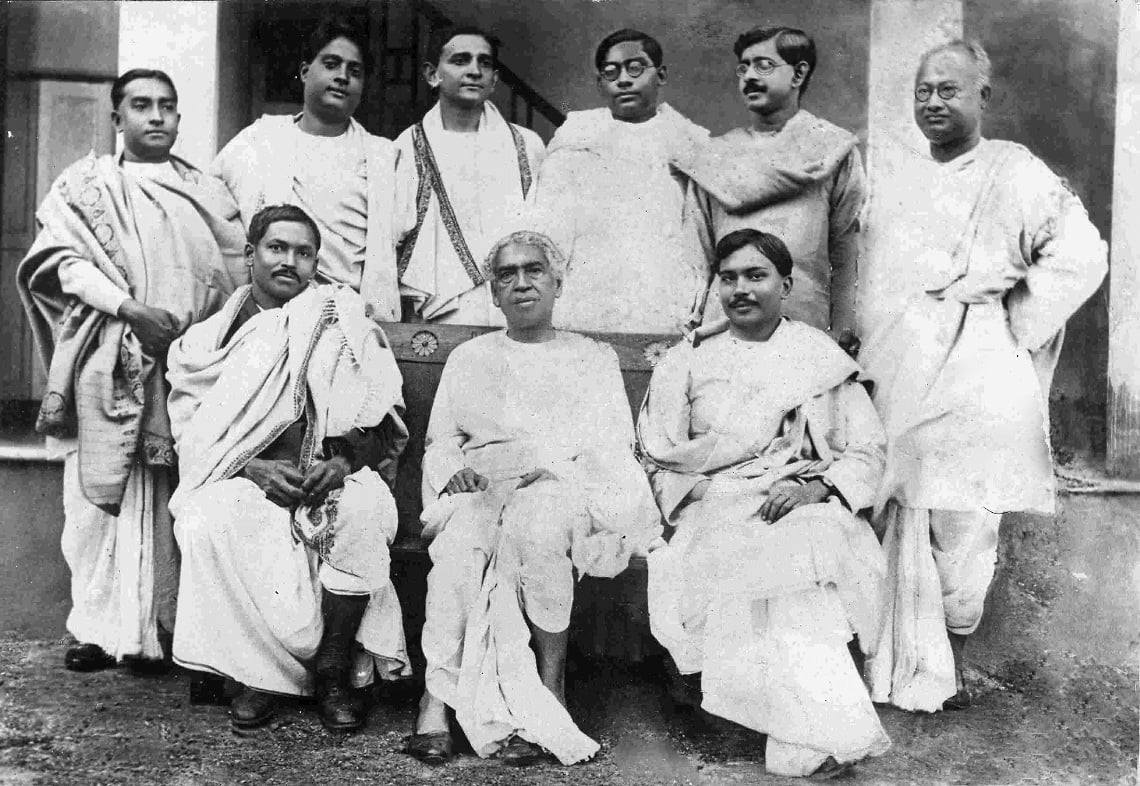
7 Nobel prizes the British discredited — and the 4 trillion-dollar industries it built
From the dhaga in physics . please read some interesting posts...about these..

Let me post again from my archive: (American Institute of Physics - Emilio Segrè Visual Archive)

How many can you identify?.
Image

For Nobel - There is one in the picture who was nominated 8 times, another 4 times and the third, the most famous of all, was a polymath, physicist, biologist, botanist and archaeologist, and an early writer of science fiction but is perhaps best known as an Electrical Engineer and father of "radio science"


How many can you recognize?
bala
BRF Oldie
Posts: 3826
Joined: 02 Sep 1999 11:31
Location: Office Lounge

Re: Know Your India

Post by bala »

Finally the politicos of India are realizing the immense contributions of India towards Mathematics

Jaishankar Unveils India’s Ancient Mathematics Legacy At United Nations Headquarters

External Affairs Minister Dr. S. Jaishankar inaugurated the exhibition titled ‘From Shunya to Ananta (Zero to Infinity) – The Indian Civilisation’s Contribution to Mathematics’ at the United Nations headquarters in New York. Organised by India’s Permanent Mission to the UN, the exhibition highlights India’s historic contribution to the field of mathematics and its impact on global scientific progress.


// the current state of affairs in EDU in India is pathetic. Nothing is taught about the actual contributions of India in seminal topics - number theory, quadratic equations, infinite series and so on. This needs to be changed dramatically and allow students to think from first principles instead of rote learning. Not only math, but physics of the newton chori kind needs to be taught from Vaisesika sutra.
Amber G.
BRF Oldie
Posts: 12933
Joined: 17 Dec 2002 12:31
Location: Ohio, USA

Re: Know Your India

Post by Amber G. »

Amber G. wrote may times about Pingala, and repeated it just a day ago!
Amber G. wrote: 11 May 2026 00:29 Pingala: He is essentially the father of binary notation and combinatorics. His work in the Chandahsastra (on poetic meters) contains the earliest descriptions of what we now call Fibonacci numbers( or Hemachandra numbers)e and Pascal’s Triangle (the Meru Prastara). As I’ve mentioned, Manjul Bhargava (India’s first Fields Medalist) often speaks about these rhythms; he highlighted how the "discovery" of these sequences was explicitly detailed in Pingala’s treatise on prosody over two millennia ago.
Now today in UN out EAM Talks about Pingala, Binary systems and Rthyms and Chandra Sutra.
“Indian civilisation created the idea of the code which runs our modern tech age. The digital era runs on the binary system. Its roots can be actually traced to Pingala’s Chandra Sutra. The rhythm of our ancient verses was algorithmic,
Jai Ho!
bala
BRF Oldie
Posts: 3826
Joined: 02 Sep 1999 11:31
Location: Office Lounge

Re: Know Your India

Post by bala »

Ok some videshi dude put together this based on some work done by others and is slyly taking credit in this YT.
A 9,000-Year-Old City Was Found Off India's Coast

https://www.youtube.com/watch?v=g4Z2VjDZ7dE


// the Indian ASI should be doing such work and educating India on such lost artifacts. Instead it it some bureaucratic nightmare of an organiztion with very little vision.
bala
BRF Oldie
Posts: 3826
Joined: 02 Sep 1999 11:31
Location: Office Lounge

Re: Know Your India

Post by bala »

CSIR-NGRI Discovers Massive Buried Paleo-River Near Prayagraj, Revives Saraswati Debate

Dr. Subhash Chandra being interviewed by Pallava Bagla.

Scientists from CSIR-NGRI have identified a massive buried paleo-river system between the Ganga and Yamuna near Prayagraj. The ancient river channel lies 10 to 15 metres below the surface and has been traced for nearly 200 kilometres, with further extensions possible. The discovery, confirmed through drilling and geological mapping, has reignited discussions around the mythological Saraswati River believed to have flowed through the region. Researchers say the buried system is comparable in scale to the major rivers of the Indo-Gangetic plain.

https://www.youtube.com/watch?v=qtS7VFNvzx4


// so there it is solid evidence that Prayagraj is the meeting point of 3 rivers - ganga, yamuna and saraswati. The Vedas talk about Saraswati river.
Amber G.
BRF Oldie
Posts: 12933
Joined: 17 Dec 2002 12:31
Location: Ohio, USA

Re: Know Your India

Post by Amber G. »

// so there it is solid evidence that Prayagraj is the meeting point of 3 rivers - ganga, yamuna and saraswati. The Vedas talk about Saraswati river.
"Solid eidence" ???? - Not really! That would be overstating (By FAR) what the scientists actually established.

The researchers presented evidence for a buried paleo-river system beneath parts of the Prayagraj region.
They did not establish, in a definitive historical or archaeological sense, that this river is the Saraswati described in the Vedas.
Therefore, saying there is “solid evidence that Prayagraj is the meeting point of Ganga, Yamuna, and Saraswati” goes beyond the scientific claim.

The distinction matters because there are two separate levels here:

Geological claim (reasonably strong): There was an ancient buried river or paleochannel in the region.
Civilizational / textual identification (Not there/much weaker ): That this channel is the Vedic Saraswati.
bala
BRF Oldie
Posts: 3826
Joined: 02 Sep 1999 11:31
Location: Office Lounge

Re: Know Your India

Post by bala »

The Saraswati river has more backing from ISRO satellite analysis and so on. Our ancients did not lie like modern Britshits/US/Eurotards do very routinely - these nations lie in their talk, lie in their writings, freely usurp Indian math/physics discoveries and so on. Splitting hairs over an underground channel etc is simply semantics and we don't need further evidence of what India's ancients described in various means including prayagraj as a confluence of 3 rivers. So far everything in the Vedas (which has geographical markers on the Indian continent) is absolutely true, no one has disproved anything in it.
bala
BRF Oldie
Posts: 3826
Joined: 02 Sep 1999 11:31
Location: Office Lounge

Re: Know Your India

Post by bala »

Six Indian Equations That Saved Every Bank in 2008

Brahmagupta's rules for negative numbers (628 CE). Bhaskara's compound-interest formulas (1150 CE). Mahavira's infinite-series pricing math (850 CE). Kautilya's three-office audit framework (300 BCE). The hawala-hundi double-entry settlement network (8th century onwards). Aryabhata's modular arithmetic (499 CE) — the math your bank login still runs on. Every one of them load-bearing in modern fintech and cybersecurity. Every one of them buried under European names: Fibonacci, Pacioli, Witt, Bézout.


// i am suspecting Ronny to be desi in UK
Vayutuvan
BRF Oldie
Posts: 14961
Joined: 20 Jun 2011 04:36

Re: Know Your India

Post by Vayutuvan »

bala wrote: 14 May 2026 01:23 Six Indian Equations That Saved Every Bank in 2008

Brahmagupta's rules for negative numbers (628 CE). Bhaskara's compound-interest formulas (1150 CE). Mahavira's infinite-series pricing math (850 CE). Kautilya's three-office audit framework (300 BCE). The hawala-hundi double-entry settlement network (8th century onwards). Aryabhata's modular arithmetic (499 CE) — the math your bank login still runs on. Every one of them load-bearing in modern fintech and cybersecurity. Every one of them buried under European names: Fibonacci, Pacioli, Witt, Bézout.

[youtube...]83u3jKih_2c[/youtube]

// i am suspecting Ronny to be desi in UK
Let us give credit where credit is due. RSA depends critically on the Chinese Remainder Theorem, which was discovered in 200 CE (or was it 200 BC)?
Post Reply