Understanding New China After the 19th and 20th Congresses

The Strategic Issues & International Relations Forum is a venue to discuss issues pertaining to India's security environment, her strategic outlook on global affairs and as well as the effect of international relations in the Indian Subcontinent. We request members to kindly stay within the mandate of this forum and keep their exchanges of views, on a civilised level, however vehemently any disagreement may be felt. All feedback regarding forum usage may be sent to the moderators using the Feedback Form or by clicking the Report Post Icon in any objectionable post for proper action. Please note that the views expressed by the Members and Moderators on these discussion boards are that of the individuals only and do not reflect the official policy or view of the Bharat-Rakshak.com Website. Copyright Violation is strictly prohibited and may result in revocation of your posting rights - please read the FAQ for full details. Users must also abide by the Forum Guidelines at all times.
ricky_v
BRFite
Posts: 1615
Joined: 11 Aug 2016 06:14

Re: Understanding New China After the 19th and 20th Congresses

Post by ricky_v »

a bit of a meta commentary, as it were, on good literature in recent times and their paucity before moving onto the relevant post
usual haunts of news aggregators, reliable publications have all gone suddenly cold in terms of publishing good literature on geopolity, most are swept in the "he said, she said" type of discourse of the usual celebs / politicos while offering shallow level analyses and empty platitudes and ignoring the grand narrative...

maybe it has to do with the incumbent potus, when biden was incharge, people could see that agile groups were taking more and more, and so the commentaries and diplomacy, economics 101 were peddled on a regular basis. With trump incharge, perhaps everyone is being cautious, after all there have never been instances where so much power resided in 1 person and not a group as has been the convention as a sort of checks and balances. Perhaps after this term, we will be flooded with analyses on how to deal with such characters in the future in addition to the usual naked bribe, a trick first invented when the world was divided into the civilised and the barbarian

coming to the article, the person is a sort of chinese philosopher offering his views on the current trends in the chinese society and in particular amongst its younger members, not one I would usually post, but dearth of literature and all that:

https://www.readingthechinadream.com/xu ... tives.html

intro - this interview was taken down by the party soon after
It is bleak first because Xu notes sadly that he is speaking at what he sees as the end of an era - the public space that opened in China over the course of reform and opening is now disappearing. This space had allowed Xu and his fellow intellectuals to have their say on some of China’s important issues in the 30-year period preceding Xi Jinping’s rise to power, even if the space existed entirely at the mercy of the Party-State. At present, Xu jokes that he is “unemployed” because his job had been to analyze contemporary Chinese intellectual discourse, and now that Xi Jinping has succeeded in imposing greater ideological discipline there is none.

Xu does not really talk about why the space is closing and even as he mourns the closing of the public space he celebrates the rich private space that has opened up over the past few years, even blessing it was a quotation from one of Mao’s poems: "Chill waves sweep through steep skies/Yet earth's gentle breath grows warm." No one is quiet, he suggests, they are just not loud in public. This “gentle breeze” is China’s new private space, and by quoting Mao, Xu surely wants us to believe that it will ultimately triumph over the “chill waves,” although when the triumph will come and in what form is anyone’s guess.

A second reason Xu’s mood is bleak is that intellectuals like him have been pushed aside by influencers, online media personalities who possess the talent and charisma of stand-up comics and podcast hosts in China and elsewhere. Like Joe Rogan, they are smart and plugged-in and sound relevant, but their goal is to increase their following because volume is the name of the game and with numbers come advertisers and money and fame. Xu admits to dipping his toe in these waters, making short, punchy videos and posting them on popular platforms like Bilibili, but he soon realized that the messages conveyed by this machine have little or no intellectual content in the sense that Xu understands “intellectual,” so he decided that this is not for him. He and those like him will continue to write and talk because that is what they do and because there is a secondary market for them, but he speaks as if a window has closed on an era, in effect acknowledging his growing irrelevance.

This has always been true, to an extent; Xu has long described himself as “neither fish nor fowl,” both a Rawlsian Liberal keenly interested in social justice and a cultural conservative open to some version of Confucianism 2.0. But his discomfort now seems more existential, as Rawlsian Liberals and cultural conservatives have disappeared from China’s cultural scene, leaving Xu with no one to talk to, at least in public. A certain sadness thus accompanies his embrace of the pleasures of private life.
the interview proper
Xu Jilin: As part of the research in which I was engaged at the end of the 1990s, I put together a framework dividing 20th-century Chinese intellectuals into six generations: three pre-1949 generations (the late Qing, the May Fourth, and the post-May Fourth generations) and three post-1949 generations (the "17-Year generation" [1949-1966], Cultural Revolution generation, and reform and opening generation). In Front and Rear Waves, I primarily focused on the pre-1949 generations. However, during my research, I found these generational divisions somewhat oversimplified, so I developed more refined classifications in the new book, which I won’t elaborate on here. Today I’d like to focus on the contemporary era and share an interesting shift in perspective. In the work I published in the 1990s, I considered those born in the 1970s and 1980s - those shaped by reform and opening - as “new types of people,” distinct from the Cultural Revolution generation (roughly my own cohort, those born in the 1940s, 1950s, or even the early 1960s) who were steeped in revolutionary ideology. So at the outset, I saw those born in the 1970s and 1980s as new, but two decades later I have come to realize that they actually represent transitional generations. The true break from revolutionary culture are those born in the 1990s and the 2000s, who are different in [almost] physiological terms.

Those born in the 1950s and 1960s still carry traces of revolutionary culture, and certain idealistic values serve to prop up their lives. Those born in the 1990s and 2000s no longer need such things; they are more secular and prioritize personal happiness and living in the here and now. Those born in the 1970s and 1980s straddle the two, in that we can still see traces of idealism (although less and less) and while they paved the way toward secular lifestyles, they do not yet fully embrace them. So I broadly categorize active contemporary Chinese generations into these three groups: the revolutionary, the transitional, and the live for today.

We can also see this in terms of “front waves” and “rear waves.” Those born in the 1990s and 2000s are fundamentally distinct—both biologically and psychologically—from the revolutionary cohorts born in the 1950s and 1960s. This is my current understanding of these generational divides.
: From this perspective of "front and rear waves," an intriguing phenomenon is that these three generations in China span roughly 20 years each. Biologically, a generation—say, the time it takes for a child to become a parent—typically takes 20 to 30 years. But China’s transformations have been so rapid that even 5 to 10 years can create a psychological and cultural generational divide, so that even people we see as “rear waves” may instead see themselves as “front waves.”

Those born in the 1950s and 1960s experienced the 1980s - an era steeped in idealism - and members of these generations threw themselves into their work with idealistic fervor. Many still harbor nostalgia for this, and romanticize the 1980s as a golden age. Take Gao Xiaosong’s (b. 1969) song about "poetry and distant horizons" for example - a mindset rooted in that era, making him a quintessential idealist. People back then were willing to dedicate themselves to abstract symbols of value. They prioritized collective ideals over personal interests, safeguarding not individual rights but the values of the nation.

In contrast, younger generations today no longer rally around abstract ideals. In the various social movements in which they are engaged, their focus is sharply on specific individual rights. Their goals are limited, tangible, and tied to personal life and interests.


Let me use another metaphor to illustrate the divide. Those born in the 1950s and 1960s are people living in the "polis" (city-state), while those born in the 1990s and 2000s inhabit a "post-polis" world. Last October I went on a study tour to Greece, and viewing China through the lens of Greek philosophy left a profound impression on me. From Socrates to Plato and Aristotle, Greek thinkers tied the meaning of human life to the polis. Aristotle famously declared humans to be city creatures, existing for the sake of the polis and abstract ideals. But by the late Greek period, as the polis declined, philosophies like Epicureanism and cynicism emerged. Epicureanism dismissed the polis as meaningless, asserting that humans live for personal happiness. This marked a radical shift—a decoupling from the polis. Cynicism went further, advocating detachment from societal structures, akin to today’s "lying flat"[4] mentality.

We see similar transformations in today’s China. Those born in the 1950s and 1960s still have the mindset of city creatures. They follow state news broadcasts, discuss geopolitics in chat groups - Russia-Ukraine tensions, the Israel-Palestine conflict, U.S. elections - as if these define their existential purpose and they cannot leave the polis behind. The younger generation, however, is utterly different. They care little for such matters, focusing instead on what directly impacts their lives and immediate selves. They have fully decoupled from the polis, embracing an Epicurean ethos of self-fulfillment, prioritizing personal happiness and well-being.
I believe there is an inherent historical logic behind this. When an era is in its heyday - such as an empire or city-state in ascendance - people perceive their fate as closely linked to that of the collective. This sense of shared destiny is profound: individuals derive personal benefits from the collective’s prosperity, recognize that its rise or fall directly impacts their lives, and maintain confidence in its future. Think of the characters in the TV drama “Blossoms Shanghai,” (繁花/Fanhua) set in the early 1990s, whose eyes sparkled with expectations and hope - and their expectations were linked to the polis.

Today, that light has dimmed. As the polis declines, people lose sight of a shared future. Today, people are much like intellectuals during the Wei-Jin period (220–420 CE), who embraced Daoism as a way of preserving themselves in troubled times, and elites mimic Wei-Jin scholars in their philosophical escapism. They have cast aside their relations with the polis and care little about its cohesion, nor do they have any expectations for its future. It’s like when the ship is sinking, you jump into the sea and find your own life raft. This is a huge change.

You can see that they are more and more trapped in a lifestyle centered on their own mood. I recently learned a new word while watching the movie “Her Story” (好东西/Hao dongxi) – “situationship.” The best part about this movie is what it shows about changes in intimate relationships. Love is a deep feeling and is binding but young people don’t believe in love and instead are looking for “situationships” that they can take up in the breaks between classes.

In Chinese we might use the term dazi/搭子 (partner) for situationship. Young people look for all kids of partners, partners to chat with, to go to bed with. All of these have instrumental value and are not emotionally binding at any deep level. All they are looking for is mood value, and if it’s not forthcoming they’ll move on to the next partner. They do their utmost to avoid emotional engagements that are binding or exclusive. They prefer this kind of surface, concrete lifestyle, which looks shallow but avoids pain. As Isaiah Berlin put it, they inhabit life’s surface, seeking to be concrete, adaptable, and untethered from the depths.
the above might just be old man yells at clouds type of scenario
Question: In your book on intellectuals, you mention the distinctions between urban intellectuals and small-town or provincial intellectuals. When analyzing current trends or differences among younger generations, should the contrasts in mentality and behavior between youth in major cities like Beijing and Shanghai versus those in third- or fourth-tier cities (or even smaller towns) serve as a framework for our analysis?

Xu Jilin: I believe that with the rise of new media the world has become increasingly stratified. People living in same era now inhabit different worlds—not just physical or material worlds, but worlds shaped by ideas and perceptions. In the past, information and ideologies were disseminated hierarchically: mainstream media set the agenda, filtering down to secondary outlets, so as long as you controlled mainstream media you controlled everything. Today, however - especially with the advent of self-media and social platforms - there is no center. Trends and public enthusiasms and excitements emerge unpredictably, avoiding traditional media’s grasp. As a result, the information people access and the worlds they engage with vary drastically.

This divergence stems partly from material conditions in first-tier cities, new first-tier cities, third- or fourth-tier towns, and rural areas. We can see how the influential social platforms have carved this world up: Xiaohongshu (Little Red Book) dominates first- and rising first-tier cities, although WeChat Channels (Video Accounts) are also found here; Douyin (TikTok) thrives in second- and third-tier cities; while Kuaishou is the platform of choice for youth in small towns and villages. Each platform represents a separate universe.

Thus, the urban-rural divide isn’t merely physical. The informational and ideological worlds they inhabit grow further apart, breeding mutual incomprehension. We no longer share a common reality; everyone has their own world. New media hasn’t bridged the gaps—it has deepened them. Conversations between these fragmented worlds increasingly are cases of people talking past one another. (鸡同鸭讲/ji tong ya jiang, lit. “chickens talking with ducks”).
But what’s funny is that everyone believes they see it all. The parable of the blind men and the elephant grows ever more relevant. Everyone is blind but believes what their hands have told them about the elephant. But the elephant itself becomes ever more illusory and only God knows where it is. As people remain trapped within these horizontal and vertical confines, they can only grasp part of the world, and the whole becomes increasingly fragmented and no longer cohesive.
Xu Jilin: There is no longer a true public sphere in China today. Over the past two decades, from the 1980s until the early 21st century, for a period of roughly 30 years, China did have a public sphere. In Habermas’s terms, the essence of a public sphere lies in the open discussion of significant sociopolitical issues. For instance, the 1990s witnessed a four-year debate between Liberals and the New Left, during which nearly all major issues in China were openly debated. However, the public sphere is now dissolving, along with the external conditions that upheld it. Voices once part of public discourse have retreated into private domains, which I call the "private sphere." Today, the public sphere is in decline, while the private sphere thrives. Examples include hobby clubs, book clubs, independent bookstores, academic bars, and group chats.

This decline refers to the erosion of what Habermas called the public sphere, something that began to emerge in the 1980s with the policy of reform and opening, starting with the “ideological emancipation movement” and "culture fever" (often dubbed the "second enlightenment,” the first having been during the May Fourth era), fostering vibrant discussions on major sociopolitical issues. This lively public sphere persisted until around 2010, initially playing out in newspapers and magazines, later shifting online to forums like BBS. Public intellectuals were central to the creation of the public opinion in this sphere.

During this period, public life—particularly civic engagement tied to the polis—flourished, while intellectuals’ private lives remained underdeveloped. Entrepreneurs, busy capitalizing on market opportunities and optimistic about the future, largely stayed out of public debates, creating a divide between intellectuals and business elites. After 2010, however, the public sphere began to collapse due various changes and internal and external factors, including shifts in the media environment and fragmentation among intellectuals, so that the public sphere now no longer exists. Major public debates, so vibrant from the 1980s to 2010, have disappeared.
These groups are unlike traditional communities bound by blood or geography—groups that are natural, “given,” and hard to exit. These resource-based groups allow free entry and exit yet maintain strong internal cohesion. I call them "molecular communities." Alone, individuals struggle against Mao’s "cold currents," but by forming private spheres, they huddle for warmth and mutual encouragement, finding solidarity. Across China, these molecular communities are ubiquitous, yet isolated from one another—tight-knit internally but disconnected externally, some even resembling intimate fellowships.

This trend, absent in the past 30 years, has become pronounced in the last decade. Foreign observers often fixate on the "chill waves" but overlook the "gentle breath" beneath—a dynamic unique to China’s current social landscape.
Looking back at the May Fourth Movement generation, their elders often dismissed the use of the spoken Chinese vernacular, preferring the classical style they valued. The young people wanted to use everyday language in media and fiction, which critics didn’t always approve of—Hu Shi’s 胡适 (1891-1962) vernacular poetry, for example, was criticized. But ultimately, the shift to vernacular language was unstoppable, and history shows it was the right move. Sure, the vernacular had its flaws, but the May Fourth generation still carried forward some traditions, so not everything was lost. It wasn’t a complete rejection of tradition or classical language—many writers produced good poetry in the vernacular, and some of the best classical poetry was preserved. We can’t do that kind of writing anymore, but they could. This tradition was passed down, especially the poetry of the Republican period, which blended vernacular and classical styles. It’s a bit like when Xu Zhimo 徐志摩(1897-1931) wrote Western-style romantic poetry. Every era reinterprets its inheritance, and people born in the 1990s and 2000s are no different.
A_Gupta
BRF Oldie
Posts: 15911
Joined: 23 Oct 2001 11:31
Contact:

Re: Understanding New China After the 19th and 20th Congresses

Post by A_Gupta »

China is converting its huge US treasuries reserves into physical assets.
https://youtu.be/3LcG_tJ0rn4?si=xxBo82T5FM7S42AC
ramana
Forum Moderator
Posts: 60410
Joined: 01 Jan 1970 05:30

Re: Understanding New China After the 19th and 20th Congresses

Post by ramana »

Its a prudent move as the $ is eroding in value.
India is also exchanging US Treasuries for gold.
ramana
Forum Moderator
Posts: 60410
Joined: 01 Jan 1970 05:30

Re: Understanding New China After the 19th and 20th Congresses

Post by ramana »

Media is agog with news if Gen Zhang Youxia ouster by Xi Jinping.

Here is an article on PLA and CPC structure

https://geoinsiders.com/xi-jinping-pla- ... -analysis/
m_saini
BRFite
Posts: 815
Joined: 23 May 2020 20:25

Re: Understanding New China After the 19th and 20th Congresses

Post by m_saini »

I read this fascinating (for me) piece on the Youxia ouster:

Xi’s Military Meltdown

Some excerpts:
In his third term, he started going after associates — kind of like a mafia boss, seeing these guys as disposable. He made them, he could break them. But now he’s going after his friends, or at least his political allies in his innermost circle
What it suggests is that Xi was fed up with the whole crop of leaders for whatever reason — possibly different reasons for different people. But he clearly determined at some point, “I don’t like this crop, and I’ve got to get rid of them wholesale.”
Getting the Wall Street Journal to write an article saying this guy sold nuclear secrets to America — that was a choice. I’m not saying Lingling Wei made it up, but someone had to tell her. And you don’t tell that to Lingling and keep your head unless you’re being told it’s okay to tell her.
This gets lost sometimes: it’s not just the formality of being purged. Before the purge comes, you’re disgraced for your disloyalty to the party — and in this instance, to the country as well. It’s full bore.

What’s really striking is the timing. We’re about 20 months away from a Party Congress. Xi could just as easily have let Zhang Youxia retire quietly, even if there were a real issue.
...My guess is Xi probably has some kind of dossier on all these guys. That’s why the Discipline Inspection Commissions are so important — that’s Zhang Shengmin’s job in particular.
.. oftentimes the people who get purged had no intention to cause problems and there was no ill will or scheming. They just read the tea leaves the wrong way unintentionally — they thought what Xi wanted was A, but what he actually wanted was B. Honestly, I put that as a much higher probability than this guy being the highest-ranking American agent this country’s ever pulled off.
It’s almost like the Putin thing: if you’re going to lose the war in Ukraine, you can’t lose it to the Ukrainians, you have to lose it to the Americans. Getting corrupted by the Taiwanese or Japanese is just too embarrassing. You’d never want to tell anyone.
..almost a little more than a decade ago, Xi met with Ma Ying-jeou in Singapore and shook hands — the first meeting of that sort between the two sides since the Marshall Mission in 1946, when Mao met Chiang Kai-shek. Xi obviously loves that kind of historical resonance. Anything that ends with “the first since Mao” is a preferred sentence construction for him.
..His partner explained that this happened semi-regularly — the hushed one-on-one memo dissemination. “Another time this kind of thing happened in recent memory was a few months ago when a three-year-old boy went missing in our city. We had to let everyone know that it was forbidden to report on this issue, no matter what new information you may come across.”

If that’s your life as a low-level provincial employee in Shanxi Province — randomly having to make four hours of phone calls from 11 PM to 3 AM — can you imagine what it means to have a combatant command or to be on the CMC? What your day-to-day headspace is? It’s the stuff of horror movies. Really terrifying.
..It’s like Alex Honnold climbing Taipei 101 at 40 years old. He could fall at any minute.
That’s the paradox of the system. It’s a low-trust system, so trust is in many ways even more important there than in ours, where we have a high-trust society and polity on the big scale.

It’s not a “no new friends” system — it’s a “no friends, period” system
Jay
BRFite
Posts: 1208
Joined: 24 Feb 2005 18:24
Location: Gods Country
Contact:

Re: Understanding New China After the 19th and 20th Congresses

Post by Jay »

Is there an unending line of the generals available to chicoms that they go about these purges this frequently? This more and more resembles the comically unending line of queda 2nd in command jihadis who got eliminated every few months during GOAT years.
m_saini
BRFite
Posts: 815
Joined: 23 May 2020 20:25

Re: Understanding New China After the 19th and 20th Congresses

Post by m_saini »

Jay wrote: 28 Jan 2026 23:43 ..
There's a section:
Even in the last few months, just a few weeks after the exclamation mark on the last round of purges at this fall’s plenum, the PLA conducted a pretty significant military exercise around Taiwan in the closing days of 2025. There was this theory floating around that because a bunch of people from the 31st Group Army were purged, they wouldn’t know how to do these things anymore. It’s pretty clear they still know how to do these things, based on the operation they pulled together at the end of last year.

You have to think this is terrible for morale. It’s not how you’d run a high-morale, high-tempo organization in the West. But it’s their system, and this is how they operate.

These generals are a dime a dozen, Jon. As long as they get the ideology right, everything else will fall into place.
It is rather comical agreed. Their higher ups seem to have gotten there more on their yes-sir-ness than on the basis of capability. and so no surprise they get purged the moment Xi thinks a contradicting thought is forming.

But then again, the question arises: is this not a better system for them if they never enter a full scale war with a peer adversary where the capability of your higherups gets tested?
ricky_v
BRFite
Posts: 1615
Joined: 11 Aug 2016 06:14

Re: Understanding New China After the 19th and 20th Congresses

Post by ricky_v »

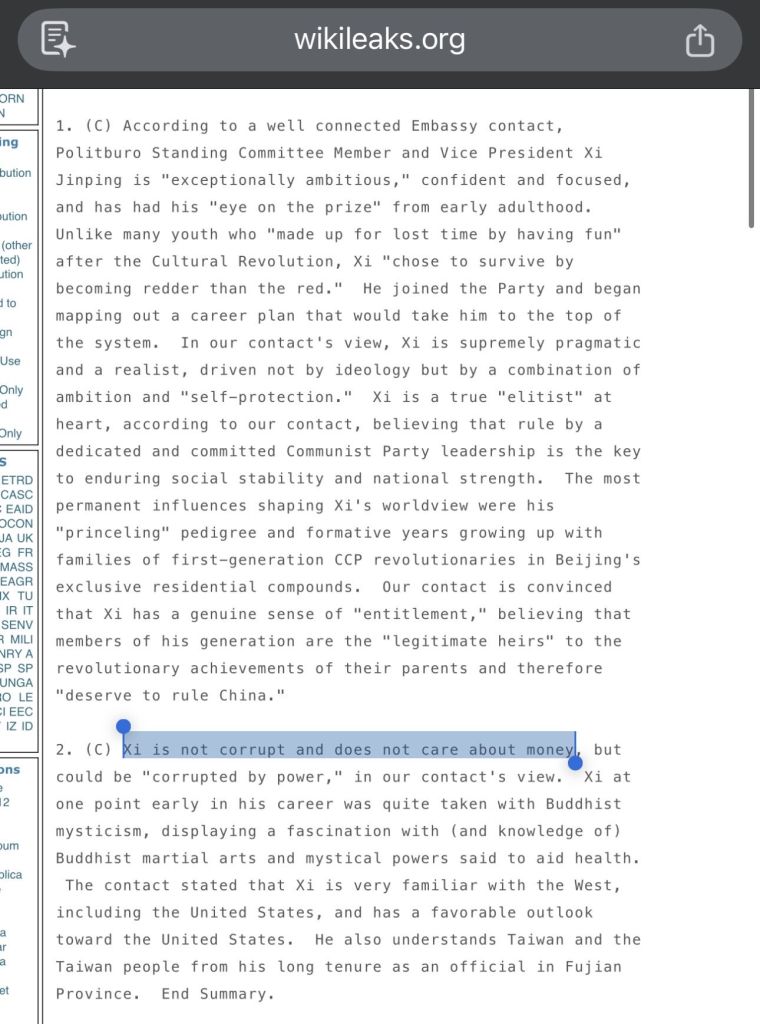
Wikileaks profile on xjp, don't know if posted earlier

https://wikileaks.org/plusd/cables/09BEIJING3128_a.html

Image
Anoop
BRFite
Posts: 666
Joined: 16 May 2002 11:31

Re: Understanding New China After the 19th and 20th Congresses

Post by Anoop »

https://sinocism.com/p/chinas-policy-an ... irect=true

Sinocism (Bill Bishop's site) and his occasional conversations with Andrew Sharp (Sharp China) are useful resources on developments in China. Now they bring a monthly recap of CCP's literature via Sinification. It can be dense reading at times, but well worth the effort.
ramana
Forum Moderator
Posts: 60410
Joined: 01 Jan 1970 05:30

Re: Understanding New China After the 19th and 20th Congresses

Post by ramana »

A businessman's view on Understanding China

Link:

https://x.com/i/status/2034358900854816795

Most “perceptual failures” on China aren’t analytical errors.
They’re operating model mismatches.

The West keeps trying to understand China.
China is busy compounding inside systems the West doesn’t operate in.

Riffing off Flavio’s post below:

• It’s not just that we see China in cross-sections → we don’t participate in the sphere

• It’s not just misread Chinese aspiration → it’s underestimating domestic sufficiency at scale

• It’s not inconsistency → it’s parallel logics running simultaneously

• It’s not a broken compass → it’s different maps entirely

Bottom line:

You don’t lose China because you misunderstood it.
You lose because your model can’t compete in its environment.

This is why:

U.S. firms optimize for capital efficiency.
China optimizes for system efficiency.

Different game. Different scoreboard.

Adapt—or partner.

That’s the Owl play. 🦉

Good framing from Flavio Marin on LinkedIn below. Worth reading closely—especially what it implies for how (and where) companies actually compete.

———

“Is your China Strategy built on Perceptual failures?
The kind that you may notice until after you miss badly?

Amazon exited China. Airbnb failed. Merck wrote off $11 billion overnight — blindsided by a competitor nobody saw coming.

They failed because they were impervious to reality perhaps?. Here are four typical Perceptual Failures:

Perceptual Failure One: You’re reading the cross-section. Not the sphere.
Imagine a sphere passing through a two-dimensional world. Inhabitants see a dot grow to a circle, shrink to a dot. They map it precisely. They understand nothing. Every Western China analysis does this. Each observation accurate. Each a cross-section of something not perceived whole.

China didn’t build AI products. It built AI infrastructure — woven into commerce, logistics, governance. Years before the West understood what that meant.
You cannot compete with what you cannot perceive.

Failure Two: You’re missing the real aspirations.
The West assumes China wants what rising powers historically wanted — dominance, expansion, replacing the existing order. Wrong.
China’s drive is restorationist. Recovering civilizational centrality interrupted by two centuries of humiliation.
The era when “Western = Aspirational” in China is over. Chinese consumers are becoming confidently Chinese. Guochao is not a trend. It is self-restoration expressed through consumption.
Brand premium built on “Westernness” is aimed at the wrong hunger.

Failure Three: You’re demanding consistency from something that isn’t a state.
China is simultaneously a state, a civilization, a historical memory, and a restoration project — all operating concurrently.
When these produce contradictory behaviors, Western analysis calls it duplicity. It is neither. It is a multi-dimensional entity that cannot be mapped two-dimensionally without losing what matters most.
Build your strategy around consistency and you will be perpetually surprised.

Failure Four: You’re navigating with a broken compass.
Western institutions deploy human rights language about China with conviction and radical selectivity simultaneously.
Four billion people in the Global South watch this with cold clarity. They remember Iraq. They watch the Middle East. They ponder.
Arrive in Jakarta, Nairobi, or São Paulo carrying that framing and your counterparts have discounted you before your first sentence ends.

China is not thinking longer than the West. It is thinking from deeper than the West currently reaches.
The four failures are correctable. But only after you accept they are yours — not China’s.

Which of these four is most costing your organization right now?”

#China #Strategy #Leadership #Geopolitics #BusinessStrategy #GlobalBusiness #ChinaBusiness #CompetitiveIntelligence #ExecutiveEducation #FutureOfBusiness
ramana
Forum Moderator
Posts: 60410
Joined: 01 Jan 1970 05:30

Re: Understanding New China After the 19th and 20th Congresses

Post by ramana »

A long essay and a comment later
https://americanaffairsjournal.org/2021 ... rom-china/

Reforming the Administrative State: A View from China
By Daniel A. Bell


REVIEW ESSAY
Law and Leviathan:
Reforming the Administrative State
by Cass R. Sunstein and Adrian Vermeule
The Belknap Press of Harvard University Press, 2020, 188 pages

Size matters. In the case of a state, smaller is usually better. Plato specifies that a state informed by justice and moderation should have 5,040 citizens. Aristotle concurs that a relatively small state, with a maximum of about one thousand households, is more likely to be well governed. It is difficult, if not impossible, to run a state well in large political communities composed of diverse peoples with large class differences. Jean-Jacques Rousseau is famous for his radical de­fense of participatory democracy. But he emphasized that well-gov­erned states need to be relatively small. In a large political community, the people have less civic pride, the cost of administration increas­es, and it is difficult to apply uniform laws in different regions with different kinds of peoples. Rousseau served as an adviser to the gov­ernment of Poland. Ideally, he said, such large states should be bro­ken up. But this prescription may not be realistic. So Rousseau’s recommendations were relatively conservative: the king should be the supreme administrator of laws, senators should have lifetime tenure, and administrators should be promoted according to a rigorous mer­itocratic process. Rousseau said nothing at all about direct democracy in the case of Poland, and liberty in this context refers to national liberty or freedom from foreign (Russian) interference.

Democratic citizenship is particularly difficult to establish in large, modern political communities. As states increase in size, the challenges of effective governance mount. The need for hierarchical decision-making and clear lines of authority grows, placing some constraints on democratic equality and political participation. In practice, in large well-governed states, where rulers have the motivation and the ability to implement policies for the good of the citizens, and where a degree of trust obtains between rulers and citizens, there is a need for large and complex bureaucracies. The larger the state, the larger the bureau­cracy led by experts, and the less room for political participation by ordinary citizens. In modern states, the need for expert rule grows as societies become even more diverse and complex. Like it or not, there is a trade-off between effective governance and the ideal of democratic participation in large states.

Cass Sunstein and Adrian Vermeule, both law professors at Har­vard, seek to address the problems of large-scale bureaucratic govern­ance in their new work Law and Leviathan: Redeeming the Administrative State. While their arguments are directed mostly at the Ameri­can political context, where the administrative state is often contested, the questions they raise are worthy of careful comparison to another large, bureaucratic state: China. In what follows, I first consider the long history of Chinese experience with governing a large state. I then examine defenses of the administrative state in light of the con­tribution of one of China’s original legal theorists—Han Feizi.

The Need for Bureaucracy in Large States

For some reason, most political thinkers in the West have lost sight of the fact that different standards should inform the governance of small and large states. In Political Order and Political Decay (2014), for example, Francis Fukuyama argues that “Denmark”—an idealized form of the actual country—should be the political ideal for the rest of the world. Denmark is prosperous, democratic, secure, and well governed, with low levels of corruption. But it also has only 5.8 mil­lion people, and a relatively homogenous population at that. What works in Denmark is highly unlikely to work in a highly diverse country with 1.4 billion people such as China. Denmark can perhaps serve as an ideal inspiring political reform for, say, the richest parts of Shanghai. But it’s absurd to hold up Denmark as the ideal for China. In huge states, dysfunction and chaos will inevitably arise in the absence of large and complex bureaucracies that impartially implement policies de­signed to benefit the people. In such states, citizens are bound to have less say than in smaller communities.

In China, political thinkers have almost always agreed on the need for a large and unified political community. The Warring States Period (475–221 BCE) was characterized by the “Hundred Schools of Thought,” meaning that different kinds of political thinkers espoused widely different ideals. But they all converged on the ideal of political unification in the form of a large political community (a point made by Yuri Pines in his 2012 book The Everlasting Empire). The unifica­tion was implemented by the state of Qin and the self-proclaimed first emperor of China, Qin Shi Huang, in 221 BCE.

The emperor was influenced by the Legalist school of thought. Legalist thinkers such as Han Feizi argued that social control can only be established by means of harsh and uniform laws that control all spheres of social life. Han Feizi criticized Confucians on the grounds that rule by morality only works in small political communities with few people and abundant resources. In large states with limited re­sources, there is a need for harsh laws and bureaucratic rule. In line with Legalist thinking, Emperor Qin Shi Huang established what Bai Tongtong terms the world’s first modern bureaucracy (China: The Political Philosophy of the Middle Kingdom, 2012). The first emperor unified the Chinese script, built an extensive network of roads and canals, began work on the Great Wall, and established an impartial system of administrators selected and promoted according to strict meritocratic criteria.

But the Qin dynasty was short-lived because its bureaucratic rule was not meant to benefit the people. The whole point was to establish a powerful state primed for success in times of war. Soldiers were promoted based on the number of enemy soldiers they decapitated; farmers were encouraged to grow crops; and other social groups—“the five vermin”—were ruthlessly crushed, including Confucian scholars who were buried alive with their books. It was a relatively objective bureaucracy, but one that allowed for gross cruelty and served immoral purposes. The next dynasty, the Han (202 BCE–220 CE), retained much of the form of Legalist bureaucracy but specified, in accordance with the Confucian ideal, that public officials are sup­posed to serve the people. Zhao Dingxin argues that the Confucian-Legalist State set the pattern for dynastic rule for the next two thousand years (The Confucian-Legalist State, 2015). Of course, there was always a gap between the ideal and the reality, and many political debates over the next two thousand years centered on the question of which meritocratic practices would best ensure that public officials actually served the people. Such institutions as the civil examination system, invented in the Sui dynasty (581–618), were criticized and re­vised when they proved to be deficient.

The need for bureaucracy and rule by experts becomes even more pressing as countries become economically complex and socially diverse. So it’s not surprising that China has reestablished a strong form of bureaucratic rule since the period of economic reform in the late 1970s, with administrators increasingly selected according to level of education and by means of ultra competitive examinations. The true surprise would have been the adoption of electoral democracy and more political participation by the people. As David Stasavage ex­plains in his recent book The Decline and Rise of Democracy (2020), China’s long history of political meritocracy and complex bureaucracy reduces the likelihood of a transition to democracy. What we might call natural selection in politics favors more bureaucracy and less democracy in large states—even more so as states modernize. Conversely, more democracy would likely come at the cost of less effective governance.

The United States is another huge political community. But it is founded on the ideals of democratic equality and individual freedom, not rule by bureaucrats. The founding fathers designed a constitution meant to protect basic civil and political rights. In Federalist no. 10, James Madison worried mainly about class-based factions that might threaten individual liberty and the property of the wealthy minority. In a small democracy, it’s easier for majority factions to unite and oppress the minority. In large republics with rule by elected representatives, factions are more diffuse, and the variety of interests makes it more difficult for a faction to unite and oppress the rest. Elected delegates are less likely to be corrupt compared to small democracies because it’s harder to bribe voters in large constituencies. So, in Madison’s view, large republics are better than small democracies—an apparent exception to the “smaller is better” rule favored by earlier theorists of equal democratic citizenship in the West.

But the founding fathers, including Madison, did not foresee the rise of the administrative state—rule by bureaucrats and experts—and the threat it might pose to freedom and democracy. Over the last several decades, there has been an explosion of government in the United States. In retrospect, it doesn’t seem so surprising. With the rapid expansion of industrial capitalism and new technologies, there is a need to regulate the way we eat, drink, consume, work, and travel to ensure that these technologies benefit rather than harm citizens. The government needs to secure our health and safety against the threat of unregulated technology and greedy capitalists who might peddle dangerous products and endanger the environment—not to mention the need to regulate nuclear weapons and other existential threats. Elected representatives can’t do all, or even most, of the work them­selves. They need the help of professional administrators who have the expertise to implement their decisions. But how much authority should be delegated to the experts? And how should we limit abuses of power by the “administrative state”?
Limiting the Power of the Administrative State

There are good reasons to worry about excesses of the administrative state. In the United States, a large bureaucracy can pose fundamental threats to the interests of the citizens it is supposed to help. First, the rise of the military-industrial complex threatens to divert public funds away from social welfare and can lead to unwanted and unjust wars abroad. Second, the administrative state often seems to implement policies and regulations designed to benefit wealthy plutocrats rather than the majority of the people. Third, the administrative state has become so powerful that it can go against the will of elected representatives and implement regulations that threaten business activity and individual liberty. In the American context, the third concern is raised mainly by libertarians committed to the overriding value of individual freedom and constitutional “originalists” who favor sticking to strict interpretations of the founding fathers.

Cass Sunstein and Adrian Vermeule primarily address the con­cerns of the third group of critics of the modern-day “Leviathan.” The authors do not say so explicitly, but they try to respond to this group of critics because the U.S. Supreme Court now has a majority composed of relatively conservative justices who take the concerns of the third group seriously. There is a serious risk that the Supreme Court will seek to overturn many of the regulations of the administrative state, including regulations that serve the common good.

There is also a political dimension to this debate. Self-styled con­servative political actors, including former president Donald Trump, worry about the “deep state”—a cabal of unelected bureaucrats who work behind the scenes to sabotage the work of elected officials. But the federal bureaucracy—with 2.79 million civilian employees spread across two hundred and fifty agencies—is diverse, compartmentalized, and spread throughout the country. There is little evidence that they can organize against the elected government, even if they wanted to. Still, some bureaucrats can resist the decisions of elected political leaders and regulate beyond their mandate. It’s a myth that bureaucrats simply implement decisions handed down to them by elected leaders. They influence decisions and often have wide discretion to do what they want. So how to ensure that bureaucrats stick to the will of elected leaders?

In the United States, the Supreme Court has the supreme authority to interpret the Constitution. In principle, it can limit the power of administrative agencies if they violate the Constitution. At the most basic level, the question is whether the Constitution allows for administrative agencies. Does Congress have the power to allow agencies such as the Federal Reserve Board to operate independently of the president? Can Congress delegate wide discretion to administrative agencies such as the Environmental Protection Agency and other “alphabet soup” agencies? More broadly, should democratically elected leaders be allowed to empower relatively independent agencies composed of bureaucrats with life tenure to decide things unconstrained by meaningful checks on what they do? Perhaps unelected judges can and should force elected representatives to do their job of deciding on the key policy issues affecting the country, including detailed regulations that affect the ordinary lives of citizens.

Sunstein and Vermeule seek to respond to “libertarian-originalist” judges, legal scholars, and think-tank commentators who argue that federal courts should strictly limit, if not abolish, administrative agencies because they are fundamentally illegitimate in a constitutional democratic state. In chapter one, they respond to the “originalists” who argue that the administrative state conflicts with the intentions of the founding fathers. While the founding fathers sought to prevent executive abuses, they also wanted an effective government. Sunstein and Vermeule argue that “members of the founding generation want­ed a strong national government, not a weak one” (23). They did not favor a powerless executive branch, and they realized that administrative agencies would be required. It may be true that the founding fathers did not foresee the development of a vast administrative state with wide discretionary authority to decide matters that affect many areas of our ordinary lives. But they may well have allowed for its development, so long as its power was limited.

Given the existence of the administrative state, the question is how to limit its power. Sunstein and Vermeule argue that there is a princi­pled answer to this question: the authority of administrators should be limited by the rule of law. And what is meant by the rule of law? Sunstein and Vermeule turn to the legal philosopher Lon Fuller, who specified the minimal conditions necessary for the very existence of law. Law is absent when any of the following conditions obtain:

(1) a failure to make rules in the first place, ensuring that all issues are decided on a case-by-case basis; (2) a failure of transparency, in the sense that affected parties are not made aware of the rules with which they must comply; (3) an abuse of retroactivity, in the sense that people cannot rely on current rules, and are under the threat of change; (4) a failure to make rules understandable; (5) issuance of rules that contradict each other; (6) rules that require people to do things that they lack the power to do; (7) frequent changes in rules, so that people cannot orient their action in accordance with them; and (8) a mismatch between rules as announced and rules as administered. (40)

When administrative agencies, empowered by Congress to do their work, implement policies and regulations that do not violate the mini­mal conditions for the rule of law, those agencies can and should be allowed to implement rules and regulations for the benefit of citizens. But when they violate these conditions, federal courts can and should limit their power.

Fuller’s conditions offer a neat, principled answer to the question of how to limit the power of administrative agencies. More surprisingly, perhaps, this “internal morality” of law has informed recent decisions of the U.S. Supreme Court. Sunstein and Vermeule show that recent cases of the Roberts court allowed the decisions of admin­istrative agencies to stand if they adhered to Fullerian conditions for the rule of law, and struck them down if they didn’t. Now, it does seem odd that U.S. Supreme Court justices would draw on “inartic­ulate intuitions” (81) without being consciously aware of the source of their judgments. Why didn’t the justices make more explicit the “administrative law’s implicit procedural logic” (18)? But perhaps it’s easier for thinkers to make sense of things after the fact. Like the owl of Minerva, Sunstein and Vermeule uncover and make explicit the inner logic of the decisions of the Roberts-led Supreme Court. They endorse the decisions and seek to make explicit the fact that judges are “responding to a kind of intuition about administrative law’s inner morality” (159).

But Sunstein and Vermuele are not complacent defenders of the status quo. With the addition of Amy Coney Barrett as an associate justice, the balance of the majority may tilt in favor of those who seek to revive the “nondelegation doctrine,” which would forbid Congress from granting excessively broad discretion to administrative agencies. Last fall, the authors penned a New York Times op-ed titled “The Very Structure of Modern Government Is under Legal Assault,” making more explicit their worry for the future. It may soon become harder for agencies to regulate in favor of environmental protection and occupational safety. That’s why Sunstein and Vermeule seek to make explicit the underlying logic of morally and legally justifiable decision-making by administrative authorities: If the administrative state makes regulations that are informed and limited by the minimal conditions for the rule of law, they should be allowed to stand. If not, they should be struck down. Supreme Court justices, regardless of ideological orientation, should agree to stick to those principles as long as they are committed to the rule of law.
The Internal Morality of Law: A Chinese Invention?

Sunstein and Vermeule’s solution to the question of how to limit the power of administrative agencies is an elegant one, but it is worth asking whether it will satisfy libertarian critics of the administrative state who worry about encroachments on civil and political liberties. If the administrative state is constrained by Fuller’s eight minimal conditions for the rule of law, do we need to stop worrying about the state’s curtailment of freedom? Here’s an important reason for a negative answer: Fuller’s minimal conditions for the rule of law are compatible with nondemocratic rule, and maybe even with totalitarianism. Indeed, Sunstein and Vermeule recognize that “a nondemocratic nation might comply with the morality of law” (41). And as it turns out, Fuller had an intellectual forefather in Chinese political thinking: the Fullerian account of the minimal conditions for the rule of law is strikingly similar to those put forward by the Legalist think­er Han Feizi.

Two thousand years before Lon Fuller, Han Feizi articulated the “internal morality of law.” Kenneth Winston, in an article on “The Internal Morality of Chinese Legalism,” notes the the eight conditions Han Feizi gave as necessary for the rule of law: generality, pub­licity, clarity, prospectivity, noncontradiction, conformability, stabil­ity, and congruence. On the point of publicity, for example, Han Feizi says that “law wants nothing more than publicity . . . when the enlightened sovereign speaks on law, high and low within the bound­aries will hear and know it.” Clarity matters, as well: “In administering your rule and dealing with the people, if you do not speak in terms that any man and woman can plainly understand, but long to apply the doctrines of the wise men [i.e., Confucian scholar-officials], then you will defeat your own efforts at rule.” And so on for the other conditions. Han Feizi, it is no exaggeration to say, is the world’s first defender of the rule of law.

Admittedly, the ideal of law as superior to the will of rulers, along with its institutional manifestation in the form of an independent judiciary, is foreign to traditional Chinese culture. Han Feizi was clear that the ruler, in principle, should have the unchecked power to change the law as he sees fit. In practice, however, the law should be dominant most of the time. The ruler of a large state should not change the law too often: “if, when governing a big country, you alter laws and decrees too often, the people will suffer hardships. Therefore, the ruler who follows the proper course of government . . . takes the alteration of law seriously.”

Han Feizi was influenced by the Daoist idea of non-action (wu wei): power can best be exercised when it is rarely exercised. The ruler should proclaim the laws, then put in place a vast bureaucratic system that strictly enforces the laws regardless of circumstance. Moreover, the ruler should not change the laws too frequently be­cause, in doing so, he would show his desires and open himself to manipulation by ministers and bureaucrats. The ruler accumulates power by building up mystique, only rarely making an appearance to change the laws.

A good example of this approach came after the chaos of the Cultural Revolution, when Deng Xiaoping rebuilt a strong bureaucratic state and then exercised power behind the scenes in the last few years of his life without holding any formal political posts. When he did make a public appearance—as in 1992, visiting Shenzhen and praising the model of market reform—he could literally transform the whole country with the use of a few words (in this case, relaunching the economy). In contrast, Han Feizi would be critical of the constant tweets by former president Trump because they lead to a situation where no one takes the leader seriously and undermine the effective exer­cise of power.

The similarity of Han Feizi’s thought to Lon Fuller’s, then, sug­gests that minimal rule of law concepts may be too easily compatible with near totalitarian states and harsh laws that prioritize social order over individual or common benefits. On the other hand, Randall Peerenboom, in his work China’s Long March toward the Rule of Law (2002), argues that such “thin rule of law” concepts are compatible with diverse forms of “thick conceptions of law.” One can cer­tainly find the minimal conditions of law met in the liberal democratic version of the rule of law, with its protections for free market capitalism and civil and political rights. But one can also find them met in the statist socialist version—a socialist form of economy in which public ownership plays an im­portant role and “a nondemocratic system in which the Party plays a leading role and an interpretation of rights that emphasizes stability, collective rights over individual rights, and subsistence as the basic right rather than civil and political rights.”

In effect, the U.S. Supreme Court has also been invoking Han Feizi’s theory of the minimal conditions of the rule of law. Of course, quoting Han Feizi is not likely to persuade originalists, but perhaps libertarians need not worry too much. The U.S. Constitution protects civil and political rights, so federal judges are not likely to rule in a way that endangers those basic rights, even if they invoke the Han-Fuller theory of the minimal conditions of the rule of law when thinking about how to limit (and empower) the administrative state. Nor is size always a problem: history shows that large states can and do protect the individual freedoms cherished by libertarians. As his­torian James Hankins has put it, “individual liberty: ‘negative’ liberty under law, protection of civil rights, can easily be done by large states—this kind of liberty was effectively invented by the Roman Empire.”

In China, there may be good reason to worry about gross abuses of power by the administrative state, but less so in the United States with its a thick liberal democratic conception of the rule of law and a long history of protecting “negative” freedoms. If the thin rule of law is combined with thick liberal democratic institutions, then admin­istrative agencies—given some independence by elect­ed representatives—should have the power to regulate aspects of our lives, so long as they respect the internal morality of the thin rule of law. Libertarians may still be upset by regulations of business activity that curtail property rights, but they should recognize that, in a democratic sys­tem, nobody gets everything they want.
The Divided States of America?

The main problem facing the administrative state may come from the opposite direction: that bureaucrats in the United States have too little power, not too much. A large state needs a strong and effective bureaucracy to effectively govern in the interests of citizens, and such needs increase as societies modernize and become more diverse and complex.

To strengthen the case in defense of their preferred version of the administrative state, Sunstein and Vermeule would need to make an empirically de­tailed argument showing that an administrative state adhering to the internal morality of law is more likely to implement regulations that promote the common good and human well-being compared to other administrative arrangements. But they do not make such a case.

Consider China’s response to Covid-19, in comparison to the disastrous American response, led by a political leader who resisted the scientific advice of his own bureaucracy. To be sure, terrible mistakes were made at the start of the crisis in Wuhan, including the cover-up of whistleblowers by paranoid local officials. But once the central government got on board in late January, the Legalist-style, top-down mobilization of massive state power managed to contain the pandemic in a few weeks. It could be argued that less draconian measures, such as those employed in Taiwan, could have been suc­cessful in mainland China. But it’s much easier to contain a pan­demic in a small island than in a huge and diverse political community. It could also be argued that public officials were given too much discretion to control the virus, thus violating the condition for the internal morality of law that rules must remain relatively stable over time. But it’s difficult to abide by stable rules in the face of a fast-changing pandemic that cannot be contained with old methods. Sometimes, our interest in life matters more than adherence to the rule of law.

In the United States, the current trend of dismantling the bureaucracy should be a major source of concern. To deal with new, increasingly complex chal­lenges such as pandemics that threaten to undermine social order and general welfare, there is a clear need to rebuild a competent and pub­lic‑spirited bureaucracy driven by scien­tific considerations with wide discretion to regulate in the people’s interests. Libertarians and conservatives may not like it, but further undermining the administrative state under these conditions could well lead to more social polarization, in addition to health and environmental disasters plus less protection for workers and consumers. To attract more talent in the bureaucracy, civil servants should be given higher salaries and more job security, and they should have more social respect.

Because of its constraints on freedom and democracy, China may be too politically distasteful to be considered a model for the United States. Plus, it may be difficult for the United States, with its libertarian tendencies and anti–big government political culture, to learn from the Chinese case. Can the case for bureaucracy be made in a society where “bureaucrat” is a dirty word?

It’s worth keeping in mind that there is not necessarily a conflict between an effective bureaucracy and democratic citizenship. Some liberal democratic countries better strike the balance between the commitment to freedom and democracy and the need for an effective state run by competent and public-spirited officials. Compared to the United States, for example, Nordic countries give wide discretion to civil servants. Public agencies are independent of the government in conducting their ordinary activities, thus ensur­ing that deci­sions are made based on knowledge and expertise. It’s no coincidence that Nordic countries regularly top the scales of global indices that measure human well-being.

Of course, it’s easier for small countries to strike the right balance between democracy and expertise. But unless the United States were to be broken up into smaller, independent states, the country will likely remain as Sunstein and Vermeule describe it: a large democratic state whose constitution allows for a minimal rule of law approach that results in defensible regulations—yet with a dire need for a more capable bureaucracy empowered to make decisions for the long-term common good.
This article originally appeared in American Affairs Volume V, Number 1 (Spring 2021): 170–82.
Note
The author thanks James Hankins for detailed comments on an earlier draft of this essay.
MY comment is Wang Huning is considered to be a modern Han Feizi
ramana
Forum Moderator
Posts: 60410
Joined: 01 Jan 1970 05:30

Re: Understanding New China After the 19th and 20th Congresses

Post by ramana »

My next comment is after the successful SCO and Beijing summits is Xi Jinping set for another fourth term or will he fade into the background like Deng Xiaoping?
RaviB
BRFite
Posts: 287
Joined: 09 Jun 2020 14:32

Re: Understanding New China After the 19th and 20th Congresses

Post by RaviB »

Retirement is not an option for him because unlike Deng, he has no protégé or trusted followers to protect him.

Soon as he loses power, he will be executed.

He will leave unwillingly, either due to a coup or severe illness or death. He's riding a tiger and can't get off without being eaten.
Post Reply