Tradition, Culture, Religion & Law in Indian Society

The Strategic Issues & International Relations Forum is a venue to discuss issues pertaining to India's security environment, her strategic outlook on global affairs and as well as the effect of international relations in the Indian Subcontinent. We request members to kindly stay within the mandate of this forum and keep their exchanges of views, on a civilised level, however vehemently any disagreement may be felt. All feedback regarding forum usage may be sent to the moderators using the Feedback Form or by clicking the Report Post Icon in any objectionable post for proper action. Please note that the views expressed by the Members and Moderators on these discussion boards are that of the individuals only and do not reflect the official policy or view of the Bharat-Rakshak.com Website. Copyright Violation is strictly prohibited and may result in revocation of your posting rights - please read the FAQ for full details. Users must also abide by the Forum Guidelines at all times.
chetak
BRF Oldie
Posts: 36774
Joined: 16 May 2008 12:00

Re: Tradition, Culture, Religion & Law in Indian Society

Post by chetak »

Just elitist single malt delusions that are infesting these late blooming social bacteria.

On the other side the people and military both are crystal clear , here even top officers are delusional.

These deluded and woke clowns love this bullshit nasha of aman ki asha.

If the pakis had the capability they would destroy us without even blinking.

Shatrubodha is not merely non existent, but these clowns don't even have the faintest suspicion that anything like Shatrubodha exists


Press Trust of India@PTI_News

VIDEO | Mumbai: On RSS leader Dattatreya Hosabale advocating window of dialogue with Pakistan to be kept open, Former Army chief Gen MM Naravane
(@ManojNaravane) says, “One important point is that people-to-people connections and contacts are extremely important.

Ordinary people live on both sides of the border, and common people everywhere have the same concerns, food, clothing, shelter, and daily life.

Ordinary citizens generally do not have much to do with politics.

When friendship develops between the people of two countries, it naturally helps improve relations between the countries themselves.

That is why I said earlier that people-to-people contact, whether through Track-II diplomacy or through sporting events, is very important…

One thing is very clear, and we have always maintained this: whatever differences exist between two countries should always be resolved through discussion and dialogue.

However, that does not mean we cannot use military force if necessary. India is a country that believes in speaking the language of peace, but if the need arises, we will not hesitate to use our strength and capabilities as well.”
(Full video available on PTI Videos - http://ptivideos.com)


watch video


https://x.com/i/status/2054493376331030772


BTW, He is the same general who felt he had been handed a ‘hot potato’ when the GOI gave him full operational freedom to deal with PLA troops in Galwan.

Journalists should ask him why he felt so.

Doesn’t the Indian Army war-game and train for the very exact scenario he was asked to deal with?


Image


just imagine a jernail who was anxiously trying to pass the buck, and that too, at his level of seniority.......


he seems to have had no idea at all as to where the buck stopped, but was happy with just collecting salary and enjoying the perks


If the Hindus had the sense of Shatrubodha that every other cultural ethnicity has, bar none, so many millions of rohinghiya, paki and beedi scum would not have been allowed to illegally enter into India and freeload, demographically change and be allowed to seize political power in so many constituencies across the country while financially draining the sacred land
bala
BRF Oldie
Posts: 4006
Joined: 02 Sep 1999 11:31
Location: Office Lounge

Re: Tradition, Culture, Religion & Law in Indian Society

Post by bala »

Manoj Naravane types abound everywhere. Even in MB Arjuna wavered and Krishna admonished him in no uncertain terms. In the US such types abound and every armed forces have bleeding hearts who are not good in geopolitics/diplomacy/real politik other than their chosen field which is to fight a good fight. Manoj Naravane track thoo is none of his expertize and he should not comment upon such topics. What has Manoj done to make India a good fighting machine and where is his leadership that he is supposed to display. The Indian army, if given the right impetus, can easily beat back the armies in the neighborhood - be it China or Pukeland.
drnayar
BRF Oldie
Posts: 2925
Joined: 29 Jan 2023 18:38

Re: Tradition, Culture, Religion & Law in Indian Society

Post by drnayar »

Check out what Tianzhu means in Chinese .. the heavenly land , birthplace of buddha

interesting how communist china warped their own history
bala
BRF Oldie
Posts: 4006
Joined: 02 Sep 1999 11:31
Location: Office Lounge

Re: Tradition, Culture, Religion & Law in Indian Society

Post by bala »

Ravana's RED Lingam Found? The "Untouchable" Secret Of Cambodia
May 16, 2026

The silence around this Cambodian temple is unsettling. No crowds. No voices. Just a collapsing stone structure hidden in the jungle… and a gigantic object at its center that locals refuse to touch. They call it the “Untouchable Lingam” of Ravana, a massive monolith stained with a dark red residue that has somehow survived centuries of weather and destruction. Up close, the surface feels wrong — the stone resonates with a strange hollow vibration, the carvings appear impossibly precise, and deep cracks across the structure suggest a violent attempt to destroy it long ago. Yet somehow, it still stands. Tree roots are tearing through the walls as if nature itself is trying to bury this place forever, but secret rituals continue here even today. Some believe Ravana infused this object with his own essence. Others believe the stone is still carrying an ancient energy that was never meant to survive into the modern world. The deeper you go into this forgotten Cambodian temple, the more it feels like you are standing near something that should have remained hidden.

Vayutuvan
BRF Oldie
Posts: 15132
Joined: 20 Jun 2011 04:36

Re: Tradition, Culture, Religion & Law in Indian Society

Post by Vayutuvan »

Who doesn't pay taxes?
The following are exempt from taxes:

Vedic scholars, women of all classes,
pre-pubescent boys,
all students studying with a guru,
ascetics, sudras who work as personal servants,
people who are blind, dumb, deaf, and sick,
Anyone excluded from acquiring property.

— Apastamba Dharmasutras 2.26.10-17
uddu
BRF Oldie
Posts: 8388
Joined: 15 Aug 2004 17:09

Re: Tradition, Culture, Religion & Law in Indian Society

Post by uddu »

The First Religion of the Philippines? | Forgotten Hindu-Buddhism History
The Philippines is almost never included in the Hindu-Buddhist history of Southeast Asia. Cambodia has Angkor Wat. Indonesia has Borobudur. But the Philippines? Almost never mentioned.

🔗 Part of a three-part series — watch all three:
-Was The Philippines Muslim Before It Was Catholic? — • The Philippines Was Muslim Before It Was C...
-The Indigenous Roots of Filipino Catholicism — • Were Filipinos Forced to Become Catholic?
-Full playlist — • The Religious Layers That Shaped the Phili...

-Support my new book Forgotten Kingdoms of the Sea: Coming soon!

I've been researching and teaching Philippine history for over 14 years. In this video, I trace over 300 Sanskrit loanwords in our languages, the golden artifacts scattered across the archipelago, and the Laguna Copperplate Inscription — a 1,000-year-old legal document linking Luzon, Mindanao, and Java.

00:00 Was the Philippines part of the Hindu-Buddhist world?
01:37 What Sanskrit words are in Philippine languages?
05:00 What is the Golden Tara of Agusan?
07:24 What Hindu-Buddhist artifacts were found in the Philippines?
09:08 How did Hindu-Buddhism reach the Philippines?
11:22 What is the Laguna Copperplate Inscription?
14:08 Did Hindu-Buddhism replace indigenous Filipino beliefs?
uddu
BRF Oldie
Posts: 8388
Joined: 15 Aug 2004 17:09

Re: Tradition, Culture, Religion & Law in Indian Society

Post by uddu »

https://medium.com/@surashiva/chola-roy ... 9881fd9070
Image

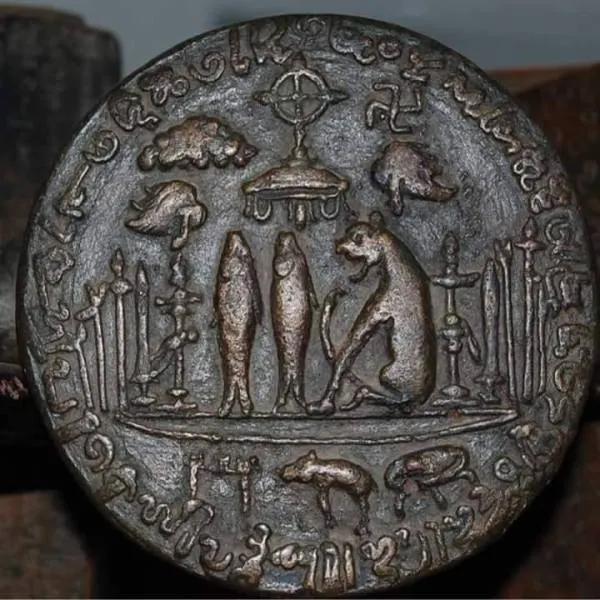
This is the official seal of the great Rajendra Chola. It shows a roaring tiger (symbol of Cholas) seated in front of twin fishes (symbol of Pandyas)....and above the bow & boar (symbol of Cheras & Chalukyas respectively).

The seal signifies Chola subjugation of all those great dynasties.Above it there is a royal parasol(chatra) flanked by fly whisks & topped by a chakra(wheel) - which are insignia of a Chakravartin ruler. Swastika & flowers are depicted as sign of auspiousness on both side of chakra while Lamps and weapons flank the tiger and twin fishes.

Sanskrit legend surrounds the seal & reads

“Etad Rajendra Colasya Parakesarivarmanah | Rajad-rajanya-mukuta-sreni-ratnesu sasanam || “


which means

"This is the order of Rajendra Chola alias Parakesarivarman, which (rests) on the crest jewel of (all) the reigning kings"
chetak
BRF Oldie
Posts: 36774
Joined: 16 May 2008 12:00

Re: Tradition, Culture, Religion & Law in Indian Society

Post by chetak »

Image
chetak
BRF Oldie
Posts: 36774
Joined: 16 May 2008 12:00

Re: Tradition, Culture, Religion & Law in Indian Society

Post by chetak »

sati was never a part of Hindu society but it was deliberately induced by east India Company.


Image


Fascinating! The britishers edited a Rigveda Hymn to lie that Sati pratha was a compulsory part of Hinduism. It wasn’t.


watch video

https://x.com/i/status/1740987048331538939
uddu
BRF Oldie
Posts: 8388
Joined: 15 Aug 2004 17:09

Re: Tradition, Culture, Religion & Law in Indian Society

Post by uddu »

https://x.com/i/status/2056213111649284202
@KreatelyMedia
"सकल जगत में खालसा पन्थ जाजे । जगे धर्म हिन्दू सभी भंड भाजे।"

"THE KHALSA SECT WILL ROAR AROUND THE WORLD. HINDUISM WILL AWAKEN, IT'S ENEMIES WILL FLEE"

-GURU GOBIND SINGH
Image
chetak
BRF Oldie
Posts: 36774
Joined: 16 May 2008 12:00

Re: Tradition, Culture, Religion & Law in Indian Society

Post by chetak »

Image
chetak
BRF Oldie
Posts: 36774
Joined: 16 May 2008 12:00

Re: Tradition, Culture, Religion & Law in Indian Society

Post by chetak »

https://www.youtube.com/watch?v=ayd7gEp97rI


How Sanskrit Built the Foundations of Half the Languages on Earth


Manish_Sharma
BRF Oldie
Posts: 5429
Joined: 07 Sep 2009 16:17

Re: Tradition, Culture, Religion & Law in Indian Society

Post by Manish_Sharma »

if true then what to say about fadnavis:
https://x.com/SachdevaAmita/status/2058 ... 08539?s=20
Must Watch: Section-wise Exposure of the Draconian Anti-Temple Land Bill

Maharashtra’s Devasthan Inam Nirmulan Draft Act 2026 is a direct attack on Hindu temples.

In this video, I have explained section by section how this Bill snatches temple lands, legalises encroachments, discriminates against Hindus, and violates our religious rights.

Every section is dangerous for Sanatan Dharma.

We demand: Complete Withdrawal of this Bill!

Please submit your strong objections before 5th June 2026.Jai Bhavani! Jai Shivaji!
Protect Temple Lands. Protect Hindu Dharma
She explains point by point in the video
chetak
BRF Oldie
Posts: 36774
Joined: 16 May 2008 12:00

Re: Tradition, Culture, Religion & Law in Indian Society

Post by chetak »

The same mistake all over again................... :mrgreen:


Image
uddu
BRF Oldie
Posts: 8388
Joined: 15 Aug 2004 17:09

Re: Tradition, Culture, Religion & Law in Indian Society

Post by uddu »

Indus Valley Script CRACKED AFTER 4000 Years...HOW?
What if the 4,000-year-old Indus Valley Script — one of the biggest unsolved mysteries of ancient history — has finally been decoded?

For more than 100 years, archaeologists, historians, linguists and scholars have tried to understand the mysterious symbols found on seals from the Indus Valley Civilisation, also known as the Harappan or Indus-Saraswati Civilisation. But no one could clearly read what was written on them.

In this episode, Amish explores the extraordinary claim made by Dr Bharath Rao, an Indian computer scientist and cryptographer, who says he has decoded the Indus Script using cryptography, Sanskrit grammar, pattern recognition, and information theory.

Could the ancient Indus Valley language be connected to Sanskrit?
Could the famous Pashupati Seal be an early representation of Shiva?
Could the Indus Script and Brahmi script show continuity in ancient Indian writing?
And if this theory is correct, what does it mean for Indian history, the Vedas, the Saraswati River, and the Aryan Invasion / Aryan Migration debate?

This episode looks at the evidence, the method, the criticism, and the larger civilisational question behind one of India’s oldest mysteries.

Watch till the end for the possible translation of the Pashupati Seal.

Chapters

00:00 – The 4,000-Year-Old Seal Nobody Could Read
00:42 – Why The Indus Valley Script Is History’s Biggest Puzzle
01:42 – The Indian Computer Scientist Who Took On The Mystery
02:13 – How Ancient Scripts Have Been Cracked Before
03:17 – How Cryptography Can Decode A Dead Script
03:52 – Claude Shannon, Information Theory & Unicity Distance
04:57 – How Dr Bharath Rao Tried To Decode The Indus Script
05:47 – The Astronomy Clue: Dhruv, Thuban & The Pole Star
08:02 – The Pashupati Seal And The Shiva Connection
11:27 – Was Shiva Worshipped In The Indus Valley Civilisation?
12:08 – Did Indian Writing Continue From Indus To Brahmi?
13:47 – What This Could Mean For Ancient Indian History
15:21 – The Biggest Objections To This Theory
18:24 – The Evidence: Sanskrit, Astronomy, Pashupati Seal & Saraswati
19:12 – Aryan Invasion, Aryan Migration & The Indus Debate
21:01 – The Timeline Problem In Vedic Literature
28:51 – Why Did The “Aryans” Never Mention A Foreign Homeland?
30:28 – The Script That Waited 4,000 Years To Be Read
31:23 – What Was Written On The Pashupati Seal?

SRajesh
BRF Oldie
Posts: 3116
Joined: 04 Aug 2019 22:03

Re: Tradition, Culture, Religion & Law in Indian Society

Post by SRajesh »

^^
The counter attack has already started.
Audrey Trashcan has this to say :
https://www.indiatoday.in/india/story/a ... 2026-05-29
Also the Pakis have become over active on the SM and X claiming Indus Civilisations as their own.
I did think of this as some planned move
Looks like it is one.
1. Discredit IVC has anything to do with present day India.
2. Pakis Claiming ownership of IVC
3. They had tried Keeladi etc as Opponent to IVC and try to bring in AIT in some devious ways
4. Disprove Sanskrit's link to IVC
5. Insuinate Pashupati/Iconography as some Elamite ones
6. Attempts at rift of : North India/Sanatan Gods Vs Tamil Gods
The Pakis tried renaming but that has fallen flat given the raging howling jihardi crowd.
Trashcan will still try to push IVC has no connection to Vedic/Sanatan/Dharmic ways
Jihards might try to open up Mohenjodaro as say : Egypt and the Pyramids or Italy and Pompeii
And the local BIFs and the Leftist will jump at the prospect of visiting Jihardland for Photo-ops
chetak
BRF Oldie
Posts: 36774
Joined: 16 May 2008 12:00

Re: Tradition, Culture, Religion & Law in Indian Society

Post by chetak »

this is for those racist goras, one of whom with malicious intent, heckled the PM of India during his recent trip


Image
bala
BRF Oldie
Posts: 4006
Joined: 02 Sep 1999 11:31
Location: Office Lounge

Re: Tradition, Culture, Religion & Law in Indian Society

Post by bala »

Audrey Trashcan is alarmed with this:

Decoded the writing on the seal of Pasupati using Claude Shannon MIT information theory guidelines by Dr. Bharat Rao aka Yajnadevam, computer scientist/cryptographer - Using US theory by US resident Indian.

आशासन मान aashasana mana - the honourable punisher (Lord Shiva)

Maybe the "honourable punisher" has something in store for Audrey Trashcan, also for Haarvaard's Michael Witzel and his equally trash papers and hypothesis. Need to add Columbia's Stephen Pollock and Wendy Doniger of Univ of Chicago to the list.
chetak
BRF Oldie
Posts: 36774
Joined: 16 May 2008 12:00

Re: Tradition, Culture, Religion & Law in Indian Society

Post by chetak »

Image


Image


Image


Image


Image
uddu
BRF Oldie
Posts: 8388
Joined: 15 Aug 2004 17:09

Re: Tradition, Culture, Religion & Law in Indian Society

Post by uddu »

Why I like Audrey Truschke: In defence of a clickbait historian
https://www.firstpost.com/opinion/audre ... 16904.html
From Aurangzeb to the Pashupati seal, Audrey Truschke has inadvertently exposed the intellectual hollowness of Left-‘liberal’ historiography

At the very outset, I must make a confession. I like Audrey Truschke. Not because I agree with her. Quite the opposite. I like her because few ‘historians’ in recent years have done more to expose the intellectual frailties, ideological biases and selective morality of contemporary Left-‘liberal’ historiography than she has.

In her relentless attempts to sanitise Aurangzeb, delegitimise Hindutva and challenge civilisational narratives associated with Bharat, Truschke has inadvertently become the perfect case study of what happens when ideology trumps scholarship. She represents a new clique of historians that is least interested in understanding the past and is determined to weaponise history to win politico-ideological battles.
drnayar
BRF Oldie
Posts: 2925
Joined: 29 Jan 2023 18:38

Re: Tradition, Culture, Religion & Law in Indian Society

Post by drnayar »

https://www.nytimes.com/2026/05/31/worl ... ivaji.html

Statues of Shivaji are rising everywhere. The founder of the Maratha empire who fought against the Mughal dynasty is now a symbol for nationalists remaking the country.

Shivaji’s warrior legacy is increasingly being promoted as inspiration for India’s modern military. To mark the country’s 75th year of independence in 2022, the Indian Navy unfurled a new flag that incorporated Shivaji’s stamp as a tribute to his “visionary maritime outlook” and creation of a naval fleet capable of protecting the coastline. The Indian Army has said it will study Shivaji’s guerrilla warfare when planning its own battlefield strategies. And an Army regiment has erected Shivaji statues over the past few years in towns close to the country’s borders with China and Pakistan, with support from governments and civil groups.
chetak
BRF Oldie
Posts: 36774
Joined: 16 May 2008 12:00

Re: Tradition, Culture, Religion & Law in Indian Society

Post by chetak »

This is a new take on the aryan invasion imbroglio 8)

has anyone heard of this...........


Indian Cattle tells an unspoken story of Out of India migration

Why? Because cattle cannot just walk outside of India and go all over these places!

It needs Indian cattle herders, real people to move out of India with these cattle!

This is creating nightmare in the Aryan Invasion Theory camp!

Indian humped cattle – the indicine lineage (Bos indicus) – were domesticated in the Indus–Sarasvati region around 8000–7000 BCE, with early evidence from Neolithic Mehrgarh.

From this core zone, they spread steadily across the subcontinent between 7000–4000 BCE, becoming integral to early agro-pastoral economies.

By 3000–2000 BCE, indicine cattle moved eastward into Southeast Asia, contributing to the formation of regional zebu populations, and by 2000–1500 BCE they had entered parts of China, where they interacted with local taurine lineages.

A further major expansion carried Indian indicine cattle westward into Africa beginning around 2000 BCE, with multiple waves continuing into the first millennium CE; this movement profoundly reshaped East African cattle genetics, producing the taurine–indicine admixture visible today.

Thus, over several millennia, cattle domesticated in northwest India radiated outward across Asia and Africa, leaving a durable genetic and economic footprint that still defines tropical cattle populations.

Taurine cattle – the humpless lineage (Bos taurus) – were first domesticated in the Near East around 10,500–10,000 BCE from local aurochs populations in the Fertile Crescent.

They expanded with Neolithic farming communities into southeastern Europe by 7000–6000 BCE, and across most of Europe over the next millennium.

A southern dispersal carried taurine cattle into North Africa by 6000–5000 BCE, and progressively into Sub-Saharan Africa between 4000–2000 BCE, where they later encountered and hybridised with incoming indicine cattle.

Eastward movements brought taurine herds into Central Asia by 5000–3000 BCE, contributing to later Eurasian pastoral systems.

No evidence of any of them entering India! This agains weakens Aryan Invasion Theory or it's weakened version Aryan Migration Theory!

All silly political games played with human genetics in scholarship arena now checkmated by cow genetics


Image
Rudradev
BRF Oldie
Posts: 4637
Joined: 06 Apr 2003 12:31

Re: Tradition, Culture, Religion & Law in Indian Society

Post by Rudradev »

Yes, have heard of it Chetak ji and the same is true of Sheep as well.
See https://pmc.ncbi.nlm.nih.gov/articles/PMC3145132/
Chessa et al. Revealing the History of Sheep Domestication Using Retroviral Integrations. Science 2009;324:532-536.

Image

As you can see, there are two most ancient ancestral lines of sheep (dark green and yellow). Both are present in India. North & west of the Eurasian mountain divide (a boundary formed by Himalayas/Hindu Kush/Elburz/Caucasus ranges) there are many more ancestral lines of sheep (other colours).

The point is that while you see traces of the most ancient ancestral lines (dark green and yellow) in many of the domestic sheep populations north/west of the boundary, you never see all those other colours (different ancestral lines) south/east of the boundary. This means the idea of sheep domestication evolved south of the boundary and traveled north, and conversely there was no significant trafficking of domestic sheep from northern Eurasia to India, ME, China etc.

Why is India the preferred candidate for sheep domestication among all lands south/east of the boundary? Simple-- population. India had by far the largest population in the world (around 5 million people, i.e. 1/3 of the people in the world, at approx 3-5000 BCE). Nowhere else would they have had the sheer manpower and resources to dedicate for not only domestication and rearing of sheep and cattle, but trading these flocks to other lands (that is how the green and yellow ancestries traveled throughout Asia and finally into Europe).
chetak
BRF Oldie
Posts: 36774
Joined: 16 May 2008 12:00

Re: Tradition, Culture, Religion & Law in Indian Society

Post by chetak »

Rudradev ji,


so now the aryan invasion/migration/tourist theory liars have to contend with sheep and cows.......


The empire strikes back using ovis aries and bovinae as their weapons of choice


that devious old coot friedrich max müller must be turning over in his grave
uddu
BRF Oldie
Posts: 8388
Joined: 15 Aug 2004 17:09

Re: Tradition, Culture, Religion & Law in Indian Society

Post by uddu »

https://x.com/BanCheneProduct/status/20 ... 7029220374
@BanCheneProduct
In 1640, Nawab Shah Jahan of the invading Mughal Dynasty sent General Najabat Khan, along with thirty thousand troops to capture Uttarakhand. As the invading army reached Rishikesh, Maharani Karnavati of the Gharwal Kingdom attacked them heavily from all sides of the hilly pass.

Around twenty thousand Mughals were killed in the attack which compelled Najabat Khan to send a peace treaty message to the Queen. The Queen decided to let them go but only after cutting off their noses.

After this humiliating defeat, the Mughal invaders never dared to attack Uttarakhand again. Thus, Maharani Karnavati got the title "Nak-Kati-Rani" meaning "Nose Cutting Queen"
Image
uddu
BRF Oldie
Posts: 8388
Joined: 15 Aug 2004 17:09

Re: Tradition, Culture, Religion & Law in Indian Society

Post by uddu »

https://x.com/MonaADhar/status/2063486930495685005
@MonaADhar
If you’re from Jammu, you’ve probably noticed the scary face hangers on the outer walls of many Dogri homes.
Ask around, and most people will say they’re meant to ward off the 🧿 (evil eye).

To be honest, I suspected there’s more to it than that - something that may have been forgotten or lost in translation over generations.

Recently, I came across similar traditions in other parts of India, especially Karnataka. Digging a little deeper, I found that these faces closely resemble Kirtimukha , dwarpala or sometimes Yali - the fierce protective motif seen on ancient Hindu temples across the country.

What survives today as a household charm may well be a continuation of a much older civilizational symbol, whose original meaning has gradually faded from popular memory from Jammu to Tamil Nadu
Image
chetak
BRF Oldie
Posts: 36774
Joined: 16 May 2008 12:00

Re: Tradition, Culture, Religion & Law in Indian Society

Post by chetak »

Image
uddu
BRF Oldie
Posts: 8388
Joined: 15 Aug 2004 17:09

Re: Tradition, Culture, Religion & Law in Indian Society

Post by uddu »

https://x.com/BanCheneProduct/status/20 ... 0792395965
@BanCheneProduct

This is the condition of the Punjab mansion of Hindu businessman Todar Mal who paid 7,800 gold coins and bought 4 yards of land from the Mughal emperor Aurangzeb to bury the bodies of the 2 young sons and mother of Guru Gobind Singh on December 13, 1705.

The Mughal faujdar Wazir o young children be bricked alive as they refused to accept Islam. When they died, their grandmother died of shock

The Mughals did not want to allow the cremation to humiliate the martyrs. They stipulated that the buyer can take only as much space as he could cover with give gold coins for the land. All the Sikh chiefs just stood helplessly

That's when Todar Mal produced the coins and bought the piece of land, and cremated the three bodies.

This is biggest irony of life, India is only country where its true heritage is hidden from next generation and falsehood Is taught.
Image
uddu
BRF Oldie
Posts: 8388
Joined: 15 Aug 2004 17:09

Re: Tradition, Culture, Religion & Law in Indian Society

Post by uddu »

Cross posting from Modi 3.0
https://x.com/SanatanPrabhat/status/2064345729418793394
@ShefVaidya

This handle has REALLY improved from the woke idi0t babu who used to call ‘Sahasrabahu temple’ Saas Bahu, and used to be rude to people asking queries. Good for you @ASIGoI cc @gssjodhpur
@ASIGoI

https://x.com/ASIGoI/status/2064232143249969314
The 4,000-year-old Sinauli chariot, excavated in 2018 from the ancient burial site of Sinauli, stands among the most significant archaeological discoveries in recent decades.

Buried in a ceremonial grave and richly adorned with copper, the chariot reflects the sophistication of ourished around 2000–1900 BCE. Crafted from wood and sheathed in copper sheets, it features two solid wheels mounted on a fixed axle and connected to a yoke by a central shaft. The wheels are embellished with striking copper triangular inlays arranged in concentric circles, showcasing remarkable craftsmanship.

Its semi-circular seat is supported by a framework of copper pipes, while the front structure rises into a distinctive canopy-like form. Excavations at Sinauli also uncovered copper weapons, shields, helmets, and other elite grave goods, underscoring the site's importance as a ceremonial and martial center.
uddu
BRF Oldie
Posts: 8388
Joined: 15 Aug 2004 17:09

Re: Tradition, Culture, Religion & Law in Indian Society

Post by uddu »

https://x.com/RapperPandit/status/2064350604651360373
@RapperPandit

NCERT is healing . History is Healing
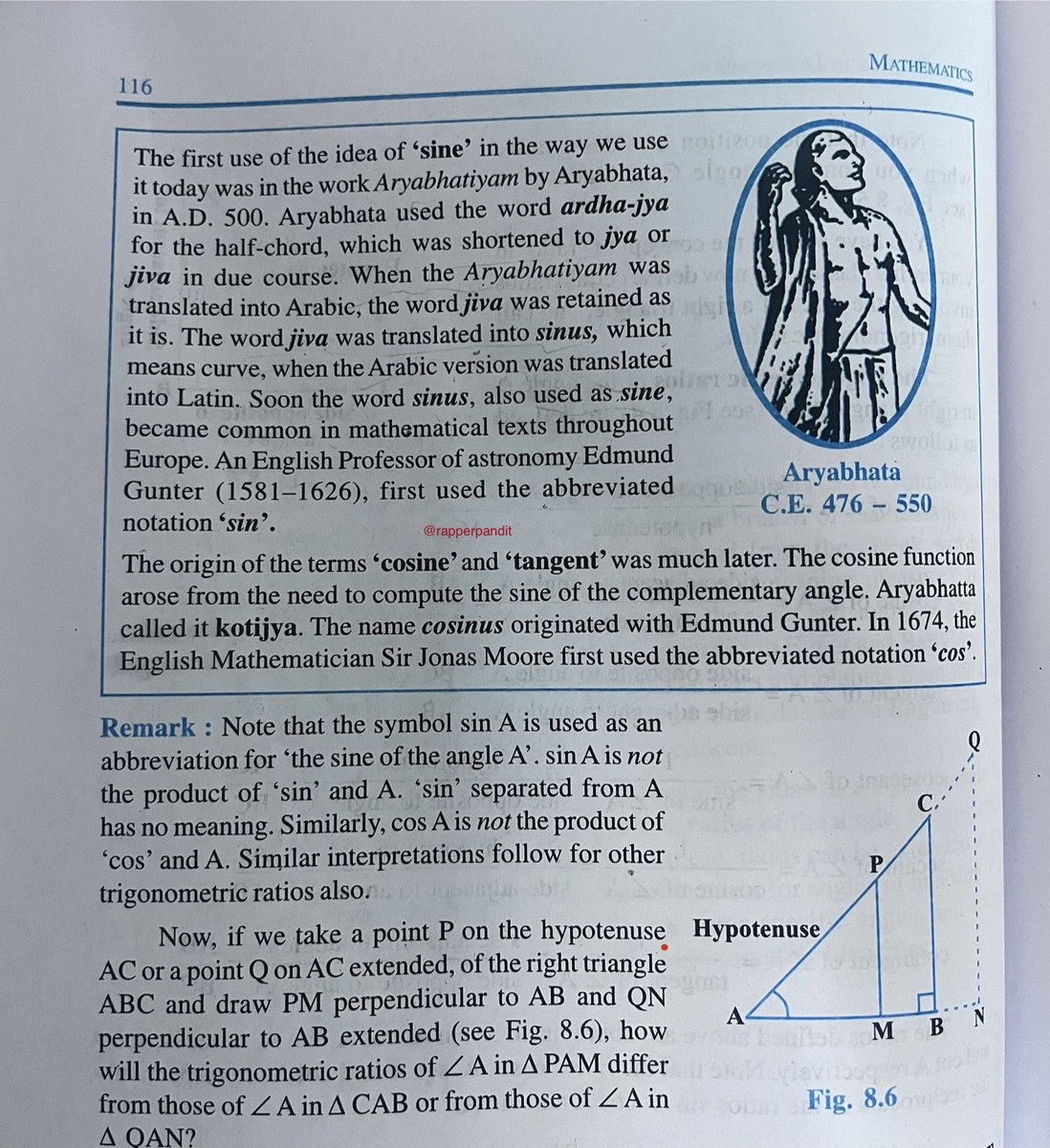
Class 10th Mathematics Book

Thank you Govt of India for this , something I dreamt of in 2020

https://pbs.twimg.com/media/HKYL7dobAAAaIzy.jpg

@RapperPandit

Replying to @RapperPandit
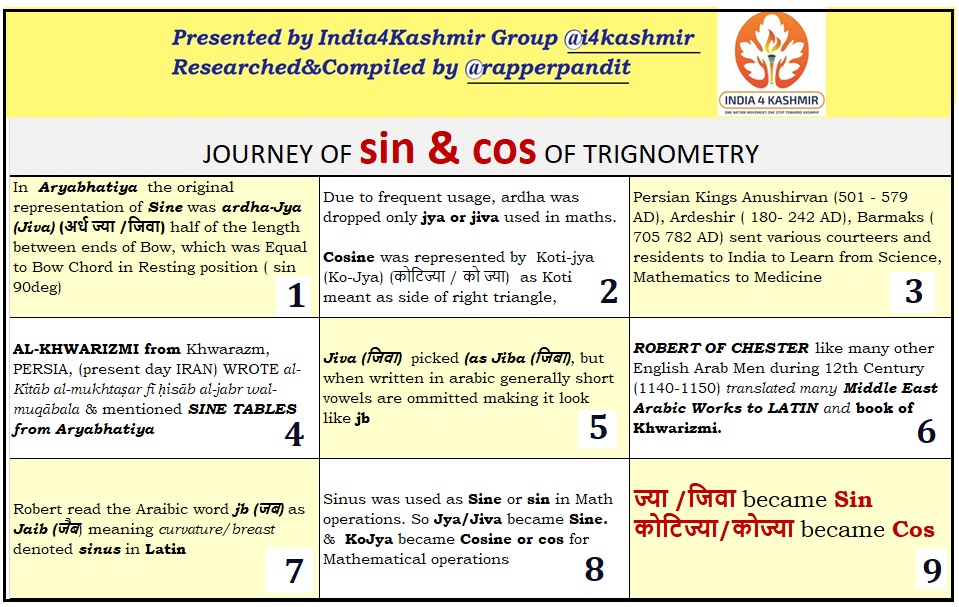
12/n Let's Now now see the Journey of very familiar "sin & cos" from INDIA to EUROPE
ज्या /जिवा to "sin"
कोटिज्या/कोज्या to "cos"
https://pbs.twimg.com/media/EVvLwdLUYAAmCvZ.jpg
Manish_P
BRF Oldie
Posts: 7487
Joined: 25 Mar 2010 17:34

Re: Tradition, Culture, Religion & Law in Indian Society

Post by Manish_P »

uddu wrote: 10 Jun 2026 14:10 https://x.com/RapperPandit/status/2064350604651360373
@RapperPandit

NCERT is healing . History is Healing
Class 10th Mathematics Book

...
One of the real reasons why the BIF are asking for the resignation of the Indian Education Minister... the NEET exam paper leak is an opportunity.
chetak
BRF Oldie
Posts: 36774
Joined: 16 May 2008 12:00

Re: Tradition, Culture, Religion & Law in Indian Society

Post by chetak »

Great philosopher Voltaire, venerated Indian thought and wrote a book on Indian history - Fragments sur I'Inde


Image
uddu
BRF Oldie
Posts: 8388
Joined: 15 Aug 2004 17:09

Re: Tradition, Culture, Religion & Law in Indian Society

Post by uddu »

Anand Ranganathan on sanatan Dharma, indic Civilization, Bharat & Hindu Rashtra | Dushyanth Sridhar
Anand Ranganathan's central argument was that Hinduism has survived thousands of years not because of governments, politicians, or institutions, but because ordinary Hindus carried forward their traditions, values, knowledge systems, festivals, temples, and civilizational memory generation after generation.

00:00:00 – Warning About Future of Hindu Society

00:06:53 – Destruction of Nalanda & the Forgotten Civilizational Loss

00:08:25 – Why Understanding the Quran Is Essential in Today’s India

00:11:34 – Why Hinduism Does Not Need Revitalization but Protection

00:15:12 – The Nupur Sharma Controversy & the Debate on Free Speech

00:19:00 – Demographic Change and Its Impact on Society

00:23:04 – Challenges Faced by Hindus in Modern India

00:27:13 – The Plight of Bangladeshi Hindus at India’s Borders

00:29:39 – Temple Control Laws and the Debate Over Religious Equality

00:32:59 – Sabarimala and the Question of Judicial Consistency

00:37:08 – The Places of Worship Act

00:42:05 – What Secularism Means in the Indian Context

00:44:26 – Why Excellence Matters More Than Street Protests

00:57:21 – Nupur Sharma’s Exile & the Politics Behind It

01:00:02 – Anti-Hindu Laws and the BJP’s Record on Reform

01:05:44 – The Risks of Building Ideological Echo Chambers

01:08:09 – Reservations, Religious Conversion, and the Supreme Court Debate

According to him, the biggest mistake Hindus make is believing that someone else will save Hindu civilization. No politician, no party, no organization, and no single leader can do that. The responsibility lies with Hindus themselves.

He stressed that revitalizing Hinduism does not mean merely attending events, posting on social media, or endlessly discussing problems. It means becoming excellent at what you do. Whether one chooses science, law, media, education, politics, business, engineering, literature, cinema, or public life, the goal should be to become outstanding in that field.

Anand argued that civilizations become strong when their people occupy positions of influence and competence. If Hindus want their civilization to flourish, they must produce great judges, lawyers, journalists, teachers, entrepreneurs, scientists, artists, administrators, and political leaders.

He emphasized that Hindu society should stop thinking defensively and start thinking confidently. Hindu civilization is one of the oldest surviving civilizations on earth. It has produced immense knowledge, philosophy, literature, mathematics, science, art, and spiritual traditions. A civilization with such a legacy should not suffer from an inferiority complex.

Addressing the youth directly, he said that India does not need everyone to become activists. Instead, every young person should focus on becoming exceptionally good at at least one thing. Excellence itself is service to the nation and civilization.

When asked what young people can do to bring change, he jokingly replied that they should become the Prime Minister, the Chief Justice of India, and own media channels. But behind the humor was a serious point: influence matters, institutions matter, and Hindus must participate in shaping them rather than merely complaining about them.

His final advice to students was clear: do not obsess over what profession you choose. Focus on mastery. Excel in one field. Become the best version of yourself. India and Hindu civilization need people of competence, character, and excellence far more than they need slogans.

In essence, Anand Ranganathan’s message was that revitalizing Hinduism will not happen through rhetoric alone. It will happen when Hindus regain civilizational confidence, stop outsourcing responsibility, and build excellence in every sphere of national life.

uddu
BRF Oldie
Posts: 8388
Joined: 15 Aug 2004 17:09

Re: Tradition, Culture, Religion & Law in Indian Society

Post by uddu »

https://x.com/LostTemple7/status/2064739122716311660
@LostTemple7

+1600 years old , mamleshwar shiv temple... Pahalagam,Kashmir 🇮🇳
bala
BRF Oldie
Posts: 4006
Joined: 02 Sep 1999 11:31
Location: Office Lounge

Re: Tradition, Culture, Religion & Law in Indian Society

Post by bala »

Did Mahabharat Really Happen? Nilesh Oak Proves It In 180 Minutes
Awaara Musaafir Jun 1, 2026

In this episode of The Awaara Musaafir Show, host Jayesh Gangan is joined by researcher and author Nilesh Oak for a fascinating conversation on Indian history, Mahabharata, Ramayana, and the evidence behind some of the most debated questions about Bharat’s ancient past. Drawing upon years of research, Nilesh Oak challenges conventional historical narratives and presents a radically different perspective on the age and continuity of Indian civilization.

The discussion begins with a memorable incident from an international conference where a Western professor claimed that "India has no history." Nilesh Oak explains his famous response, "India does not have history, it has Itihas," and breaks down the profound difference between the Western concept of history and the Indian tradition of Itihas, which combines chronology, philosophy, ethics, and civilizational memory.

The conversation then explores the impact of colonial rule on India’s historical narrative. Nilesh Oak discusses how British scholars and institutions shaped the way Indians view their own past, the origins of theories such as the Aryan Invasion Theory, and why he believes many accepted assumptions about ancient India deserve closer scrutiny.

A major focus of the episode is the scientific dating of the Mahabharata and Ramayana. Using astronomy, geology, oceanography, genetics, river studies, and textual analysis, Nilesh Oak explains how researchers attempt to reconstruct ancient timelines. He also discusses the famous Arundhati Vashishtha observation, astronomical references embedded in the Mahabharata, and why he believes these clues point to a much older chronology than commonly accepted.

The episode also dives deep into the question of evidence. What proof exists for the historicity of Krishna, the Mahabharata war, and ancient Indian civilization? How should historical claims be evaluated? Why do different researchers arrive at vastly different dates for the same events? And what role does science play in understanding ancient texts? Nilesh Oak shares his methodology and addresses some of the most common criticisms of his work.

Whether you are interested in history, archaeology, mythology, philosophy, or the search for truth, this conversation offers a thought provoking exploration of India’s civilizational legacy and the ongoing debate about its ancient past.

https://www.youtube.com/watch?v=_U4qnzH8d1k
chetak
BRF Oldie
Posts: 36774
Joined: 16 May 2008 12:00

Re: Tradition, Culture, Religion & Law in Indian Society

Post by chetak »

The connection b/w the South Indian Murukku (that crunchy, coiled, savory snack we all love) & the ancient medical treatise of the Sushruta Samhita is 1 of the most brilliant, hidden examples of how ancient Indian snack food was originally engineered as preventative medicine.

When people think of the Sushruta Samhita, they immediately think of plastic surgery, rhinoplasty & complex surgical tools. But Sushruta was a holistic genius. He knew that the ultimate goal of medicine was to ensure a patient never needed surgery in the 1st place.

Volume 1 (Sutra Sthana, Chapter 46) contains an entire, massive section dedicated to Ahara-tattva (the nutritional science of food). And this is where the fascinating origin story of the Murukku begins.

In the Sushruta Samhita, Sushruta categorizes deep-fried pastry items under the broad family of Bhakshyas (cooked, chewable foods). Among them, he singles out a distinct item called Śaṣkulī. Over centuries, as the Sanskrit word Śaṣkulī traveled across different regions of India, it underwent phonetic shifts: In the North & West, the word evolved through Prakrit into Chakli (retaining the circular, coiled meaning).

In the South cultures translated the physical action of making it, twisting the dough giving us the beautiful descriptive name Murukku (which literally means twisted in Tamil).

Sushruta was deeply concerned with the concept of Agni (metabolic digestive fire). He categorized foods based on whether they were Guru (heavy to digest)/Laghu (light to digest). He noted that deep-frying grain dough in ghee makes it highly caloric & strength-giving (Bala-vardhana), but it can be incredibly heavy for the stomach.

To fix this chemical problem, ancient Indian cooks did something brilliant that Sushruta documented: they introduced Masha (Black Gram/Urad Dal) into the rice flour matrix. By mixing rice flour with roasted, ground urad dal, they created a complete amino acid profile (rice is low in lysine but high in methionine, while dal is high in lysine but low in methionine).

A few might think why did Sushruta spend time documenting a fried, coiled snack in a medical text meant for surgeons? Because of shelf-life & thermodynamics.

In ancient India, monks, traders & soldiers traveling across vast empires needed food that met 3 strict scientific conditions:

- It could not contain moisture (water causes bacterial spoilage).

- It had to be compact & physically rigid so it would not crumble into dust in a horse carriage.
- It had to be nutrient-dense to sustain high physical exertion.

By taking the Śaṣkulī dough, piping it into tight, concentric, interlocking coils (which structurally reinforces the snack against breaking) & deep-frying it until 100% of the water content evaporated, ancient Indians invented the ultimate preservative-free, shelf-stable survival ration.

When you hear the crunch of a Murukku today, you are literally tasting a recipe that was vetted, chemically balanced & medically approved by the Father of Surgery himself, Acharya Sushruta, 1000s yrs ago.

So, the next time you serve Murukku/Chakli with tea, you can proudly tell your guests: You are not just eating a snack. You are consuming a highly engineered, ancient Ayurvedic military ration designed to preserve human tissue :))
Image
chetak
BRF Oldie
Posts: 36774
Joined: 16 May 2008 12:00

Re: Tradition, Culture, Religion & Law in Indian Society

Post by chetak »

Image
chetak
BRF Oldie
Posts: 36774
Joined: 16 May 2008 12:00

Re: Tradition, Culture, Religion & Law in Indian Society

Post by chetak »

Genetic evidence places India at the centre of early human history, debunking 'Aryan' migration theory.

Renowned historian, @ProfVemsani says the oldest non-African male and female genetic lineages trace back to India, overturning long-standing colonial interpretations of human origins.

Watch the full interview in the first comment.


https://x.com/TheAusToday/status/206594 ... 12/video/1


https://www.youtube.com/watch?v=fwlTYIHkb6I


Genetic evidence busts colonial “Aryan” invasion myth, centres India in early human history


Hriday
BRFite
Posts: 668
Joined: 15 Jun 2022 19:59

Re: Tradition, Culture, Religion & Law in Indian Society

Post by Hriday »

Sorry if the below topic was mentioned here earlier. Not easy to search inside BR Forum.

Hindu texts mention that Sun is predominantly green. But human eyes can't see the greenish Sun. Only a sensor that measures the peak energy spectrum can find the Sun as Green.

From Elon Musk,
https://x.com/i/status/1605477988325134338
A nice trick question is what color is the sun?

It appears white in space, but, as measured by peak photon count, it is green.
From Grok,
https://grok.com/share/c2hhcmQtMi1jb3B5 ... a782f793a7
However, several texts describe the seven horses pulling Surya's chariot as green (or greenish-yellow/haritah in Sanskrit),
...
Key References:

Rigveda 1.50.8 (one of the primary Vedic hymns to Surya):
Sanskrit: "sapta tvā harito rathe vahanti deva sūrya | śociṣkeśaṃ vicakṣaṇa ||"
Translation/Interpretation: "O divine Surya, the seven green/yellowish-green (harito) horses bear you in the chariot, you of bright hair, far-seeing one."
"Harito/haritaḥ" refers to green, yellowish-green, or bay (greenish) horses/rays. This is often interpreted symbolically as the Sun's rays or the spectrum of light.
...
2. Brahmanda Purana (and similar descriptions in Vishnu Purana, other Puranas):
The chariot is yoked with seven horses (the Vedic meters: Gāyatrī, Bṛhatī, Uṣṇih, Jagatī, Triṣṭubh, Anuṣṭubh, Paṅkti). "They are green, imperishable..." They traverse the sky, sustaining life.
Example quote (Brahmanda Purana context): "The Sun moves ahead in his chariot of green horses. Through his rays he takes up waters..."
sudarshan
BRF Oldie
Posts: 3049
Joined: 09 Aug 2008 08:56

Re: Tradition, Culture, Religion & Law in Indian Society

Post by sudarshan »

Hriday wrote: 15 Jun 2026 17:21 Sorry if the below topic was mentioned here earlier. Not easy to search inside BR Forum.

Hindu texts mention that Sun is predominantly green. But human eyes can't see the greenish Sun. Only a sensor that measures the peak energy spectrum can find the Sun as Green.

...
Wow, that's an interesting conjecture. I've been wondering about this, since the Aditya Hrudayam mentions a couple of times that Surya's horses are green:
Haridashvah sahasrarchih...
Jayaya jayabhadraya haryashvaya namo namah...
I kept thinking where that could have come from, the above is at least a rational explanation.

Another interesting fact, which I first learned about from Yakov Perelman's "Physics for Entertainment" (IIRC) - this phenomenon is observed in real life on rare occasions - and I kept going to this fact previously to explain why Surya's horses are described as being green:

https://en.wikipedia.org/wiki/Green_flash
The green flash and green ray are meteorological optical phenomena that sometimes occur transiently around the moment of sunset or sunrise. When the conditions are right, a distinct green spot is briefly visible above the Sun's upper limb; the green appearance usually lasts for no more than two seconds. Rarely, the green flash can resemble a green ray shooting up from the sunset or sunrise point.
Post Reply