India’s Electromagnetic Railgun: The Future Of Artillery
The Indian Army is exploring one of the most advanced weapon systems ever developed by DRDO, the electromagnetic railgun. During a visit to ARDE Pune, the Consultative Committee of the Ministry of Defence was briefed on this ambitious project. Unlike conventional artillery that relies on chemical propellants, a railgun uses powerful electromagnetic force to launch a solid projectile at hypersonic speeds of nearly Mach 6. With this programme, India joins a small group of nations working on operational railgun technology. While challenges remain in power generation and material durability, DRDO says key enabling technologies are already in place, with battlefield integration expected in the coming decade.
Artillery Corps: News & Discussion
Re: Artillery Corps: News & Discussion
My 2 paisa..Manish_P wrote: ↑16 Jan 2026 12:53Very noob questions, Ramana ji. Almost ashamed to ask here. Since I don't have any engineering background whatsoever.
But valuing knowledge more than shame here are a few...
Is it like an add-on 'kit' which can be added on to existing shells (not exactly alike but along the lines of the JDAM). If yes, can be done on the field? Also does it require any changes to the firing gun? If yes then can the gun be reconfigured quickly (in the field) to fire regular shells.
Or is it a modification which needs to be 'manufactured in' during the shell production stage.
What effect does it have on
a) storage - do these shells/the add on require special (additional) care in storage and transport (including packaging)?
b) shelf life - any difference in the shelf life of the shell and the add on kit (if they are different units). If yes can newer add on kit be added on to the older shells. And vice versa.
Added - my thoughts are that it is a very good development and very, very welcome. Hoping that all concerned stay on the R&D path to implementation and improvement. If it is a costly system then use it as tip of the spear, if not then use it as a volley of spears. But use it.
- This will most likely not be an add on kit (like the excalibur guidance kits) there is most likely some kind of sealing needed to ensure the shell doesnt separate from the ramjet base immediately on firing.. would be interesting to know how this is actually done
- This would mean some special handling requirements with slightly stricter protection protocols for the rounds, like, better environmental seals for storage and transportation. Definitely some logistics change needed.
- Shelf life would be a factor too, IMHO, and as per my first statement, this would not be field replaceable...
Happy to be corrected on the above..
Re: Artillery Corps: News & Discussion
I think so too.
The images shared in earlier posts hint at it.
More info will come out in due course.
Exciting times for Indian artillery
The images shared in earlier posts hint at it.
More info will come out in due course.
Exciting times for Indian artillery
Re: Artillery Corps: News & Discussion
Its likely similar to JDAM conversion kits. Needs to be mounted at a factory using existing shells. Not field modified like excalibur kits.
Re: Artillery Corps: News & Discussion
IIT-M variant is like that.
While there is another version from DRDO which is much more like a mini Brahmos ---> https://www.indiandefensenews.in/2025/0 ... wered.html
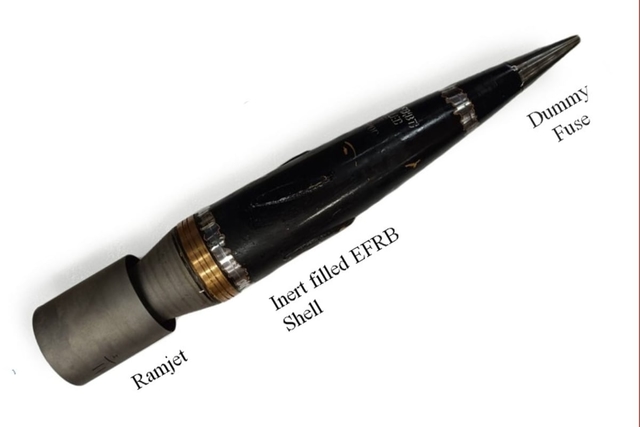
Re: Artillery Corps: News & Discussion
Below is the video that explains everything. This replaces the base bleed with the ramjet. The air scoop is at the rear. Essentially, you can screw the ramjet part onto any 155mm shell. Amazing !
India Leads the World in Ramjet Shell Technology
India may have just rewritten the future of artillery warfare. In this exclusive conversation with Chakra News, Lieutenant General P. R. Shankar reveals how India became the first country to successfully fire a ramjet-powered artillery shell. Unlike global designs that trade firepower for range, this breakthrough uses a rear-intake, modular ramjet attachment that fits existing 155 mm shells. Developed through a rare Army–IIT collaboration, this innovation could redefine long-range firepower, logistics, and battlefield dominance.
India Leads the World in Ramjet Shell Technology
India may have just rewritten the future of artillery warfare. In this exclusive conversation with Chakra News, Lieutenant General P. R. Shankar reveals how India became the first country to successfully fire a ramjet-powered artillery shell. Unlike global designs that trade firepower for range, this breakthrough uses a rear-intake, modular ramjet attachment that fits existing 155 mm shells. Developed through a rare Army–IIT collaboration, this innovation could redefine long-range firepower, logistics, and battlefield dominance.
Re: Artillery Corps: News & Discussion
a)The current base bleed motor is factory-installed by the shell assembler. So this ramjet module is a plug-and-play replacement for the base bleed motor and will also be factory-installed.Manish_P wrote: ↑16 Jan 2026 12:53Very noob questions, Ramana ji. Almost ashamed to ask here. Since I don't have any engineering background whatsoever.
But valuing knowledge more than shame here are a few...
Is it like an add-on 'kit' which can be added on to existing shells (not exactly alike but along the lines of the JDAM). If yes, can be done on the field? Also does it require any changes to the firing gun? If yes then can the gun be reconfigured quickly (in the field) to fire regular shells.
Or is it a modification which needs to be 'manufactured in' during the shell production stage.
What effect does it have on
a) storage - do these shells/the add on require special (additional) care in storage and transport (including packaging)?
b) shelf life - any difference in the shelf life of the shell and the add on kit (if they are different units). If yes can newer add on kit be added on to the older shells. And vice versa.
Added - my thoughts are that it is a very good development and very, very welcome. Hoping that all concerned stay on the R&D path to implementation and improvement. If it is a costly system then use it as tip of the spear, if not then use it as a volley of spears. But use it.
Current base bleed motor cross section view.

The storage and transport will be similar to the base bleed motor, as the propellant is the same.
b)Should be the same as the base bleed shells for reasons already stated.
c)The module should cost the same as the base bleed shell. In fact, the cost of machining should be lower as there is no need for the intricate angle drilled nozzles and they can be replaced with a large nozzle for the ramjet.
Re: Artillery Corps: News & Discussion
Lt Gen Shankar says it's field modification and not factory installation.
I was incorrect.
I was incorrect.
Re: Artillery Corps: News & Discussion
Field modification 
Wow. That's a proper game changer.
Hoping they stay the course to full implementation across the spectrum.
Wow. That's a proper game changer.
Hoping they stay the course to full implementation across the spectrum.
Re: Artillery Corps: News & Discussion
SSS defence founder had made a post referencing 'Jawab-e-hind'. An Indian answer. Referring to origins of excellent Damascus steel swords made by using ancient Indian metallurgy.
This Ramjet shell will go right to my personal list of 'Jawab-e-Hind'.
The SMART torpedo system is the other item in that list.
Hopefully the list will be a 'Navratna' list in the next few years
This Ramjet shell will go right to my personal list of 'Jawab-e-Hind'.
The SMART torpedo system is the other item in that list.
Hopefully the list will be a 'Navratna' list in the next few years
Re: Artillery Corps: News & Discussion
Field modification is incredible!
when combined with a precision guided artillery shell and top notch ISR, we can dominate upto ~70 kms into the paki territory without sending a single soldier/jet or expending a costly missile
when combined with a precision guided artillery shell and top notch ISR, we can dominate upto ~70 kms into the paki territory without sending a single soldier/jet or expending a costly missile
Re: Artillery Corps: News & Discussion
Kalyani Challenging DRDO! | Impressive Innovation
Kalyani is developing a 155/52 caliber mounted gun on a 4 wheel truck; weighing only 24 tons.
Kalyani is developing a 155/52 caliber mounted gun on a 4 wheel truck; weighing only 24 tons.
Re: Artillery Corps: News & Discussion
Text style article of the above news
Bharat Forge Unveils World’s First 155mm/52 Artillery Gun on 4×4 Chassis
Bharat Forge Unveils World’s First 155mm/52 Artillery Gun on 4×4 Chassis
May they get a lot of export orders. Will help funding for their R&D program.In a breakthrough that could significantly reshape India’s artillery doctrine, Bharat Forge has unveiled what it describes as the world’s first 155mm/52-calibre artillery gun mounted on a 4×4 high-mobility chassis, achieving a combination of firepower, mobility and weight reduction previously considered impractical. Weighing just 24 tonnes, the system has completed initial development and internal trials and is now set to undergo formal testing at the Proof and Experimental Establishment (PXE), Balasore, Odisha.
A New Class of Mobile Heavy Artillery
The newly developed gun system represents a radical departure from conventional mounted artillery platforms. Traditionally, 155mm/52-calibre guns — the global benchmark for long-range tube artillery — require heavy 6×6 or 8×8 trucks to absorb recoil forces and maintain firing stability. By contrast, Bharat Forge’s platform compresses the same firepower onto a compact 4×4 chassis, reducing overall mass by nearly seven tonnes when compared to the mounted variant of the Advanced Towed Artillery Gun System (ATAGS), which weighs around 31 tonnes.
Strategic Mobility for the Himalayas
Military planners have long sought a heavy gun that can be rapidly deployed in high-altitude terrain, particularly along the Line of Actual Control (LAC), where road width, bridge load classifications and steep gradients restrict the movement of heavier platforms. The lighter 4×4 configuration allows the gun to traverse narrow mountain roads and bridges that are inaccessible to conventional mounted systems.
The reduced weight and footprint also enhance strategic airlift capability. The system can be transported more efficiently by Indian Air Force heavy-lift aircraft, such as the C-17 Globemaster, enabling faster redeployment between theatres — a key requirement in a two-front contingency.
Firepower Without Compromise
Officials familiar with the programme indicate that the gun is expected to achieve ranges of 40–45 kilometres with standard ammunition, with the potential to exceed 50 kilometres using advanced extended-range and ramjet-assisted projectiles currently under development in India.
The system incorporates a semi-automatic loading mechanism, maintaining a high rate of fire while reducing crew fatigue and exposure. This feature is particularly important in high-altitude conditions, where physical exertion significantly affects sustained operations.
Recoil Management: The Core Challenge
The central technical question surrounding the project has been whether a 4×4 platform can withstand the intense recoil forces generated by a 52-calibre gun during sustained firing. Bharat Forge has addressed this through a combination of patented soft-recoil technology, reinforced chassis architecture and advanced hydraulic stabilisers designed to anchor the vehicle during firing sequences.
Implications for India’s Artillery Modernisation
A successful 155mm/52-calibre gun on a 4×4 chassis would introduce an entirely new category of artillery — combining long-range firepower, rapid shoot-and-scoot capability and exceptional deployability.
As the prototype moves to Balasore for its most critical evaluations yet, defence observers view the programme as a high-risk, high-reward effort(# the risk is being taken by the private company on it's own). If validated, it could redefine how heavy artillery is designed, deployed and employed — not only for India, but for modern armies worldwide.
Re: Artillery Corps: News & Discussion
IIT-Madras to begin work on ramjet tech to boost range of army’s rocket arsenal
https://www.hindustantimes.com/india-ne ... 77765.html
22 Jan 2026
https://www.hindustantimes.com/india-ne ... 77765.html
22 Jan 2026
The army is looking at creating a rocket force at the earliest to boost its combat effectiveness with weapons that can hit targets at longer ranges
Re: Artillery Corps: News & Discussion
Further details by Defence DecodeRakesh wrote: ↑28 Jan 2026 20:45 IIT-Madras to begin work on ramjet tech to boost range of army’s rocket arsenal
https://www.hindustantimes.com/india-ne ... 77765.html
22 Jan 2026
The army is looking at creating a rocket force at the earliest to boost its combat effectiveness with weapons that can hit targets at longer ranges
RAMJET powered Pinaka test in March | Range 240Km
Ramjet for Grad / Pinaka rockets (what the article says is NEXT). This is where things change. Rockets cannot use the exact same base-ramjet layout because: The base is occupied during boost. At launch, the rear is: Solid rocket motor. High-temperature exhaust plume. Structural thrust loads. So you can’t run a ramjet there at the same time. That means rocket ramjets must be staged propulsion systems.
Re: Artillery Corps: News & Discussion
I also that like Rampage there is a variant which can be aircraft launched, should give it additional range and gives the ability to make Pakistan Nishastra fast.
Re: Artillery Corps: News & Discussion
There could be an aircraft launched variant of the Ramjet once it succeeds with Pinaka, going even greater range than the land launched Ramjet variant.
Re: Artillery Corps: News & Discussion
PULS Makes Its Debut at India’s Republic Day
https://www.elbitsystems.com/blog/puls- ... public-day
28 Jan 2026
https://www.elbitsystems.com/blog/puls- ... public-day
28 Jan 2026
Re: Artillery Corps: News & Discussion
https://x.com/Resonant_News/status/2017117904282800582
𝗕𝗥𝗘𝗔𝗞𝗜𝗡𝗚:𝗜𝗻𝗱𝗶𝗮𝗻 𝗔𝗿𝗺𝘆 𝗲𝘃𝗮𝗹𝘂𝗮𝘁𝗲𝗱 𝗞𝗦𝗦𝗟’𝘀 𝗶𝗻𝗱𝗶𝗴𝗲𝗻𝗼𝘂𝘀 𝗮𝗿𝘁𝗶𝗹𝗹𝗲𝗿𝘆 𝘀𝘆𝘀𝘁𝗲𝗺𝘀 𝗳𝗼𝗿 𝘀𝗽𝗲𝗰𝗶𝗮𝗹𝗶𝘀𝗲𝗱 𝗿𝗼𝗹𝗲𝘀
MArG 155mm/45 Mounted Gun tested for high-altitude requirements
Built for high mobility + rapid deployment in mountains & semi-desert terrain
Range: 36+ km with conventional ammunition
Quick deployment: ~1.5 min (day) / ~2 min (night)
Carries 18 rounds onboard with Zone-6 charges for sustained fire missions
Elevation range -2° to +72° enabling direct + high-angle indirect fire
Garuda 105mm/37 system assessed for Para Brigade & rapid reaction forces
Mounted on 4x4 all-terrain vehicle with shoot-and-scoot capability
Both systems gaining international interest, boosting India’s export potential

𝗕𝗥𝗘𝗔𝗞𝗜𝗡𝗚:𝗜𝗻𝗱𝗶𝗮𝗻 𝗔𝗿𝗺𝘆 𝗲𝘃𝗮𝗹𝘂𝗮𝘁𝗲𝗱 𝗞𝗦𝗦𝗟’𝘀 𝗶𝗻𝗱𝗶𝗴𝗲𝗻𝗼𝘂𝘀 𝗮𝗿𝘁𝗶𝗹𝗹𝗲𝗿𝘆 𝘀𝘆𝘀𝘁𝗲𝗺𝘀 𝗳𝗼𝗿 𝘀𝗽𝗲𝗰𝗶𝗮𝗹𝗶𝘀𝗲𝗱 𝗿𝗼𝗹𝗲𝘀
MArG 155mm/45 Mounted Gun tested for high-altitude requirements
Built for high mobility + rapid deployment in mountains & semi-desert terrain
Range: 36+ km with conventional ammunition
Quick deployment: ~1.5 min (day) / ~2 min (night)
Carries 18 rounds onboard with Zone-6 charges for sustained fire missions
Elevation range -2° to +72° enabling direct + high-angle indirect fire
Garuda 105mm/37 system assessed for Para Brigade & rapid reaction forces
Mounted on 4x4 all-terrain vehicle with shoot-and-scoot capability
Both systems gaining international interest, boosting India’s export potential
-
Prem Kumar
- BRF Oldie
- Posts: 4738
- Joined: 31 Mar 2009 00:10
Re: Artillery Corps: News & Discussion
BCs will keep evaluating, while foreigners will actually place orders
Kalyani should become a 100% export oriented country. Building for our DG Artillery is like casting pearls before a swine
Kalyani should become a 100% export oriented country. Building for our DG Artillery is like casting pearls before a swine
Re: Artillery Corps: News & Discussion
Our arms sales are on upward trajectory. Check the new thread on Atmanirbhar Bharat.
IMHO we should have a full fledged Ministry of Arms & Ammunition Sales & Exports. Should be separate from the defence and industries ministry. Can be additional charge for Raksha Mantri but eventually have a cabinet level minister of its own.
IMHO we should have a full fledged Ministry of Arms & Ammunition Sales & Exports. Should be separate from the defence and industries ministry. Can be additional charge for Raksha Mantri but eventually have a cabinet level minister of its own.
Re: Artillery Corps: News & Discussion
DRDO Plans to Expand Pinaka Long-Range Guided Rocket Family with New 300 km and 450 km Precision Rockets
https://defence.in/threads/drdo-plans-t ... ets.17013/
28-2-2026
https://defence.in/threads/drdo-plans-t ... ets.17013/
28-2-2026
Following the successful validation of the 120 km variant in late 2025, DRDO is now focusing on extending this reach significantly.
Ankathi Raju, Director of the Armament Research and Development Establishment (ARDE), confirmed that the 300 km model is currently in the design phase.
This system is anticipated to begin initial trials within three years, with the goal of entering active service within five years.
Simultaneously, a 450 km version is being developed using the same core technology to become one of the longest-reaching guided rockets globally.
Re: Artillery Corps: News & Discussion
Why they can't place an order for 1,000 or more is still beyond me, but it's a start at any rate. Hope the news is legit and not more DDM.
Indian Army to order 300 indigenous Dhanush howitzers for 15 regiments
https://www.msn.com/en-in/news/india/in ... regiments/
03 March 2026
Indian Army to order 300 indigenous Dhanush howitzers for 15 regiments
https://www.msn.com/en-in/news/india/in ... regiments/
03 March 2026
Re: Artillery Corps: News & Discussion
Indian Army to place orders for 300 indigenous Dhanush Howitzers
https://aninews.in/news/national/genera ... 303192532/
03 March 2026
https://aninews.in/news/national/genera ... 303192532/
03 March 2026
Re: Artillery Corps: News & Discussion
414 was the original plan for Dhanush- 114+300, ATAGS, MGS, Indian Light howitzers, more indigenized K-9, more mobile 105mm all are required.vonkabra wrote: ↑04 Mar 2026 15:34 Why they can't place an order for 1,000 or more is still beyond me, but it's a start at any rate. Hope the news is legit and not more DDM.
Indian Army to order 300 indigenous Dhanush howitzers for 15 regiments
https://www.msn.com/en-in/news/india/in ... regiments/
03 March 2026
I think right now we must be having 300 Original Bofors, ~100 Dhanush, 180-250 converted 130 mm, 145 M777, ~100 K-9, 100 K9 on order, 400 ATAGS in production, a far cry from 300 Bofors in 2014.
Re: Artillery Corps: News & Discussion
OFB has not finished the original order from the first batch. In light of this, ordering any more in the thousands is counter productive.vonkabra wrote: ↑04 Mar 2026 15:34 Why they can't place an order for 1,000 or more is still beyond me, but it's a start at any rate. Hope the news is legit and not more DDM.
Indian Army to order 300 indigenous Dhanush howitzers for 15 regiments
https://www.msn.com/en-in/news/india/in ... regiments/
03 March 2026
OFB should be thankful that the Army even ordered a follow on batch of 300 more. This is OFB we are talking about.
Re: Artillery Corps: News & Discussion
Placing order for parts and all takes time. So when the first lot is finished, the second lot part and all should be ready to continue production. We usually delay decision making and end up with nothing. This is the right way to do it. Either order together or even if ordered in batches, place order before the first lot production ends. This is the status of the first lotRakesh wrote: ↑05 Mar 2026 21:18OFB has not finished the original order from the first batch. In light of this, ordering any more in the thousands is counter productive.vonkabra wrote: ↑04 Mar 2026 15:34 Why they can't place an order for 1,000 or more is still beyond me, but it's a start at any rate. Hope the news is legit and not more DDM.
Indian Army to order 300 indigenous Dhanush howitzers for 15 regiments
https://www.msn.com/en-in/news/india/in ... regiments/
03 March 2026
OFB should be thankful that the Army even ordered a follow on batch of 300 more. This is OFB we are talking about.
Indian Army to place orders for 300 indigenous Dhanush Howitzers
Read more At:
https://aninews.in/news/national/genera ... 303192532/
Out of 144 initial order, 4 regiments inducted, 2 more soon.
Last edited by uddu on 05 Mar 2026 21:43, edited 1 time in total.
Re: Artillery Corps: News & Discussion
In principle, yes.uddu wrote: ↑05 Mar 2026 21:34 Placing order for parts and all takes time. So when the first lot is finished, the second lot part and all should be ready to continue production. We usually delay decision making and end up with nothing. This is the right way to do it. Either order together or even if ordered in batches, place order before the first lot production ends.
The original order was supposed to be completed by March 2026. That will not happen, due to OFB's inefficiencies. Another poor showing by a Govt PSU. In light of this, it does not give the user much confidence in ordering these guns in the thousands.
A good measure of comparison would be Bharat Forge & TASL that received the order for 307 ATAGS on 26 March 2025. Lets see if the private manufacturer will meet their contractual obligations in delivery timeframes. These two companies are not Govt PSUs and thus there is sufficient in-house pressure to ensure that deliveries are met. Failure to meet those timelines, could result in Bharat Forge & TASL losing future contracts.
Re: Artillery Corps: News & Discussion
Understandable. That's why 300 lot is good order for defense PSU.Rakesh wrote: ↑05 Mar 2026 21:41In principle, yes.uddu wrote: ↑05 Mar 2026 21:34 Placing order for parts and all takes time. So when the first lot is finished, the second lot part and all should be ready to continue production. We usually delay decision making and end up with nothing. This is the right way to do it. Either order together or even if ordered in batches, place order before the first lot production ends.
The original order was supposed to be completed by March 2026. That will not happen, due to OFB's inefficiencies. Another poor showing by a Govt PSU. In light of this, it does not give the user much confidence in ordering these guns in the thousands.
A good measure of comparison would be Bharat Forge & TASL that received the order for 307 ATAGS on 26 March 2025. Lets see if the private manufacturer will meet their contractual obligations in delivery timeframes. These two companies are not Govt PSUs and thus there is sufficient in-house pressure to ensure that deliveries are met. Failure to meet those timelines, could result in Bharat Forge & TASL losing future contracts.
Hopefully, the follow on order for ATAGS follow on will be larger. ATAGS delivery has started as per one report.
Army’s first regiment of long-range ATAGS artillery guns to be ready by February 2027
https://www.newindianexpress.com/nation ... ruary-2027
08 Jul 2025
Since he said this in Jul 2025, we could expect the 18 within Jul 2026? probably one year after the product model test. Which must be taking about 6 months based on the February 2027 timeline.“The first gun system is ready for the mandatory first of product model test. The first regiment of 18 ATAGS will be inducted within a year thereafter,” said RP Pandey, Project Director (PD) of ATAGS, speaking to The New Indian Express.
Re: Artillery Corps: News & Discussion
That is the metric to watch out for. Pin your post and visit back at the end of July 2026, to see if the private manufacturer has met its obligation.
If they also fail, then Army HQ will import a gun.
Re: Artillery Corps: News & Discussion
Kalyani On Track to Produce 350+ Artillery Guns Annually, Eyes Exports to US and Europe, Yet Still Awaits Crucial Indian Army Order
https://defence.in/threads/kalyani-on-t ... der.13256/
Mar 11, 2025
^^^The company's recent success in exporting nearly 100 artillery guns in 2024 highlights its growing international presence. This achievement demonstrates KSSL's capacity to deliver high-quality, combat-proven systems to foreign customers.
Not a single artillery gun needs to be imported. They have already exported six ATAGS to Armenia and got a follow on order of 84 ATAGS. Another order of 18 ATAGS from an European nation delivered. An order from West Asian nation also reported. Then there is the 72 mArG shipped to Armenia in 2026, The Indian Army is late in placing orders.
Re: Artillery Corps: News & Discussion
Atmanirbharata is the Govt's initiative. If the services are delaying orders of local maal, then it rests on the Govt's shoulder to enforce its own policy.uddu wrote: ↑05 Mar 2026 22:18 Not a single artillery gun needs to be imported. They have already exported six ATAGS to Armenia and got a follow on order of 84 ATAGS. Another order of 18 ATAGS from an European nation delivered. An order from West Asian nation also reported. Then there is the 72 mArG shipped to Armenia in 2026, The Indian Army is late in placing orders.
It take two hands to clap (import) ---> The service who "wants" the import and the Govt who "funds" the import. The services report to the Govt and not the other way around.
Re: Artillery Corps: News & Discussion
Rakesh and Uddu,
The Dhanish follow in order for 300 guns was stuck due to some scandal about bearings origin investigation.
The babus/ generals were saying let the investigation finish. PMO said let the investigation continue and meantime order the guns.
The Dhanish follow in order for 300 guns was stuck due to some scandal about bearings origin investigation.
The babus/ generals were saying let the investigation finish. PMO said let the investigation continue and meantime order the guns.
Re: Artillery Corps: News & Discussion
Am I right in saying that the confirmed orders so far are:
ATAGS: 307 split between 184 to Bharat Forge, 123 to Tata Advanced Systems
Dhanush: 114 units initially ordered. They may order 300 more
K9 Vajra: 100 delivered plus may order 100 more
M777: 145 delivered
No orders for mountain guns or truck mounted yet
If the above is correct then the ATAGS order speaks volumes.
ATAGS: 307 split between 184 to Bharat Forge, 123 to Tata Advanced Systems
Dhanush: 114 units initially ordered. They may order 300 more
K9 Vajra: 100 delivered plus may order 100 more
M777: 145 delivered
No orders for mountain guns or truck mounted yet
If the above is correct then the ATAGS order speaks volumes.
Re: Artillery Corps: News & Discussion
To this you can also add 300 Sharang guns (130mm to 155mm upgrade by OFB) ordered. However, procurement was stopped after 159 guns due to quality issues. Soltam also upgraded 180 guns (130mm to 155mm) and these were delivered way back in 2008 or so.
Re: Artillery Corps: News & Discussion
Ongoing trials
DRDO’s Mounted Gun System | Precision on Wheels, Power in Motion
Kalyani Challenging DRDO! | Impressive Innovation | हिंदी में
DRDO’s ‘shoot and scoot’ mounted gun system ready for Indian Army trials
https://www.indiasentinels.com/defence- ... rials-6921
Cost edge and strategic significance
July 11, 2025.
The Defence Research and Development Organization, on Monday, announced that the 155mm/52 calibre truck-mounted howitzer has successfully completed internal trials and is ready for extensive field testing across diverse terrains and weather conditions. The system, weighing approximately 30 tonnes, has already fired over 100 rounds during rigorous testing at Balasore and Pokhran ranges, validating its operational reliability.
Senior DRDO officials confirmed that the mounted gun system has demonstrated exceptional mobility, transitioning from transport mode to firing position in just 80 seconds and relocating within 85 seconds after firing.
The indigenous mounted gun system offers exceptional value compared to international alternatives, with unit costs approximately ₹15 crore ($1.74 million) significantly undercutting foreign competitors. For perspective, the French Caesar system costs $4.26 million, the Serbian Nora B-52 requires $7.06 million, and the Swedish Archer demands $10.41 million per unit.
The trials are expected to conclude within the next six months, with potential induction into service following successful completion of all evaluation parameters.
Re: Artillery Corps: News & Discussion
This is interesting. The DRDO gun is 52 cal as compared to the MaRG one from Kalyani that is presumably lighter by at 6.5 tons but is 45 cal. However the MaRG can be carried on the C390 but DRDO one cannot… horses for courses but this one has a role.uddu wrote: ↑07 Mar 2026 18:59
The Defence Research and Development Organization, on Monday, announced that the 155mm/52 calibre truck-mounted howitzer has successfully completed internal trials and is ready for extensive field testing across diverse terrains and weather conditions. The system, weighing approximately 30 tonnes, has already fired over 100 rounds during rigorous testing at Balasore and Pokhran ranges, validating its operational reliability.
Senior DRDO officials confirmed that the mounted gun system has demonstrated exceptional mobility, transitioning from transport mode to firing position in just 80 seconds and relocating within 85 seconds after firing.
The indigenous mounted gun system offers exceptional value compared to international alternatives, with unit costs approximately ₹15 crore ($1.74 million) significantly undercutting foreign competitors. For perspective, the French Caesar system costs $4.26 million, the Serbian Nora B-52 requires $7.06 million, and the Swedish Archer demands $10.41 million per unit.
Lets see how many orders any of these get.
Re: Artillery Corps: News & Discussion
https://x.com/AjayshreeSamby3/status/20 ... 35196?s=20 ---> FOPM, the bottleneck that needs to be phased out. #DAP2026
"Procurement process starts with the govt calling out the tender quotations which itself takes about a year. Then the order is issued to the lowest bidder. Following that, the manufacturer has to produce first of production model (FOPM), which is only one unit of the consignment. It has to be tested again by the quality wing of the Indian Army, which takes another one year. Also there is an additional rule that the company cannot order any material till the FOPM is tested. Whereas when you are exporting, the question asked is, has the Indian Army approved your gun?”

"Procurement process starts with the govt calling out the tender quotations which itself takes about a year. Then the order is issued to the lowest bidder. Following that, the manufacturer has to produce first of production model (FOPM), which is only one unit of the consignment. It has to be tested again by the quality wing of the Indian Army, which takes another one year. Also there is an additional rule that the company cannot order any material till the FOPM is tested. Whereas when you are exporting, the question asked is, has the Indian Army approved your gun?”
Re: Artillery Corps: News & Discussion
INDIAN ARMY BOLSTERS PINAKA ARSENAL TO TEN REGIMENTS, EYES DEEP-STRIKE DOMINANCE
From: The New Indian ExpressNEW DELHI: The Indian Army has added another Pinaka regiment and is preparing to induct one more by the end of the year as it expands rocket artillery capability along the western and northern frontiers, it is learnt.
“The seventh regiment has already been operationalised. The eighth has been raised and has received more than half its equipment. It is currently undergoing conversion and should become operational before the end of the year,” sources in the defence establishment said.
Two more regiments from a batch of six ordered in 2020 are expected to be operationalised next year, which will take the total number of Pinaka regiments in service to ten.
The Army had ordered four Pinaka regiments between 2010 and 2020, with expansion accelerating after the Galwan Valley clash with Chinese troops in eastern Ladakh.
That year, the defence ministry inked contracts worth about Rs 2,580 crore with BEML, Tata Power Company Limited and Larsen & Toubro for six additional Pinaka regiments. The order included 114 launchers equipped with Automated Gun Aiming and Positioning Systems, 45 command posts and 330 support vehicles.
In artillery parlance, a regiment is the basic operational formation and typically comprises three batteries. Each battery operates six Pinaka launchers, giving a regiment 18 launchers in combat configuration. Two additional launchers are generally maintained for training and wartime replacement.
A single battery of six launchers can fire 72 rockets in about 44 seconds, covering an area of roughly 1,000 by 800 metres. Such barrages are intended to neutralise troop concentrations, artillery positions, logistics hubs and other high-value targets within minutes.
The Army fields multiple variants of the Pinaka system with progressively longer strike ranges. The original Mk-I rockets can strike targets at 37–40 km, the extended-range Mk-II reaches about 60 km, while guided Pinaka rockets can engage targets at around 75–90 km with greater accuracy.
In December last year, DRDO successfully tested a long-range guided rocket (LRGR) from a Pinaka launcher at a range of about 120 km with textbook accuracy. France is understood to be showing interest in this variant.
The requirement for a long-range, deep-strike rocket capability was identified during Operation Sindoor, following which the Army acquired two Indo-Israeli Suryastra long-range rocket launcher systems under the Emergency Procurement (EP) mechanism. The systems are currently undergoing live-fire trials before subsequent orders.
At present, the Army fields about 15 rocket artillery regiments across three platforms: seven Pinaka regiments, three Russian-origin Smerch systems and five older BM-21 Grad units. The Army plans to gradually replace the ageing Grad systems with additional Pinaka units, with long-term plans to expand the Pinaka fleet to about 22 regiments.
During Operation Sindoor last year, Pakistan fired a Fatah-II guided rocket that was intercepted by Indian air defence units over Sirsa in Haryana. Pakistan has claimed the system has a range of up to 400 km. In August last year, Pakistan also announced the creation of an Army Rocket Force Command (ARFC) to manage long-range rockets and missiles, modelled on its ally, China.
China, meanwhile, fields a far larger and more integrated rocket artillery capability. The PLA Ground Force operates systems such as the PHL-16 multiple launch rocket system, claimed to fire guided rockets to about 130 km and tactical missiles approaching 290 km. Integrated with satellites, drones and digital command networks, these systems allow Chinese forces to detect and strike targets deep inside contested areas along the Line of Actual Control (LAC).
In January this year, Army Chief Gen. Upendra Dwivedi said the military was working on the creation of a dedicated rocket-cum-missile force to manage conventional ballistic missiles, cruise missiles and multi-barrel rocket launcher systems.
Re: Artillery Corps: News & Discussion
Good. God speed.VinodTK wrote: ↑16 Mar 2026 17:13 INDIAN ARMY BOLSTERS PINAKA ARSENAL TO TEN REGIMENTS, EYES DEEP-STRIKE DOMINANCENEW DELHI: The Indian Army has added another Pinaka regiment and is preparing to induct one more by the end of the year as it expands rocket artillery capability along the western and northern frontiers, it is learnt.
...
Really? On BRF the need has been identified for at least a decade or two......
The requirement for a long-range, deep-strike rocket capability was identified during Operation Sindoor, .....
Ah...following which the Army acquired two Indo-Israeli Suryastra long-range rocket launcher systems under the Emergency Procurement (EP) mechanism. The systems are currently undergoing live-fire trials before subsequent orders.
Chalo.. der aaye, durust aaye. Full speed ahead now...
In January this year, Army Chief Gen. Upendra Dwivedi said the military was working on the creation of a dedicated rocket-cum-missile force to manage conventional ballistic missiles, cruise missiles and multi-barrel rocket launcher systems.
From: The New Indian Express