https://x.com/i/status/2022640228389781696
@DrSJaishankar
Pleased to engage with G7 Foreign Ministers today at
@MunSecConf. Reiterated India’s support of the UN@80 agenda, particularly meaningful reform of the UN Security Council.
Emphasised our role in safeguarding sea lines of communication, serving as a first responder, strengthening port security, and contributing to resilient submarine cable infrastructure.
Our conversation brought out the many convergences and shared interests between India and the G7.
Modi 3.0 - Bharat
Re: Modi 3.0 - Bharat
Full quote:
McGarr, Paul M.. Spying in South Asia: Britain, the United States, and India's Secret Cold War (p. 82). (Function). Kindle Edition.Evidence from Indian and American sources did suggest that the CIA was successful in recruiting ‘assets’ inside the Indian government. Notably, M. O. Mathai, who served as Nehru’s special assistant between the mid-1940s and the late 1950s, is amongst those reputed to have worked for US intelligence. According to one authority, parliamentary unease surrounding Mathai’s inability to account for the accumulation of considerable personal wealth, prompted an enquiry conducted by India’s Cabinet Secretary. This concluded that Mathai had ‘without doubt had received money from the C.I.A. as well as from businessmen in India’.36 Nehru’s most prominent biographer went as far as to state: ‘It can … be safely assumed that, from 1946 to 1959, the CIA had access to every paper passing through Nehru’s Secretariat.’37 While charges levelled against Mathai remain contentious, former State Department officers have corroborated claims of collusion between Indian government officials and the CIA. One American diplomat who served in India in the early 1960s, recalled how the CIA station in New Delhi openly boasted that it could obtain a copy of any document produced by the Indian government. ‘So, I put this to the test once’, the US official claimed, ‘and they [the CIA] provided it for me’.38
I will fill in the foot notes later.
Re: Modi 3.0 - Bharat
Footnote: "This concluded that Mathai had ‘without doubt had received money from the C.I.A. as well as from businessmen in India’.36"
36: Sahay to Radhakrishnan, 17 February and 31 October 1966, Radhakrishnan Papers, NMML, quoted in Sarvepalli Gopal, Jawaharlal Nehru: A Biography, Vol. 3, 1956–1964 (London: Jonathan Cape, 1984), p. 122.
What I have been able to ascertain - the Vishnu Sahay official inquiry report did not find that Mathai had taken money from the CIA. The citation above is Sahay’s later assessment, not the formal published findings of the 1959 inquiry.
36: Sahay to Radhakrishnan, 17 February and 31 October 1966, Radhakrishnan Papers, NMML, quoted in Sarvepalli Gopal, Jawaharlal Nehru: A Biography, Vol. 3, 1956–1964 (London: Jonathan Cape, 1984), p. 122.
What I have been able to ascertain - the Vishnu Sahay official inquiry report did not find that Mathai had taken money from the CIA. The citation above is Sahay’s later assessment, not the formal published findings of the 1959 inquiry.
Re: Modi 3.0 - Bharat
Footnote: "Nehru’s most prominent biographer went as far as to state: ‘It can … be safely assumed that, from 1946 to 1959, the CIA had access to every paper passing through Nehru’s Secretariat.’37'
37: Gopal, Nehru, 1956–1964, p. 122. A biographer of Nehru’s, who received privileged access to his private papers, found no evidence linking Mathai to the CIA. See, Judith M. Brown, Nehru: A Political Life (London: Yale University Press, 2003), pp. 382–83. While maintaining his innocence, Mathai admitted to circumventing Indian government security protocols by keeping, ‘a spare copy of everything Nehru wrote and also copies of important telegrams and documents’. M. O. Mathai, Reminiscences of the Nehru Age, (New Delhi: Vikas Publishing House 1978), p. 249.
McGarr, Paul M.. Spying in South Asia: Britain, the United States, and India's Secret Cold War (pp. 285-286). (Function). Kindle Edition.
The book: Sarvepalli Gopal. Jawaharlal Nehru: A Biography. Volume Three, 1956–1964. London: Jonathan Cape, 1984. p. 122.
Per Sahay to Radhakrishnan in 1966 (seven years later), Sahay kept the information about CIA involvement out of the official report, but says he told Nehru. Nehru accepted Mathai's resignation and did not reemploy him even when the official report exonerated him.
At present, I am unable to access Judith Brown's book to see how she came to the conclusion that there was no evidence linking Mathai to the CIA.
Added: I am able to ascertain that Judith Brown had access to certain archives that Sarvepalli Gopal did not.
37: Gopal, Nehru, 1956–1964, p. 122. A biographer of Nehru’s, who received privileged access to his private papers, found no evidence linking Mathai to the CIA. See, Judith M. Brown, Nehru: A Political Life (London: Yale University Press, 2003), pp. 382–83. While maintaining his innocence, Mathai admitted to circumventing Indian government security protocols by keeping, ‘a spare copy of everything Nehru wrote and also copies of important telegrams and documents’. M. O. Mathai, Reminiscences of the Nehru Age, (New Delhi: Vikas Publishing House 1978), p. 249.
McGarr, Paul M.. Spying in South Asia: Britain, the United States, and India's Secret Cold War (pp. 285-286). (Function). Kindle Edition.
The book: Sarvepalli Gopal. Jawaharlal Nehru: A Biography. Volume Three, 1956–1964. London: Jonathan Cape, 1984. p. 122.
Per Sahay to Radhakrishnan in 1966 (seven years later), Sahay kept the information about CIA involvement out of the official report, but says he told Nehru. Nehru accepted Mathai's resignation and did not reemploy him even when the official report exonerated him.
At present, I am unable to access Judith Brown's book to see how she came to the conclusion that there was no evidence linking Mathai to the CIA.
Added: I am able to ascertain that Judith Brown had access to certain archives that Sarvepalli Gopal did not.
Last edited by A_Gupta on 16 Feb 2026 12:40, edited 1 time in total.
Re: Modi 3.0 - Bharat
Footnote: One American diplomat who served in India in the early 1960s, recalled how the CIA station in New Delhi openly boasted that it could obtain a copy of any document produced by the Indian government. ‘So, I put this to the test once’, the US official claimed, ‘and they [the CIA] provided it for me’.38
38: Mary Olmsted, 8 April 1992, FAOHC.
FAOHC is the Foreign Affairs Oral History Collection in the US Library of Congress.
I had previously mentioned (several posts above) that Ambassador Galbraith had wanted the CIA to reduce its activities in India.
McGarr tells us:
38: Mary Olmsted, 8 April 1992, FAOHC.
FAOHC is the Foreign Affairs Oral History Collection in the US Library of Congress.
I had previously mentioned (several posts above) that Ambassador Galbraith had wanted the CIA to reduce its activities in India.
McGarr tells us:
McGarr, Paul M.. Spying in South Asia: Britain, the United States, and India's Secret Cold War (p. 98). (Function). Kindle Edition.During Galbraith’s tenure in India, and that of his successor, Chester Bowles, the CIA in-country presence remained (in the eyes of many close observers) as pervasive and powerful as ever. Joseph Greene, Bowles’s deputy chief of mission, observed ruefully that his boss’s distaste for covert operations was exacerbated by the nagging sense that Kennedy’s assertion of the primacy of ambassadors over CIA station chiefs was simply ignored by the Agency. ‘CIA never really went along with that [Kennedy’s directive]’, Greene reflected, ‘and were always keeping things from the front office’.106 American diplomats who worked in New Delhi at the time have corroborated Greene’s misgivings. Mary Olmstead spent four and a half years working in the economic section of the US embassy in the 1960s. The CIA, she observed, ‘was very, very active’ in the country. State Department officials seconded to India were appalled at the extent of financial incentives offered by the Agency to attract local agents. Such largesse appeared morally questionable and, from a purely economic perspective, helped to sustain a national bureaucratic culture riven with corruption and graft. India, Olmstead lamented, came to represent ‘another illustration of CIA having too much money, too many people’.
Re: Modi 3.0 - Bharat
This is an excerpt of Mary Olmsted's oral history transcript: ( https://www.loc.gov/item/mfdipbib000881/ )
Q: In India, as an economist, you had to deal with both the Indian bureaucracy, and Indian statistics. How did you find these?
OLMSTED: Well, of course, a little bit difficult. I spent a good deal of time working on the Five Year Plan, and trying to measure what was happening against what their hopes were for the Third Five Year Plan. The statistics were obviously very imperfect. On the other hand, what do you do? Do you just throw them out the window and forget about them.
Some of the reporting that I did, and others did, I think was impressionistic, rather than statistically based. But you've got to have some statistics to peg things on even though you realized what their flaws are. I worked mainly with the people in the planning commission, which was composed of professionally competent officers to a large extent. They were intelligent people who were willing to talk about various aspects. They were defensive
sometimes, but I didn't find that they were obstructionists.
CIA used to claim that it could get any document in India, “Just ask for it, we'll get it for you.” So I put this to the test once and I've forgotten now what the document was, and they provided it for me the day before it was released publicly, which was not what I would consider a major achievement. CIA was very, very active there. I know Ambassador Bowles, for example, had some real reservations about their activities, feeling they were adding to the corruption of the country.
I'll contrast with this - they could get any document, but did not have live information, it would seem, about the Chinese attack:Q: You were mentioning earlier about Bowles and the CIA. Did you get any feel for that relationship? The CIA's operation in India?
OLMSTED: Well, it was very large, and very invasive. The CIA was everywhere.
Q: What were they trying to do? They weren't really an enemy, or really much of a potential enemy.
OLMSTED: In part I think it's another illustration of CIA having too much money, too many people, and here was this great big country with some communist influence, and let's find out everything that's going on.
Q: Basically we're talking about pay-offs, aren't we?
OLMSTED: Yes.
Q: And again we were probably against corruption all the time?
OLMSTED: Yes, that was something that troubled Bowles, I know. But the CIA was deeply involved in the Indian Government. I can remember an incident when I was having a dinner party for people who had attended the Fletcher School of Law and Diplomacy. There were some Fletcher grads in the Indian government and there were some in the Pakistani embassy, and a couple at our embassy.
I was very much surprised when a CIA officer came into my office one day and said, “I understand you have invited,” and he mentioned the name of an Indian government official, “up to your house for a dinner.”
And I thought this over. I had not discussed this party with anyone at the embassy. I had not submitted a list of invitees to anybody, there wasn't a list lying around on my desk. This was more of a private thing than an official party. I concluded that one of his informants had seen my written invitation on the desk of this man, and the word had gotten back to him that way.
The reason the CIA was interested in this man was because he was in the archives, and had access to the most highly classified information in the archives. I was very taken aback.
Q: You had some reservations about the seriousness of this incursion of this so-called Indochina war, which really was fought very high in the Himalayas over a small bit of unpopulated areas. Did the embassy get very involved in our support of the Indians?
OLMSTED: Oh, yes, very much so. We had no advance information about it, of course, and the Indians did not tell us immediately. The incursions took place—if my memory is correct—on a Saturday afternoon or evening. And it wasn't until the following day that somebody in the Embassy picked it up from the radio. Our contacts in the Indian Government were not so good that they immediately informed us.
Re: Modi 3.0 - Bharat
Dear Moderator, can you please make a thread for 'Examination of misleading crap taken from X/Twitter", and move all of the McGarr/Spying/CIA posts to that thread from the Modi 3.0 - Bharat thread?
Re: Modi 3.0 - Bharat
https://x.com/jai_a_dehadrai/status/2022677980225695904
@jai_a_dehadrai
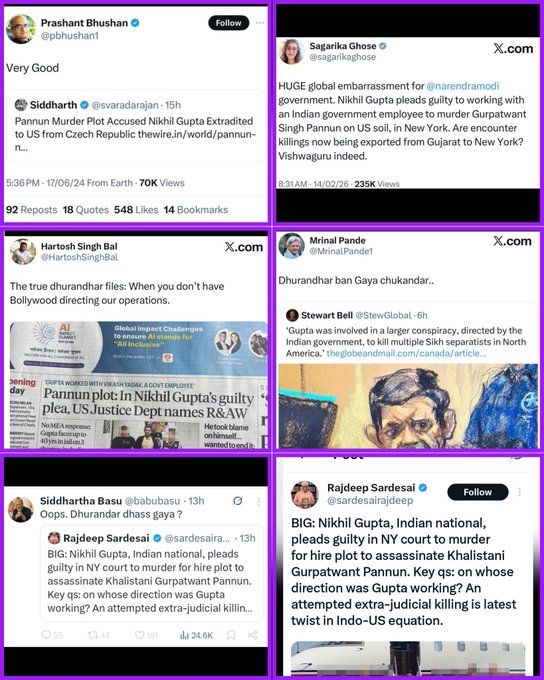
Ladies and gentlemen - this is an “Indian” journalist.
https://x.com/_sabanaqvi/status/2022646440754033014
@_sabanaqvi
The real Dhurandhar pleads guilty …
https://x.com/i/status/2023263502765535519
@rishibagree
This is the 0.5 front that Gen. Bipin Rawat ji has talked about in his The Two and a Half Front War.
@jai_a_dehadrai
Ladies and gentlemen - this is an “Indian” journalist.
https://x.com/_sabanaqvi/status/2022646440754033014
@_sabanaqvi
The real Dhurandhar pleads guilty …
https://x.com/i/status/2023263502765535519
@rishibagree
This is the 0.5 front that Gen. Bipin Rawat ji has talked about in his The Two and a Half Front War.
Last edited by uddu on 16 Feb 2026 19:25, edited 2 times in total.
Re: Modi 3.0 - Bharat
https://x.com/Shehzad_Ind/status/2023299668453818521
@Shehzad_Ind
Mani Shankar Aiyyar vs Congress escalates
Mani Aiyyar says to channels
- I’m in congress still
- pawan khera is tattu or puppet
- kc venugopal cannot remove me / kharge ji can
- Congress is bunch of competing scorpions
- I’m Gandhian nehruvian rajivian not Rahulian - whatever that means !
No confidence in rahul
First Uncle Mani
Then TMC
Then Bhupen Borah Assam PCC
@Shehzad_Ind
Mani Shankar Aiyyar vs Congress escalates
Mani Aiyyar says to channels
- I’m in congress still
- pawan khera is tattu or puppet
- kc venugopal cannot remove me / kharge ji can
- Congress is bunch of competing scorpions
- I’m Gandhian nehruvian rajivian not Rahulian - whatever that means !
No confidence in rahul
First Uncle Mani
Then TMC
Then Bhupen Borah Assam PCC
Re: Modi 3.0 - Bharat
https://x.com/i/status/2023110094679081180
@FinMinIndia
Union Minister for Finance and Corporate Affairs Smt. @nsitharaman is welcomed upon arrival by Ms. @GloriaGangte, Ambassador of India to Norway @IndiainNorway, at the Oslo Airport, Norway, today.
During her two-day visit in Oslo, the Union Finance Minister will call on Mr. Jonas Ghar Store, the Prime Minister of Norway; hold bilateral meetings with Norwegian Finance Minister Mr. Jens Stoltenberg and Minister for Trade and Industry Ms. Cecilie Myrseth besides engagements at the Oslo Science Park where she will interact with start-ups.
FM Smt. @nsitharaman will also hold a roundtable discussion with Norwegian CEO and Investors and engage with the diaspora at a community event.
@FinMinIndia
Union Minister for Finance and Corporate Affairs Smt. @nsitharaman is welcomed upon arrival by Ms. @GloriaGangte, Ambassador of India to Norway @IndiainNorway, at the Oslo Airport, Norway, today.
During her two-day visit in Oslo, the Union Finance Minister will call on Mr. Jonas Ghar Store, the Prime Minister of Norway; hold bilateral meetings with Norwegian Finance Minister Mr. Jens Stoltenberg and Minister for Trade and Industry Ms. Cecilie Myrseth besides engagements at the Oslo Science Park where she will interact with start-ups.
FM Smt. @nsitharaman will also hold a roundtable discussion with Norwegian CEO and Investors and engage with the diaspora at a community event.
Re: Modi 3.0 - Bharat
https://x.com/OfficeOfDGP/status/2023379282853281845
@OfficeOfDGP
Pick up any Hindu festival wish from this old man, you will never find him tweeting any Hindu deities picture
because in his religion it is prohibited
Do ur own research

@OfficeOfDGP
Pick up any Hindu festival wish from this old man, you will never find him tweeting any Hindu deities picture
because in his religion it is prohibited
Do ur own research
Re: Modi 3.0 - Bharat
VI@WA

At first I thought the author is critical of India-US trade deal, going by the graphic. Then I read on and realised it is a well researched analysis of the 'zero' tariff items that India has agreed to. Read on ...
How Modi Single-Handedly Destroyed Indian Agriculture by Letting Americans Sell Us What We Were Already Buying.
By A Concerned Citizen Who Passed Class 10 Economics
New Delhi, February 2026 – Breaking news from the parallel universe inhabited by India’s professional mourners: the sky is falling, the fields are burning, and the American imperialists have finally won. All because India has agreed to drop tariffs to zero on a handful of items in the new US-India trade framework. Yes, you heard that right — zero tariffs on things we have been importing for decades. Farmers are apparently committing mass suicide as we speak, or at least that’s what the usual suspects on Twitter and primetime television would have you believe.
Let us examine the crimes against Indian sovereignty, one apocalyptic item at a time.
Crime #1: Tree Nuts (Almonds, Walnuts, Pistachios)
For twenty years, India has produced roughly 10% of the almonds it consumes. The remaining 80–90% has come almost entirely from — brace yourselves — the United States. Yes, the same United States that Congress and Left intellectuals have been warning us about since the days of Nehru’s non-alignment cosplay. Now that the tariff is going to zero (it was already low), the opposition has discovered an overnight agricultural crisis. One wonders where these fierce defenders of the kisan (Farmers) were when 90% of our almonds were already American. Perhaps they were busy planting imaginary almond orchards in their Propagandic backyards.
Crime #2: Dried Distillers’ Grains (DDGs)
This is animal feed, ladies and gentlemen — essentially the protein shake for cows, poultry and our very own librandus ecosystem . Domestic production? Virtually non-existent outside the fever dreams of Congress and Left “virtual farmers” who produce it only to feed their own brainless livestock. Every tonne India actually uses has been coming from — surprise! — the United States. Now it will come with zero tariff instead of whatever negligible duty existed before. The horror. Somewhere a think-tank fellow is drafting a 47-page report on how this will wipe out India’s non-existent DDG farmers.
Crime #3: Soybean Oil
India is one of the world’s largest importers of edible oil, period. We buy massive quantities because we simply do not produce enough. Current sources: Argentina 40–50%, Brazil 30–40%, United States 10–15%. With zero tariff, the US share might go up a few points. This is apparently the death knell for Indian agriculture. Never mind that we were already importing the stuff in bulk; the crime is that a slightly larger slice might now come from America instead of South America. The same people who lecture us about climate change and food miles are suddenly outraged that we might buy from a closer supplier. Consistency is bourgeois, comrade.
Crime #4: Wine and Spirits
Premium imported liquor now faces zero tariff. Quick, somebody alert the fields! Indian vineyards are collapsing as we speak! Oh wait — there are no Indian vineyards producing single-malt scotch or Napa Valley cabernet. This is purely a luxury import for the elite. Yet the ecosystem that claims to speak for the downtrodden is clutching pearls over Glenfiddich prices. One suspects the real terror is that their own addas, powered by more democratically priced desi cholai, might cause Identical Crisis if someone orders an
imported whiskey. Perish the thought.
Crime #5: Certain Fresh and Processed Fruits (Blueberries, Cranberries, etc.)
These are low-volume, high-price luxury items. Domestic production? Effectively zero. Blueberries come mainly from Peru, Chile, and the US; cranberries from Peru, Chile, Canada, and the US. These fruits were already being imported; now they will be slightly cheaper for the tiny minority who eat them.
Yet the guardians of India’s agricultural soul are wailing as if Modi personally air-dropped American blueberries into every Indian village to poison the local amrood crop.
The mental gymnastics required to turn imported cranberries into an existential threat to the Indian farmer deserve an Olympic gold.
And there you have it — the complete list of “farmer-destroying” items in the deal.
Dairy? Protected. Apples? Protected. Poultry? Protected. Rice, wheat, pulses, most fruits and vegetables? All protected. But never let facts get in the way of a good hysteria.
This is not policy criticism; this is performance art by an ecosystem that has elevated brainless opposition into a profession. They do not care that sensitive sectors remain shielded. They do not care that India has been importing most of these items for decades. They only care that there is a headline, a hashtag, and a chance to scream “sellout” before anyone checks the actual list.
The real tragedy is not the trade deal. The real tragedy is that these people still have television panels, verified Twitter accounts, and the shamelessness to pose as defenders of the farmer while peddling lies so transparent they could be used as greenhouse plastic.
Indian agriculture faces genuine challenges — water scarcity, soil degradation, middlemen, lack of cold storage, and yes, sometimes unfair global trade rules. None of those problems are addressed by pretending that cheaper almonds and cranberries are the end of civilization.
Let’s not forget the cherry on this rotten cake: the same propaganda machine is now frantically trying to kiss Trump’s ass, breathlessly declaring him the “big winner” who “out-negotiated” India—just so they can paint Modi as the loser who “sold out” the nation. They are dying to pull him down, desperate for any narrative that sticks, and yet they fail—spectacularly, predictably, shamelessly—every single time.
So here’s to the professional mourners: keep bawling till you slip on your own crocodile tears, keep groveling till you face-plant right into Trump’s boots, keep flailing like drunk clowns in a circus tent on fire. The rest of us will be over here, sipping discounted imported whiskey, munching on luxury berries like they’re popcorn, and laughing as you trip over your own tangled web of lies—straight into a giant cream pie of reality.
Epic face-slap with extra custard. Encore, please—make it hurt more next time.
Re: Modi 3.0 - Bharat
https://x.com/ARanganathan72/status/1060785445536256000
He may have in Kodagu but he didn't in Karnataka.
This is Girish Karnad, the intellectual powerhouse of the Left, on Tipu Sultan. Leave alone History, the man doesn't even know his Geography.
This isn't just hatred for facts; this is hatred for India.

He may have in Kodagu but he didn't in Karnataka.
This is Girish Karnad, the intellectual powerhouse of the Left, on Tipu Sultan. Leave alone History, the man doesn't even know his Geography.
This isn't just hatred for facts; this is hatred for India.

Re: Modi 3.0 - Bharat
https://x.com/ProfVemsani/status/2022784285078343907
@ProfVemsani
Because once upon a time they taught Aurangzeb’s letters and writings in schools and colleges at Kakatiya university in Warangal … certainly a shock for them. It was considered a Leftist land
https://x.com/BattaKashmiri/status/2022628339186622749
@BattaKashmiri
Why are Liberandus crying and chest beating while watching this campus video
@ProfVemsani
Because once upon a time they taught Aurangzeb’s letters and writings in schools and colleges at Kakatiya university in Warangal … certainly a shock for them. It was considered a Leftist land
https://x.com/BattaKashmiri/status/2022628339186622749
@BattaKashmiri
Why are Liberandus crying and chest beating while watching this campus video
Re: Modi 3.0 - Bharat
Jana Gana Mana before India TP cricket match
https://x.com/i/status/2023113773146640816
@AdityaRajKaul
Powerful
https://x.com/i/status/2023113773146640816
@AdityaRajKaul
Powerful
Re: Modi 3.0 - Bharat

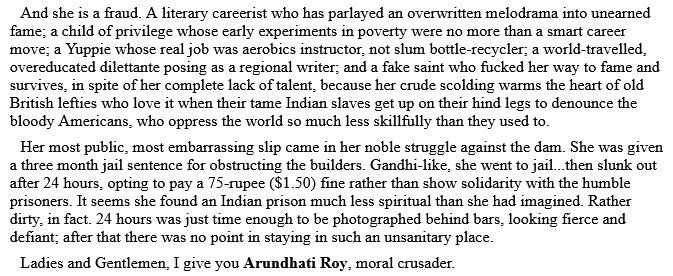
Aatish Taseer on Arundhati Roy.
Re: Modi 3.0 - Bharat
When PM Modi met the country’s brightest AI minds at India AI Impact Expo 2026
After the inauguration of the India AI Impact Expo 2026 at Bharat Mandapam in Delhi, Prime Minister Narendra Modi interacted with leading innovators and startups, witnessing groundbreaking AI solutions across sectors. The expo highlighted India’s growing strength in artificial intelligence and innovation. The PM encouraged innovators to build scalable, inclusive solutions.
After the inauguration of the India AI Impact Expo 2026 at Bharat Mandapam in Delhi, Prime Minister Narendra Modi interacted with leading innovators and startups, witnessing groundbreaking AI solutions across sectors. The expo highlighted India’s growing strength in artificial intelligence and innovation. The PM encouraged innovators to build scalable, inclusive solutions.
Re: Modi 3.0 - Bharat
Bharat’s Vision for AI in the Creative Economy
Had a conversation with Charles Rivkin, CEO of the Motion Picture Association (MPA).
Key Highlights:
Establishment of the Indian Institute of Creative Technologies (IICT) with advanced laboratories
Launch of Content Creator Labs across 15,000 schools and colleges
Reskilling, upskilling, and new skilling initiatives for a future-ready talent pipeline
Development of techno-legal solutions to balance copyright and innovation
Guardrails against misinformation, disinformation, and deepfakes
Importance of cultural context in global OTT platforms
Upcoming “Create in India” mission to strengthen the creative economy
Had a conversation with Charles Rivkin, CEO of the Motion Picture Association (MPA).
Key Highlights:
Establishment of the Indian Institute of Creative Technologies (IICT) with advanced laboratories
Launch of Content Creator Labs across 15,000 schools and colleges
Reskilling, upskilling, and new skilling initiatives for a future-ready talent pipeline
Development of techno-legal solutions to balance copyright and innovation
Guardrails against misinformation, disinformation, and deepfakes
Importance of cultural context in global OTT platforms
Upcoming “Create in India” mission to strengthen the creative economy
Re: Modi 3.0 - Bharat
52 Reforms in 52 Weeks | Cleaner general & reserved coaches | Transforming logistics landscape
Indian Railways has approved the first two reforms of its “52 reforms in 52 weeks” for 2026.
1st Railway Reform in 2026
Elevating passenger experience across general & reserved coaches through:
Cleaner coaches | Improved onboard services | Professional service delivery | Technology-driven monitoring
2nd Railway Reform in 2026
Tranforming India’s logistics landscape through:
Multi-modal connectivity | Cargo + processing hubs | Reduced logistics costs across the nation
Indian Railways has approved the first two reforms of its “52 reforms in 52 weeks” for 2026.
1st Railway Reform in 2026
Elevating passenger experience across general & reserved coaches through:
Cleaner coaches | Improved onboard services | Professional service delivery | Technology-driven monitoring
2nd Railway Reform in 2026
Tranforming India’s logistics landscape through:
Multi-modal connectivity | Cargo + processing hubs | Reduced logistics costs across the nation
Re: Modi 3.0 - Bharat
Snakecharming got a new meaning today
Tejasvi Surya Hosts US Ambassador Sergio Gore for Late-Night Auto Ride and Masala Dosa in Bengaluru
BJP MP Tejasvi Surya hosted the United States Ambassador to India, Sergio Gore, for a unique cultural experience in Bengaluru. The Ambassador, visiting the city for the first time, was seen 'soaking in the Bengaluru flavor' through a late-night ride in a 'Nama Auto' and enjoying a traditional masala dosa. During the interaction, Surya praised the Ambassador's efforts, stating, 'Thank you so much for what you are doing for the US-India relationship.' Surya described Bengaluru as 'India's best city' and its 'most happening city' while welcoming the diplomat. The footage captured the two leaders engaging in informal diplomacy, highlighting the strengthening ties between the two nations. The visit underscores the importance of Bengaluru as a hub for international relations and technological partnership, with the Ambassador experiencing the city's local lifestyle firsthand alongside the Bengaluru South representative.
Tejasvi Surya Hosts US Ambassador Sergio Gore for Late-Night Auto Ride and Masala Dosa in Bengaluru
BJP MP Tejasvi Surya hosted the United States Ambassador to India, Sergio Gore, for a unique cultural experience in Bengaluru. The Ambassador, visiting the city for the first time, was seen 'soaking in the Bengaluru flavor' through a late-night ride in a 'Nama Auto' and enjoying a traditional masala dosa. During the interaction, Surya praised the Ambassador's efforts, stating, 'Thank you so much for what you are doing for the US-India relationship.' Surya described Bengaluru as 'India's best city' and its 'most happening city' while welcoming the diplomat. The footage captured the two leaders engaging in informal diplomacy, highlighting the strengthening ties between the two nations. The visit underscores the importance of Bengaluru as a hub for international relations and technological partnership, with the Ambassador experiencing the city's local lifestyle firsthand alongside the Bengaluru South representative.