Why does India repeatedly face a dollar problem?
Because India, in many ways, followed the American model of growth

without possessing America’s greatest advantage: the US Dollar.
The United States could gradually move away from manufacturing because the Dollar became the world’s reserve and trade currency.
America could run large trade deficits, import goods from across the world, consume more than it produced, and still sustain prosperity because global demand for Dollars financed that model.
Over time, the US increasingly shifted:
from factories to finance
from production to consumption
from industrial capital to financial capital(this is important ton understand)
Its brightest minds moved towards finance, technology, consulting, and asset management rather than mass manufacturing.
Financial wealth became more rewarding than industrial production.
India, after liberalisation, slowly moved in a similar direction.
Privatisation, efficiency, profitability, ROE, EPS growth, shareholder value, and financial market expansion became the dominant economic language.
But India did not have what America had:
A reserve currency.
India cannot endlessly run trade deficits without consequences.
India cannot print globally demanded currency to finance imports.
India must continuously earn or attract Dollars.
And this is where the structural challenge begins.
India became a service and consumption economy before becoming a manufacturing powerhouse.
As manufacturing failed to dominate at scale, growth increasingly depended on:
-services
-domestic consumption
-capital inflows
-financialisation
-and rising asset prices
Meanwhile, China followed a very different path.
China became a manufacturing civilisation before becoming a consumption economy.
China focused relentlessly on:
-factories
-exports
-industrial ecosystems
-logistics
-supply chains
-infrastructure
-and production scale—> most important
For years, Chinese firms often operated with lower margins and lower returns on capital but with enormous focus on volume, exports, employment, and industrial depth.
China chased capacity.
India chased profitability.
China built factories.
India built financial markets.
China strengthened its ability to earn Dollars through exports.
India became dependent on attracting Dollars through capital flows.
And that is why every global shock oil spikes, wars, capital outflows, rising US yields, or risk aversion creates pressure on the Rupee and India’s external position.
Because India’s economic structure still depends heavily on foreign capital and imported energy, while its manufacturing base remains relatively shallow compared to China.
This is also why replacing China in manufacturing is extraordinarily difficult.
Manufacturing dominance cannot be built merely by optimising quarterly profits and market valuations.
It requires:
patient capital
large-scale production
lower short-term profitability
deep infrastructure
supply chain ecosystems
export competitiveness
and long-term industrial ambition
Perhaps India now faces a defining economic choice:
Can India become a true economic superpower primarily through consumption, services, finance, and rising stock markets?
Or must it reduce its obsession with margins, ROE, EPS growth, and financial engineering to build real industrial depth and manufacturing strength?
India’s only problem is-
It can’t earn dollars - it has to attract dollars and till than it will remain India’s weak link.
 Nominal do vary based on the USD-INR. While in GDP PPP we are at 19 Trillion USD economy and U.S is 32 Trillion USD. From 6 trillion in 2014 to 20 trillion by 2027 in GDP PPP. 3X. India also doubled Nominal GDP from 2 Trillion in 2014 to 4 Trillion in 2026.2X


 But there are 5 million people employed to drive this vehicle and 20% of intercity transportation happens today with these vehicles. I would simply encourage changing them electric and keep them until we figure out better jobs for those auto drivers. Banning them from highways is probably a good idea.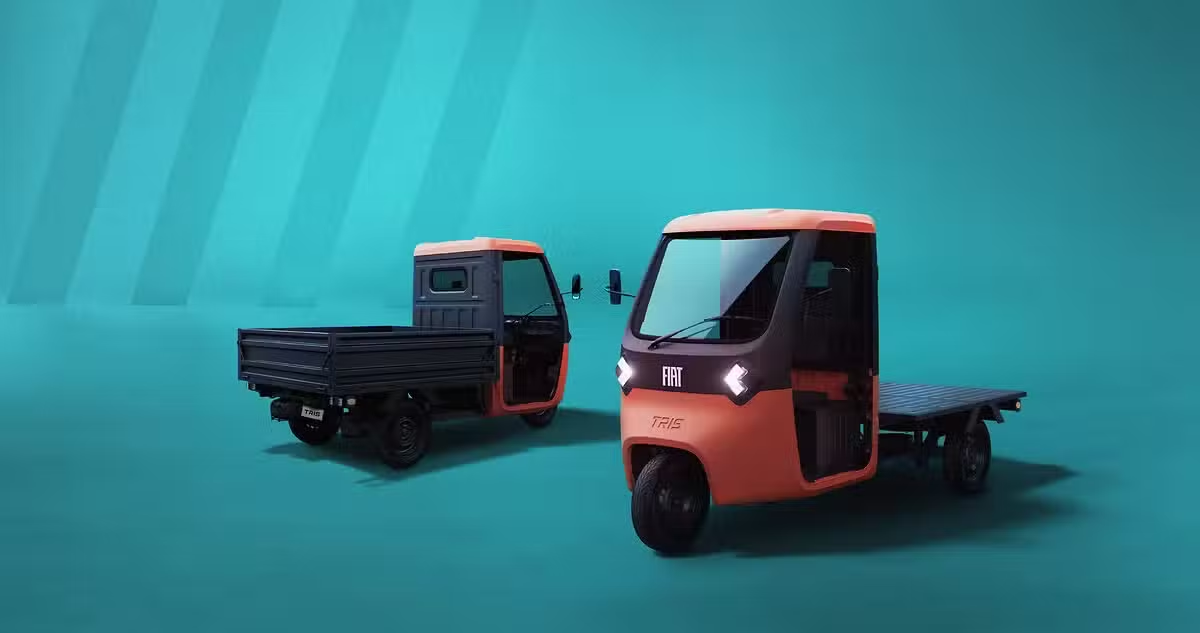

 without possessing America’s greatest advantage: the US Dollar.