https://x.com/i/status/2016910380690493652
@_TheTathya
India Blocks Starlink’s Direct-to-Phone Ambition: Gen-2 Satellite Signals Halted...
> India has rejected Starlink’s Gen-2 satellite application
> Gen-2 aimed to beam signals directly to mobile phones... no towers, no terminals
> Approval granted only for Gen-1 satellite broadband
What India Stopped... And Why It Matters
> Gen-2 would have bypassed India’s telecom networks entirely
> Used new frequency bands not yet cleared under Indian law
> Raised national security, interception, and spectrum control concerns
> Required a separate regulatory framework... which does not exist yet
Here's What India Allows
> Starlink Gen-1 approved for terminal-based satellite internet
> Requires ground stations + user dishes
> Same regulatory path as OneWeb and other satcom providers
> India is also building its own Direct-to-Device (D2D) framework
Satellite-to-phone sovereignty is non-negotiable... No foreign network will beam signals straight into Indian phones without rules.
Modi 3.0 - Bharat
Re: Modi 3.0 - Bharat
Good. I was against the approval of starlink for natsec reasons since the beginning. Even Gen 1 must be stopped.
Re: Modi 3.0 - Bharat
https://x.com/MeghUpdates/status/2016970706995859670
@MeghUpdates
BREAKING: PRICELESS STOLEN INDIAN ART TO BE RETURNED BACK!
Smithsonian's National Museum of Asian Art to return 3 priceless Chola-era bronze sculptures — including a stunning ~990 AD Shiva Nataraja — to India after provenance research confirmed they were illegally removed from Tamil Nadu temples decades ago and stolen.
One masterpiece (Shiva Nataraja) will stay on long-term loan for display in the US.


@MeghUpdates
BREAKING: PRICELESS STOLEN INDIAN ART TO BE RETURNED BACK!
Smithsonian's National Museum of Asian Art to return 3 priceless Chola-era bronze sculptures — including a stunning ~990 AD Shiva Nataraja — to India after provenance research confirmed they were illegally removed from Tamil Nadu temples decades ago and stolen.
One masterpiece (Shiva Nataraja) will stay on long-term loan for display in the US.
Re: Modi 3.0 - Bharat
uddu wrote: ↑30 Jan 2026 11:29 https://x.com/i/status/2016910380690493652
@_TheTathya
India Blocks Starlink’s Direct-to-Phone Ambition: Gen-2 Satellite Signals Halted...
<snip.,,
FWIW some comments:
This isn’t really “India blocking Starlink” as much as India saying: Gen-2 ≠ Gen-1, and the law isn’t ready yet.
Gen-2’s direct-to-phone model is a fundamentally different beast and from a regulator’s perspective, that’s not a routine approval — it’s a new category.
What’s telling is that India did approve Gen-1 under the same framework used for OneWeb and others.
This means - NOT anti-satellite per se -just unwilling to green-light a tech that jumps ahead of the regulatory stack
Note: India has explicitly said it’s working on a Direct-to-Device (D2D) framework. Once that exists, everyone (Starlink included) will be evaluated under the same rules.
So this is less about blocking ambition, and more about sequencing - infrastructure → law → spectrum → D2D.
--
Second point above, the sentiment is valid, but, IMO, the phrasing is stronger than what India has explicitly said.Satellite-to-phone sovereignty is non-negotiable... No foreign network will beam signals straight into Indian phones without rules.
Valid: India’s position ( across DoT / TRAI / NSCS discussions, is broadly )
-Any network that delivers signals directly to devices in India must be regulatable
(spectrum assignment, lawful interception, national security oversight etc)
- D2D satellite links cannot bypass Indian jurisdiction, even if the satellites are foreign-owned
So this principle is absolutely mainstream and non-controversial. (US, EU, Chinaholds the same line.)
IMO it overreaches - India has not formally declared:
“Satellite-to-phone sovereignty is non-negotiable” (as a doctrinal phrase)
or “No foreign network will beam signals straight into Indian phones” (blanket ban)
What India has actually said (implicitly, via approvals and refusals) is closer to:
Direct-to-device satellite services require a separate regulatory and spectrum framework, which is not yet in place.
That’s a procedural barrier, not an ideological veto.
If I had to tweet, I would say:
“
”India is unwilling to allow direct satellite-to-phone services that bypass domestic licensing, spectrum control, and lawful interception frameworks. Until a D2D regime exists, such services will not be permitted.
Re: Modi 3.0 - Bharat
Calling for a total ban on Starlink — including Gen-1 — isn’t really a reasonable position.
If the argument is national security, then you have to show why terminal-based satcom cannot be regulated at all, even with licensed gateways, Indian ground stations, lawful interception, data-localisation rules, and kill-switch controls. Just saying “foreign company = natsec risk” is not a policy argument.
India already allows satcom under strict conditions. That’s not naïveté — it’s risk management.
Gen-2 is different because direct-to-phone bypasses telcos, spectrum licensing, and interception frameworks entirely. Pausing that until a D2D regime exists makes sense. Stopping Gen-1 as well would mean rejecting all regulated satellite broadband, which is a much bigger—and largely self-defeating—claim.
The current approach is cautious, not weak:
.allow what can be regulated, pause what cannot (yet)
(Not quoting anyone or revealing off-record conversations. Just saying this matches the general technocratic mindset I’ve seen — cautious, sequencing-first, not anti-technology.)
Re: Modi 3.0 - Bharat
Also: operators pay thousands of crores as spectrum licence fees to the government. Why should someone get to use the spectrum for free just because it’s using a satellite? Any D2D venture will have to go through a similar auction or fee payment exercise before it will be allowed. Not to mention LI requirements.
Having said that Musk has a worrying tendency to think American laws apply everywhere, so just because it’s an American sat doesn’t mean he can dictate his laws around LI, which he will try for sure.
Having said that Musk has a worrying tendency to think American laws apply everywhere, so just because it’s an American sat doesn’t mean he can dictate his laws around LI, which he will try for sure.
Re: Modi 3.0 - Bharat
Anyone called VFS Global for any consular services? I called them to enquire about taking a pet with me to India. Their 800 said the call is chargeable after 7 minutes @ $2:45/minute. They wanted my CC no to begin the call. Also the free time is only once every 7 days. First I thought it is scam no I called. But I double checked. 800 320 9625.
Re: Modi 3.0 - Bharat
I have had cause to use them. They pretty much have a monopoly on these services I think. They are brutal about their fees and charges; for me its was their way or get stranded on the highway, but on the flip side they did not disppaoint me. A very successful business founded and owned by a desi bawa-ji if I am, correct. I could be wrong.saip wrote: ↑31 Jan 2026 04:18 Anyone called VFS Global for any consular services? I called them to enquire about taking a pet with me to India. Their 800 said the call is chargeable after 7 minutes @ $2:45/minute. They wanted my CC no to begin the call. Also the free time is only once every 7 days. First I thought it is scam no I called. But I double checked. 800 320 9625.
Re: Modi 3.0 - Bharat
Sharing - A memorable frame. Prime Minister's leadership and vision in strengthening India–EU research and innovation cooperation alongside the historic India–EU trade deal.
India-EU Summit PM,Shri Narendra Modi ji, Mr. António Costa ( President of the European Council),Ms. Ursula von der Leyen ,( President of the European Commission!) and DST Secretary Dr. Abhay Karandikar

India-EU Summit PM,Shri Narendra Modi ji, Mr. António Costa ( President of the European Council),Ms. Ursula von der Leyen ,( President of the European Commission!) and DST Secretary Dr. Abhay Karandikar
Re: Modi 3.0 - Bharat
https://x.com/i/status/2017298571645854165
@sidhant
Venezuela Prez Delcy Rodriguez says she had 'dialogue of deep human and spiritual connection' with Indian PM Modi earlier today
Venezuela readout
I had a fraternal telephone conversation with the Prime Minister of the Republic of India, Mr. Narendra Modi, in a dialogue of deep human and spiritual connection, in which we agreed to deepen and expand our bilateral partnership in all areas.
I thanked the supportive support of the Government and people of India to our country. Prime Minister Modi reiterated his willingness to accompany the Venezuelan people in defending their peace, sovereignty and independence.
We address strategic cooperation in energy, agriculture, science and technology, pharmaceutical industry, mining, automotive sector and tourism; and agreed to advance a common roadmap to relaunch our relations in 2026.

@sidhant
Venezuela Prez Delcy Rodriguez says she had 'dialogue of deep human and spiritual connection' with Indian PM Modi earlier today
Venezuela readout
I had a fraternal telephone conversation with the Prime Minister of the Republic of India, Mr. Narendra Modi, in a dialogue of deep human and spiritual connection, in which we agreed to deepen and expand our bilateral partnership in all areas.
I thanked the supportive support of the Government and people of India to our country. Prime Minister Modi reiterated his willingness to accompany the Venezuelan people in defending their peace, sovereignty and independence.
We address strategic cooperation in energy, agriculture, science and technology, pharmaceutical industry, mining, automotive sector and tourism; and agreed to advance a common roadmap to relaunch our relations in 2026.
Re: Modi 3.0 - Bharat
Video of court arguments
https://x.com/i/status/2017111461756358704
@DikshaKandpal8
So ragging was not even defined under the new UGC Guidelines. No provisions for ragging complaints. It used to be there in the old regulations, and conveniently removed from the new guidelines. Why? Why this deliberate removal of such a critical safeguard?
https://x.com/i/status/2017111461756358704
@DikshaKandpal8
So ragging was not even defined under the new UGC Guidelines. No provisions for ragging complaints. It used to be there in the old regulations, and conveniently removed from the new guidelines. Why? Why this deliberate removal of such a critical safeguard?
Re: Modi 3.0 - Bharat
https://x.com/i/status/2017219961685745865
@JethmalaniM
.
@Jairam_Ramesh I understand your frustration. You have no lived memory of a Prime Minister who worked relentlessly for the country rather than for a coterie. For decades, your party specialised in PMs who were corrupt, comatose, or compulsively saying “Yes, Madam.”
So when you see a Prime Minister like @narendramodi who sets the agenda, drives legislation, answers to the people directly, and treats Parliament as a place of accountability and worship - it feels alien. Work ethic can be unsettling if you’ve never encountered it.
@Jairam_Ramesh
He will not convene and chair all-party meetings to take the Opposition into confidence on national issues.
He will suddenly have Bills introduced at the last minute and bulldozed through Parliament without the necessary legislative scrutiny.
He will not sit in Parliament and respond to the concerns of Opposition Leaders, and will instead make election rally speeches in both Houses.
Before the beginning of each session he will give his usual hypocrisy-laden ‘desh ke naam sandesh’ with Parliament as his backdrop. Today’s performance is part of this series.
@JethmalaniM
.
@Jairam_Ramesh I understand your frustration. You have no lived memory of a Prime Minister who worked relentlessly for the country rather than for a coterie. For decades, your party specialised in PMs who were corrupt, comatose, or compulsively saying “Yes, Madam.”
So when you see a Prime Minister like @narendramodi who sets the agenda, drives legislation, answers to the people directly, and treats Parliament as a place of accountability and worship - it feels alien. Work ethic can be unsettling if you’ve never encountered it.
@Jairam_Ramesh
He will not convene and chair all-party meetings to take the Opposition into confidence on national issues.
He will suddenly have Bills introduced at the last minute and bulldozed through Parliament without the necessary legislative scrutiny.
He will not sit in Parliament and respond to the concerns of Opposition Leaders, and will instead make election rally speeches in both Houses.
Before the beginning of each session he will give his usual hypocrisy-laden ‘desh ke naam sandesh’ with Parliament as his backdrop. Today’s performance is part of this series.
Re: Modi 3.0 - Bharat
Starlink is an invented need. It seems the iranians have jammed it with chinese help during the latest attempt at a revolution. Bharat doesn't need to prove anything to anyone. We must have our own stringent natsec requirements, and it's up to the vendor to prove that their tech is compliant.
Re: Modi 3.0 - Bharat
The Russians are masters at it. They are fitting Starlink anetenna on drones and launching it on Ukrainian targets. And starlink works fine in Ukraine.
Russia is using Starlink to make its killer drones fly farther
https://edition.cnn.com/2026/01/29/euro ... ink-drones
Russia is using Starlink to make its killer drones fly farther
https://edition.cnn.com/2026/01/29/euro ... ink-drones
Re: Modi 3.0 - Bharat
The only sensible thing for Bharat to do is to allow a few terminals to understand the tech and prepare our own jamming capabilities and reverse engineer all possible elements and learn until we have our own satellite network at some point of time in future.
Re: Modi 3.0 - Bharat
Budget may see money purse opened for foreign purchases. But will there be something to fix the long pending requirements of our research and development needs?
https://x.com/Rethik_D/status/2017492086078177353
@Rethik_D
Speaking of Test facility, This is what DRDL is asking for Currently!

https://x.com/Rethik_D/status/2017492086078177353
@Rethik_D
Speaking of Test facility, This is what DRDL is asking for Currently!
Re: Modi 3.0 - Bharat
https://x.com/MEAIndia/status/2017625609493745846
@MEAIndia
Statement by the Official Spokesperson to clarify certain reports:
We have seen reports of an email message from the so-called Epstein files that has a reference to the Prime Minister and his visit to Israel. Beyond the fact of the Prime Minister’s official visit to Israel in July 2017, the rest of the allusions in the email are little more than trashy ruminations by a convicted criminal, which deserve to be dismissed with the utmost contempt.
https://x.com/i/status/2017621069558157632
@Mrsinha
1) The email is NOT about PM Modi.
The discussion is about Qatar and how it could improve relations with the West amid terrorism-financing allegations in 2017.
2) PM Modi is cited only as an example of strategic diplomacy, balancing ties with the USA and Israel.
3) PM Modi met Donald Trump on June 24, 2017, and visited Israel from July 3-6, 2017.
The email dated July 9, 2017 perfectly fits this timeline.
The phrase “danced and sang” is slang, used in casual, sloppy language, it simply means visible diplomatic outreach, not anything literal.
4) The mail does NOT say Modi took advice from Jeffrey Epstein.
“Modi took advice”, from whom?
No name is mentioned. That claim is invented.
5) The sender was a lobbyist. Lobbyists often exaggerate their influence to appear important. That does not make it true.
Try something better...!!!!
Congress as usual.
https://x.com/INCIndia/status/2017606087365824569
@INCIndia
Extremely shameful!!
Narendra Modi’s name has surfaced in the Epstein files. America’s serial rapist, child sex offender, and human trafficker Jeffrey Epstein wrote in an email on July 9, 2017:
“The Indian Prime Minister Modi took advice and danced and sang in Israel for the benefit of the US President. They had met a few weeks ago. IT WORKED!”
Epstein clearly states that Modi took advice from him and went to Israel, where he danced and sang for the benefit of the US President. He also said that it worked.
PM Modi was on a visit to Israel from July 4 to 6, 2017. Epstein wrote this email just three days later.
Just before the Israel visit, on June 25–26, 2017, Modi had met US President Donald Trump in America.
Connecting the dots in Jeffrey Epstein’s emails reveals that Modi went to America in June 2017 and took advice from Epstein there.
One week later (July 4 to 6, 2017), Modi arrived in Israel and, as per that advice, danced and sang there, and it WORKED!
Now it is clear that Prime Minister Modi has a very deep and long-standing connection with Jeffrey Epstein, which is shameful for India.
This is a matter of national dignity and international reputation, for which Prime Minister Modi must answer.
What kind of advice was Narendra Modi taking from Jeffrey Epstein?
Why was Modi dancing and singing in Israel? How did Trump benefit from it?
Epstein wrote, “IT WORKED!” So what does that mean?
PM Modi, the nation wants to know: What is your relationship with Jeffrey Epstein?
Link to the document on US Department of Justice Website:

@MEAIndia
Statement by the Official Spokesperson to clarify certain reports:
We have seen reports of an email message from the so-called Epstein files that has a reference to the Prime Minister and his visit to Israel. Beyond the fact of the Prime Minister’s official visit to Israel in July 2017, the rest of the allusions in the email are little more than trashy ruminations by a convicted criminal, which deserve to be dismissed with the utmost contempt.
https://x.com/i/status/2017621069558157632
@Mrsinha
1) The email is NOT about PM Modi.
The discussion is about Qatar and how it could improve relations with the West amid terrorism-financing allegations in 2017.
2) PM Modi is cited only as an example of strategic diplomacy, balancing ties with the USA and Israel.
3) PM Modi met Donald Trump on June 24, 2017, and visited Israel from July 3-6, 2017.
The email dated July 9, 2017 perfectly fits this timeline.
The phrase “danced and sang” is slang, used in casual, sloppy language, it simply means visible diplomatic outreach, not anything literal.
4) The mail does NOT say Modi took advice from Jeffrey Epstein.
“Modi took advice”, from whom?
No name is mentioned. That claim is invented.
5) The sender was a lobbyist. Lobbyists often exaggerate their influence to appear important. That does not make it true.
Try something better...!!!!
Congress as usual.
https://x.com/INCIndia/status/2017606087365824569
@INCIndia
Extremely shameful!!
Narendra Modi’s name has surfaced in the Epstein files. America’s serial rapist, child sex offender, and human trafficker Jeffrey Epstein wrote in an email on July 9, 2017:
“The Indian Prime Minister Modi took advice and danced and sang in Israel for the benefit of the US President. They had met a few weeks ago. IT WORKED!”
Epstein clearly states that Modi took advice from him and went to Israel, where he danced and sang for the benefit of the US President. He also said that it worked.
PM Modi was on a visit to Israel from July 4 to 6, 2017. Epstein wrote this email just three days later.
Just before the Israel visit, on June 25–26, 2017, Modi had met US President Donald Trump in America.
Connecting the dots in Jeffrey Epstein’s emails reveals that Modi went to America in June 2017 and took advice from Epstein there.
One week later (July 4 to 6, 2017), Modi arrived in Israel and, as per that advice, danced and sang there, and it WORKED!
Now it is clear that Prime Minister Modi has a very deep and long-standing connection with Jeffrey Epstein, which is shameful for India.
This is a matter of national dignity and international reputation, for which Prime Minister Modi must answer.
What kind of advice was Narendra Modi taking from Jeffrey Epstein?
Why was Modi dancing and singing in Israel? How did Trump benefit from it?
Epstein wrote, “IT WORKED!” So what does that mean?
PM Modi, the nation wants to know: What is your relationship with Jeffrey Epstein?
Link to the document on US Department of Justice Website:
Re: Modi 3.0 - Bharat
Budget 2026: In a first, Nirmala Sitharaman to spotlight Part B as reform roadmap
https://www.indiatoday.in/business/budg ... 2026-01-31
Finance Minister Nirmala Sitharaman's ninth Union Budget marks a strategic shift by emphasising Part B to outline India's economic vision and reform agenda.
Finance Minister Nirmala Sitharaman’s ninth consecutive Union Budget is set to break with long-standing convention, with Part B of her Budget speech emerging as the main platform for outlining India’s economic vision and reform agenda, according to government sources.
https://www.indiabudget.gov.in/
https://www.indiatoday.in/business/budg ... 2026-01-31
Finance Minister Nirmala Sitharaman's ninth Union Budget marks a strategic shift by emphasising Part B to outline India's economic vision and reform agenda.
Finance Minister Nirmala Sitharaman’s ninth consecutive Union Budget is set to break with long-standing convention, with Part B of her Budget speech emerging as the main platform for outlining India’s economic vision and reform agenda, according to government sources.
https://www.indiabudget.gov.in/
Re: Modi 3.0 - Bharat
no need to allow ., the terminals and electronics are available off market ., for understanding how to jam / intercept , need to study starlink satellites , not sure they can hop frequencies
direct to phone is same as a satellite phone, which is banned in india for unlicensed users
Re: Modi 3.0 - Bharat
I think, people are mixing up two very different things: learning the tech and allowing commercial rollout.drnayar wrote: ↑31 Jan 2026 23:17no need to allow ., the terminals and electronics are available off market ., for understanding how to jam / intercept , need to study starlink satellites , not sure they can hop frequencies
direct to phone is same as a satellite phone, which is banned in india for unlicensed users
India doesn’t need to approve consumer Starlink terminals to study the system, spectrum behaviour, or security risks. That’s already a sovereign capability and is done off-market.
Granting retail access just to “understand” the tech makes no sense. (neither useful or necessary)
Policy is about who gets to deploy at scale.
Gen-1 fits existing satcom rules: licensed gateways, interception, shutdown controls. Gen-2 D2D is effectively mass satellite telephony — different spectrum, different scale, different risk — and India doesn’t yet have a framework for that. (As DrNayar said - No satellite phone use in India, without prior approval, and even possession can be a legal risk.)
So treating Gen-1 and Gen-2 differently isn’t inconsistency or fear. It’s basic regulatory hygiene:
"Allow what can be governed, pause what can’t (yet)"
Amber G.
Re: Modi 3.0 - Bharat
^^^ Added some technical points - to answer explicitly to be helpful - can be ignored if not interested.
@cyrano - “Allow a few terminals to learn, jam, reverse-engineer, prepare”
The intent — understand the technology before deciding long-term policy — is sensible and we routinely do controlled pilots, testbeds, and evaluations of new comms tech. Also building defensive awareness (spectrum behavior, resilience, failure modes) is legitimate. But “allow terminals so we can jam / reverse engineer” is not how states actually do this. India does not need commercial approval to study a foreign systems.
India does this via defence labs, spectrum agencies, and space command structures, not retail terminals.
- “Reverse engineering” via civilian deployment looks legally messy, operationally unnecessary and rhetorically alarming.
Controlled Technical evaluation by state agencies is useful. Commercial rollout is not required for that.
DrNayar - “No need to allow anything; terminals are off-market; study satellites; D2P = satellite phone”
This is well said and I agree.
- You don’t need commercial permission to understand the tech at a sovereign level.
- Studying space-segment behavior matters more than consumer terminals.
- India already treats satellite phones as licensed-only — so D2P being tightly controlled is consistent with precedent.
What I think is a little oversimplification:
-Saying “D2P is the same as satellite phones” is policy-useful but technically incomplete. (D2P targets mass consumer devices, not niche handsets with different spectrum coordination and interference implications)
-- In short
India’s real choice is not: allow terminals vs ban terminals or learn vs not learn
It’s:
Commercial consumer deployment is a policy decision.
Technical understanding is a sovereign capability and does not require market access.
Study quietly, License cautiously and delay mass-market changes until law + spectrum + security frameworks exist. (And i think at present with Modi's leadership and good technical ministers we are at a good spot )
)
@cyrano - “Allow a few terminals to learn, jam, reverse-engineer, prepare”
The intent — understand the technology before deciding long-term policy — is sensible and we routinely do controlled pilots, testbeds, and evaluations of new comms tech. Also building defensive awareness (spectrum behavior, resilience, failure modes) is legitimate. But “allow terminals so we can jam / reverse engineer” is not how states actually do this. India does not need commercial approval to study a foreign systems.
India does this via defence labs, spectrum agencies, and space command structures, not retail terminals.
- “Reverse engineering” via civilian deployment looks legally messy, operationally unnecessary and rhetorically alarming.
Controlled Technical evaluation by state agencies is useful. Commercial rollout is not required for that.
DrNayar - “No need to allow anything; terminals are off-market; study satellites; D2P = satellite phone”
This is well said and I agree.
- You don’t need commercial permission to understand the tech at a sovereign level.
- Studying space-segment behavior matters more than consumer terminals.
- India already treats satellite phones as licensed-only — so D2P being tightly controlled is consistent with precedent.
What I think is a little oversimplification:
-Saying “D2P is the same as satellite phones” is policy-useful but technically incomplete. (D2P targets mass consumer devices, not niche handsets with different spectrum coordination and interference implications)
-- In short
India’s real choice is not: allow terminals vs ban terminals or learn vs not learn
It’s:
Commercial consumer deployment is a policy decision.
Technical understanding is a sovereign capability and does not require market access.
Study quietly, License cautiously and delay mass-market changes until law + spectrum + security frameworks exist. (And i think at present with Modi's leadership and good technical ministers we are at a good spot
)Re: Modi 3.0 - Bharat
"Ministry of Defence allocated an all-time high of Rs 7.85 lakh crore in Union Budget 2026-27, 15% higher over Budgetary Estimates of FY 2025-26
Record Rs 2.19 lakh crore allocated under Capital Head; Quantum leap of 24% in the Capital Acquisition budget
Rs 1.39 lakh crore allocated for domestic industries, including private players"
https://www.pib.gov.in/PressReleasePage ... g=3&lang=1
Record Rs 2.19 lakh crore allocated under Capital Head; Quantum leap of 24% in the Capital Acquisition budget
Rs 1.39 lakh crore allocated for domestic industries, including private players"
https://www.pib.gov.in/PressReleasePage ... g=3&lang=1
Re: Modi 3.0 - Bharat
We are in agreement then!
Re: Modi 3.0 - Bharat
Post Operation Sindoor push: Defence budget jumps 15% to Rs 7.85 lakh crore; what’s in the pipeline for India’s military
From: Times Of IndiaNEW DELHI: The Union Budget 2026 has set aside Rs 7.85 lakh crore for defence, marking a sharp 15 per cent jump from Rs 6.81 lakh crore last year, as the government sharpens its focus on military modernisation in the post Operation Sindoor security environment.
According to official figures, the defence outlay for 2026–27 stands at Rs 7,84,678 crore, compared with Rs 6,81,210 crore in the previous financial year. Of this, the capital outlay has been pegged at Rs 2,19,306 crore, while revenue expenditure stands at Rs 5,53,668 crore, including Rs 1,71,338 crore for pensions.
The armed forces will receive Rs 2.19 lakh crore for modernisation, with allocations including Rs 63,733 crore for aircraft and aero engines and Rs 25,023 crore for the naval fleet. The defence ministry has several major projects in the pipeline, including contracts for fighter jets, submarines, unmanned systems and helicopters.
In comparison, the capital outlay in 2025–26 was pegged at Rs 1,80,000 crore, later raised to Rs 1,86,454 crore at the revised estimate stage.
In her budget speech, finance minister Nirmala Sitharaman proposed exempting basic customs duty on components and parts required for the manufacture of civilian, training and other aircraft. She also announced the waiver of basic customs duty on raw materials imported for the manufacture of aircraft parts used for maintenance, repair or overhaul by defence sector units, a move expected to provide a boost to the defence aerospace industry.
Meanwhile, the defence services (Revenue) and Capital Outlay were allocated Rs 3,65,478.98 crore and Rs 2,19,306.47 crore, reflecting jumps of 17.24 per cent and 21.84 per cent, respectively.
In a boost to the defence sector, Sitharaman announced, “It is proposed to exempt basic customs duty on raw materials imported for the manufacture of parts of aircraft to be used in maintenance, repair or overall requirements by units in the defence sector.”
What’s in the pipeline for India’s defence in 2026–27
Rafale jets and Su-57: Two parallel paths for India’s future fighter fleet
India’s fighter aircraft pipeline for 2026–27 is being shaped by two parallel and strategically distinct tracks: a large-scale expansion of the Rafale fleet through indigenous manufacturing, and renewed technical talks with Russia on the fifth-generation Su-57, even as New Delhi keeps its long-term focus on homegrown programmes.
On the western front, the defence ministry is preparing to take up a Rs 3.25 lakh crore proposal to acquire 114 Rafale fighter jets from France, a deal that would become India’s largest-ever defence procurement if cleared. Under the proposal, most of the aircraft would be manufactured in India under a government-to-government agreement, with around 30 per cent indigenous content initially, a figure officials say could rise to over 60 per cent during production. The plan also includes 12 to 18 Rafales in fly-away condition to meet the Indian Air Force’s immediate operational needs. If approved, the deal would take the total number of Rafales in Indian service to 176, including 36 already inducted by the IAF and 26 Rafale-M jets ordered for the Navy. India has also sought integration of indigenous weapons and systems on the aircraft, though source codes will remain with the French side. The push comes amid reports that Rafales performed effectively during Operation Sindoor, particularly against advanced Chinese air-to-air missiles using the Spectra electronic warfare suite. France is also planning a maintenance, repair and overhaul facility for Rafale M-88 engines in Hyderabad, with Indian private sector participation.
Running in parallel is Russia’s renewed pitch for the Su-57, its fifth-generation stealth fighter, after years of dormancy following India’s exit from the earlier FGFA programme. Senior Russian aerospace officials have said that technical consultations with India are at an advanced stage, including discussions on licensed production of the export variant Su-57E in India at facilities currently manufacturing the Su-30MKI. According to United Aircraft Corporation CEO Vadim Badekha, the talks also cover maximum use of Indian industry and Indian systems, signalling Moscow’s attempt to re-enter India’s fighter ecosystem as New Delhi evaluates multiple options for future air combat capability. Russia has also offered assistance in India’s indigenous AMCA programme, positioning the Su-57 as both a near-term capability and a technology bridge.
Despite offers from both Russia and the United States, including the F-35, India continues to prioritise the Rafale for near-term induction while keeping discussions on fifth-generation platforms open. Officials indicate that the Indian Air Force’s future fighter fleet will likely rest on a mix of Su-30MKI upgrades, an expanded Rafale fleet, large-scale induction of LCA Mk1A, and the indigenous AMCA beyond 2035, with the 2026–27 budget cycle marking a decisive phase in shaping that trajectory.
Submarine development and Project 75(I): India’s $8 billion undersea capability leap
Project 75(I) is emerging as one of India’s most consequential defence programmes for 2026–27, with India and Germany close to signing an estimated $8 billion (around Rs 70,000–72,000 crore) deal to build six next-generation conventional submarines for the Indian Navy. Negotiations have reached an advanced stage and the pact is expected to be finalised by March-end, making it India’s largest-ever defence contract, surpassing even the 2016 Rafale deal.
The long-delayed Project 75(I) is designed to address the rapid ageing of India’s conventional submarine fleet and to strengthen maritime deterrence at a time when China and Pakistan are expanding their undersea presence in the Indian Ocean Region. The programme focuses on diesel-electric attack submarines fitted with fuel-cell-based air-independent propulsion (AIP), a capability that allows submarines to remain submerged for weeks rather than days, drastically reducing detection risks.
Under the proposed arrangement, Germany’s ThyssenKrupp Marine Systems (TKMS) will partner with Mazagon Dock Shipbuilders Ltd (MDL) to build all six submarines in India under the Strategic Partnership model. The selected platform is the German Type-214 Next Generation submarine, which edged out Spain’s S-80 Plus primarily due to the maturity and operational reliability of its AIP technology, acoustic stealth and lower lifecycle risk. Indigenous content is expected to begin at 45 per cent and rise to nearly 60 per cent by the final boat, in line with the government’s Make in India and Atmanirbhar Bharat goals.
The programme, approved by the defence acquisition council in 2014 and formally tendered through an RFP in July 2021, also envisages deep technology transfer, long-term industrial collaboration and the creation of a domestic submarine-building ecosystem. Beyond shipyards, the project is expected to benefit MSMEs through manufacturing of spares, sensors, combat systems and associated equipment, giving a sustained boost to India’s naval industrial base.
For the Indian Navy, Project 75(I) is a critical capability upgrade. India currently operates around a dozen Russian-origin submarines and six French-built Scorpène-class boats, even as undersea activity by China’s PLA Navy and Pakistan’s Navy intensifies across the Indo-Pacific. The induction of six advanced AIP-equipped submarines is expected to significantly enhance sea denial, surveillance and deterrence, reshaping the regional balance under the waterline.
The push behind Project 75(I) also aligns with India’s broader naval indigenisation drive. Under the Indian Naval Indigenisation Plan 2015–2030, 51 large vessels worth nearly Rs 90,000 crore are already under construction in Indian shipyards, with over 40 indigenous warships and submarines delivered since 2014. Against this backdrop, Project 75(I) stands out as the centrepiece of India’s undersea warfare roadmap for the coming decade.
Naval unmanned platforms and coastal security: India’s leap into autonomous maritime warfare
India’s coastal and near-sea security architecture is set for a major upgrade in 2026–27 with the induction of the country’s first autonomous weaponised unmanned fast interceptor crafts (FICs) into the Indian Navy, marking a decisive shift towards network-centric and unmanned maritime operations.
The Navy is preparing to deploy the first batch of two weaponised unmanned interceptor crafts, developed and manufactured entirely in India by Pune-based Sagar defence Engineering, with deployment planned along the western seaboard, according to official sources. The induction will place India in a select global club of nations capable of developing and operating weaponised unmanned vessel swarms, a capability that has so far been limited to a handful of advanced naval powers.
The Navy had placed an order for 12 such interceptor crafts under a contract signed on January 5, 2022, as part of the iDEX–defence Innovation Organisation framework, aimed at promoting indigenous defence technologies. Until now, the Navy has relied largely on Israel-made unmanned surface vessels, primarily restricted to mine counter-measure roles, making the FIC programme a major expansion in scope and capability.
The unmanned interceptor craft is equipped with a 12.7 mm gun for close-range engagements and has the capability to deploy short-range missiles and loitering munitions, allowing it to counter asymmetric maritime threats, fast attack boats and hostile surface targets. A key operational advantage lies in its swarm capability, where multiple crafts can be controlled from a single command-and-control station, enabling force multiplication while significantly reducing risk to human operators.
One of the most critical features of the platform is its ability to operate in a GPS-denied and electronic warfare environment. Advanced navigation and control systems allow the craft to continue missions even when satellite signals are disrupted, ensuring resilience during high-intensity conflict scenarios. With an endurance of over 48 hours at sea, the craft provides sustained surveillance and patrol capability, strengthening maritime domain awareness along India’s extensive coastline.
Despite being unmanned, the interceptor craft retains operational flexibility, with the ability to carry more than 14 personnel for specific missions, including special operations, rapid insertion, evacuation or boarding tasks. Its layered weapons architecture and operational range of over 400 nautical miles, or roughly 800 km, make it suitable for extended patrols, coastal defence and quick-response roles in sensitive maritime zones.
The induction of these autonomous interceptor crafts aligns with India’s broader push towards self-reliance in defence manufacturing and reflects a strategic pivot towards autonomous, networked and unmanned warfare, an area increasingly shaping modern naval doctrine. As the Navy expands its unmanned surface fleet in the coming years, such platforms are expected to play a central role in securing India’s coastline, ports and offshore assets while redefining maritime operations in the Indian Ocean region.
Capital outlay fuels modernisation, indigenisation across air, land and sea
The Union Budget 2026 sharpens India’s defence modernisation push, with higher capital outlay directed towards missiles, UAVs, next-generation drones, advanced radars, air defence systems and network-centric warfare capabilities. Customs duty exemptions on aircraft components and raw materials for maintenance, repair and overhaul are expected to lower costs, attract private investment and deepen the domestic aerospace ecosystem under Make in India. Since January 2025, the Defence Acquisition Council has approved capital acquisitions worth over Rs 3.84 lakh crore, spanning missiles, electronic warfare systems, drones, artillery, armoured vehicles and air defence platforms across all three services.
Naval expansion, helicopters and frontline systems get major boost
India’s maritime and expeditionary capabilities are set to expand after the DAC cleared procurement proposals worth around Rs 79,000 crore, including large amphibious warships, landing platform docks, naval guns and support vessels, alongside anti-tank missiles, high-mobility vehicles and long-range drones. The modernisation roadmap also prioritises 156 Light Combat Helicopters (LCH) Prachand for the Army and Air Force, designed for high-altitude operations with over 65% indigenous content, as well as expanded induction of armed drones, surveillance UAVs and counter-drone systems. Smaller but critical deals, including 4.25 lakh carbines for the Army and 48 heavyweight Black Shark torpedoes for the Navy, are aimed at closing frontline capability gaps.
Indigenous aerospace, missiles and manufacturing ecosystem gathers momentum
India’s long-term air combat plans remain anchored in indigenous programmes led by the LCA Tejas Mk1A and the Advanced Medium Combat Aircraft (AMCA). Contracts for 97 additional LCA Mk1A jets, featuring over 64% indigenous content, are in place with deliveries from 2027–28, while the AMCA execution model has opened development to both public and private Indian firms. HAL has expanded production capacity by operationalising a third LCA Mk1A line and a second HTT-40 trainer line, raising Tejas output to 24 aircraft annually. Parallelly, ammunition self-reliance has accelerated, with 32 variants worth Rs 15,899 crore offered for long-term domestic production, most expected to be indigenised by 2027–28. The BrahMos Integration and Testing Facility in Lucknow has begun missile dispatches, reinforcing India’s end-to-end missile manufacturing capability. Overall, 193 defence contracts worth over Rs 2.09 lakh crore were signed in 2024–25, with 92% awarded to domestic industry, marking a decisive shift towards a robust public-private defence manufacturing ecosystem.
Re: Modi 3.0 - Bharat
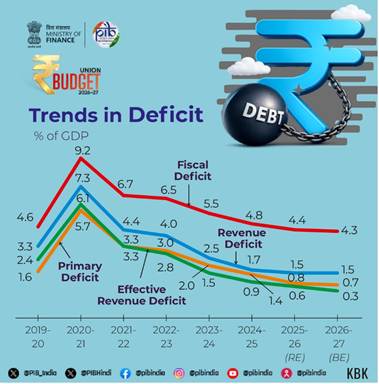
from:
INDIA ON TRACK TO REACH DEBT-TO-GDP RATIO OF 50±1 PERCENT BY 2030-31
https://www.pib.gov.in/PressReleasePage ... g=3&lang=1
Fiscal Deficit = Total Expenditure − (Revenue Receipts + Non‑Debt Capital Receipts)
- It represents the total borrowing requirement of the government in a year.
Total Expenditure = Revenue Expenditure + Capital Expenditure (creation. of assets, repayment of principal amounts of past loans).
Primary Deficit = Fiscal Deficit − Interest Payments
- It measures how much the government is borrowing excluding the burden of past debt.
Revenue Deficit = Revenue Expenditure − Revenue Receipts
- It shows whether the government’s day‑to‑day expenses (salaries, pensions, subsidies, interest, administration, etc.) are being met by its regular income (tax + non‑tax revenue).
Effective Revenue Deficit = Revenue Deficit − Grants for Capital Creation
- Some “revenue expenditure” is actually used to create assets, especially when the Union Government gives grants to states for building infrastructure (roads, irrigation, schools, etc.). The effective revenue deficit removes these asset‑creating grants from the revenue deficit.
The Financial Express goes into some analysis here:
Budget 2026: What is the debt-to-GDP ratio? Why the government is focusing on it
Unlike a one-year fiscal deficit number, the debt-to-GDP ratio gives a clearer picture of the government’s overall financial health.
https://www.financialexpress.com/policy ... opilot.com
for which AI gives this summary:
India’s deficit profile is neither alarming nor exemplary:
- Stronger than high‑deficit emerging markets (Brazil, South Africa).
- Weaker than fiscally conservative Asian peers (Indonesia, Thailand).
- Revenue deficit remains India’s biggest structural weakness.
- Fiscal consolidation to 4.4% keeps India in a stable, credible zone for investors.
Re: Modi 3.0 - Bharat
BJP’s Shehzad Poonawalla Puts DMK Spox Saravanan Annadurai On The Spot On Budget Debate
During a heated Budget 2026 debate, BJP’s Shehzad Poonawalla put DMK spokesperson Saravanan Annadurai on the spot with a pointed question, triggering laughter across the panel. Watch the moment that stole the spotlight on Times Now.
During a heated Budget 2026 debate, BJP’s Shehzad Poonawalla put DMK spokesperson Saravanan Annadurai on the spot with a pointed question, triggering laughter across the panel. Watch the moment that stole the spotlight on Times Now.
Re: Modi 3.0 - Bharat
India Budget 2026 Explained: The 10 Big Takeaways | Vantage with Palki Sharma | N18L
India’s Budget 2026 is out, and it walks a careful tightrope. Finance Minister Nirmala Sitharaman has doubled down on infrastructure spending while reiterating the government’s commitment to fiscal discipline. The focus is on sustaining growth amid global uncertainty, even as borrowing remains elevated and external pressures mount. There are no headline-grabbing tax cuts or overtly populist moves. Instead, the budget leans heavily toward manufacturing, logistics, and long-term economic stability. The big question, however, is whether this strategy can withstand rising global trade tensions and deliver enough jobs at home. We break down the priorities, policy signals, and risks embedded in Budget 2026.
India’s Budget 2026 is out, and it walks a careful tightrope. Finance Minister Nirmala Sitharaman has doubled down on infrastructure spending while reiterating the government’s commitment to fiscal discipline. The focus is on sustaining growth amid global uncertainty, even as borrowing remains elevated and external pressures mount. There are no headline-grabbing tax cuts or overtly populist moves. Instead, the budget leans heavily toward manufacturing, logistics, and long-term economic stability. The big question, however, is whether this strategy can withstand rising global trade tensions and deliver enough jobs at home. We break down the priorities, policy signals, and risks embedded in Budget 2026.
Re: Modi 3.0 - Bharat
Sanjeev Sanyal Decodes Fiscal Budget 2026 I Nirmala Sitharaman
-
Prem Kumar
- BRF Oldie
- Posts: 4744
- Joined: 31 Mar 2009 00:10
Re: Modi 3.0 - Bharat
Looks like ex-COAS Navarane is shooting his mouth off in his memoir. This was one of the import-bahadurs who loved to talk about 6th gen warfare and generally make controversial statements
Now, idiot Rahul has picked up on it
Serves Modi & Rajnath right - they haven't fixed the line of succession in the Armed Forces, which ensures that bahadurs get serially promoted to Chiefs. Atmanirbhar is dead on arrival if you cannot clean up the organization & promote the right people
Now, idiot Rahul has picked up on it
Serves Modi & Rajnath right - they haven't fixed the line of succession in the Armed Forces, which ensures that bahadurs get serially promoted to Chiefs. Atmanirbhar is dead on arrival if you cannot clean up the organization & promote the right people
Re: Modi 3.0 - Bharat
Youth Dialogue on Budget 2026-27 | Special Broadcast
Re: Modi 3.0 - Bharat
Parliament Storm: Rahul Gandhi Cites Ex Army Chief Naravane’s Book; Amit Shah, Rajnath Singh Respond
Massive uproar erupted in Parliament after Rahul Gandhi mentioned former Army Chief General MM Naravane’s book during a discussion. Defence Minister Rajnath Singh and Home Minister Amit Shah strongly countered Rahul Gandhi, triggering a heated political exchange.
Massive uproar erupted in Parliament after Rahul Gandhi mentioned former Army Chief General MM Naravane’s book during a discussion. Defence Minister Rajnath Singh and Home Minister Amit Shah strongly countered Rahul Gandhi, triggering a heated political exchange.
Re: Modi 3.0 - Bharat
Fuel Switch Moves From 'Run to Cutoff' on Air India Boeing 787-8 London Heathrow-Bengaluru Flight, Plane Grounded
Reported by: Shafali NigamEdited by: Shashwat Bhandari
Feb 2, 2026, 19:04 IST
Air India has grounded one of its Boeing 787-8 aircraft following a pilot's report concerning a potential issue with the fuel control switch. The airline is prioritizing the investigation and has involved the Original Equipment Manufacturer (OEM) to address the pilot's concerns.
https://www.timesnownews.com/india/air- ... -153548947
https://www.ndtv.com/india-news/air-ind ... Bengaluru.
https://www.republicworld.com/india/fue ... regulators
watch videoRepublic@republic
#BreakingNews | Similarities in AI171 crash and AI1321 incident, Safety Matters Foundation writes to regulators; calls for probe over fuel system.
https://x.com/i/status/2018302658759852326
Re: Modi 3.0 - Bharat
How can you get the unpublished Naravane’s book, only words I heard from RG's speech was Kailash range and some meters away.
- Wonder why the book is not being allowed to be published
- What is the Govt. (Rajnath Singh, and the rest)trying to hide
- BJP following Cong. policies
- If the book cannot to be published in India it can be published outside India
- People need to know the truth/reality
Re: Modi 3.0 - Bharat
“India Opened Fire; China Realised They Made a Mistake” Ex-Army Chief Gen. M. M. Naravane
Galwan clash truth explained! Ex-Army Chief Gen MM Naravane reveals what really happened at LAC
Galwan clash truth explained! Ex-Army Chief Gen MM Naravane reveals what really happened at LAC
Re: Modi 3.0 - Bharat
Can any one summarise the key findings of this Naravane issue (and his unpublished book)? It seems as per Defence Service rules, defence officials need to get written approval from Union Govt to publish memoirs etc. And looks like such an approval has not been given. Then on what basis is Pappu Ghandi making big noise in Parliament?
100% agreed. Especially after the UGC equity committee debacle, I am now really getting a feeling that BJP & Modi are now becoming another version of Congress (and to keep in step, Congress moving towards being a Muslim League).VinodTK wrote:How can you get the unpublished Naravane’s book, only words I heard from RG's speech was Kailash range and some meters away.
Wonder why the book is not being allowed to be published... What is the Govt. (Rajnath Singh, and the rest)trying to hide.. BJP following Cong. policies
Re: Modi 3.0 - Bharat
From: Indian Express
What Gen Naravane’s memoir says about 2020 Ladakh face-off with China: ‘I had been handed a hot potato’
What Gen Naravane’s memoir says about 2020 Ladakh face-off with China: ‘I had been handed a hot potato’
Proceedings in the Lok Sabha were disrupted on Monday after Leader of Opposition (LoP) Rahul Gandhi was not allowed to quote from the unpublished memoir of former Army chief General M M Naravane, with the government saying it is against parliamentary rules.
In Four Stars of Destiny, Gen Naravane, who was the Army chief from 2019 to 2022, mentions the conversations he had with the Defence Minister on the night of August 31, 2020, following the movement of Chinese PLA tanks and troops in Rechin La on the Line of Actual Control in eastern Ladakh. The LoP said he wanted to quote excerpts of the book from an article in The Caravan magazine, while responding to BJP MP Tejasvi Surya for allegedly “questioning the patriotism” of the Congress.
The book was slated to hit the stands in January 2024, but The Indian Express reported at the time that it was under review by the Indian Army and that its publisher, Penguin Random House, had been asked not to share excerpts or soft copies of the book until the review was over. The Ministry of Defence was also said to be involved in the exercise “at some level”.
The vetting has been underway since then, and there has been no official word from the publisher, the author, or the MoD on the status of the book. The Indian Express reached out to Penguin Random House publisher Milee Ashwarya and Gen Naravane, but did not receive a response.
What happened on August 31, 2020
General Naravane first received a call from Northern Command chief, Lt Gen Y K Joshi. “At 2015 hours on the evening of 31 August, Jo (Lt Gen Joshi) rang me up, quite worried. He reported that four tanks supported by infantry had slowly started moving up the track towards Rechin La … They had fired an illuminating round but this had had no effect. I had clear orders not to open fire, ’till cleared from the very top’,” he writes.
Gen Naravane says he then called up the Defence Minister, External Affairs Minister S Jaishankar, National Security Advisor Ajit Doval, and Chief of Defence Staff Gen Bipin Rawat. “To each and every one my question was, ‘What are my orders?’ At 2110 hours, Northern Command again rang up, the tanks had continued moving ahead and were now less than a km from the top.”
“I rang up the RM again at 2125 hours, with the latest and once more asked for clear directions. The situation was tense. Telephone lines were buzzing,” Gen Naravane writes.
There was an exchange of hotline messages and the PLA commander, Major General Liu Lin, suggested that both sides should stop any further moves and the two local commanders should meet at the pass at 9.30 am the following morning. Gen Naravane says he called up the Defence Minister and NSA Doval at 10 pm to convey this information.
“I had hardly put the phone down when Jo rang up once again at 2210 hours. He said that the tanks had started moving up again and were now only about 500 metres away,” Gen Naravane writes.
“I conveyed the criticality of the situation to the RM (Raksha Mantri Rajnath Singh), who said he would get back to me, which he did, by about 2230 hours.”
“He said that he had spoken to the PM and that it was purely a military decision. ‘Jo ucchit samjho woh karo’ (Do whatever you deem is appropriate). I had been handed a hot potato. With this carte blanche, the onus was now totally on me. I took a deep breath and sat silently for a few minutes. All was quiet save for the ticking of the wall clock.”
The military standoff between India and China began in April 2020 and continued till October 2024, when both countries mutually agreed to disengage from legacy friction points along the LAC in eastern Ladakh, following multiple rounds of military and diplomatic-level talks. Before October 2024, the disengagement of troops was carried out at certain patrolling points. However, an overall de-escalation of troops has yet to take place in eastern Ladakh.
Rules on publishing books
Gen Naravane had earlier told The Indian Express: “I have enjoyed writing this book and that is what matters. The satisfaction has come from writing it.”
After a session at the Khushwant Singh Literature Festival in Kasauli in October 2025, he said his job was to write the book and submit it to the publisher. It was the publisher who was to get the permission from the MoD. “They gave it (the book) to them. It is under review,” he said.
Gen Naravane also added that the publisher and the MoD were in constant touch. “So it is not for me to follow up. The ball is in the publisher’s and the MoD’s court. But I enjoyed writing the book, for better or for worse. And that’s that. It is for the MoD to give permission as and when they deem fit,” he said.
At present, serving officers of the Armed Forces and bureaucrats are governed by specific rules for publishing a book. However, for retired officers, the matter falls into a grey area.
Section 21 of The Army Rules, 1954, states that no person under the Act shall publish in any form whatever or communicate directly or indirectly to the press any matter in relation to a political question or on a service subject or containing any service information, “or publish or cause to be published any book or letter or article or other document on such question or matter or containing such information without the prior sanction of the Central Government,” or any officer specified by the Central Government in this regard.
But these may not apply to an Armed Forces personnel writing a book unrelated to his work and/or of literary or artistic nature.
While there are no specific rules for retired Army officers, a defence source cited the Central Civil Services (Pension) Rules, 1972, which were amended in June 2021 by the Department of Personnel and Training. The amended rules barred retired government servants who have served in intelligence or security-related organisations from publishing any information related to the organisation after retirement without prior permission.
While the three services are not covered under these rules, retired Armed Forces personnel should also adhere to such expectations, defence sources said. Sources had earlier said a top services officer is privy to a lot of confidential information, and so, if they are documenting it in a book or article, it might need prior government sanction.
Re: Modi 3.0 - Bharat
Storm in an empty cup as usual by Pappu.
If anything the excerpt only backs up what we know and what the PM has said long back, that the forces had been given a free hand to deal with the tactical situation on the borders as they see fit.
It's strange to see some forumites questioning the current govt on the basis of Pappu's blatherings.
If anything the excerpt only backs up what we know and what the PM has said long back, that the forces had been given a free hand to deal with the tactical situation on the borders as they see fit.
It's strange to see some forumites questioning the current govt on the basis of Pappu's blatherings.
Re: Modi 3.0 - Bharat
Don't' believe him and Caravan to go ballistic on govt. Wait for some clarity. Especially from Gen Naravane himself.Sachin wrote: ↑02 Feb 2026 20:43 Can any one summarise the key findings of this Naravane issue (and his unpublished book)? It seems as per Defence Service rules, defence officials need to get written approval from Union Govt to publish memoirs etc. And looks like such an approval has not been given. Then on what basis is Pappu Ghandi making big noise in Parliament?100% agreed. Especially after the UGC equity committee debacle, I am now really getting a feeling that BJP & Modi are now becoming another version of Congress (and to keep in step, Congress moving towards being a Muslim League).VinodTK wrote:How can you get the unpublished Naravane’s book, only words I heard from RG's speech was Kailash range and some meters away.
Wonder why the book is not being allowed to be published... What is the Govt. (Rajnath Singh, and the rest)trying to hide.. BJP following Cong. policies
They wanted some content to disrupt parliament proceedings. Caravan provided the cover story.
Re: Modi 3.0 - Bharat
Exclusive: Lt Gen K.J.S. Dhillon On Why Gen Naravane's Book Clearance May Have Been Withheld
On this special report, Lieutenant General K.J.S. Dhillon, former Director General of the Defence Intelligence Agency, discusses the procedural hurdles surrounding military memoirs. Addressing the delay in the publication of former Army Chief General M.M. Naravane’s book regarding the 2020 India-China standoff, Lt Gen Dhillon notes, 'If the book has not been approved by the military authorities and it contains operational details which can jeopardize the national security... I don't think it can be allowed to be published.' He elaborates on the three-tier clearance process at Army Headquarters, involving manuscript review, collaborative edits, or withholding permission for sensitive content. Lt Gen Dhillon also clarifies the distinction between political higher direction for initiating war and the tactical autonomy of commanders on the ground once a conflict has joined. He references General Y.K. Joshi’s book 'Who Dares Wins' to explain that battle drills and sub-tactical decisions, such as tank positioning during the Kailash Range operations, do not require constant political clearance once engagement has begun.
On this special report, Lieutenant General K.J.S. Dhillon, former Director General of the Defence Intelligence Agency, discusses the procedural hurdles surrounding military memoirs. Addressing the delay in the publication of former Army Chief General M.M. Naravane’s book regarding the 2020 India-China standoff, Lt Gen Dhillon notes, 'If the book has not been approved by the military authorities and it contains operational details which can jeopardize the national security... I don't think it can be allowed to be published.' He elaborates on the three-tier clearance process at Army Headquarters, involving manuscript review, collaborative edits, or withholding permission for sensitive content. Lt Gen Dhillon also clarifies the distinction between political higher direction for initiating war and the tactical autonomy of commanders on the ground once a conflict has joined. He references General Y.K. Joshi’s book 'Who Dares Wins' to explain that battle drills and sub-tactical decisions, such as tank positioning during the Kailash Range operations, do not require constant political clearance once engagement has begun.
Re: Modi 3.0 - Bharat
Exactly! I'd even say that the Govt does not owe any explanations to anyone in matters such as these. Why should we expose the inner workings of the govt like who calls whom and when and why? If we could trust Gen Naravane to lead the entire army then we can trust him to be discreet where required in his book. It's also the govt's prerogative to review the book before it's published. Because while the Gen may write about the military aspects the govt can have larger geopolitical considerations and future border negotiations in mind. This is naarmal when the military is 100% under elected civilian leadership and not govt under a military or military under a party as in the case of pakis and chinese.